No: CBD itself is not detected by the saliva test. It's the presence of THC that triggers a positive result, and this distinction makes all the difference for a driver who uses CBD in France. A roadside saliva test targets exclusively delta-9-THC, the psychoactive molecule in cannabis. CBD, however, is not included in any screening panel used by law enforcement.
The real risk, therefore, does not come from CBD itself, but from the traces of THC that some products contain despite having compliant labeling. A properly certified isolate or broad-spectrum product should, in theory, have no reason to trigger a saliva test. However, a poorly labeled full-spectrum product or a flower consumed in large quantities can absolutely lead to a positive result, even if its legal THC content remains below the permitted threshold for sale.
Three key points to keep in mind before driving after consuming CBD:
- According to Drugs Info Service, the police saliva test looks for THC, never CBD.
- A CBD product guaranteed to be THC-free, with a supporting certificate of analysis , does not present any known analytical risk
- A full spectrum or mislabeled product may contain enough THC to trigger an offense, regardless of the consumer's intent.
French regulations governing the sale of hemp, published in the Official Journal, set production limits. However, they offer no protection against traffic penalties if traces of THC are detected in your saliva during a roadside check.
Key points
The saliva test targets THC and never CBD, but a CBD product containing traces of THC can trigger a positive result and a roadside procedure in France.
| Point | Details |
|---|---|
| Target of the test | The saliva test detects delta-9-THC, not CBD itself. |
| Risky products | Smoked or vaped flowers and resins expose more than a certified isolate. |
| Cautionary period | If in doubt, allow at least 24 hours without consumption before driving. |
| Driver's rights | Require confirmation blood sampling and retain the COA of the consumed product. |
| Choose traceable products | Thefrenchhempempire provides independent certificates of analysis for each batch sold. |
Table of Contents
- What exactly does a roadside CBD saliva test detect?
- Why can a CBD product still produce a positive effect?
- How long does THC remain detectable in saliva?
- What are the legal risks in France in the event of a positive saliva test?
- Which CBD products pose the greatest risk of driving?
- You have tested positive: what steps should you take immediately?
- How to concretely reduce your risk before getting behind the wheel
- How to read a certificate of analysis before buying CBD?
- Sources
What exactly does a roadside CBD saliva test detect?
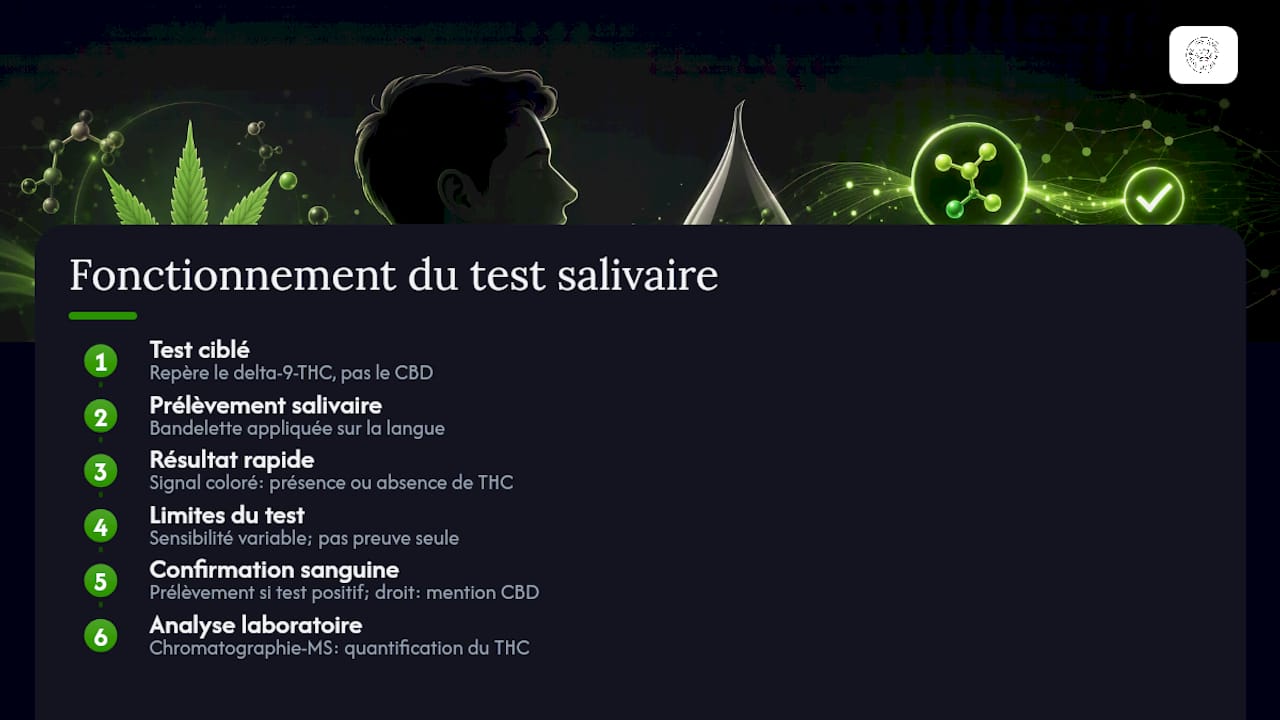
The saliva test used in the field is not generic. It is calibrated to detect a handful of specific substances, including delta-9-THC, the molecule that produces the psychoactive effects of cannabis. CBD, a non-psychoactive molecule, is not on any regulatory detection list for roadside checks in France.
In practice, the officer applies a strip to the driver's tongue. Within minutes, a colored result indicates the presence or absence of THC above a certain threshold. The French Society of Analytical Toxicology notes that these portable tests have varying sensitivity and are never sufficient, on their own, to establish an offense in court.
This is why any positive saliva test automatically triggers confirmation by blood sample, performed in a laboratory using much more precise analytical methods such as chromatography coupled with mass spectrometry. This second analysis allows for the precise quantification of THC concentration , unlike the field test which only provides a binary indication.
Pro tip: During the test, you have the right to request that the box corresponding to your CBD consumption be noted on the report. This clarification does not invalidate the test, but it can support a counter-analysis if the blood sample proves negative or below the legal threshold.
Why can a CBD product still produce a positive effect?
The answer almost always lies in the product's form and the rigor of its manufacturing process. CBD never transforms into THC in the body, a common misconception. However, traces of THC already present in a product can migrate into the bloodstream and saliva after consumption, as a technical document from MILDECA.
Three product families do not pose the same level of risk:
- Raw flowers and resins naturally retain the full profile of the plant, including THC, even at low doses.
- Full spectrum oils, by definition, contain all the cannabinoids of hemp, including residual THC.
- Isolates and broad spectrum guaranteed to be THC-free normally eliminate this molecule during extraction, provided the process is controlled.
Errors rarely stem from fraudulent intent. They most often result from insufficient upstream traceability, agricultural variability between harvests, or overly lax quality control at some suppliers who sell without systematic independent analysis.
Before making any purchase, always request the Certificate of Analysis (COA) for the specific batch, not just a generic product sheet. A reputable seller will provide this without hesitation, and our article on the differences between CBD and THC details the key points to consider before buying.
How long does THC remain detectable in saliva?
The salivary detection window for THC depends largely on the frequency and form of consumption, not on a universally fixed duration. Occasional use typically leaves a detectable trace for a few hours to a day, while regular or heavy use can extend this window to several days, as THC accumulates in fatty tissues and is gradually released.
| Consumption profile | approximate saliva detection window |
|---|---|
| Occasional use, low dose | A few hours to about 24 hours |
| Regular use (several times a week) | 1 to 3 days |
| Intensive or daily use | Up to several days |
The method of administration also makes a difference. Smoking or vaporizing flower deposits THC directly into the oral cavity, artificially inflating salivary concentration in the first few hours, far exceeding what blood levels actually reflect. Sublingual oil intake, on the other hand, exposes less of the oral mucosa and tends to produce salivary results more consistent with actual exposure. Individual metabolism, body fat percentage, and hydration also play a role, which explains why two people consuming the same dose can have different results.
Pro tip: If you absolutely must drive, avoid smoking or vaping any flower or resin in the hours beforehand, and if in doubt, allow a safety period of at least 24 hours after consuming any product whose total absence of THC you are not certain of.
What are the legal risks in France in the event of a positive saliva test?
French road traffic regulations stipulate a two-step procedure. If the initial saliva test is positive, it systematically triggers a confirmatory biological sample, taken from an accredited laboratory. It is this second, quantified result that serves as the legal basis for any prosecution.
The consequences can be serious, even for a driver who thought they were using a perfectly legal product:
- An administrative suspension of the driving licence can be decided by the prefect, often quickly after a positive saliva test.
- A fine of up to several thousand euros and a deduction of points in the event of a criminal conviction for driving under the influence of drugs.
- A prison sentence is possible in the most serious cases, particularly in cases of repeat offenses or associated accidents.
Recent case law confirms that the legal sale of a CBD product never exempts the buyer: as soon as traces of THC are detected in the blood, the offense is established, regardless of the product's conformity at the time of purchase, as highlighted in a summary by ActiROUTE on this specific point. To protect your rights, always request a confirmatory blood test through the official procedure, keep your proof of purchase, and request a second opinion if any doubt remains.
Which CBD products pose the greatest risk of driving?
Not all CBD products are created equal when it comes to roadside checks. The format and method of consumption drastically alter the likelihood that a trace of THC will cross the saliva detection threshold.
| Product type | Risk level in the saliva test |
|---|---|
| Flowers and resins that are smoked or vaped | Pupil |
| Full spectrum oils and e-liquids | Moderate |
| Isolates and broad spectrum certified THC-free | Low to zero if COA verified |
Combustion and vaporization directly expose the oral mucosa to THC particles, artificially inflating salivary concentration in the hours following consumption, regardless of the actual blood level. An analysis by PermisAPoints confirms that this method of administration significantly increases the risk of detection compared to oral or sublingual ingestion, even at equivalent THC levels.
Pro tip: If you drive regularly, opt for CBD isolates or broad-spectrum products with a certificate of analysis explicitly stating a non-detectable delta-9-THC content. These formats inherently limit the risk, unlike smoked flower.
You have tested positive: what steps should you take immediately?
A positive saliva test is not a conviction. Here is the order of steps to follow to protect your rights and prepare, if necessary, an appeal:
- Immediately mention your CBD use to law enforcement and request that it be recorded in the police report.
- Demand the confirmatory blood test required by the procedure, as this is the only test that will be considered valid in court.
- Keep the packaging of the consumed product, its certificate of analysis (COA) and your proof of purchase in a safe place.
- Gather all evidence that allows you to date and document your consumption, including exchanges with the seller if necessary.
- Contact a lawyer specializing in traffic law as soon as you are notified of the administrative suspension, especially if the blood test result is close to the legal threshold or if you have a solid COA.
The deadlines are tight: requests for counter-analyses or additional sampling must generally be submitted within days of the inspection, according to the procedure outlined by the Ministry of the Interior. A well-documented file, with supporting analysis certificates, remains your strongest argument when dealing with the authorities.
How to concretely reduce your risk before getting behind the wheel
Prevention takes place at two points: the purchase and the consumption itself. When purchasing, always demand an independent certificate of analysis for each batch, favor isolates or broad spectrum guaranteed to be THC-free, and buy from French sellers who can provide full traceability of their products, from cultivation to sale.
Regarding consumption, avoid smoking or vaporizing flowers or resins in the hours leading up to a trip, limit doses if you have any doubts about the composition, and allow at least 24 hours for any product whose THC-free nature you are not 100% certain of. Our guide to getting started with CBD details the best practices to adopt from your very first purchase.
Pro tip: Always keep your certificates of analysis for several months after purchase, even after you've consumed the product. In case of an inspection, this dated document remains your best proof of good faith.
How to read a certificate of analysis before buying CBD?
A certificate of analysis (COA) is only valuable if it contains the correct information.
Here are the elements to systematically check on a COA:
- The identity of the laboratory that carried out the analysis and its accreditation, if mentioned.
- The date of analysis and the batch number correspond exactly to the product purchased.
- The numerical result for delta-9-THC, expressed as a percentage or in mg/kg, and not simply a ticked box.
- The analytical method used is ideally gas or liquid chromatography coupled with mass spectrometry (GC-MS or LC-MS).
- Limits of detection and quantification (LOD/LOQ), which specify the threshold below which THC is no longer technically measurable.
| Element of the COA | What should be demanded |
|---|---|
| Laboratory | Identifiable name, independent of the seller |
| THC result | A precise numerical value, not just a qualitative description |
| Analytical method | GC-MS or LC-MS explicitly mentioned |
| LOD/LOQ Limits | Thresholds indicated for correctly interpreting the result |
Without these details, a Certificate of Analysis (COA) has only marketing value, as highlighted in the SFTA's technical work on screening methods. Thefrenchhempempire applies this requirement to every batch sold, with independent analyses available for each product, a practice that aligns with the recommendations detailed in our article on the legal framework for CBD in France and Europe.
Why this caution regarding CBD and driving?
This guide starts from a simple observation: the confusion between CBD and THC is costly for well-intentioned drivers who buy a legal product without knowing that a saliva test cannot differentiate between a trace of THC from a joint and a trace of THC from a mislabeled oil. Clearly explaining this mechanism seems more useful to me than downplaying the risk to increase sales.
In my opinion, caution remains the best policy until France harmonizes its saliva detection thresholds with the pharmacological reality of CBD. Prioritizing certified products, respecting a waiting period before driving, and keeping proof of purchase is not paranoia, but basic risk management in the face of an administrative procedure that leaves little room for nuance at the roadside.
Products guaranteed to be free of detectable THC, with supporting certificates
Unlike an impulsive purchase on a site without traceability, Thefrenchhempempire provides an independent certificate of analysis for each batch sold, with explicit mention of the delta-9-THC result and the analytical method used.
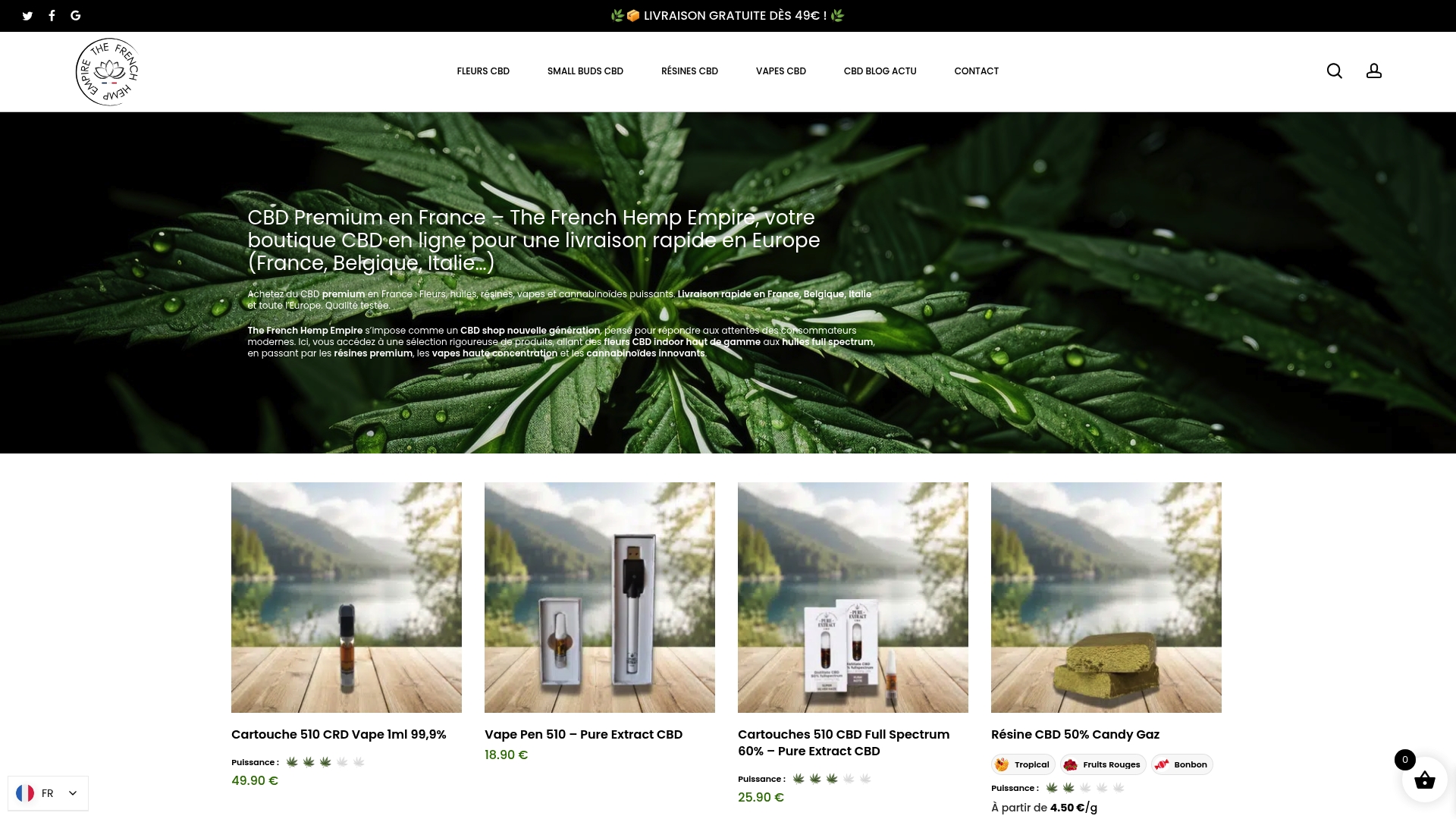
The shop offers a wide range of products, from premium CBD flowers and CBD resins to formats less likely to pose a risk to drivers, such as CBD vapes and e-liquids. Each product is shipped from France with complete traceability, from the hemp's origin to laboratory analysis. If you're looking for an option designed to minimize the risk of driving, consult our page dedicated to high-concentration CBD and its precautions for use before choosing your format. You can request the Certificate of Analysis (COA) for any product directly on its product page before finalizing your order.
Sources
This technical synthesis from the French Society of Analytical Toxicology remains the most detailed reference on the methodological limitations of field tests.
To understand the complete administrative procedure, road safety regulations detail the consequences of a positive test, while the website Démarches.gouv.fr explains step by step how to request a counter-expertise. The regulatory text published in the Official Journal establishes the legal framework for the marketing of hemp, and MILDECA offers a pharmacological analysis of CBD, useful for understanding why CBD and THC follow distinct biological pathways in the body.
This article provides general information and is not a substitute for legal advice. Consult a qualified legal professional regarding your specific situation before taking any action based on this content.
- CBD and saliva tests: always positive, always prosecuted? – Drugs Info Service
- Road safety — Risk-related regulations: drug-driving regulations
- Legifrance — regulatory text (JORF)
- SFTA — State of knowledge on saliva screening (technical document)
Recommendation
- CBD vs THC: Differences, effects, legality, and points to consider – The French Hemp Empire
- CBD Quality: Analysis, Traceability, THC, and Lab Certificates – The French Hemp Empire
- CBD gets you high without illegal THC: what the law says
- Hemp, cannabis, CBD and THC: differences, legality and explanations – The French Hemp Empire