


Potent CBD without illegal THC is legal in France, provided its THC content remains below 0.3% in the finished product. CBD is not classified as a narcotic and does not produce psychoactive effects, unlike THC. This distinction is crucial: a potent CBD product without illegal THC can reach high concentrations of cannabidiol while remaining fully compliant with French and European legislation. The decree of December 30, 2021, and the decisions of the Council of State precisely define this threshold. Understanding this legal boundary protects consumers and allows them to choose effective products safely.
How does potent CBD work without causing a high?
CBD and THC are two distinct cannabinoids with radically different mechanisms of action on the brain. THC binds directly to CB1 receptors in the endocannabinoid system, producing the euphoria and altered perception characteristic of a high. CBD, on the other hand, does not activate these receptors in the same way. Rather, it acts as an indirect modulator, influencing other biological pathways without triggering a pronounced psychoactive state.

This pharmacological difference explains why CBD at a concentration of 20% or 30% does not produce a high comparable to that of traditional cannabis. Pure CBD does not generate psychoactive effects ; the "high" associated with some products comes from THC exceeding 0.3% or from illegal synthetic cannabinoids such as HHC or H4-CBD. A legal CBD product, even at high concentrations, produces relaxing, calming, and stress-management effects without altering perception or cognition.
The effects of legal CBD therefore remain within the realm of well-being: reduced anxiety, improved sleep, and muscle relaxation. These effects are real and desirable, but they do not constitute a high in the pharmacological or legal sense of the term.
Pro tip: Be wary of products that promise a "legal high" from CBD. This wording is either misleading or a sign of a non-compliant composition. Strong, legal CBD produces noticeable effects, not psychoactive intoxication.
What are the legal criteria for CBD in France?
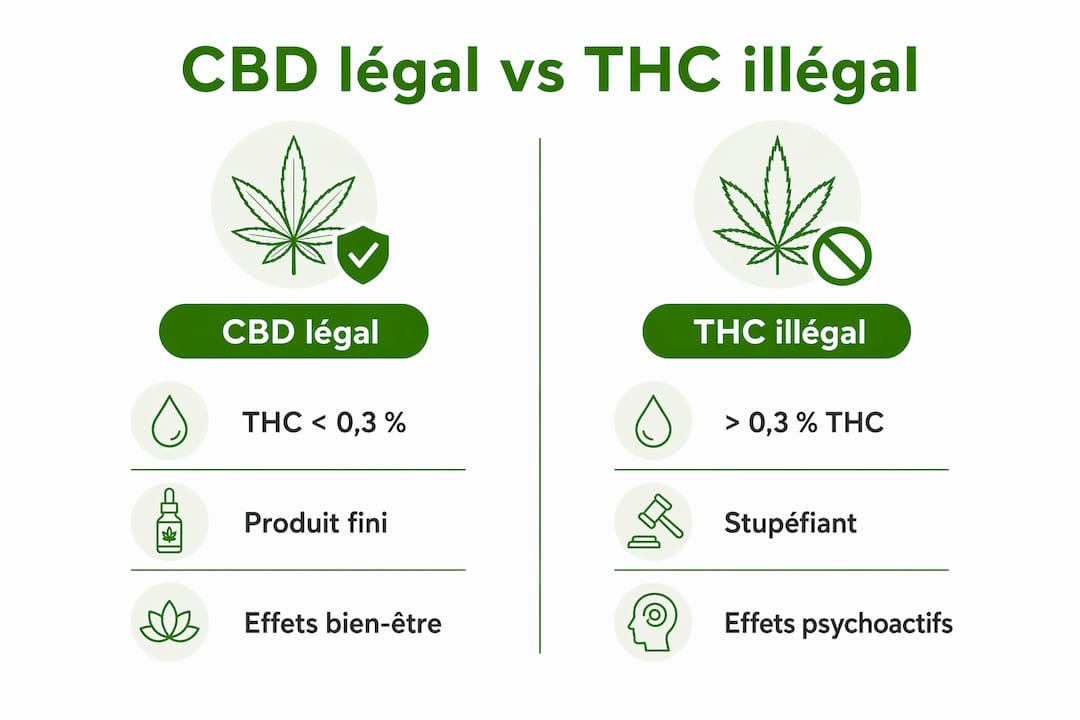
The French legal framework is based on a single threshold: THC must remain below 0.3% in the finished product. This threshold applies to all forms of CBD products sold commercially, whether flowers, oils, resins, or vapes. Above this level, the product is classified as a narcotic, and its possession, sale, or consumption is subject to criminal penalties.
The decree of December 30, 2021, clarified the conditions for marketing hemp flowers and leaves in France. The Council of State confirmed the legality of selling CBD flowers to individuals, subject to strict compliance with the THC threshold. This decision ended a period of legal uncertainty that had plagued the sector. Since then, CBD regulations in France have stabilized around this clear framework.
The following table summarizes the key legal distinctions between CBD and THC in France:
| Criteria | Legal CBD | THC is illegal |
|---|---|---|
| Permissible threshold | Less than 0.3% THC in the finished product | Greater than 0.3% THC |
| Classification | Not a stupefying | Amazing, classified |
| Psychoactive effects | Absent (no drugs) | Present (euphoria, altered perception) |
| Penalties for exceeding | Illegal product, seizure, criminal prosecution | Possession and trafficking are punishable by imprisonment |
An additional point of concern relates to driving. Roadside saliva tests detect THC at levels between 1 and 5 ng/ml in saliva, without distinguishing between legal and illegal sources. The Court of Cassation upheld this zero-tolerance policy for driving in 2023. Therefore, consuming legal CBD does not exempt you from a positive THC test during a roadside check.
Can CBD still produce a "high"? Myths and reality
Several misconceptions circulate about the effects of high-strength CBD. Dispelling these myths protects the consumer and clarifies what can legitimately be expected from a potent CBD product.
Myth #1: High-concentration CBD causes a high.
False. CBD concentration has no effect on the psychoactive nature of a product. Only THC, above 0.3%, produces this effect. A 30% CBD product remains non-psychoactive if the THC content is within legal limits.
Myth #2: The relaxing effects of CBD are comparable to those of cannabis.
Inaccurate. The effects of legal CBD are more subtle and gradual. They act on anxiety, muscle tension, and sleep, without altering consciousness or coordination.
Myth #3: All CBD products sold online are safe and compliant.
False. Some mislabeled products contain illegal synthetic cannabinoids such as HHC, HHCP, or H4-CBD. These substances produce genuine psychoactive effects and have been classified as narcotics in France since 2023.
The reality is this: a strong, legal CBD product produces measurable effects on well-being. These effects are real, documented, and sought after by many consumers. But they do not constitute a high in the legal or pharmacological sense of the term.
Pro tip: Before buying a CBD product, always check for an independent laboratory analysis certificate. This document should indicate the exact CBD and THC levels and confirm the absence of contaminants. Without this certificate, the product offers no guarantee of compliance.
What are the risks and precautions when choosing a legal, high-quality CBD product?
Choosing a potent CBD product without illegal THC requires a rigorous approach. The risks do not come from the CBD itself, but from non-compliant or fraudulent products circulating on the market.
Here are the steps to follow to secure your purchase:
- Check the Certificate of Analysis (CoA). This document, issued by an accredited independent laboratory, certifies the CBD and THC levels, as well as the absence of pesticides, heavy metals, and residual solvents. Traceability of CBD products is the primary criterion for reliability.
- Check the origin of the hemp. Hemp grown in Europe, using varieties certified by the European Union, offers a better guarantee of regulatory compliance than an imported product without traceability.
- Avoid products without clear labeling. Any CBD flower, resin, or oil must state the CBD content, THC content, and production batch. The absence of this information is a red flag.
- Adhere to the recommended daily dose. In 2026, the EFSA established a provisional daily intake of 0.0275 mg/kg per day, which is approximately 2 mg of CBD for a 70 kg adult. High doses may cause drowsiness, dizziness, or nausea.
- Be cautious if you are undergoing medical treatment. CBD interacts with certain medications via the liver enzyme CYP450. This interaction does not systematically contraindicate consumption, but it warrants prior medical consultation.
The table below compares the characteristics of a reliable CBD product and a risky product:
| Criteria | Reliable product | Risky product |
|---|---|---|
| Certificate of analysis | Available, accredited laboratory | Absent or unverifiable |
| THC levels | Less than 0.3%, verified | Not mentioned or not checked |
| Origin of hemp | EU certified variety, traceable | Origin unknown or undeclared |
| Cannabinoids present | CBD only or legal full spectrum | Possible presence of HHC, H4-CBD |
| Labeling | Complete, lot and date visible | Incomplete or in a foreign language only |
French authorities have strengthened controls on the quality and concentration of CBD products. This increased monitoring protects consumers, but it also requires sellers to maintain impeccable documentation.
Key points
High-THC CBD without illegal THC is legal in France as long as the THC level remains below 0.3% in the finished product, without producing a psychoactive high-type effect.
| Point | Details |
|---|---|
| Legal threshold for THC | The THC level must remain below 0.3% in the finished product to remain legal in France. |
| No high with CBD | Pure CBD does not activate CB1 receptors and does not cause euphoria or perceptual alteration. |
| Risks of synthetic cannabinoids | HHC, H4-CBD and similar substances are illegal in France and can cause real psychoactive effects. |
| Importance of the certificate of analysis | Any reliable CBD purchase should be backed by an independent laboratory certificate verifying THC, CBD and contaminants. |
| Caution while driving | A positive saliva test for THC results in penalties even if the THC comes from legally consumed CBD. |
What I've observed after years of following this sector
The CBD market in France has matured, but persistent confusion is detrimental to serious consumers. Many seek "strong" CBD, believing that potency implies a recreational effect. This expectation is understandable, but it stems from a confusion between CBD concentration and psychoactivity.
What I've observed is that the most satisfied consumers are those who understand the difference between CBD and THC before buying. They're not looking to "get legally high." They're looking for genuine relaxation, improved sleep, and stress management without medication. And strong, legal CBD provides exactly that, provided they choose traceable and certified products.
The trend for 2026 is toward stricter controls and increased transparency. Sellers who publish their certificates of analysis and clearly display their cannabinoid levels will survive this evolution. The others will disappear under regulatory pressure. For consumers, this is good news: the market is becoming more professional.
My recommendation is simple. Don't look for a high from legal CBD. Look for quality, traceability, and compliance. These are the criteria that guarantee an effective, safe, and legal product.
— Vanessa
Powerful and legal CBD flowers at Thefrenchhempempire
Thefrenchhempempire offers a selection of rigorously controlled CBD products, with a THC content of less than 0.3% guaranteed by independent laboratory analyses. Each product comes with its certificate of analysis, accessible directly on the website.
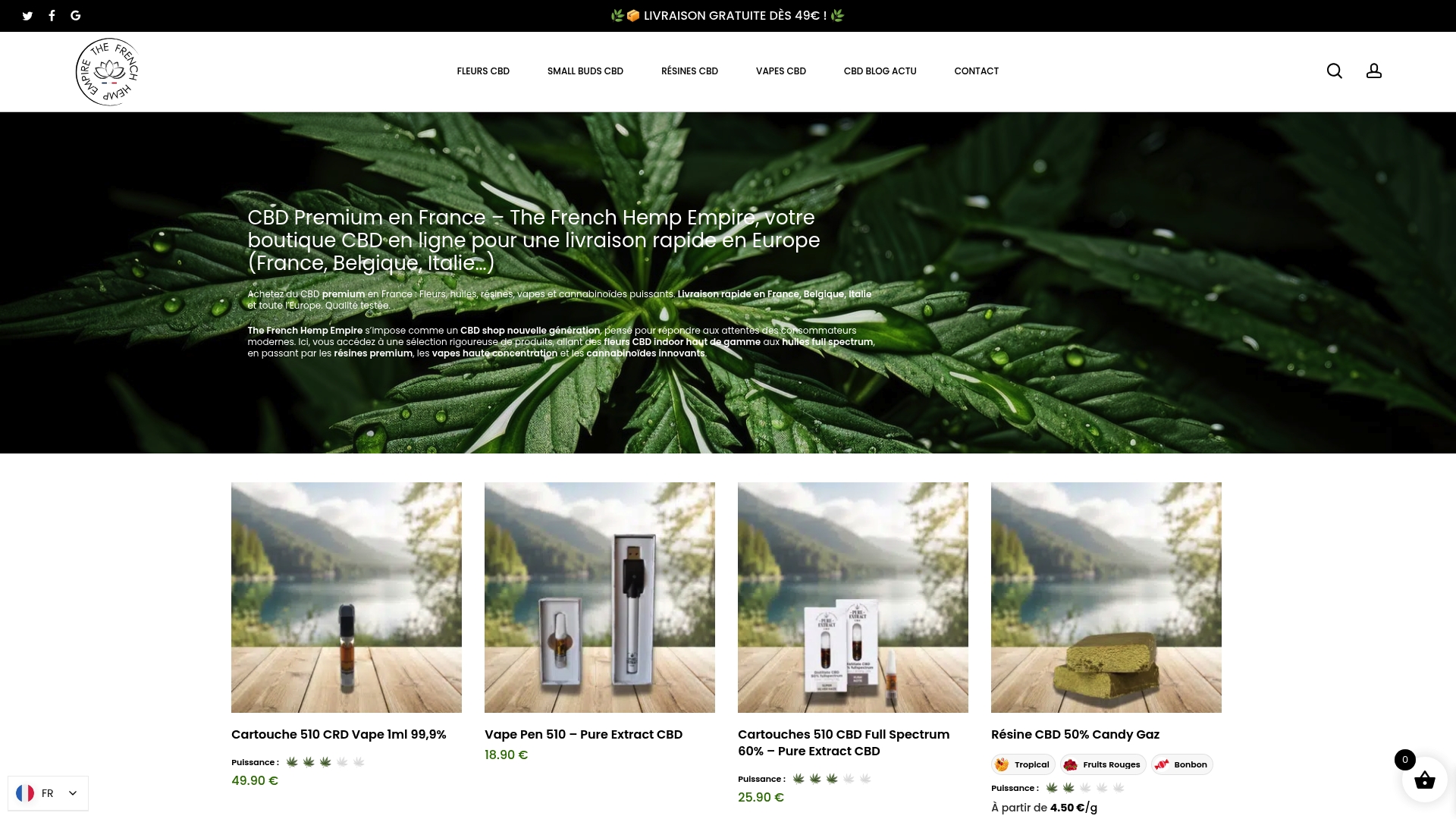
The premium CBD flowers available at Thefrenchhempempire are grown from certified varieties, with complete traceability from cultivation to delivery. For consumers seeking high CBD concentrations without compromising legality, the range also includes legal CBD resins with high cannabidiol levels. Discreet and fast delivery throughout France and Europe.
Frequently Asked Questions
Can strong CBD cause a legal high?
No. Pure CBD, even at high concentrations, does not produce a high. Only THC above 0.3% or illegal synthetic cannabinoids like HHC produce psychoactive effects.
What is the legal THC limit in CBD products in France?
The legal limit is set at 0.3% THC in the finished product, in accordance with the decree of December 30, 2021, and the decisions of the Council of State. Any product exceeding this level is classified as a narcotic.
Can I drive after consuming legal CBD?
Caution is advised. Roadside saliva tests detect THC at levels between 1 and 5 ng/ml without distinguishing its origin. In 2023, the Court of Cassation upheld the zero-tolerance policy for driving under the influence of THC, even for consumers of legal CBD.
How can you verify that a CBD product is truly free of illegal THC?
Demand a certificate of analysis from an independent laboratory that explicitly states the THC level, the CBD level, and the absence of contaminants. Without this document, no guarantee of compliance is possible.
Does strong legal CBD have any side effects?
At high doses, CBD can cause drowsiness, dizziness, or nausea. In 2026, the EFSA established a provisional daily intake of approximately 2 mg for a 70 kg adult. If you are undergoing medical treatment, prior consultation is recommended due to potential interactions with the liver enzyme CYP450.
Recommendation
- CBD vs THC: Differences, effects, legality, and points to consider – The French Hemp Empire
- CBD legal in France and Europe: regulations, THC 0.30% and Novel Food – The French Hemp Empire
- Hemp, cannabis, CBD and THC: differences, legality and explanations – The French Hemp Empire
- CBD: Definition, effects, legality, and a complete guide to cannabidiol – The French Hemp Empire


