T9HC
Here is the only result
T9HC: Discover a new generation of cannabinoid formulations
Discover the T9HC universe from The French Hemp Empire, a range dedicated to one of the newest names on the new cannabinoid market.
Our selection includes Vape T9HC 98% Rollz 1ml, available in various flavor profiles inspired by iconic varieties: Amnesia Haze, Blackberry Kush, Blue Dream, Gelato Drip, Chem Dawg, Jet Fuel, Midnight Octane, Skunk, Sugar Dough or Tahoe OG.
In a market where new names are multiplying, The French Hemp Empire prioritizes traceability, the announced composition and the information available on each reference.
Since the term T9HC does not currently have a sufficiently standardized scientific definition to allow identification of a precise molecule from the trade name alone, we recommend always examining the composition and analytical information corresponding to the product in question.
For adults only. Emerging cannabinoid formulations may have psychoactive effects and toxicological data are still limited. Do not drive after using a product that may impair alertness.
-
Vape T9HC 98% Rollz 1ml
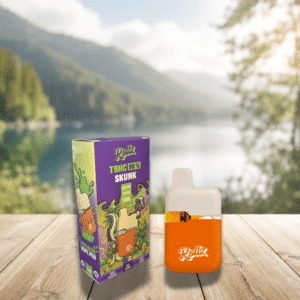 Selecting options: This product has several variations. Options can be selected on the product page.Power :39.90 €


T9HC: effects, composition, reviews, risks and legality in France
T9HC one of the most recent names encountered in the world of new cannabinoids.
Since its appearance in various European catalogues, the term has generated a great deal of research:
What is T9HC?
Are T9HC and THC the same?
Is T9HC a natural cannabinoid?
What are the effects of T9HC?
Is T9HC psychoactive?
What is the difference between T9HC, THC, CBD and HHC?
Is T9HC legal in France in 2026?
What are the risks of T9HC?
Can T9HC be detected in a saliva test?
But before answering these questions, a fundamental clarification is necessary.
Unlike CBD, CBG, CBN or delta-9-THC, T9HC is not currently a scientific name standardized enough to allow unambiguously identifying a unique molecule from its name alone.
The definitions found on the market are contradictory.
Some commercial sources present T9HC as a semi-synthetic cannabinoid related to THC.
Others identify it as a compound with a different carbon chain.
Still others use T9HC as a proprietary name for a cannabinoid formulation.
This situation imposes a simple rule:
The actual composition should take precedence over the brand name.
What is T9HC?
The term T9HC is used commercially to refer to certain formulations belonging to the new generation of cannabinoids.
Its name is very similar to:
THC
Or
delta-9-THC.
This proximity probably explains part of its commercial success.
But it also creates a lot of confusion.
The fact that a name contains the characters "T9HC" is not sufficient to demonstrate that it corresponds to delta-9-tetrahydrocannabinol.
Similarly, it is not sufficient to establish that it is a completely different cannabinoid.
To answer correctly, you need to know the chemical identity of the substance used in the product in question.
Is T9HC a real molecule?
This is probably the most important question.
For classic cannabinoids, the situation is simple.
CBD
Cannabidiol.
CBG
Cannabigerol.
CBN
Cannabinol.
CBC
Cannabichromene.
THCV
Tetrahydrocannabivarin.
Delta-9-THC
Delta-9-tetrahydrocannabinol.
For each of these compounds, there is a clearly defined chemical identity.
In the case of T9HC, the name is used much less consistently.
A serious page should therefore avoid inventing a scientific definition solely from the acronym.
Does T9HC stand for tetrahydrocannabihexol?
Some commercial content identifies T9HC with tetrahydrocannabihexol, sometimes compared to THCH.
This statement must be handled with great caution.
The problem is not only whether a molecule with this structure can exist.
The real question is:
Do all products marketed under the name T9HC contain this same molecule?
Without analytical and chemical documentation to demonstrate this, the answer cannot be generalized.
Therefore, T9HC should not be automatically translated as tetrahydrocannabihexol on all product sheets.
Does T9HC mean Delta-9-THC?
Another interpretation encountered is to read:
T9HC = T9HC = Δ9-THC.
This interpretation also presents a problem.
Delta-9-THC already has an extremely well-established nomenclature:
Δ9-THC
Or
delta-9-tetrahydrocannabinol.
If a product actually contains delta-9-THC, it must be presented as such rather than under an ambiguous name that could lead people to believe it contains another substance.
Why is the identity of T9HC important?
Because virtually all other questions depend on this identity.
To determine:
the effects,
pharmacology,
toxicity,
the interactions,
metabolism,
legality,
First, we need to know which molecule is present.
Without this information, it becomes impossible to attribute with certainty to T9HC the properties of a specific substance.
Is T9HC natural?
Some sellers present T9HC as a cannabinoid naturally present in extremely small quantities in Cannabis sativa.
Others describe it as a semi-synthetic cannabinoid obtained by transforming precursors derived from hemp.
These two statements should not be artificially merged.
To determine the origin of a commercial formulation, one must examine:
- chemical identity;
- manufacturing process;
- raw material;
- manufacturer's documentation.
The word T9HC alone does not provide an answer.
Is T9HC semi-synthetic?
Many modern cannabinoid formulations are obtained by transforming molecules derived from hemp.
The term semisynthetic can be used when a natural substance serves as the starting point for a chemical transformation.
But to accurately describe T9HC in this way, one needs to know the product and its manufacturing process.
The correct wording is therefore:
Some products marketed under the name T9HC are presented as being derived from the transformation of cannabinoids from hemp, but this characteristic should not be generalized without documentation from the manufacturer.
T9HC vs THC: what's the difference?
The T9HC vs THC is particularly important.
THC, when used without further specification, generally refers to delta-9-THC.
This is the main intoxicating cannabinoid naturally present in cannabis.
Its structure, metabolism, and pharmacology have been extensively studied.
T9HC is in a different situation.
The trade name is not sufficiently standardized to allow for universal pharmacological comparison.
The first difference is therefore documentary:
delta-9-THC = precisely identified substance
T9HC = designation requiring verification of the substance actually present
Is T9HC a new type of THC?
The term "new THC" is sometimes used to refer to new cannabinoids.
It's primarily about marketing.
A compound that is chemically different from delta-9-THC does not become THC simply because it may eventually produce comparable subjective effects.
Conversely, a trade name is also not sufficient to demonstrate that it is a new molecule.
T9HC vs CBD
The difference between T9HC and CBD is also important.
CBD stands for cannabidiol.
This is a well-identified and widely studied phytocannabinoid.
CBD is not considered to produce the typical intoxication of delta-9-THC.
T9HC, on the other hand, is marketed in a world where psychoactive effects are frequently claimed or reported.
However, due to insufficient standardization of the terminology, it is necessary to avoid extrapolating a precise mechanism to all T9HC products.
Is T9HC more potent than CBD?
This question is poorly formulated from a scientific standpoint.
CBD and a potentially psychoactive formulation should not be compared on a simple scale:
CBD = low
T9HC = strong.
They can have completely different pharmacological profiles.
It is more relevant to compare:
- chemical identity;
- mechanisms;
- composition ;
- scientific data;
- risks.
T9HC vs HHC
HHC , or hexahydrocannabinol, is a much better identified chemically .
It enjoyed very widespread distribution on the European market before being classified as a narcotic in France.
T9HC should not automatically be considered a new version of HHC.
The similarity between trade names does not constitute proof of a chemical relationship.
Is T9HC a derivative of HHC?
Some marketing descriptions draw parallels between the two.
But a structural relationship should only be asserted when the identity of the compound is known.
Therefore, it is best to avoid:
"T9HC = new HHC"
without analytical evidence.
T9HC vs THV-N10
The THV-N10 is another name that has recently appeared on the market.
T9HC and THV-N10 share a common problem:
Their trade names can circulate faster than the scientific information needed to characterize them.
To compare them properly, we must therefore examine:
composition,
COA,
chemical identity,
concentration,
purity.
T9HC vs Delta HC
Delta HC also belongs to the modern names used on certain cannabinoid formulations.
A comparison based solely on user comments would be insufficient.
The first question should be:
Which molecules are actually being compared?
T9HC vs DC10
The same principle applies to the DC10.
A commercial name does not necessarily constitute a scientific nomenclature.
The expressions:
T9HC is stronger than DC10
Or
DC10 is more powerful than T9HC
should not be presented as scientific facts without reliable comparative data.
T9HC vs 10-OH-HHC
10 -OH-HHC has a chemically much more informative name since it refers to a hydroxylated compound linked to HHC.
T9HC should not be automatically equated with 10-OH-HHC.
The two categories must remain distinct until their documentation demonstrates a precise identity or relationship.
T9HC vs 10-OH-HHCP
The same reasoning applies to 10-OH-HHCP.
The length of a name or its proximity to THC does not automatically allow us to predict its pharmacology.
T9HC vs THCA
THCA , or tetrahydrocannabinolic acid, has a well-defined chemical identity .
In particular, it constitutes a biosynthetic precursor of THC in the plant.
T9HC and THCA should therefore not be confused.
T9HC vs THCV
THCV is tetrahydrocannabivarin .
It belongs to the scientifically identified phytocannabinoids.
T9HC is not another spelling of THCV.
T9HC vs THCP
THCP ,also has a specific chemical identity.
Therefore, it should not be inferred that T9HC is a variant of THCP solely from their names.
T9HC vs THCH
This comparison is particularly important.
THCH is generally used to refer to tetrahydrocannabihexol.
Some commercial sources equate T9HC with this substance.
Others do not.
Consequently:
T9HC and THCH should not be presented as universal synonyms without product documentation to confirm this identity.
What are the effects of T9HC?
The query "T9HC effects" is probably one of the main searches around this name.
The available sales descriptions and testimonials mention, among other things:
- euphoria;
- modification of perception;
- relaxation;
- drowsiness;
- altered alertness.
But a clear distinction must be made:
user testimonials
And
controlled clinical data.
There is currently no robust clinical body of evidence to establish a universal profile of the effects of all products sold under the name T9HC.
Is T9HC psychoactive?
T9HC products are generally marketed in a context where psychoactive properties are claimed.
As a precaution, a product presented as T9HC should therefore be considered as potentially capable of impairing alertness or perception, unless reliable documentation establishes the contrary for the formulation concerned.
But it would be incorrect to invent a precise CB1 affinity or specific potency without knowing the molecule.
Does T9HC produce a high?
The expression "to float" corresponds to a subjective description.
Users may report changes in perception after using certain products sold under this name.
This does not mean that a precise feeling can be guaranteed.
Reactions can vary considerably depending on:
- product ;
- composition ;
- concentration;
- individual;
- other substances present.
Is T9HC more potent than THC?
Many claims of this type can be found on the internet:
"T9HC is twice as strong as THC"
Or
"T9HC has a higher potency than THC.".
Without a robust comparative study on a precisely identified substance, these multipliers should not be considered scientific.
Pharmacological potency cannot be determined from a marketing argument.
Is T9HC more potent than HHC?
Same principle.
A testimonial may indicate that a person experienced a product as more intense.
This does not allow for the establishment of a universal pharmacological hierarchy.
How long do the effects of T9HC last?
There is no universally documented duration for the designation T9HC.
The potential duration depends in particular on:
- of the real substance;
- of the formulation;
- of the concentration;
- of metabolism;
- individual characteristics.
Therefore, specific promises regarding a guaranteed duration of effect should be avoided.
T9HC 98%: what does this concentration mean?
The French Hemp Empire currently lists a Vape T9HC Rollz advertised at 98%.
This statement deserves to be understood correctly.
A percentage describes a concentration.
It does not directly describe a psychoactive potency.
98% therefore does not mean 98% effect.
And this obviously does not mean that the product is 98 times more powerful than a 1% formulation.
98% of what?
That's the essential question.
When the designation T9HC is not sufficiently standardized, the following should be used:
T9HC 98%
ideally, it should be accompanied by information that allows us to identify what has actually been quantified.
The certificate of analysis then takes on considerable importance.
Vape T9HC 98% Rollz 1 ml
The French Hemp Empire currently lists Vape T9HC 98% Rollz 1 ml.
The advertised commercial features include, but are not limited to:
format: 1 ml
Advertised concentration: 98%
range: Rollz
Several aromatic profiles are available.
To evaluate this formulation more precisely, the most important information remains the documented chemical composition of the contents.
T9HC Rollz Aromatic Profiles
The range currently offered includes, in particular:
Amnesia Haze
Blackberry Kush
Blue Dream
Gelato Drip
Chem Dawg
Jet Fuel
Midnight Octane
Skunk
Sugar Dough
Tahoe OG
These names mainly correspond to the aromatic profiles offered.
T9HC Amnesia Haze
Amnesia Haze generally evokes citrus, vegetal and slightly spicy notes.
T9HC Blackberry Kush
Blackberry Kush falls more into a universe of black fruits associated with vegetal and earthy nuances.
T9HC Blue Dream
Blue Dream is generally associated with a fruity and vegetal profile.
T9HC Gelato Drip
Gelato traditionally evokes a world of indulgence, creaminess and fruitiness.
T9HC Chem Dawg
Chem Dawg is known for its particularly pronounced aromatic profiles, with vegetal, earthy and "gaseous" nuances.
T9HC Jet Fuel
Jet Fuel falls within the world of powerful, plant-based fuel profiles.
T9HC Midnight Octane
Midnight Octane evokes a deep aromatic profile belonging to the "gas" universe.
T9HC Skunk
Skunk is one of the most well-known historical aromatic families in the world of cannabis.
T9HC Sugar Dough
Sugar Dough evokes more of a gourmet, sweet and sugary world.
T9HC Tahoe OG
Tahoe OG belongs to the OG profiles generally associated with resinous, vegetal, earthy and citrus notes.
T9HC and terpenes
Terpenes contribute to the aromatic profile.
Terpenes frequently found in the world of hemp include:
myrcene,
limonene,
pinene,
beta-caryophyllene,
linalool.
However, the terpene profile does not allow us to determine the pharmacological potency of a T9HC formulation.
Why is COA essential for T9HC?
COA stands for Certificate ofAnalysis.
For a perfectly standardized cannabinoid, the COA allows, in particular, for verification of concentrations.
For a name like T9HC, it plays an even more important role.
Ideally, it should allow us to establish:
- product analyzed;
- lot number;
- date ;
- laboratory;
- substance sought;
- measured concentration;
- other cannabinoids;
- delta-9-THC;
- analytical method.
Is a COA simply stating "T9HC" sufficient?
Not necessarily.
If T9HC is a proprietary name, reproducing that same name in an analytical table does not automatically provide a chemical structure.
For maximum transparency, the documentation should ideally provide:
full chemical name,
substance identifier,
analytical standard,
method,
concentration.
T9HC and CAS number
The CAS number allows for the identification of many chemical substances.
When a supplier markets a material under a recent name, having a CAS number and a full chemical name greatly reduces ambiguity.
If this information is not available, it is best not to invent the chemical identity.
T9HC and purity
High concentration does not automatically guarantee high quality.
If a formulation contains 98% of a substance, one must also consider the remaining constituents.
Depending on the product, it may be:
- of terpenes;
- other cannabinoids;
- formulation constituents;
- of impurities or by-products.
A detailed analysis allows for greater transparency.
T9HC and contaminants
For cannabinoids obtained by chemical transformation, the issue of contaminants and by-products is particularly important.
Depending on the process, different controls may be relevant:
- residual solvents;
- heavy metals;
- contaminants;
- reaction by-products;
- cannabinoid purity.
Not all COAs necessarily look for the same parameters.
T9HC: What are the risks?
The main problem with T9HC lies in the lack of specific data and the ambiguity surrounding certain formulations.
A new substance may have very little information about it regarding:
acute toxicity
chronic toxicity
metabolism,
drug interactions,
cardiovascular effects,
neurological effects,
potential for addiction.
The lack of data should be viewed as an uncertainty, not as proof of security.
What side effects can occur?
There is no universal clinical list specific to all T9HC products.
For psychoactive or related cannabinoids, various adverse effects may nevertheless include, depending on the substance:
- anxiety ;
- dizziness;
- confusion ;
- nausea;
- drowsiness;
- accelerated heart rate;
- impaired coordination;
- faintness.
This does not mean that each of these effects is specifically demonstrated for a universal molecule called T9HC.
T9HC and alcohol
Combining a potentially psychoactive formulation with alcohol should be avoided.
Combining several substances that can impair alertness may increase the unpredictability of the effects.
T9HC and medications
Drug interactions specific to T9HC are insufficiently characterized.
A person undergoing drug treatment must therefore exercise particular caution.
If in doubt, a healthcare professional is the appropriate source to assess a potential interaction.
T9HC and pregnancy
Psychoactive or insufficiently studied cannabinoid products should be avoided during pregnancy and breastfeeding.
The lack of sufficient safety data makes it impossible to conclude that they are harmless.
T9HC and minors
T9HC formulations should be reserved for adults and kept out of reach of children.
Electronic devices and liquids, in particular, must be stored appropriately.
T9HC and driving
One essential rule must be remembered:
Never drive after using a product that may impair alertness, perception, coordination, or reaction time.
This precaution is particularly important for psychoactive cannabinoid formulations whose effects are insufficiently documented.
T9HC and saliva test
The query "T9HC saliva test" naturally appears with this type of product.
It is not possible to guarantee a negative result.
Several factors may be involved:
- actual composition;
- possible presence of THC;
- metabolites;
- device sensitivity;
- cross reactions.
A T9HC product should never be presented as a method to avoid or circumvent screening.
Will T9HC be legal in France in 2026?
The question of "T9HC legal in France" must be treated with great caution.
The first difficulty stems from the product's identity.
If T9HC is not a universally standardized chemical name, simply searching for the word "T9HC" in a regulatory list is not sufficient.
We need to determine:
what chemical substance is actually present?
then check:
if this substance, its isomers, derivatives or its family are covered by the French laws in force.
T9HC not listed = legal?
No.
This is a common mistake.
Regulations may target:
- molecule;
- isomers;
- derivatives;
- salts;
- chemical families.
The absence of a trade name in a list does not therefore automatically establish the legality of the product.
T9HC and the 0.3% THC threshold
Another common mistake:
"The product contains less than 0.3% delta-9-THC, so it is definitely legal.".
This conclusion is too broad.
The threshold applicable to delta-9-THC in the regulatory framework for hemp does not constitute a general authorization for any other substance.
The complete composition must be examined.
Why is the example of HHC important?
HHC perfectly illustrates how quickly the landscape of new cannabinoids can evolve.
After its rapid development on the French market, HHC was classified as a narcotic.
Other cannabinoids or families of substances were subsequently subject to regulatory measures.
Therefore, it is necessary to regularly check the texts rather than maintaining for several years a claim that is "legal in France".
T9HC reviews: how reliable are the testimonials?
Searches for T9HC reviews primarily lead to:
- forums;
- shops;
- social networks;
- user comments.
These accounts may describe a personal experience.
However, they do not allow us to determine:
composition,
purity,
pharmacology,
toxicity,
legality.
They must therefore remain clearly identified as testimonies.
Why are T9HC reviews sometimes contradictory?
Several factors can explain this:
- individual differences;
- different products;
- different concentrations;
- different formulations;
- presence of other cannabinoids;
- compositions that are insufficiently documented.
This variability becomes particularly important when a commercial name is not perfectly standardized.
T9HC danger: what do we really know?
Specific scientific data remain insufficient to fully characterize the risk associated with all formulations sold under this name.
This uncertainty itself constitutes important information.
Few studies do not mean few risks.
This means:
little information is available to accurately assess the risk.
T9HC and addiction
The potential for addiction of a T9HC formulation cannot be precisely characterized without knowing the substance.
When a product has psychoactive properties, it should not be claimed that it is devoid of potential for abuse or addiction without data to demonstrate this.
T9HC and tolerance
The same caution applies to tolerance.
Specific data on repeated use of T9HC products are insufficient to establish a universal profile.
How to evaluate a T9HC product?
Several criteria must be prioritized.
1. Chemical identity
What substance is actually behind the name?
2. Concentration
What does the stated percentage represent?
3. COA
Does the certificate correspond to the batch sold?
4. Analytical Method
How was the substance identified?
5. Purity
What other constituents are present?
6. Contaminants
What checks were carried out?
7. Traceability
Are the manufacturer, batch number, and origin clearly identified?
T9HC and transparency
The emerging cannabinoids market needs more transparency, not more mysterious names.
A truly informative product description should allow customers to understand what is being sold.
The consumer should be able to distinguish:
trade name
of
chemical name.
This is particularly important for T9HC.
T9HC and EEAT
A high-performing SEO page shouldn't just repeat what other stores are saying.
To work properly with EEAT, it is best to recognize the limitations of available knowledge.
For T9HC, this means distinguishing:
scientifically established facts,
manufacturer's information
laboratory results,
user testimonials,
business assumptions.
This distinction significantly enhances the editorial quality.
T9HC FAQ
What is T9HC?
T9HC is a name used on some recent cannabinoid formulations. Its commercial use is not sufficiently standardized to universally identify a specific molecule from the name alone.
Does T9HC mean delta-9-THC?
These two expressions should not automatically be used as synonyms. Delta-9-THC has a clearly established chemical nomenclature.
Does T9HC stand for tetrahydrocannabihexol?
Some commercial sources use this definition, but it should not be generalized to all T9HC products without corresponding chemical documentation.
Are T9HC and THCH the same?
Not necessarily. The chemical identity of the product in question must be verified.
Is T9HC natural?
The name alone does not allow us to determine the origin or manufacturing process of a product.
Is T9HC semi-synthetic?
Some formulations are presented as such. This characteristic should be verified with the manufacturer.
Is T9HC CBD?
No. CBD corresponds precisely to cannabidiol.
What is the difference between T9HC and THC?
Delta-9-THC is a well-identified molecule. The term T9HC requires further documentation to precisely define the substance being marketed.
What is the difference between T9HC and HHC?
HHC stands for hexahydrocannabinol and has a defined chemical identity. T9HC should not automatically be considered an HHC derivative.
What are the effects of T9HC?
Psychoactive effects are reported for some products, but specific clinical data are insufficient to establish a universal profile.
Is T9HC psychoactive?
These products are generally marketed in a psychoactive context. It is prudent to consider that they may impair alertness depending on their composition.
Is T9HC stronger than THC?
There is insufficient robust comparative data to establish a universal equivalence.
Is T9HC stronger than HHC?
User testimonials are not sufficient to scientifically establish this comparison.
What does T9HC 98% mean?
This is a reported concentration. The analytical documentation must be consulted to precisely identify what constitutes this 98%.
Is there such a thing as a T9HC vape?
Yes. The French Hemp Empire currently lists a Vape T9HC 98% Rollz in 1ml format.
What flavor profiles are offered?
The currently displayed range includes Amnesia Haze, Blackberry Kush, Blue Dream, Gelato Drip, Chem Dawg, Jet Fuel, Midnight Octane, Skunk, Sugar Dough and Tahoe OG.
Why request a COA?
The certificate of analysis allows for the documentation of the composition and concentrations measured on a sample.
Does a COA guarantee the legality of T9HC?
No. The COA documents the composition. The legal status must then be determined based on this composition and the applicable texts.
Is T9HC dangerous?
Specific data remains insufficient. The lack of toxicological experience therefore justifies particular caution.
Can T9HC and alcohol be mixed?
The combination with alcohol should be avoided when a formulation is likely to be psychoactive.
Are T9HC and medications compatible?
Interactions are not well documented. If you are taking medication, consult a healthcare professional.
Is it safe to drive after using T9HC?
You should not drive after using a substance that may impair alertness or psychomotor skills.
Does T9HC appear in saliva tests?
A negative result cannot be guaranteed. The composition, metabolites, and characteristics of the test must be taken into account.
Is T9HC legal in France?
The product's status should not be inferred solely from its trade name. Its exact chemical identity and compliance with applicable French regulations must be verified.
Does less than 0.3% THC mean that T9HC is legal?
Not automatically. Another substance present in the product may be subject to specific regulations.
How to recognize a properly documented T9HC?
Opt for a clearly identified composition, a documented concentration, a COA corresponding to the batch and complete traceability.
T9HC: Key information to remember in 2026
T9HC perfectly represents the difficulties encountered with the new generation of cannabinoids.
Its name is similar to that of THC.
It is marketed as a cannabinoid.
It is attributed with psychoactive effects.
Highly concentrated products are available.
However, its name does not currently benefit from the same scientific standardization as:
CBD,
CBG,
CBN,
THCV
delta-9-THC
or other specifically identified cannabinoids.
The first question to ask is therefore not:
"Is T9HC more potent than THC?"
but :
"What chemical substance is actually sold under the name T9HC?"
Once this information is obtained, it becomes possible to study:
its pharmacology,
its risks,
his analyses,
and its regulatory status.
The same logic should be applied to an advertised concentration such as T9HC 98%.
A high percentage does not automatically indicate high pharmacological potency.
It indicates the stated proportion of a substance or formulation.
The certificate of analysis should make it clear what was actually measured.
For The French Hemp Empire, a transparent presentation of T9HC therefore rests on four pillars:
IDENTIFY
What substance is actually behind the name T9HC?
COMPOSITION
What cannabinoids and other constituents are present?
ANALYSIS
Are the reported concentrations documented?
TRACEABILITY
Does the certificate correspond to the batch sold?
This approach allows for a much more serious response to searches for T9HC effects, T9HC reviews, T9HC danger, T9HC France, T9HC legal, T9HC vs THC or T9HC 98% than a simple accumulation of commercial promises.
The market for new cannabinoids is evolving rapidly.
Scientific knowledge and regulations can also evolve.
A page dedicated to T9HC must therefore be regularly updated so that the chemical, health and regulatory information remains consistent with the available data.
For adult use only. Keep out of reach of children. Not recommended during pregnancy or breastfeeding. Avoid combining with alcohol or other psychoactive substances. Do not drive or operate machinery after using a product that may impair alertness. Long-term toxicological and clinical data on formulations marketed under the name T9HC remain limited.
Official sources on T9HC and new cannabinoids
The French regulations concerning emerging cannabinoids are constantly evolving. Consult the ANSM's information on the classification of new cannabinoids.
The regulatory text must be verified in the ANSM decision modifying the list of substances classified as narcotics.
The European situation is presented in the EUDA 2026 report on new psychoactive substances.
To learn more about the risks and characteristics of this family of products, consult the European dossier dedicated to synthetic cannabinoids.
The difficulties in identifying certain molecules marketed under new names are examined in the EUDA work on the analysis of semi-synthetic cannabinoids.
The need to verify each batch in the laboratory is reinforced by the French health alert on products whose composition differs from that announced.
The name T9HC is not a standardized chemical identifier. Legality and risk level depend on the exact molecular composition of the product.