The official list of prohibited substances is published and kept up to date directly by the ANSM (French National Agency for Medicines and Health Products Safety) on its dedicated page, "Poisonous Substances (Lists I and II, Narcotics, Psychotropic Substances)," which compiles the historical decree and recent decisions of the Director General. Among the molecules recently added to the list as narcotics are H4-CBD, H2-CBD, HHCPO, THCP, and THCA, the classification of which took effect on June 3, 2024.Before undertaking any professional or commercial activity, consulting the consolidated official documents is essential.
Key starting points:
- ANSM reference page : Poisonous substances — consolidated source, updated after each decision of the Director General.
- Consolidated PDF narcotics : consolidated list published by the ANSM, dated February 17, 2026, specifying isomers, esters, ethers and salts included.
- Consolidated PDF on psychotropic drugs : version dated July 3, 2026, available on the ANSM website.
- Légifrance / Official Journal : enforceable texts for formal legal verification.
- Recent examples : H4-CBD, H2-CBD, HHCPO, THCP, THCA — classified as narcotics since June 2024.
Key points
Access to the consolidated lists of the ANSM, cross-referenced with the enforceable texts on Légifrance, constitutes the only reliable basis for establishing the legal status of a molecule in France.
| Point | Details |
|---|---|
| Official source to consult | The consolidated PDFs from the ANSM (narcotics and psychotropic substances) are the reference working documents, to be downloaded with dates. |
| Newly registered molecules | H4-CBD, H2-CBD, HHCPO, THCP and THCA have been classified as narcotics since June 3, 2024. |
| Scope of the prohibition | Production, manufacture, transport, possession, sale and use are prohibited without express authorization from the ANSM. |
| In case of poisoning | Call 15 or the poison control center (0 800 59 59 59), keep the sample and report on signalement.social-sante.gouv.fr. |
| Regulatory monitoring | Set up alerts for Légifrance and the ANSM newsletter to be notified of each new decision by the Director General. |
Table of Contents
- Where can I find the official list of molecules banned by the ANSM?
- Which families of substances and recent molecules are included on these lists?
- What is the legal significance of being listed as a narcotic?
- Why is the ANSM registering new molecules, and what risks are identified?
- What to do in case of a suspicious product or poisoning?
- How to keep up with updates to the official lists?
- Practical checklist for pharmacists and healthcare professionals
- Why documentary rigor takes precedence over simply knowing the lists
- Thefrenchhempempire: compliant, traceable, and analyzed CBD products
- Sources
Where can I find the official list of molecules banned by the ANSM?
The hierarchy of legally binding sources rests on two complementary levels. On the one hand, the amended decree of February 22, 1990, still in force and available on Légifrance, constitutes the historical legislative foundation. On the other hand, the decisions of the Director General of the ANSM (French National Agency for Medicines and Health Products Safety) – a power transferred pursuant to Law No. 2020-1525 and Decree No. 2022-113 – amend this decree and enter into force the day after their publication. The consolidated version published by the ANSM incorporates these two layers and is therefore the most reliable daily working document.
Here is the recommended verification protocol, in four steps:
- Consult the consolidated ANSM list : access the reference page Poisonous Substances and download the most recent dated PDF (narcotics or psychotropics depending on the substance concerned).
- Identify the amending decision : locate in the PDF the decision of the Director General that registered or amended the status of the substance, noting its publication date and its effective date.
- Cross-check with Légifrance and the Official Journal : verify the consolidated version of the decree on Légifrance to confirm the legal enforceability of the classification.
- Date and archive : note the date of consultation and keep the downloaded PDF, as the list changes; an undated version cannot serve as proof of compliance during an inspection.
Pro tip: Set up an alert on Légifrance for the decree of February 22, 1990: you will receive an automatic notification for each modification, without having to manually monitor the Official Journal.
Which families of substances and recent molecules are included on these lists?
Recent registrations focus on several chemical families, knowledge of which makes it possible to anticipate regulatory risks.
Semi-synthetic cannabinoids and THC derivatives
This is the most active family in terms of new registrations. H4-CBD (hexahydrocannabidiol), H2-CBD (dihydrocannabidiol), HHCPO (hexahydrocannabiphorol acetate), THCP (tetrahydrocannabiphorol) and THCA (tetrahydrocannabinolic acid) have all been classified as narcotics by decision of the Director General of the ANSM, with an entry into force on June 3, 2024. These molecules were marketed under "wellness" names — gummies, e-liquids, resins — which masked their now illegal nature.

Synthetic cannabinoids
Unlike semi-synthetic derivatives, synthetic cannabinoids (the JWH, AM-2201, and related families) have been on the lists for several years. Their psychoactive potential is often greater than that of natural THC, which explains the severity of the associated intoxication reports.
Synthetic cathinones
Mephedrone, alpha-PVP, and their structural derivatives are listed as psychotropic or narcotic drugs. They frequently circulate under code names or names such as "bath salts," making their identification difficult without chemical analysis.
Tryptamines and phenethylamines
Substances such as 5-MeO-DMT and certain phenethylamines of the NBOMe family are classified as narcotics. Their powerful hallucinogenic effects led to their inclusion on the list following reports of serious poisonings.
Warning : This presentation by family is not exhaustive. Only the consolidated PDFs from the ANSM and the texts published on Légifrance are authoritative for establishing the legal status of a given substance.
What is the legal significance of being listed as a narcotic?
The classification of a molecule as a narcotic or psychotropic substance has specific consequences for the entire chain, from production to consumption. The operations subject to the prohibition, unless expressly authorized by the ANSM (French National Agency for Medicines and Health Products Safety) or the relevant ministry, are as follows:
| Operation prohibited | Scope |
|---|---|
| Production and culture | Any method of obtaining the substance, including through plant-based means |
| Manufacturing and processing | Chemical synthesis, extraction, pharmaceutical formulation |
| Transport and import | Entry into French territory, including transit |
| Export | Leaving the territory, including to the European Union |
| Detention | Storage for personal or professional use without authorization |
| Offer, transfer and sale | Any provision, whether for a fee or free of charge |
| Acquisition and employment | Purchase and use, including for research purposes without approval |
For pharmacies, the distinction between the inclusion of a substance on a list of poisons and the suspension of a marketing authorization (MA) is fundamental: two distinct procedures, two different sets of consequences. A pharmaceutical product can retain its MA even if its active ingredient is reclassified, which modifies the dispensing conditions without necessarily leading to its withdrawal. Furthermore, compounded and extemporaneous preparations using classified substances must be verified against the Good Preparation Practices published by the ANSM (French National Agency for Medicines and Health Products Safety), which strictly regulate authorized pharmaceutical raw materials.
Pro tip: When receiving a MPUP (Medicinal Product Information File), always cross-reference the substance's INN (International Nonproprietary Name) with the ANSM (French National Agency for Medicines and Health Products Safety) consolidated list dated that day. A substance not listed the previous week may be listed the day after the Director General publishes a decision.
Why is the ANSM registering new molecules, and what risks are identified?
- Direct or indirect danger to public health : serious neurological effects (seizures, dissociative states, coma), cardio-respiratory risks documented in reports sent to poison control centers and emergency services.
- Potential for abuse and dependence : some molecules have an affinity for CB1 receptors or other pharmacological targets that generate rapid tolerance and withdrawal syndrome.
- Reports of serious poisonings : feedback from poison control centers, hospital services and pharmacovigilance constitutes the operational trigger for registration procedures.
The ANSM also emphasizes that products purchased outside the pharmaceutical distribution network present an inherent risk due to the lack of traceability and quality control. Recent public health decisions illustrate this reality: product recalls have targeted items marketed as containing GLP-1 agonists, sold outside of any regulated distribution channel covering the entire production-sales-promotion chain.
Recent registrations of semi-synthetic cannabinoids confirm a recurring pattern: molecules initially marketed under "wellness" names (gummies, e-liquids, resins) were identified as dangerous after an accumulation of reports, before being classified as narcotics by decision of the Director General.
What to do in case of a suspicious product or poisoning?
The speed of response in the first few minutes often determines the medical outcome and the quality of subsequent administrative procedures. Here is the procedure to follow:
- Securing the person : in case of acute symptoms (loss of consciousness, convulsions, respiratory distress), call 15 (SAMU) or 18 (firefighters) without delay.
- Contact the poison control center : For any suspected poisoning without immediate life-threatening emergency, the national number is 0 800 59 59 59 (toxicological information number). Regional poison control centers provide 24/7 service.
- Preserve the sample : If a suspect product is available, seal it in an airtight container without further handling. A sealed sample submitted to an accredited laboratory facilitates substance identification and subsequent administrative procedures.
- Report the incident : declare the health event on the national reporting platform, accessible to both healthcare professionals and the general public. This formal report contributes to pharmacovigilance and may trigger a registration or withdrawal procedure.
- Referring the matter to the ANSM : for products sold outside the pharmaceutical circuit (internet sites, parallel markets), a direct referral to the ANSM allows a health police procedure to be initiated.
- Transmit to the laboratory : in a professional context, coordinate with the regional health authority to direct the sample to an approved laboratory and obtain a legally binding certificate of analysis.
How to keep up with updates to the official lists?
The consolidated lists evolve without a predictable schedule: a decision by the Director-General can be published at any time, taking effect the following day. Several mechanisms allow for effective monitoring:
- ANSM newsletter subscription : available on the agency's website, it disseminates new decisions and announcements, including substance registrations.
- Légifrance alerts : by creating an account on Légifrance, it is possible to set up an alert on the decree of February 22, 1990; any modification generates a notification by email.
- Official Journal monitoring : the Official Journal offers thematic alerts; the decisions of the Director General of the ANSM are published there.
- Regular download of consolidated PDFs : keeping a dated copy of the narcotics PDF and the psychotropics PDF allows for comparison of versions and identification of new entries by difference.
- Regulatory blog monitoring : specialized publications, including Thefrenchhempempire's news blog, relay legislative developments and ANSM decisions concerning cannabinoids.
Practical checklist for pharmacists and healthcare professionals
Regulatory compliance management in pharmacies or healthcare facilities relies on documented procedures that can be verified during an inspection.
Verification of raw materials and products
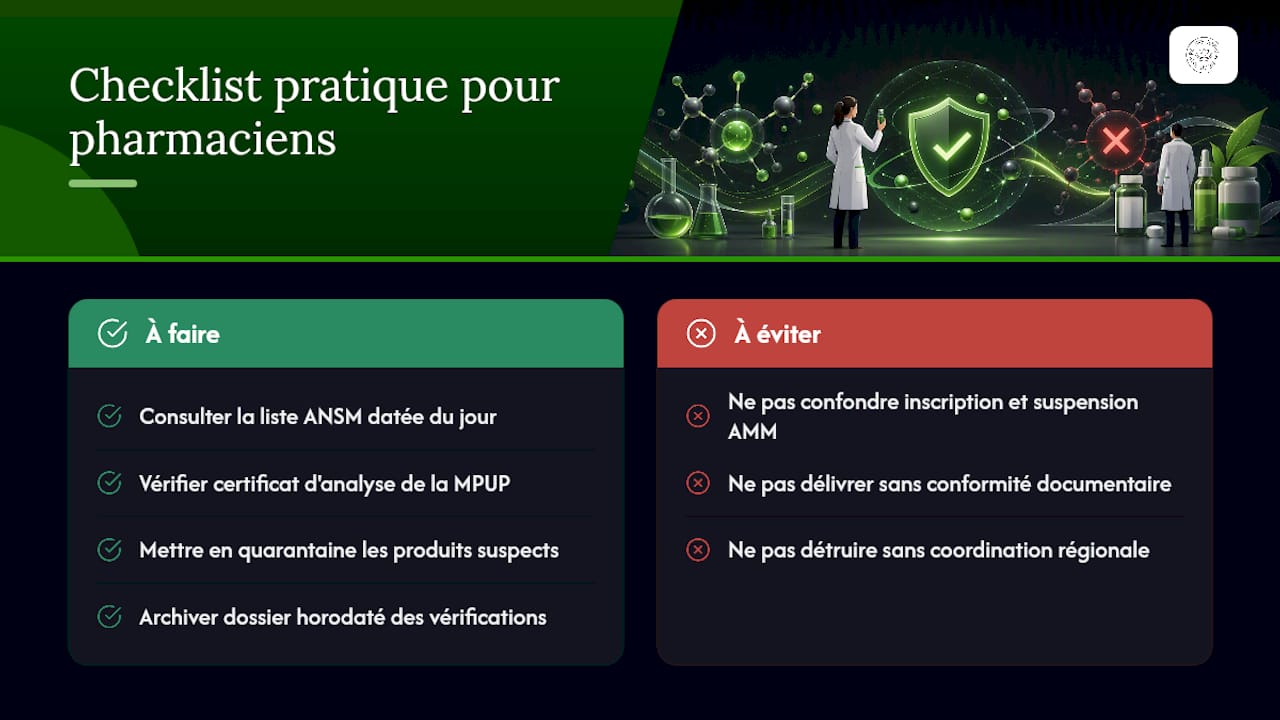
Before dispensing or preparing any substance whose regulatory status may have changed, the pharmacist must cross-reference the INN (International Nonproprietary Name) with the ANSM (French National Agency for Medicines and Health Products Safety) consolidated list dated that day, verify that the preparation material used has a certificate of analysis compliant with Good Preparation Practices, and refuse to dispense any product whose conformity cannot be documented. The traceability and origin of CBD products are a concrete example of the rigor expected for substances with sensitive regulatory status.
Suspicious product management
Any product whose status is uncertain must be quarantined, labeled, and isolated from current stock. Coordination with the regional health authority is required before any decision to destroy the product, which must follow a documented plan that complies with regulatory requirements.
Documentation and archiving
Maintaining a time-stamped record of regulatory checks—including a screenshot of the consolidated PDF, the date of consultation, and the name of the person responsible—allows for substantiating the controls in the event of an inspection. This practice, recommended by the ANSM (French National Agency for Medicines and Health Products Safety), transforms an obligation of due diligence into tangible proof.
Patient communication
If there is any doubt about a recent exposure, referring the matter to a poison control center remains the safest course of action.
Pro tip: Always distinguish between the inclusion of a substance on a poisonous list and the suspension of a marketing authorization (MA): the former applies to the molecule in all its forms and uses, while the latter concerns only a specific pharmaceutical product. Confusing the two can lead to dispensing errors or unjustified withdrawal decisions.
Why documentary rigor takes precedence over simply knowing the lists
The regulation of poisonous substances in France relies on a continuous updating mechanism that quickly renders any static knowledge obsolete. Knowing which molecules are listed at a given time is not enough: it is the ability to verify their status at the precise moment of a professional decision that determines actual compliance.
The listing of H4-CBD, THCP, and their counterparts in June 2024 illustrates this dynamic. These molecules circulated legally—or in a tolerated gray area—before their classification. Professionals relying on outdated lists may have unknowingly found themselves in a situation of non-compliance. The regulation of legal CBD in France is evolving according to the same logic: the THC threshold of 0.30% and the conditions for authorizing sale are not fixed, and their interpretation depends on the laws in force at the time of the transaction.
For consumers, the lesson is even simpler: a product sold under a "wellness" label does not guarantee the legality of its composition. Only independent, verifiable, and dated certificates of analysis can ensure that a substance is not on prohibited lists.
Thefrenchhempempire: compliant, traceable, and analyzed CBD products
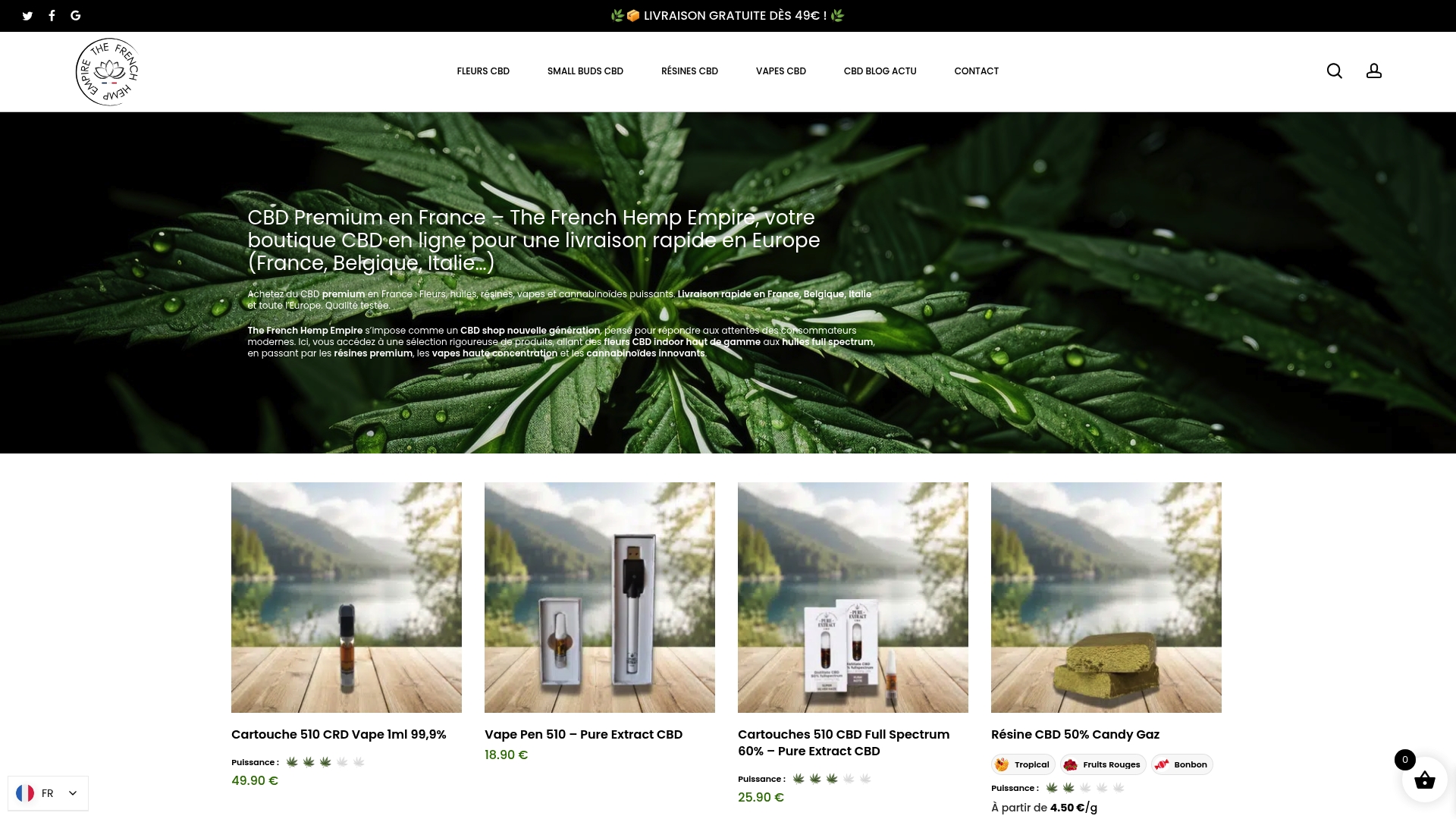
Thefrenchhempempire exclusively offers premium CBD flowers and CBD vapes whose compliance is established by independent certificates of analysis, with a THC content strictly below 0.30%. Each product comes with traceability documentation, allowing any professional or consumer to verify the origin and composition before purchase. The cannabinoids offered— CBD, CBG, CBN —are not on the lists of prohibited substances published by the ANSM (French National Agency for Medicines and Health Products Safety), and their regulatory status is continuously monitored.
Sources
- News – ANSM adds new cannabinoids to the list of narcotics – ANSM
- Legifrance – amended decree referenced (example JORFTEXT)
- Reporting – national platform
The information contained in this article is provided for general informational purposes only and does not constitute legal or medical advice. For any specific situation, consult a qualified healthcare professional or verify the applicable regulations with the official sources cited.
This article provides general information and is not a substitute for professional medical advice. Consult a qualified healthcare professional about your specific situation before taking any action based on this content.