The benchmark remains the 0.3% delta-9 THC threshold set by Legifrance for hemp-derived products. Any substance classified as a narcotic by decree—such as HHC since June 2023—is illegal regardless of its THC content. Before purchasing, verify the Certificate of Analysis (COA) issued by an independent laboratory, the product's exact chemical formula, and the current regulations published by the ANSM (French National Agency for Medicines and Health Products Safety).
Pro tip: Always check the updated list of narcotics on Legifrance and cross-reference it with the product's Certificate of Authorization (COA) before ordering. A vague label or the absence of a COA is an immediate red flag.
Key points
Delta HC includes neo-cannabinoids, several of which have been classified as narcotics in France since 2023, and none of which can be purchased without prior verification of the COA and the official list of prohibited substances.
| Point | Details |
|---|---|
| Variable legal status | HHC has been classified as a narcotic since June 2023; THV-N-10 (T10) remains in a grey area with a high risk of development. |
| Delta-9 THC threshold | Any hemp-derived product must contain a maximum of 0.3% delta-9 THC to be legally marketed. |
| COA required | The absence of an independent certificate of analysis is sufficient grounds to refuse the purchase of a product. |
| Evolving framework | The ANSM decisions of June 2023 and June 2024 show that the bans occur in successive and rapid waves. |
| Alternative Thefrenchhempempire | CBD flowers and broad spectrum oils , with accessible COA and THC content controlled below the legal threshold. |
Table of Contents
- What is "Delta HC" and its related compounds (HHC, Δ-10, THV-N-10)?
- What are the effects and health risks?
- What is the exact legal status: texts, ANSM decisions and sanctions?
- How have the bans unfolded since 2026?
- How can you verify if a product is likely legal and safe?
- What legal alternatives should be favored for a relaxing effect?
- Why is the legal status of neo-cannabinoids changing so quickly?
- Editorial viewpoint on neo-cannabinoids and compliance
- Compliant CBD products, with COA and full traceability
- Sources
What is "Delta HC" and its related compounds (HHC, Δ-10, THV-N-10)?
"Delta HC" is not a single molecule; it is a generic trade term encompassing several isomers and semi-synthetic derivatives of cannabis. Products sold under this label frequently include:
- HHC (hexahydrocannabinol): obtained by hydrogenation of THC or CBD, classified as a narcotic in France since June 2023.
- Delta-10 THC (Δ-10): isomer of THC produced by chemical isomerization, with variable psychoactive effects.
- THV-N-10 / T10 (tetrahydrocannabivarin-N-10): more recent molecule, absent from some lists of narcotics at the date of publication, but whose status remains fragile according to sectoral analyses.
The fundamental distinction with CBD is pharmacological: CBD is non-psychoactive and legal under strict conditions, whereas the molecules mentioned above have varying affinities for CB1 receptors in the central nervous system, producing psychoactive effects comparable to those of delta-9 THC. From a regulatory standpoint, the manufacturing method matters: a natural hemp extract and a semi-synthetic molecule produced through isomerization are not treated the same way by health authorities.
Pro tip: On the label, look for the terms "semi-synthetic," "isomerization process," or "hydrogenation" in the technical data sheet or Certificate of Analysis (COA). These terms indicate a chemically transformed molecule, which is subject to higher regulatory risk.
What are the effects and health risks?
HHC, for example, produces a "high" described as less intense than delta-9 THC but more pronounced than CBD. Δ-10 is often associated with moderate cognitive stimulation.

The reported risks are real. Episodes of acute anxiety, tachycardia, nausea, and cognitive impairment have been documented, particularly with repeated or high-dose use. The government fact sheet on CBD reiterates the health precautions applicable to hemp derivatives and directs users to consult a healthcare professional in case of adverse effects.
The main limitation of the current state of knowledge is the scarcity of clinical data. A search on PubMed confirms that the scientific body of knowledge on neonicotinoids remains largely preclinical or consists of isolated cases, lacking long-term studies to assess the risks of addiction or chronic effects. This scientific gap is precisely one of the reasons why health authorities are adopting a precautionary approach.
What is the exact legal status: texts, ANSM decisions and sanctions?
The legal framework rests on two distinct levels. On the one hand, the 0.3% delta-9 THC threshold established by the texts available on Legifrance determines the legality of hemp-derived products. On the other hand, a substance can be classified as a narcotic by decree independently of its THC content, which makes its production, sale, and possession illegal.
Regarding HHC, the ANSM's decision to classify it as a narcotic in June 2023 is the clearest precedent. Similar decisions followed in 2024 for other derivatives. For THV-N-10 (T10), available analyses indicate that it did not appear on certain narcotic lists on recent dates, but this status can change without notice.
Customs checks and shop seizures have increased since 2023.
Pro tip: Check the ANSM decision number and the exact chemical formula (IUPAC name) on the COA. A COA that only mentions a trade name without a precise chemical formula does not confirm legal compliance.
To delve deeper into the applicable regulatory framework, Thefrenchhempempire's page legal CBD in France and Europe details the points of vigilance related to the THC threshold and the Novel Food regime.
How have the bans unfolded since 2026?
The regulatory process follows a repetitive pattern: a new molecule appears on the market, health reports accumulate, and then a classification decision is made. The key dates are as follows:
- June 2023 : ANSM classifies HHC and its main derivatives (HHC-O, HHC-P) as narcotics, leading to massive withdrawals from the French market.
- June 2024 : extension of the classification to other neo-cannabinoids, confirming the logic of a "wave" of prohibition documented by industry players.
- 2025-2026 : increased monitoring of THV-N-10 (T10) and other emerging isomers, whose status remains uncertain according to available analyses.
This precedent is significant: it means that any molecule currently marketed under the label "Delta HC" without explicit classification could become illegal in the short term. The EMCDDA report has played a key role in accelerating European surveillance, providing scientific support for national decisions.
How can you verify if a product is likely legal and safe?
Before purchasing any product labeled "Delta HC" or similar, follow this five-step procedure:
- Identify the exact molecule : ask for the chemical formula (IUPAC name) and check that it is not on the list of narcotics published on Legifrance.
- Require the COA : the certificate of analysis must come from an accredited independent laboratory, mention the delta-9 THC content (≤ 0.3%) and be less than six months old.
- Check the labeling : verify the presence of the seller's SIRET number, full legal information and the origin of the plant (preferably European industrial hemp).
- Refuse to buy in case of ambiguity : absence of COA, unspecified chemical formula or seller without legal notices are sufficient reasons not to buy.
- Keep the evidence : in case of an inspection, the proof of purchase and the COA constitute the strongest elements of defense.
Pro tip: An incomplete COA—one that doesn't separately list delta-9 THC, delta-8 THC, and other cannabinoids—doesn't guarantee compliance. Demand a full cannabinoid profile, not just an overall result.
To understand what the law says about products sold as "THC-free high", Thefrenchhempempire's article "CBD THC-free high illegal" provides useful details.
What legal alternatives should be favored for a relaxing effect?
The compliant products available on the French market offer serious options for consumers seeking relaxation or well-being without legal risk:
- CBD flowers , sourced from European industrial hemp, with a delta-9 THC content ≤ 0.3% and an accessible COA.
- Broad spectrum oils : they contain a spectrum of legal cannabinoids (CBD, CBG, CBN) with no detectable THC, which reduces regulatory risk.
- CBD resins , the composition of which can be verified by COA.
The key purchasing criteria are the plant's traceability, the availability of the Certificate of Authenticity (COA) upon request or online, and the seller's transparency (business registration number, legal information, return policy). The gray market for unregulated neo-cannabinoids presents a dual risk: legal for the buyer, and health-related due to the lack of quality control. To compare the effects of legal cannabinoids, Thefrenchhempempire's guide to CBG, CBN, and CBD details the practical differences
Why is the legal status of neo-cannabinoids changing so quickly?
The mechanism is precise: a health-related report (poisoning, hospitalization, pharmacovigilance alert) triggers a referral to the ANSM (French National Agency for Medicines and Health Products Safety), which can issue a classification decision as a narcotic within a few weeks. Reports from the EMCDDA (European Medicines Agency) and EFSA (European Food Safety Authority) serve as the scientific basis for these decisions, accelerating the convergence of national and European regulations.

This volatility creates a symmetrical regulatory risk for both buyers and sellers. A product legally marketed today could become a controlled substance within weeks, retroactively exposing unsold stock to seizure. Regulatory caution is therefore not a conservative stance; it is the only rational response to a framework that evolves through successive decrees.
Pro tip: Subscribe to ANSM alerts and regularly check Thefrenchhempempire's regulatory blog to follow developments without delay.
Editorial viewpoint on neo-cannabinoids and compliance
The proliferation of labels such as "Delta HC," "T10," or "THV-N-10" on the French market reflects a commercial strategy that exploits the time lag between a molecule's discovery and its official classification. This is not an innocent gray area; it is a deliberate risk, often at the expense of the consumer who is unaware that the product they are buying could become illegal even before delivery.
This positioning is not a commercial constraint, but a condition for building lasting trust with consumers. While unclassified neo-cannabinoids may seem attractive today, their lack of traceability and unstable legal status make them products to be avoided by anyone wishing to purchase safely.
Compliant CBD products, with COA and full traceability
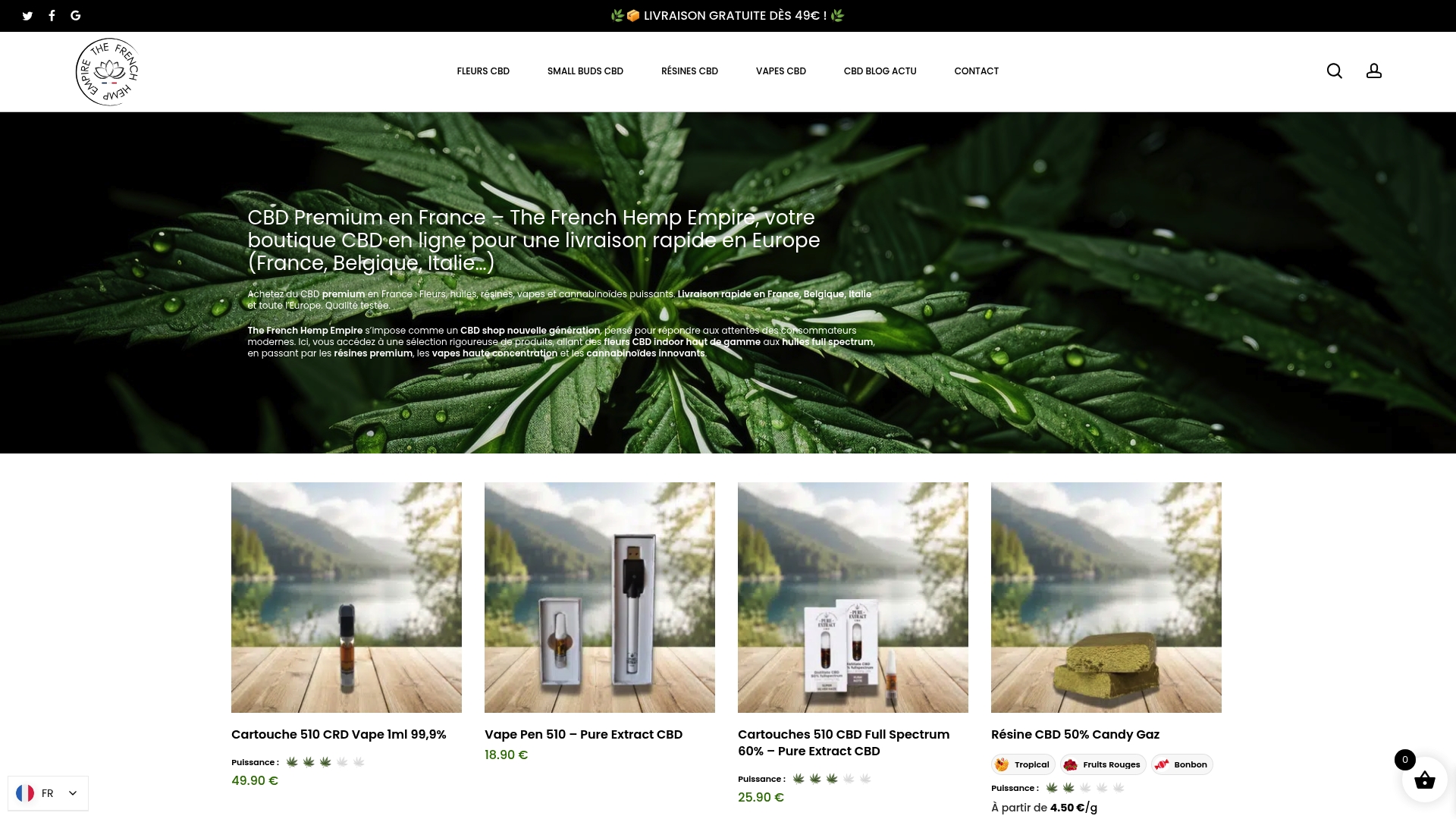
Thefrenchhempempire offers a selection of premium CBD flowers andbroad-spectrum oils , each batch accompanied by a Certificate of Analysis (COA) issued by an accredited independent laboratory. Unlike "Delta HC" products, whose legal status is uncertain, these products comply with current French and European regulations. For any questions regarding product compliance or to obtain a COA, Thefrenchhempempire's customer service is available directly through the online store.
Sources
To check and monitor regulatory changes, the following resources are the most reliable:
Pro tip: Always keep the Certificate of Analysis (COA) and proof of purchase for each product. In the event of an inspection, these documents are your first line of defense. Also, check the ANSM decision number mentioned on the COA to confirm that no bans subsequent to the date of analysis apply to the molecule in question.
This article provides general educational information and does not constitute legal advice. For any personal situation, consult a legal professional or check the relevant legislation directly on Legifrance and the decisions published by the ANSM.
This article provides general information and is not a substitute for legal advice. Consult a qualified legal professional regarding your specific situation before taking any action based on this content.