CBD, CBG, and CBN are three distinct cannabinoids derived from hemp, each with its own pharmacological profile. CBD (cannabidiol) acts as an indirect modulator of the endocannabinoid system, promoting relaxation and reducing anxiety. CBG (cannabigerol) is the biosynthetic precursor to all other cannabinoids and produces faster, more stimulating effects. CBN (cannabinol), on the other hand, results from the oxidation of THC and is distinguished by its sedative properties. Understanding the differences between CBD and CBG allows you to choose the cannabinoid best suited to your specific wellness needs.
How do the cannabinoids CBD, CBG, and CBN act on the body?
The human endocannabinoid system comprises two main types of receptors: CB1, concentrated in the brain and central nervous system, and CB2, present in the immune system and peripheral tissues. Each cannabinoid interacts differently with these receptors, which explains the diversity of their effects.
CBD does not act directly on CB1 or CB2 receptors. It functions as a negative allosteric modulator, meaning it modulates receptor activity without binding directly to them. This indirect action produces diffuse but long-lasting effects, which explains its versatile profile.
CBG, on the other hand, binds directly to CB1 and CB2 receptors with moderate affinity. This direct binding explains the speed of its effects, noticeable within 15–20 minutes. Its action is more targeted and immediate than that of CBD, but also shorter-lived.
CBN has a low affinity for CB1 and CB2 receptors. Its sedative effects result primarily from interaction with other molecular targets, including TRPV2 receptors and potassium channels. It has the slowest onset of action of the three, with a delay of 45–60 minutes.
- CBD : indirect allosteric modulator, diffuse and long-lasting effects, suitable for daily use
- CBG : direct CB1/CB2 interaction, fast and targeted effects, shorter duration
- CBN : low receptor affinity, slow action via other targets, pronounced sedative effect
Pro tip: Combining CBD and CBN in the same dose amplifies the sedative effect: CBD prepares the body for relaxation, then CBN takes over to help you fall asleep. This synergy, known as the entourage effect, is more effective than CBN administered alone.
What are the differences in the effects and uses of CBD, CBG and CBN?
The three cannabinoids target distinct needs. Choosing the right one depends on the time of day, the desired outcome, and each person's individual profile.
Main effects of each cannabinoid
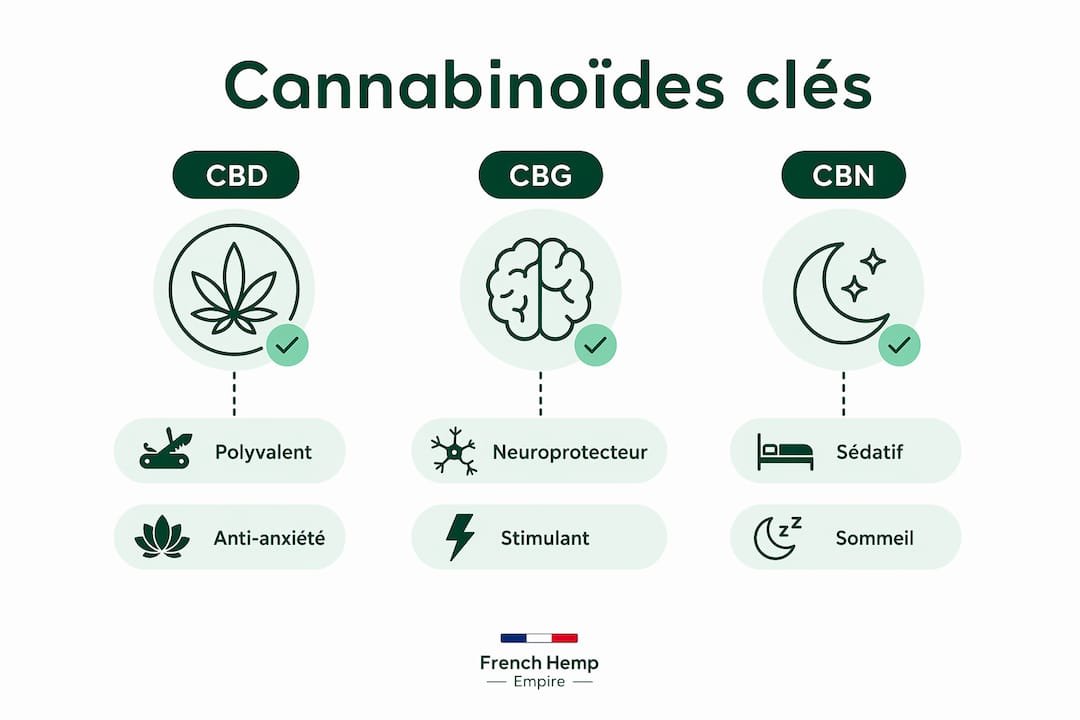
CBD is the most versatile cannabinoid. Its main effects include anxiety reduction, anti-inflammatory action, and stress regulation. It can be used both during the day and in the evening, without causing significant drowsiness at typical doses. For a complete overview of its properties, Thefrenchhempempire's CBD definition and effects page details its full profile
CBG is distinguished by its neuroprotective, analgesic, and mildly stimulating effects. It is best suited for daytime use, particularly for improving concentration or managing localized pain. Its rapid action makes it a relevant choice for situations requiring an immediate response.
CBN is the cannabinoid of choice for sleep. Taken 45–60 minutes before bedtime, it promotes sleep onset and helps maintain sleep longer than melatonin. Its sedative effect is more pronounced than that of CBD, but its action is slow and should be anticipated.
Comparison of the three cannabinoids
| Criteria | CBD | CBG | CBN |
|---|---|---|---|
| Main effect | Anxiolytic, anti-inflammatory | Stimulant, analgesic | Sedative, sleep |
| Speed of action | 30–45 min | 15–20 min | 45–60 min |
| Recommended time | Day and evening | Daytime | Night |
| Duration of effects | Long | Short to medium | Long |
| Psychoactivity | None | None | Very low |
Recommended synergies and combinations
- CBD + CBN : the most documented combination for sleep disorders. CBD reduces anxiety in the evening, then CBN takes over to promote sleep. The CBD+CBN synergy is more effective than CBN administered alone.
- CBD + CBG : a useful combination for managing chronic pain during the day, with CBG providing a rapid action and CBD prolonging the effect.
- CBG alone : relevant for targeted morning use, without the sedative component of CBN.
How to choose and consume CBD, CBG and CBN effectively?
The method of consumption directly determines the amount of cannabinoid that reaches the bloodstream. This parameter, called bioavailability, varies considerably depending on the route of administration.
Bioavailability by method as follows: sublingual 13–35%, capsules and oral ingestion 6–15%, vaporization 30–50%. Vaporization offers the highest bioavailability, but the sublingual route remains the most practical and best controlled for oils.
For sublingual administration, holding the oil under the tongue for at least 90 seconds increases bioavailability by 20 to 40% compared to a 30-second hold. This simple detail is often overlooked, yet it significantly alters the perceived effectiveness of the product.
Sublingual administration bypasses first-pass metabolism in the liver, which significantly reduces the bioavailability of capsules and edibles. This is why sublingual oils remain the preferred form for those seeking precise dosage control.
- Sublingual oil : absorption in 15–45 minutes depending on the cannabinoid, bioavailability 13–35%, ideal for CBD and CBN
- Vaporization : absorption in 5–10 min, bioavailability 30–50%, suitable for CBG for a rapid effect
- Capsules : absorption in 60–90 min, bioavailability 6–15%, convenient but less precise
- Infusions : bioavailability similar to capsules, diffuse effect, less recommended for CBG or CBN
Pro tip: For CBN, opt for sublingual oil taken 45–60 minutes before bedtime rather than capsules. The slow absorption of capsules further delays the sedative effect, which can disrupt the desired timing.
For those wishing to delve deeper into the precautions associated with high concentrations, highly concentrated CBD provides detailed recommendations.
Availability, scarcity and cost of CBD, CBG and CBN
The three cannabinoids are not present in equal quantities in the hemp plant. This difference in natural concentration directly impacts the cost of the finished products.
CBD is the predominant cannabinoid in industrial hemp varieties legally cultivated in Europe. Its high concentration in the mature plant facilitates extraction and keeps production costs affordable.
CBG represents less than 1% of the mature plant. To obtain sufficient quantities, producers must either harvest the plant very early (before the CBG converts to CBD or THC) or use specifically selected varieties. This constraint makes CBG 5 to 10 times more expensive than CBD at equivalent concentrations.
CBN is not naturally present in the fresh plant. It results from the degradation of THC through exposure to heat, light, and oxygen. Its extraction therefore requires specific processes, which complicates production and increases costs.
- CBD : the dominant cannabinoid, simple extraction, affordable price
- CBG : less than 1% in the mature plant, early extraction or specialized varieties, high cost
- CBN : a THC degradation product, complex extraction, limited availability
A high CBN level in CBD resin can indicate an aged or improperly stored product. Therefore, the product's freshness is a key quality indicator to verify, particularly through the certificate of analysis provided by the manufacturer. Thefrenchhempempire systematically publishes independent laboratory analyses for each product, allowing you to verify the actual cannabinoid concentration before purchase.
Key points
CBD, CBG, and CBN act on distinct receptors, at different speeds, and address specific wellness needs that are not interchangeable.
| Point | Details |
|---|---|
| Distinct mechanisms of action | CBD modulates indirectly, CBG acts directly on CB1/CB2, CBN targets other receptors. |
| Different speeds of action | CBG takes effect in 15–20 min, CBD in 30–45 min, CBN in 45–60 min. |
| Additional uses | CBG is suitable for daytime use, CBD for any time of day, and CBN exclusively for evening use. |
| CBD+CBN Synergy | The combination improves sleep more effectively than CBN administered alone. |
| Cost related to scarcity | CBG is 5 to 10 times more expensive than CBD due to its naturally low concentration. |
My analysis after years of observing these three cannabinoids
The question I'm asked most often is simple: "Which one should I choose?" The honest answer is that this poorly framed question leads to disappointment. These three molecules are not in competition. They occupy distinct niches within a wellness routine.
What I've observed is that people who stop taking CBN after a week often took it at the wrong time or in the wrong form. A CBN capsule taken 20 minutes before bed will produce no noticeable effect. Sublingual oil taken 50 minutes before bedtime, in a calm environment, makes all the difference.
CBG, on the other hand, is often underestimated for managing mild daytime pain. Its rapid and direct action on CB1/CB2 makes it a useful tool for people who find CBD too diffuse or slow-acting. The higher price is a real drawback, but the amount needed is often less.
My consistent recommendation is to start with CBD to establish a baseline, observe the effects over two to three weeks, and then introduce CBG or CBN as needed. Increasing doses gradually remains the golden rule, regardless of the molecule. And only purchase products with an accessible certificate of analysis, as the actual concentration varies significantly from one supplier to another.
— Vanessa
CBD, CBG and CBN products from Thefrenchhempempire
Thefrenchhempempire offers a range of cannabinoid-based products that comply with European regulations, with THC levels below 0.3%. Each product comes with an independent laboratory analysis, available directly on the website.
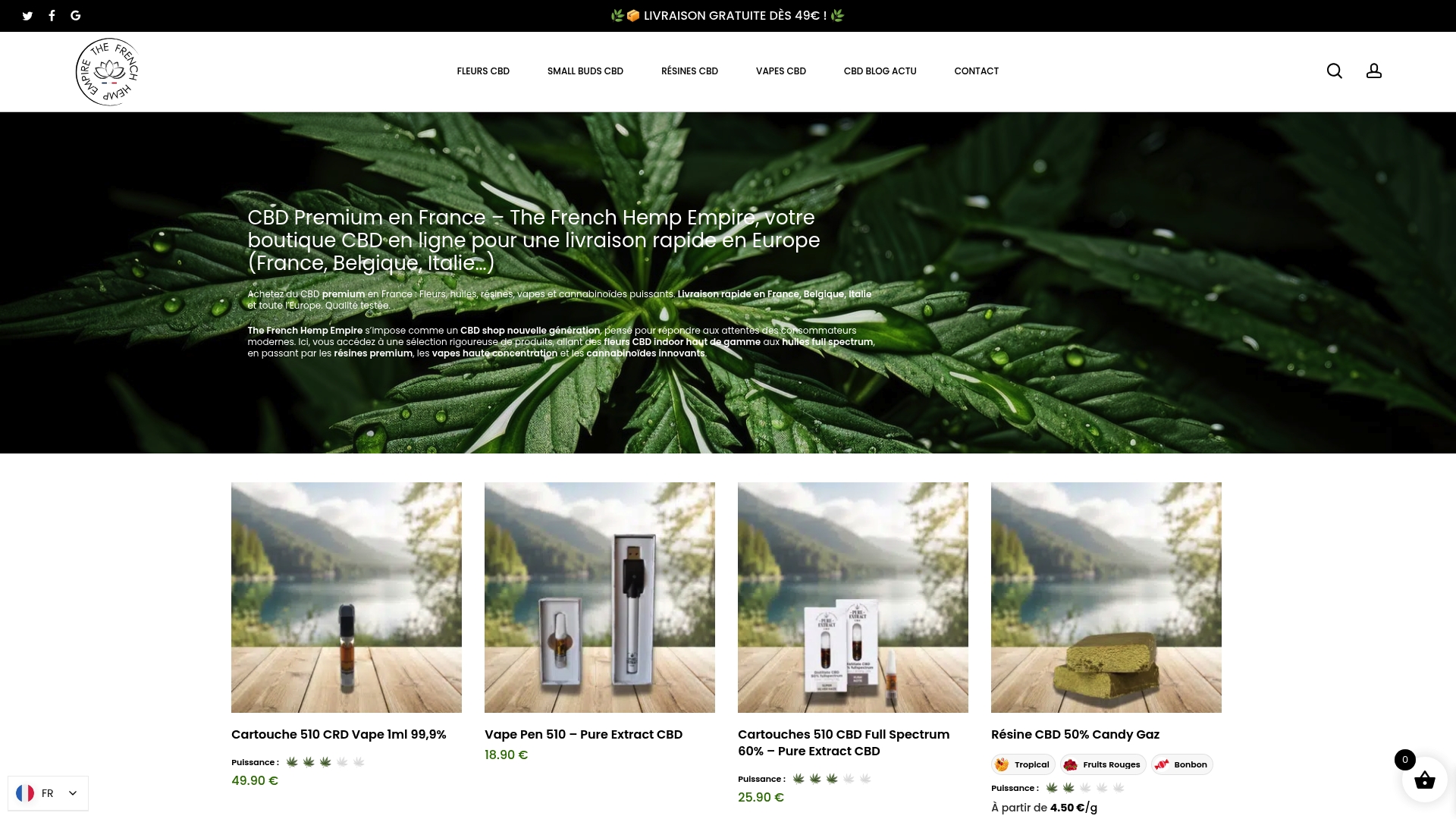
The leading online store for premium CBD flowers, resins, oils, and vapes tailored to different consumer profiles. Whether you're looking for a CBG-rich product for daytime use or a sleep-focused formula with CBN, we have something for everyone. Discreet and fast delivery is available throughout Europe. To see our full range, visit Thefrenchhempempire.
Frequently Asked Questions
What is the main difference between CBD, CBG and CBN?
CBD acts as an indirect modulator of the endocannabinoid system, CBG binds directly to CB1 and CB2 receptors, and CBN results from the breakdown of THC with a primarily sedative effect.
Is CBN psychoactive like THC?
CBN exhibits very low psychoactivity, significantly less than that of THC. At the doses commonly found in legal products, it produces no noticeable psychoactive effect.
Can CBD and CBN be combined for sleep?
Yes. The CBD+CBN combination is more effective than CBN alone: CBD reduces anxiety in the evening, and then CBN promotes sleep. It should be taken 45–60 minutes before bedtime.
Why is CBG more expensive than CBD?
CBG represents less than 1% of the mature hemp plant. Its extraction requires early harvesting or specialized varieties, making it 5 to 10 times more expensive than CBD at an equivalent concentration.
How can you tell if a CBN product is still fresh?
An abnormally high CBN level in CBD resin may indicate an aged or improperly stored product. Always check the manufacturer's certificate of analysis to verify the actual cannabinoid concentration.
Recommendation
- CBD: Definition, effects, legality, and a complete guide to cannabidiol – The French Hemp Empire
- CBD vs THC: Differences, effects, legality, and points to consider – The French Hemp Empire
- CBD Blog News – The French Hemp Empire
- Hemp, cannabis, CBD and THC: differences, legality and explanations – The French Hemp Empire