Is a CBD 510 cartridge compatible with any battery bearing the number 510? No. The 510 designation primarily indicates a family of threaded connections used in vaping. It does not guarantee complete mechanical compatibility, electrical compatibility, or compatibility between a formulation and the device. Before choosing a device, check the manufacturer's recommendations, the composition of the liquid or extract, the batch identification, and the applicable regulations in France.
A single page might feature a cartridge labeled "CBD," a vape pen, a high-concentration refill, and a formulation named after another cannabinoid. The formats may look similar, but their contents can be very different. A 1 ml tank doesn't indicate a precise amount of cannabidiol. Similarly, a "60%" label doesn't tell you about the volume, density, other ingredients, or nicotine content. Marketing information must be read line by line.
This document from The French Hemp Empire is a guide for adults. It explains the vocabulary, compatibility checks, units, and scope of a certificate of analysis. It does not provide universal settings or instructions for inhaling a product. Precautions and official sources were verified on September 24, 2026; the composition of a particular product should always be checked on its label and batch number.
What does "510" mean for a CBD cartridge?
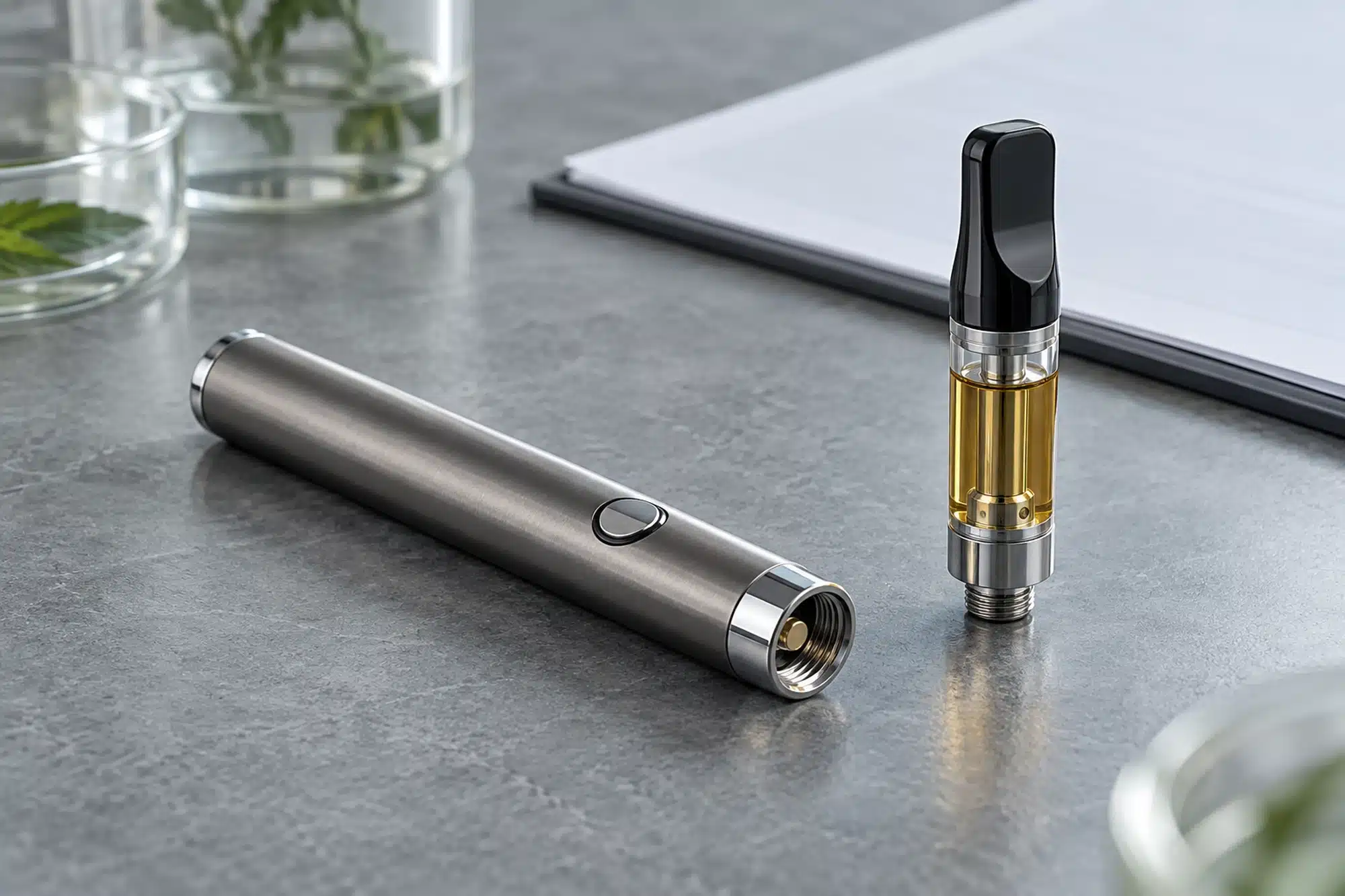
The number 510 is used to describe a type of screw-on connection between certain tanks and batteries. On a product sheet, "cartridge 510" indicates compatibility with batteries designed for that type. However, this alone does not guarantee that two specific models will work together properly. The cartridge's shape, connection depth, power requirements, and the device's documentation are all important factors.
The cartridge can be pre-filled and separate from the battery. Depending on the seller, a vape pen refers either to the complete device or to the pen-shaped battery. These two terms do not refer to the same item. A cartridge without a battery is not a usable device on its own; a battery without a suitable tank does not describe what will be vaporized. Check the exact contents of the box before comparing prices.
A label indicating "510" doesn't specify the cartridge's contents. A cartridge might be labeled as containing CBD, other cannabinoids, or a mixture. The mechanical connection is a hardware specification; the identity of the substances depends on the labeling, formulation, and analysis. Confusing the two risks purchasing a refill whose contents don't match what you intended.
The French Hemp Empire's CBD Vapes category includes various types of devices and refills. Classification in a commercial category does not guarantee that every item has the same composition. Consult the specific product description and, for technical questions, the manufacturer's documentation.
510 cartridge compatibility: four points to check
The physical connection
The advertised thread size must match that of the intended appliance. However, two screw-on components may differ in size, electrical contact, or position within a housing. Some appliances surround the cartridge with a narrow compartment; the diameter or height may then prevent the installation of a tank even if it is advertised as 510. A photo alone is not always sufficient to determine the correct size.
Look for the compatibility list provided by the battery or cartridge manufacturer. If one is not available, ask the seller to confirm the exact combination of two part numbers, and keep their answer. Do not attempt to modify a connection, force a thread, or use a damaged part to make two products compatible.
Electrical characteristics
The battery and cartridge must be designed to work together according to their stated specifications. The number 510 alone does not describe the permissible electrical range of the tank, the resistance of the heating element, or the device's safety features. Use outside the manufacturer's recommendations may result in product or equipment damage. When this information is missing, the correct question concerns the instructions for the specific combination.
The settings found on some batteries are not a guarantee of compatibility. Nor do they automatically indicate the amount of cannabinoids delivered. Avoid misinterpreting a stated setting as a promise of results or inventing a universal parameter for different formulations.
The formulation contained in the reservoir
A thinner e-liquid and a thicker extract don't necessarily behave the same way in the same device. The cartridge design must be adapted to its formulation and validated by the manufacturer. Don't assume that a bottle intended for an e-cigarette is suitable for a pre-filled cartridge, nor that a concentrated extract can be transferred to any tank.
The terms "rosin," "distillate," "sauce," or "e-liquid" describe categories of commercial preparations that can have a wide range of compositions. These words do not replace the ingredient list. A formulation presented as hemp-derived does not automatically become suitable for inhalation simply because it is sold near a battery.
The instruction manual and the condition of the equipment
An instruction manual allows users to check the recommended device, storage precautions, and signs of malfunction. A leaking reservoir, a deformed battery, a damaged connector, or unusual overheating warrants discontinuing use and contacting the manufacturer or seller. The DGCCRF (French Directorate General for Competition Policy, Consumer Affairs and Fraud Control) reiterates precautions regarding batteries, including the use of a suitable charger and the need to avoid shocks, short circuits, and excessive heat.
What does a so-called "CBD" cartridge actually contain?
The brand name may highlight cannabidiol, while the formula may also contain other cannabinoids, terpenes, flavorings, base ingredients, or possibly nicotine. The composition varies between products. Ask for a clear list of ingredients, the identity of the declared active substances, and, if a percentage is given, the exact definition of that number.
The terms "full spectrum," "broad spectrum," and "isolate" are often used to refer to different cannabinoid profiles. They do not replace the need to read the batch analysis results. A "broad spectrum" product alone does not prove the absolute absence of THC; a claim of "0%" must be interpreted in conjunction with the detection limits, the substances tested for, and the accuracy of the labeling.
The terms "natural terpenes" or "hemp flavor" do not guarantee that the entire formulation comes directly from a flower. Some compounds may be added or sourced from other sources. If this origin is important to you, ask for it explicitly. Also, distinguish between a taste description, which is primarily sensory, and an analytical measurement of composition.
The presence of another cannabinoid warrants special attention. Brand names or trade acronyms do not guarantee a stable chemical identity. A CBD category label does not validate the status of another molecule or its safety profile. Verify the substance name, its stated concentration, and any supporting documentation; regulatory classifications should then be examined separately.
TheFrench Agency for Food, Environmental and Occupational Health & Safety (ANSES) has reported cases of poisoning linked to products marketed as containing CBD when other substances were actually involved. This alert does not mean that all cartridges have the same composition, but it provides a concrete reason not to reduce the examination of a product's information sheet to the letters "CBD."
1 ml, 60%, 600 mg: why are these numbers not interchangeable?
A milliliter measures volume. A milligram measures mass. A percentage can represent a mass fraction, a volume fraction, or another basis defined by the document. To correctly convert a concentration to a mass percentage and a volume to a quantity of CBD, you need to know the mass corresponding to that volume, i.e., the density of the formulation or other equivalent information. Simply stating "1 ml at 60%" is not sufficient to definitively conclude that it contains 600 mg of CBD.
A purely arithmetic example: if a hypothetical liquid has a mass of 1 g per ml and contains 60% CBD by mass, 1 ml would represent 600 mg of CBD in this hypothetical scenario. If 1 ml of the liquid has a different mass, the result changes. If "60%" refers to total cannabinoids rather than CBD, the calculation no longer describes CBD alone. This is why a seller should specify the units and basis used.
Conversely, "600 mg of CBD per cartridge" is a total advertised quantity for the tank, which should be verified against the volume, mass, and analysis of the finished product. It doesn't indicate how much would actually be inhaled or absorbed, nor how long the device would function. Losses, device operation, and real-world conditions make these questions separate.
When two product sheets use different units, request data on a comparable basis: total CBD quantity advertised per tank, volume or mass of the refill, profile of other cannabinoids, and batch result. A dramatic percentage is not a quality rating and does not compensate for an inaccurate composition.
| Mention | What she can describe | Question to ask |
|---|---|---|
| 1 ml | Nominal filling volume | What is the total amount of CBD advertised and on what basis? |
| 60 % | CBD fraction or other total as defined | 60% of what, in what unit and for which batch? |
| 600 mg | Total stated mass of a component | Is this the measured CBD, a calculated total, or a target? |
What should you check on a CBD cartridge analysis certificate?
The first element is the link between the document and the product sold: name, batch number, date, nature of the sample, and laboratory. A report on a distillate before the addition of terpenes or other substances does not necessarily represent the final cartridge. Ask whether the test concerns the packaged product or an intermediate ingredient.
The second element is the list of cannabinoids being tested for. Look for CBD, delta-9-THC, and other compounds relevant to the advertised formulation. A substance not listed is not excluded by another line indicating "not detected." Limits of quantification must accompany the interpretation of a low or undetectable level.
The third element is the scope of additional testing. Depending on the materials and processes involved, questions may concern residual solvents, certain contaminants, metallic elements, or added substances. A certificate focusing solely on the CBD profile does not prove that all these parameters have been tested. It is also important to distinguish between the analysis of the liquid and the characteristics of the device's components.
The guide to certificates and analyses helps you read the sections of a report. An analysis number describes the sample submitted to the laboratory within the scope of its methods; it does not constitute medical validation, a universal guarantee of safety, or a complete assessment of commercial conformity.
510 cartridge, e-liquid, pod and disposable device: four distinct concepts
A 510 cartridge is a tank with a specific connection and is designed for compatible devices. E-liquid in a bottle is sold separately and requires a suitable device. A pod is a refill designed for a specific system; it may be proprietary. A disposable device combines a pre-filled vaping product with a single-use device, as defined by applicable law. Visual similarities do not make these items interchangeable.
This distinction has become essential in France. Since February 26, 2025, single-use electronic vaping devices have been banned from sale. The DGCCRF (French Directorate General for Competition Policy, Consumer Affairs and Fraud Control) specifies that the ban applies to pre-filled devices that cannot be refilled, even if their battery is rechargeable, and that it does not apply to the cartridges themselves. The classification depends on the actual design of the product, not just the word "puff" used in its advertising.
A removable cartridge paired with a reusable battery does not have the same status as a pre-filled device intended for disposal. This does not mean that all cartridges automatically comply with all other requirements. Their composition, labeling, material safety, and marketing must always be examined within their specific context.
If a shop uses the term "CBD puff" for a product sold in France, check very carefully which device it refers to. A familiar name alone is not enough to determine whether the device falls under the ban. The provisions of the law of February 24, 2025, and the guidelines of the DGCCRF (French Directorate General for Competition Policy, Consumer Affairs and Fraud Control) provide the necessary information.
What French regulations apply to a page dedicated to CBD vapes?
Vaping products are subject to safety, information, and communication regulations that go beyond simply the presence or absence of nicotine. The DGCCRF (French Directorate General for Competition Policy, Consumer Affairs and Fraud Control) explains, in particular, the information that must be provided for distance selling and reiterates the prohibition on online advertising for vaping products, except for information required under the regulations. Therefore, this document adopts a strictly informative tone and does not recommend any specific commercial product.
Vaping is prohibited in certain public places as defined by regulations. The French government's public service website on the vaping ban specifies the applicable situations and obligations. Access to vaping products is prohibited for minors; the presence of CBD or the absence of nicotine should not be interpreted as an invitation to circumvent these rules.
The presence of additional cannabinoids raises another question: their status may differ from that of CBD, and classifications are evolving. Even a low level of delta-9-THC does not, on its own, prove the compliance of a mixture containing other substances. Before drawing any legal conclusions about a specific cartridge, identify the molecules, consult the applicable regulations, and verify the final product.
Rules may also differ from one European country to another. A French product information sheet and a 510 connection common to several markets do not guarantee that the shipment of a formulation will be accepted in the destination country. This point requires a separate verification of technical compatibility.
Is vaping CBD safe?
No inhalation route should be presented as risk-free. The aerosol produced by a device, the actual composition of the liquid, and the heating conditions can all affect exposure. The available data do not allow us to conclude that all cartridges labeled as CBD have the same risk profile. A complete composition sheet and relevant controls reduce uncertainty about certain parameters; they do not demonstrate overall safety.
The FrenchNational Health Insurance (Assurance Maladie) reminds the public that CBD can interact with medications and that some products marketed under this name have had a composition different from that advertised. If you are taking medication, are pregnant, or have a specific medical condition, consult a healthcare professional. A CBD cartridge should not be presented as a treatment or as a medical aid for smoking cessation.
If you experience any unusual sensations or discomfort after using this product, discontinue use and seek appropriate medical help. Keep the packaging and batch number; these can help identify the product. A high advertised concentration or the presence of other cannabinoids makes it even more important to have a verifiable ingredient list.
The possible presence of THC may lead to a positive result during a roadside check. Products that can impair alertness should not be used in conjunction with driving or operating machinery. The claim "nicotine-free" does not mean "free of psychoactive cannabinoids" or "without precautions.".
Batteries, waste and equipment lifespan
The battery is part of the product you are buying, even if the product description highlights the battery compartment. Check for the presence of an instruction manual, the charging equipment listed, and storage guidelines. Don't confuse a reusable battery with a device whose battery can be recharged once or twice but is still legally and physically intended to be discarded after being depleted.
The DGCCRF (French Directorate General for Competition Policy, Consumer Affairs and Fraud Control) specifically recommends not using a battery that is deformed, leaking, or exhibiting unusual overheating, protecting it from metal objects, and not leaving it charging unattended. These guidelines are not vaping settings; they concern the safety of the electrical equipment, regardless of the CBD formulation.
A used cartridge and a battery do not necessarily follow the same collection process. Consult local guidelines for electronic equipment, batteries, and consumables. Do not dispose of a battery with household waste for convenience, and do not attempt to disassemble a damaged cell.
The fact that a device is "rechargeable" can also create commercial ambiguity. Ask if only the battery is rechargeable, if the cartridge is replaceable, and if the reservoir can be refilled. These questions are helpful for understanding the cost of use, waste production, and compliance with the French ban on single-use devices.
Ten questions to ask before ordering a 510 CBD cartridge
- What will you receive? A single cartridge, a single battery, or a set?
- Which part numbers are compatible? Ask for a list from the manufacturer rather than a general promise based on "510".
- What is the nominal volume? Distinguish between 0.5 ml, 1 ml and the total mass of substances stated.
- What does the percentage mean? measured CBD, calculated total CBD, or the sum of other cannabinoids?
- What ingredients are declared? Examine the cannabinoids, base components, terpenes, flavorings, and any nicotine.
- Which batch was tested? Compare the identifier on the packaging to the one in the report.
- Has the final product been analyzed? An analysis of the distillate before formulation may be insufficient.
- What parameters were investigated? Read the scope of the tests and their limitations.
- What instructions come with the device? Check the battery, maintenance and storage instructions provided by the manufacturer.
- How is the device classified? Identify whether it is a replaceable cartridge or a pre-filled single-use device subject to the French ban.
This list is a guide, not a purchase recommendation. It helps distinguish between technical information, chemical composition, and marketing requirements. A missing or ambiguous answer may warrant further investigation before making any decision.
Frequently asked questions about CBD 510 cartridges
Does a 510 CBD cartridge work with all 510 batteries?
No, the thread alone does not guarantee physical and electrical compatibility. Check the cartridge dimensions, the manufacturer's specifications, and the list of recommended combinations. Do not attempt to force a connection.
Does a 1ml cartridge at 60% contain 600mg of CBD?
This conclusion requires further assumptions. A milliliter measures a volume, while 60% could refer to a mass fraction. The mass of the formulation is needed for conversion, and it's important to know if 60% refers to CBD itself rather than a total of cannabinoids. Request the stated total quantity and its analysis.
Can a CBD cartridge contain THC?
Yes, some hemp-based formulations may contain traces of THC, while others claim to have undetectable levels according to a given test. Read the batch analysis, its limitations, and the full ingredient list. A "CBD" category does not automatically mean "zero THC.".
Are a cartridge and a puff the same thing?
No. A cartridge is a separate refill or tank. "Puff" often refers to a pre-filled, single-use device. In France, the sale of single-use electronic vaping devices has been prohibited since February 2025; the DGCCRF (French Directorate General for Competition Policy, Consumer Affairs and Fraud Control) clarifies that this ban does not apply to cartridges as such. Check the actual design of the product.
Is a CBD analysis sufficient to verify the safety of a cartridge?
No. It indicates what was tested for in the sample using a specific method. It does not automatically describe all contaminants, ingredients, or the device's physical safety. Review the scope of the report and the documentation for the finished product.
Does "nicotine-free" mean "without effects"?
No. The absence of nicotine, even if properly established, does not in itself indicate the presence of CBD, THC, or other cannabinoids. Nor does it demonstrate the absence of risks associated with inhalation or drug interactions.
Can you use a bottle of e-liquid in any 510 cartridge?
No. The compatibility of a formulation with a reservoir depends on its design and the manufacturer's instructions. A bottle, a pre-filled cartridge, and a concentrated extract are not interchangeable solely on the basis of the word CBD.
Why compare a cartridge to the batch rather than to the name of the range?
Because the same product name can cover multiple products. The date, ingredients, and results can vary. The batch number links the received packaging to the analytical document and makes your question to the seller more precise.
A clear reading before any decision
The 510 connector indicates a connection, not a guarantee of compatibility or a definition of the product's composition. The volume indicates the tank capacity, not the mass of CBD without further information. The percentage only describes a quantity when the product description and analysis clearly state what it is. These three distinctions will help you avoid most of the confusion you might encounter on a vape website.
In the current French context, it's also important to distinguish between replaceable cartridges and banned disposable devices, and to be aware of online communication restrictions. Therefore, focus on verifiable questions: ingredient identity, batch number, instructions, documented compatibility, and health precautions. A precise answer is worth more than a vague promise of performance or discretion.
Sources and documentary methodology
Report prepared on September 24, 2026. The official sources below support the regulatory and health points. This text is neither a laboratory test of the products sold by The French Hemp Empire, nor a technical validation of a specific cartridge and battery combination.
- DGCCRF — Your questions, our answers on electronic cigarettes : ban on single-use devices, exclusion of cartridges from this ban, battery precautions, distance selling information and communication.
- Légifrance — Law No. 2025-175 of February 24, 2025 : French ban on single-use electronic vaping devices.
- Public Service — ban on vaping : places and rules concerning vaping.
- Anses — poisonings caused by CBD products containing other substances : risks related to compositional discrepancies.
- Health insurance — Non-medical CBD: definition and precautions for use : interactions and vigilance.