This guide helps you distinguish between the main cases and find useful information before buying. It examines percentages, analysis reports, photographs, and the terms used in the product descriptions. When exploring The French Hemp Empire's CBD flowers, keep each product reference in mind, referring to its own description. The goal is to understand what is being offered, without assuming that all flowers in a catalog have undergone the same processing or contain the same constituents.
CBD boosted: what should we understand behind this term?
Consider "boosted" as a term that requires explanation. It provides neither a complete chemical identity nor an analytical method. A datasheet might use it to highlight a stated percentage, describe enrichment, or present a product line. These uses do not answer the same question. Look for the sentence that specifies what has been changed, instead of interpreting the word alone. If this clarification is missing, ask for it before making your decision.
The difference is particularly important when the product name contains CBD while the description mentions several cannabinoids. Cannabidiol doesn't become a different molecule simply because a preparation is described as stronger. A claimed effect also doesn't identify what's actually present. You need to be able to distinguish the plant source, the stated ingredients, and the documented concentrations. A product line name can make identification easier, but it doesn't replace this essential information.
Boosted CBD, therefore, does not constitute a homogeneous category that can be classified solely by percentage. Two products bearing this label may correspond to different preparations. Your comparison should focus on the actual products and their compositions, along with the documentation available for the batch. This approach avoids expecting a single adjective to describe the formulation, quality, compliance, and personal experience all at once. Each of these aspects requires specific information.
CBD enrichment and the addition of other cannabinoids: a key distinction
A stated enrichment with cannabidiol means the product description indicates the addition of CBD to a carrier or preparation. The addition of other cannabinoids raises a different question: what substances have been incorporated? Their names, properties, and precautions should not be replaced by a general reference to hemp. You can request a clear explanation, with an understandable list of ingredients and data corresponding to the finished product. A promise of potency does not fulfill this purpose.
It's also important to distinguish between a plant selected for its specific characteristics and a product that has been modified after harvest. In the first case, the description should focus on the variety and its characteristics. In the second, it should specify the processing method used. A photo of a flower doesn't allow you to differentiate between these two situations. If the absence of additives is important to you, ask the question directly. An answer concerning the agricultural origin is insufficient to establish what has been done afterward.
For a boosted CBD product, don't assume that a word like "natural" answers all these questions. The origin of an ingredient and its incorporation into a product are two different things. A hemp extract may have been added after harvest; the term "origin" doesn't automatically describe the final formulation. So look for answers specific to the product you're considering, with its full name and batch information, rather than a general statement about the plant.
| Presentation encountered | Main question | Useful information |
|---|---|---|
| Flower advertised as being rich in CBD | Does the rate apply to the flower as sold? | Characteristics and results corresponding to the batch |
| CBD-enriched flower | What contribution is announced after harvest? | Description of the preparation and final composition |
| Flower with several cannabinoids | What substances are present? | Precise identities and tailored analyses |
| So-called "powerful" range | What does this promise signify? | A concrete explanation, independent of the product line name |
| Product with the abbreviated name | What does the abbreviation stand for? | Explicit composition and link to the report |
Boosted CBD: Why European data suggests reading the composition
The EUDA's 2026 European Drug Report describes low-THC cannabis products to which cannabinoids have been added. The agency notes variability in substances and concentrations between products and batches, sometimes with undeclared constituents. These observations pertain to markets monitored by the agency. They do not constitute an analysis of every flower sold in stores, nor a description of all CBD-enriched preparations.
The key point for your reading is the need to identify the finished product. A flower can retain a familiar appearance while having a different formulation. The agency also highlights the uncertainties and health concerns associated with several semi-synthetic cannabinoids. It would therefore be misleading to consider any product marketed as containing CBD as equivalent to cannabidiol alone. Ask for specific names and appropriate documentation, without inferring the composition from the color, smell, or place of sale.
This is what the French alert about products presented as containing CBD reminds us of
In their joint press release of June 19, 2025, the ANSM (French National Agency for Medicines and Health Products Safety) and ANSES (French Agency for Food, Environmental and Occupational Health & Safety) reported an increase in poisonings following the use of products marketed as containing CBD. The agencies indicated that, in many cases, other substances or non-compliant THC levels were responsible. They also warned of discrepancies between the advertised and actual composition. This observation makes it impossible to diagnose a particular product based solely on its name.
For you, this warning justifies reading beyond a reassuring name or promise of potency. A product containing more CBD and a product containing another substance should not be confused. If an unexpected reaction occurs, discontinue use and seek appropriate medical advice; in an emergency, contact emergency services. Keep the packaging and product reference to help identify the product. Do not continue a trial to verify if the effect ultimately matches the advertisement.
Boosted CBD percentage: what data is actually being advertised?
Before comparing two numbers, identify what they represent. Does the percentage refer to CBD alone, a sum of cannabinoids, an added ingredient, or the finished product? A value in a title doesn't necessarily answer all these questions. Look for the full description and units. If the label only shows a number followed by the percent sign, ask which substance and denominator it represents. A comparison is only useful when the definitions match.
A mass content of 20% corresponds to 200 mg per gram for the substance and convention indicated. This conversion helps in understanding a label; it does not measure your product and does not predict the amount received during use. It is also not a recommendation for use. The calculation must remain linked to the actual stated value. If the figure refers to a mixture, you cannot automatically assign it to each component of that mixture.
For a boosted CBD product, also check if the report distinguishes between measured and calculated values. CBD and CBDA are not the same analytical term. A "total" label requires clarification. Two products can display similar numbers while using different conventions. Your first objective is therefore not to find the highest figure, but to understand what each value represents. You can then examine the other characteristics of the product.
Quantity added and final concentration: why the numbers don't simply add up
A hypothetical example helps clarify the reasoning. A 1 g sample containing 10% CBD contains 100 mg of CBD according to this assumption. If we consider a theoretical intake of 100 mg of pure CBD, the final mass becomes 1.1 g and the total quantity 200 mg. The theoretical concentration is then approximately 18.2%, not 20%. The denominator has changed along with the quantity of the substance.
This example is an arithmetic illustration, without preparation methods or modification advice. In a real product, the composition of ingredients, operations, and measurements must be documented. It simply shows why "amount added" and "final percentage" are not interchangeable. Information about the enrichment ingredient alone does not determine the result in the sold flower. The relevant documentation must correspond to this final preparation.
The same principle applies when a product label indicates the purity of an extract used in manufacturing. A 99% pure ingredient does not necessarily mean the entire finished product is 99% pure. The quantity used and the composition of the carrier affect the result. When reading a CBD boost label, ask which value refers to the ingredient and which to the product as a whole. This will prevent you from comparing the purity of the raw material to the final concentration as if they were two equivalent measurements.
Boosted CBD: Which certificate of analysis should be examined?
Start with the product and the batch. A report on the flower before enrichment is not automatically the same as a report on the flower after preparation. A document concerning only the added extract does not describe the final product. Our guide to CBD certificates of analysis details this information. Look for a clear correspondence between the offered item, the analyzed sample, and the transformations that have occurred. When the descriptions differ, ask how the seller establishes the connection.
Next, look at the list of substances tested for. An analysis limited to a few cannabinoids doesn't answer all the questions about a preparation with a new name. If a listed substance doesn't appear in the table, ask which result documents it. A trade name may not be enough for the laboratory to identify a molecule. The question must remain specific: what compounds are present, and what tests verify the claimed levels for this product?
Finally, examine the limitations of the document. "Not detected" does not mean absolute zero under all possible conditions. A result must be interpreted using a specific method and its thresholds. Similarly, a cannabinoid profile does not automatically constitute a control for pesticides, metals, or microorganisms. These categories must be sought separately when relevant. A certificate is useful because it answers specific questions, not because it transforms a product into a guaranteed risk-free preparation.
Laboratory identified, date and sample: the details that give meaning to the report
A legible document should allow you to identify the issuer and the sample examined. The laboratory name, report number, and dates facilitate this identification. The ISO/IEC 17025 standard specifically addresses the competence of testing and calibration laboratories. Its reference should not be confused with a comprehensive product certification. For a practical analysis, the scope of the tests and their relevance to the preparation process remain essential.
For a boosted CBD product, the timeline deserves special attention. A recently issued report may concern material sampled earlier; the issue date is not the manufacturing date. Also, ask if the sample was analyzed before or after the described operations. You don't need to reconstruct the entire industrial chain. You want to understand which preparation the described result was used for and why it is presented as relevant to the batch currently offered for sale.
Can you recognize an enriched flower by sight or smell?
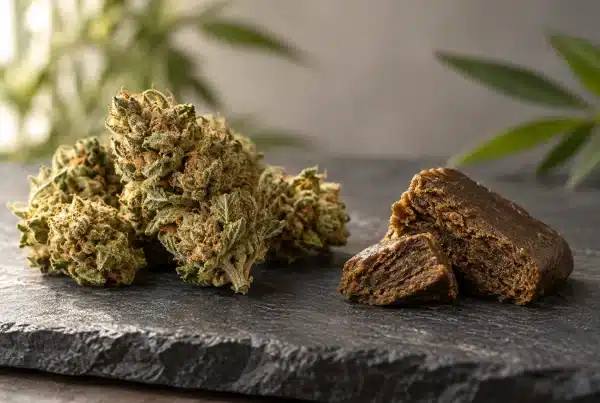
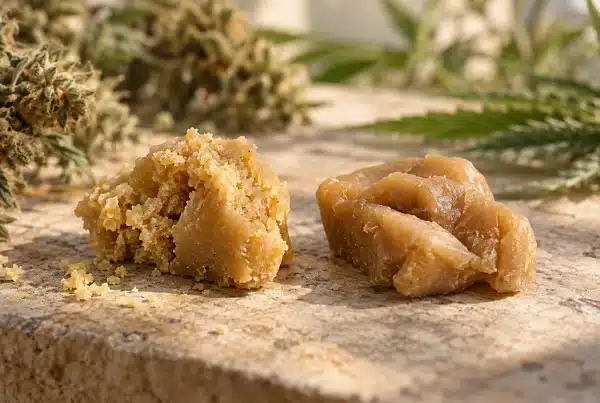
A photograph cannot definitively prove the presence or absence of enrichment. Reflections, visible trichomes, and framing provide a visual impression, not a chemical identification. A very light-colored surface may raise questions without answering them. Conversely, an ordinary-looking flower does not prove that no post-harvest processing has occurred. Use the images to examine the advertised appearance, then consult the description and documentation to understand the preparation process.
Smell is no substitute for a complete composition. An aromatic profile might appeal to you, but it doesn't reveal the list of ingredients. A name evoking lemon, a fruit, or a well-known variety should be read in conjunction with the product information. If you're looking for a flower without additives, ask for an explicit answer on this point. If you're comparing a CBD-enhanced product to another preparation, don't try to differentiate their formulations based solely on smell or a particularly striking image.
Origin, size and formulation: three different pieces of information
A "France" origin designation indicates a stated provenance, the scope of which must be understood. It may relate to cultivation, a preparation stage, or packaging, depending on the product information sheet. It does not automatically answer the question of additives. If you require details about the initial flower and subsequent processing, please provide separate information for each step. Simply stating the location of a company is insufficient to establish the complete provenance of the product.
Size is a separate issue. In the Small Buds CBD category, the term refers to a presentation in small buds. It doesn't indicate a specific formulation, concentration, or lack of enrichment. You can appreciate a smaller size while still considering the same information as for larger buds. Size and composition shouldn't be considered two separate answers to a single question of quality.
Boosted CBD and promised effects: why the comparison remains limited
The terms "powerful," "intense," or "new generation" require explanation. A claimed intensity does not provide a chemical identity and does not allow for a rigorous comparison between two preparations. A rating on a commercial scale may make it easier to identify a product line, but it does not replace a complete composition. Ask what it means, without mistaking a graphical scale for a pharmacological measurement or a promise of the same experience for everyone.
Sale status and safety are also two separate issues. A product offered on a website does not become safe simply by virtue of that, and a label alone is not enough to establish its compliance in every country. This guide does not provide regulatory validation for any particular molecule or product. If a term remains ambiguous or a substance is not clearly identified, do not fill the information gap with a reassuring assumption based solely on the word CBD.
Compare the price of the finished product with the quantity actually desired
A higher percentage doesn't automatically justify a larger purchase. Consider the net weight selected, the packaging cost, and the delivery price. The price per gram makes some comparisons easier, but it doesn't tell the whole story. Two preparations with different compositions don't become equivalent just because their unit price is similar. Your decision should be based on a product you understand, with a quantity that suits your project and a realistic budget.
For a boosted CBD product, start by clarifying the composition before considering a quantity discount. Then you can look at the features that interest you: the stated origin, presentation, and advertised profile. A promotion doesn't compensate for missing information. If the product description doesn't explain what has been added or what the percentage represents, a specific question to the seller is always helpful, even if the offer seems attractive or time-limited.
Questions to ask before choosing an enriched flower
You can structure your inquiry around four points: what material is the base material, what constituents are added, what is the stated final composition, and what ratio corresponds to the batch? Add a question about storage if instructions are unavailable. This approach avoids vague discussions about whether the product is "good" or "strong." You are seeking verifiable information related to an identifiable item and its actual preparation.
For a reference from The French Hemp Empire catalog, use our contact page with the full title and the point you need clarification on. You can browse the categories according to your preferences while still using this method. Do not assume that an explanation for one product applies to all others. The exact name and batch details will also help you find an answer for a future order or when comparing a new product.
Keep the packaging and avoid domestic modifications
Upon receipt, keep the identification information and follow the instructions for the product. Store the products separately, out of reach of children and pets. Do not mix different flowers by losing their labels, especially if the compositions differ. A simple note indicating the name and date opened can facilitate tracking. This organization allows you to find the necessary information without having to identify a formula based on the appearance of a flower.
Boosted CBD should not be rinsed, heated, or mixed with other materials in an attempt to remove an ingredient or correct a suspected issue. Home intervention does not control the final composition. If you notice a difference, set the product aside and document your findings. Retain the container, batch number, and order details until further notice. Careful observation is far more helpful than any alteration that would erase evidence of the original state.
Your questions about boosted CBD
Does boosted CBD always contain only cannabidiol?
The term alone is not enough to know. Check the advertised composition and ask which components are present in the finished product.
Is an enriched flower the same as a flower naturally rich in CBD?
The preparation process differs. To compare, look at what is announced after harvest and the results corresponding to each reference, without limiting yourself to the displayed rate.
Can you identify a boosted CBD product from a photograph?
An image shows one aspect. It does not replace chemical identification and does not certify the presence or absence of additives.
Is a report on the added extract sufficient?
It documents this ingredient within the limits of the tests carried out. It does not automatically describe the final preparation or its distribution in the product sold.
Does a more concentrated, boosted CBD promise a better effect?
A percentage alone cannot guarantee such a result. First, verify the measured substance and its composition, without conflating concentration, quality, or personal experience.
Choose with a clear understanding of the composition and specific expectations
The term "boosted CBD" becomes clearer when you ask what it actually means. Distinguish between the carrier, the advertised additives, the final concentration, and the results of the batch. You can then compare The French Hemp Empire's flowers with concrete questions, without expecting a photo or adjective to replace preparation information. Understanding the product allows you to formulate your expectations and identify points that still require clarification before purchasing.
This guide is intended for adults only and does not recommend any edible use of the flowers. It does not constitute medical advice or a guarantee of any effect. Do not drive after use and do not operate dangerous machinery. For personal health or treatment questions, consult a healthcare professional and follow the precautions specific to each product.