Documentation file prepared on September 24, 2026. Official references are included in the text and at the end of the article. This guide focuses on reading a report, not on validating a specific product.
A CBD certificate of analysis, often called a COA for "Certificate of Analysis," reports the results obtained on a specific sample, using given methods and on a given date. For it to truly help you make an informed choice, you need to be able to link it to the batch being sold, verify which substances were tested for, understand the units, and understand what the lab didn't test for. A nice-looking PDF bearing the word "compliant" doesn't answer these questions on its own.
The figures naturally grab your attention: 18% CBD, less than 0.3% THC, no pesticides. However, before comparing the values, look at the product's identity and the scope of the document. A report on a raw flower doesn't necessarily describe a resin prepared from that flower. A cannabinoid test, by definition, doesn't reveal all possible contaminants. And a single result doesn't predict the composition of all future batches.
This guide offers a reproducible method for reading a certificate of analysis for flower, resin, oil, or vape products. It distinguishes between chemical measurement, commercial traceability, and the regulatory framework. This will allow you to request precise information without mistaking marketing jargon for conclusive proof.
What exactly is a certificate of analysis?
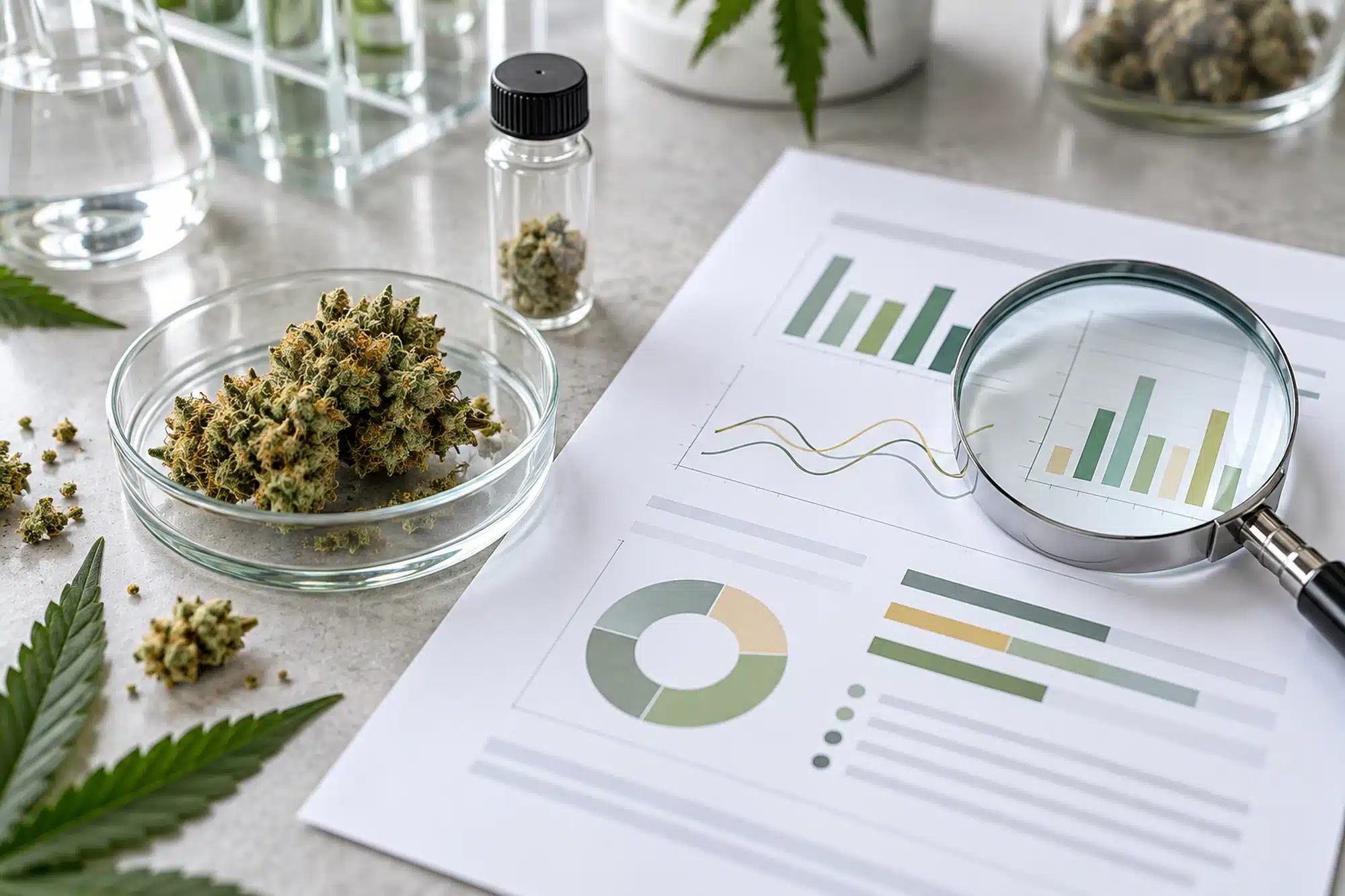
A Certificate of Analysis (COA) is typically a report issued by a laboratory after the examination of a sample. It details the sample received, the analyses performed, and the corresponding results. Depending on the laboratory and the order, it may include a cannabinoid profile, testing for pesticides, metals, residual solvents, or microbiological contaminants. Not all of these sections are automatically included.
The document therefore has a scope. It answers the questions, "What was found in this sample using this method?" and, sometimes, "Does this result meet the criteria submitted to the laboratory?" It doesn't answer, without further information, questions like, "Are all products from this brand identical?" or "Is this product safe for me?" The difference seems simple, but it radically changes how you read a product information sheet.
A distinction should be made between the original laboratory report, a summary formatted by the seller, and a claim such as "lab tested." The summary can be useful for quickly understanding the content, but it should refer to the full document. A claim without a batch number, a list of analytes, and a date remains difficult to verify. To understand the other files in The French Hemp Empire, keep in mind this separation between document, interpretation, and marketing presentation.
First check: does the report correspond to the product and batch you are looking at?
Batch number, reference and matrix
The lot number is used to link units manufactured or packaged in the same set. Look for it on the packaging or in the datasheet information, then compare it to the report. The trade name may vary slightly between the label and the lab's internal designation; in this case, ask how the two correspond. If no identifier links the two, you cannot simply assume the certificate applies to your item.
The "matrix" indicates the nature of the sample: plant material, resin, oil, e-liquid, or other preparation. This line is just as important as the name. An analysis performed on an extract before dilution does not automatically provide the content of the final oil. Similarly, a report on an untreated flower does not describe a flower enriched after processing. Inquire with the brand if the chronology between analysis, formulation, and packaging is not clearly stated.
Date of collection, receipt and transmission
Identify the available dates: sampling, receipt at the laboratory, analysis, and report issuance. These dates describe different stages. A recent report issuance does not prove that the sample was recently taken; conversely, an older report may correspond to a batch that is still being offered. The crucial point is consistency with the batch actually sold and any changes that have occurred since sampling.
Also ask who took the sample. A sample taken by the seller, a third party, or the laboratory does not provide the same level of representativeness. The sampling method, the number of units, and the storage conditions can all be factors in a heterogeneous product. An accurate result on a small fragment does not necessarily describe the variation across all the flowers in a batch.
Finished product or intermediate ingredient?
In formulations, several analyses may coexist: raw material, isolate, pre-packaging mixture, and finished product. Each has its own documentary value. To assess what you are buying, look for the report corresponding to the finished product, or explicitly ask how the ingredient data relates to it. A certified extract does not guarantee that its incorporation was carried out at the expected concentration.
When testing a vape or cartridge, be sure to check that the sample is the actual liquid contained in the commercially available product. A result for only a distillate does not document the other added ingredients. For a resin, verify that the analysis corresponds to the final product, and not just one of the materials used in its manufacture.
How to read the cannabinoid table
The list of analytes comes before the percentages
An "analyte" is a substance sought by the method. Begin by reading the list of lines, even when they display "not detected." A common profile might include CBD, CBDA, delta-9-THC, THCA, CBG, CBGA, or CBN. However, the presence of these names does not imply that all emerging molecules, isomers, or synthetic substances have been sought.
This point becomes crucial when the product has a commercial name. DC10, T9HC, THV-N10, or Delta HC do not, by their names alone, describe a universally recognized molecule. To verify a stated content, it is necessary to know the chemical identity of the components and to check if the laboratory has a suitable method for measuring them. A table limited to CBD and delta-9-THC proves nothing about the concentration of another ingredient not listed.
The EUDA report on semi-synthetic cannabinoids describes the diversity of substances and presentations available on the European market. This diversity makes the list of measured compounds particularly important. If the advertised name is not listed, ask the seller which compound is actually present and what analysis documents it.
CBD, CBDA, THC and THCA: four different lines
CBD and its acidic precursor CBDA are not in the same analytical line. Neither are delta-9-THC and THCA. Heat can cause decarboxylation of the acidic forms; therefore, a report may present the separate values and, depending on the context, a calculated "total" value. For a more detailed explanation of the difference, consult the section on THCA and THC in the journal and always check the rules specific to the product being reviewed.
"Total THC" is often calculated from the measured delta-9-THC and a fraction of the THCA. The theoretical coefficient close to 0.877 corresponds to the ratio of molecular weights; the calculation methods and conventions must be specified. A calculated value is not a second independent measurement, and it does not accurately predict what will happen to the product under all conditions of use. The USDA's documentation on hemp analysis provides an example of a framework where this distinction and measurement uncertainty are explicit. Its American rules do not supersede French law.
Percentage, mg/g and mg/ml: check the denominator
A mass percentage, provided the ratio is presented, corresponds to grams per 100 grams. A value of 10 mg/g is therefore equivalent to 1% by mass. Note: 10 mg/ml describes a concentration by volume and cannot be converted into a mass percentage without additional data, such as density. Displaying the value in milligrams per unit of product adds yet another denominator.
You can compare two reports when the units, matrices, and definitions of quantities match. If one is for dry matter and the other for liquid as sold, a simple comparison of numbers can be misleading. Also, check whether the stated content represents an individual cannabinoid, a calculated sum, or a claimed concentration for a mixture.
"Not detected" does not mean absolute zero
Laboratories use terms such as limit of detection and limit of quantification. A substance "not detected" was not identified under the specified conditions. A value "below the limit of quantification" may mean that a substance cannot be quantified with the precision required by the method. Read the report legend: the abbreviations ND, LOD, LOQ,.
Avoid transforming ".
What contaminant analyses should be sought depending on the product?
A cannabinoid profile provides information on selected substances. It does not guarantee the absence of pesticides, heavy metals, residual solvents, or microorganisms if these tests are not included in the documentation. The best approach is to look for a separate section for each relevant class of substances and to verify that it applies to the same batch and matrix.
Pesticides and metals
A pesticide test specifies the substances tested for, the method used, and the associated results. "Pesticides: compliant" without a list or criteria is difficult to interpret. A plant product may also warrant testing for certain metals. In such cases, verify which elements were measured and according to which standard any reported compliance is stated. A result below a threshold in a given context does not constitute general certification for all possible uses.
Solvents and microbiology
For an extract or product that has undergone certain manufacturing processes, testing for residual solvents may be relevant. A flower that hasn't been extracted doesn't raise the same questions as a distillate used in a cartridge. Microbiological analyses, on the other hand, can look for specific yeasts, molds, or organisms. It's important to read the list and units of each analysis, rather than assuming that a single "microbiology OK" designation covers everything.
The relevance of a panel depends on the process, presentation, and intended use of the product. For vaping, the cannabinoid profile of the liquid is insufficient to address all issues related to the formulation or its aerosol. For an oil, the composition of the carrier and storage conditions also warrant attention. No single, universal chart can guarantee the safety of all formats.
Why a negative test does not guarantee zero risk
Each analysis examines a limited set of substances, using its own method and thresholds. A contaminant not being tested for has not been evaluated. A negative result for one sample does not necessarily cover variable contamination throughout the entire batch. This does not render the certificate useless; rather, it demonstrates precisely how to use it, by relating each result to the question it can answer.
How to evaluate the laboratory and the scope of its report?
Identify the issuing laboratory, its contact information, the report number, its date, and, if available, the method name and its status. ISO/IEC 17025 defines competence requirements for testing and calibration laboratories. However, mentioning this standard on a commercial website does not prove that all the analyses in a document are accredited.
The scope of accreditation details the tests and areas covered. A laboratory may be accredited for certain analyses, without every method or matrix being included. Cofrac publishes rules relating to the accreditation of testing laboratories. For practical verification, compare the laboratory's name, its current scope, and the tests listed on your report. A single logo does not replace this verification.
A report can also distinguish between results from accredited tests and others. Out-of-range results are not automatically erroneous, but they lack the same external validation of competence for the method in question. If this distinction is unclear, ask for clarification. Also, inquire with the laboratory about its document verification procedures if a PDF appears incomplete or altered.
A fundamental limitation remains: accreditation describes competence for specific tests; it does not certify the entire product or its compliance with all French regulations. Nor does it guarantee therapeutic efficacy. These three issues require different forms of evidence and assessment.
Fictional example: how to read numbers without overinterpreting them?
Imagine a flower whose certificate indicates 120 mg/g of CBD, 25 mg/g of CBDA, 1.2 mg/g of delta-9-THC, and 1.0 mg/g of THCA. Let's assume these concentrations are all expressed per gram of the same sample and that the laboratory has defined its units in the same way. The table below illustrates an arithmetic reading, without representing an actual product or determining its conformity.
| Line | Fictitious result | Read carefully |
|---|---|---|
| CBD | 120 mg/g | 12% by mass for the measured CBD |
| CBDA | 25 mg/g | Acidic form presented separately |
| Delta-9-THC | 1.2 mg/g | 0.12% by mass for this line |
| THCA | 1.0 mg/g | 0.10% by mass for the acidic form |
| Illustrative calculation of total THC | 1.2 + (0.877 × 1.0) = 2.077 mg/g | Approximately 0.208%, if this calculation and basis are relevant |
This arithmetic alone is not enough to reach a conclusion. You still need to know if the result relates to the correct lot, what uncertainty applies, how the sample was taken, what specific legal criteria are being examined, and whether other substances are present. Conversion helps avoid confusion between units; it does not transform a hypothetical exercise into a certificate of conformity.
Now imagine that the product information sheet states "18% CBD" while the CBD line in the report shows 12%. Several explanations are possible: a sum including CBDA, a different calculation basis, a different batch, or an error. The best approach is not to arbitrarily choose the most favorable explanation; request a written definition of 18% and the corresponding documentation for the product being sold.
Does a certificate of analysis prove that a CBD product is legal in France?
No, not on its own. The laboratory provides results within the scope of its tests. The application of the rules depends on the identity of the substances, the type of product, its intended use, the date, and the applicable framework. The presence of a delta-9-THC level below 0.3% does not automatically resolve the situation regarding another classified cannabinoid or a particular formulation.
The ANSM's communication regarding newly classified cannabinoids illustrates why it is essential to identify substances precisely and to consider the exceptions outlined in the regulations. A trade name alone is insufficient to establish a chemical identity. For any question concerning a specific compound, link an analysis tailored to the current official texts and the product's actual intended use.
The well-known 0.3% threshold does not constitute a universal authorization for the sale or use of any substance in any format. Verify the rule invoked, what it measures, and the conditions it sets. An analytical document can assist in this process; however, it does not replace a legal examination of the specific case. For shipments outside of France, the destination regulations must be checked separately.
Composition data does not predict your individual reaction. The FrenchNational Health Insurance (Assurance Maladie) reminds you of the precautions associated with non-medical CBD, including interactions with medications and the possibility that some marketed products may not match their advertised composition. If you are taking any medication, consult a healthcare professional. Products that may impair alertness should not be used in conjunction with driving; the presence of THC can lead to a positive drug test.
Ten questions to ask before trusting a COA
- Which laboratory issued the document? Find its identity and a verifiable reference.
- What is the report number? It helps to avoid truncated captures and confusion.
- Which batch is being analyzed? Compare this number to your packaging or the sold reference.
- Which matrix was tested? Raw material and finished product are not interchangeable.
- Who performed the sampling? Their representativeness determines the scope of the result.
- Which substances are included among the analytes? A molecule not being sought is not covered.
- In what units are the results expressed? Check percentage, mg/g and mg/ml.
- What limits of detection and quantification apply? "Not detected" has a methodological meaning.
- What contaminants were being sought? Look at the lists and associated criteria.
- What is the scope of a potential accreditation? Check the methods and matrices actually covered.
If several answers are missing, make a short request to customer service: "Can you send me the complete report for the batch currently being sold, specifying the substances being tested for and indicating whether the analysis covers the finished product?" A documented response will save you more time than a series of slogans about "purity" or "premium quality".
Frequently Asked Questions about CBD Analysis Certificates
Is a QR code sufficient to authenticate the report?
A QR code facilitates access, but it doesn't guarantee that the target page is an original document or that it relates to the batch you're receiving. Verify the laboratory's identity, report number, batch number, date, and product information. If the laboratory offers a verification system, compare the references there.
Can a 20% CBD flower have a ratio indicating CBDA?
Yes, a flower can contain both neutral and acidic forms. The question is what exactly "20%" refers to: CBD measured alone, CBD calculated after taking CBDA into account, or some other representation. The report and the datasheet should allow for a comparison of the figures without inventing a convention.
Does the certificate need to be recent?
The date matters, but it's not the only factor. An older report that precisely matches the sold batch may be more relevant than a very recent report concerning a different production run. Examine the batch identifier, dates, subsequent processing, and, if applicable, storage conditions.
Does "tested by an independent laboratory" mean that everything has been checked?
No. The alleged independence concerns the relationship between the parties involved; the technical scope is indicated by the tests performed. Read the list of cannabinoids and contaminants, the matrices, and the methods. An external laboratory can perform a very limited panel.
Can we compare two THC levels shown on different certificates?
First, verify whether the value is delta-9-THC alone or a calculated total THC, then standardize the units and measurement bases. Next, review the available limits and uncertainty. Two similar numbers do not necessarily indicate a real difference when the methods or samples differ.
Does a COA guarantee that a vape is safe?
No. A cannabinoid profile of the liquid does not describe all ingredients, potential contaminants, or emissions produced under all conditions of use. Consult the scope of testing and formulation information. Do not interpret a partial analytical result as a general guarantee of safety.
What if the batch number in the PDF and the product number differ?
Request a document corresponding to the received batch and an explanation of the correspondence between the references. Do not spontaneously transfer the contents from one production run to another, even if the trade name is the same. A documented correction can resolve a simple transmission error.
Read the certificate as a limited but useful piece of evidence
A good certificate isn't judged by the number of logos or the color of a "compliant" box. Its practical value lies in a clear chain of events: identified sample, corresponding batch, appropriate method, understandable results, and properly defined criteria. The more complete this chain, the easier it is to verify claims about the composition.
Always return to three distinct questions. What does the analyzed sample contain? Is the result representative of the product you are examining? What conclusions can be drawn from the applicable safety rules and data? The same page may shed light on the first question while leaving the other two unanswered. This is a reason to ask for clarification, not to invent certainty.
At The French Hemp Empire, as with any online retailer, the availability of a report must be assessed on a batch-by-batch basis. This document provides a method for reading the product and does not constitute an independent audit of the catalog. For a specific product, consult its current product page and request the report for the relevant batch; older blog posts do not replace the official documentation for the product currently on sale.
Sources and documentary methodology
The following references clarify the principles of analytical competence, the diversity of cannabinoids, and French precautions. They do not certify any product mentioned in this article. The numerical example is provided solely to illustrate conversions and questions to ask.
- ISO — ISO/IEC 17025:2017, General requirements for the competence of testing and calibration laboratories.
- Cofrac — LAB REF 08, rules relating to the accreditation of testing laboratories.
- USDA Agricultural Marketing Service — Laboratory Testing Guidelines : example of an American analytical framework for hemp, without French legal scope.
- EUDA and Europol — Semi-synthetic cannabinoids, 2024 : diversity of substances and formats observed.
- ANSM — The ANSM adds new cannabinoids to the list of narcotics : substances concerned, exclusions and precautions.
- Health insurance — Non-medical cannabidiol: definition and precautions for use.