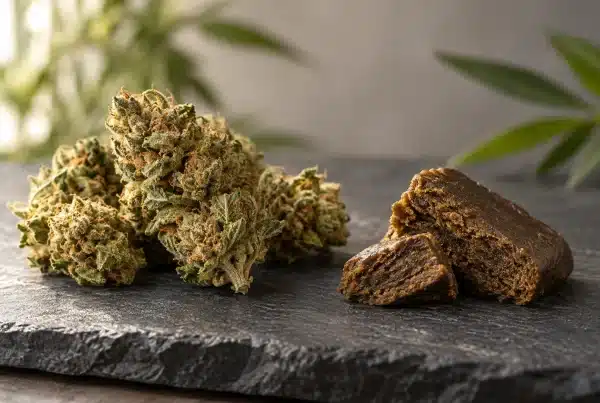
Can CBN really improve sleep? Human research shows encouraging results on some indicators, but it doesn't yet support its being considered an established treatment for insomnia. To understand what the studies show, several questions need to be considered separately: do you fall asleep faster, wake up less often, stay awake for shorter periods during the night, and feel better the next day? A positive answer to one doesn't automatically answer the others.
Cannabinol, commonly known as CBN, is often described as the "sleep cannabinoid." This phrase is easy to remember, but it poorly summarizes a scientific body of work that is still developing. Controlled trials have now been published, including a 2026 study of people with diagnosed insomnia. Interpreting these studies requires more nuance than simply classifying cannabinoids as "relaxing" or "potent.".
In this report from The French Hemp Empire, you will find the main findings, their limitations, and a method for evaluating claims about CBN and sleep. The goal is to help you distinguish between a promising research avenue, a measured effect, and a marketing claim, without turning an experimental protocol into self-medication advice.
Information pack prepared on September 24, 2026. Information intended for adults. This content is not a substitute for medical advice and does not recommend any specific CBN dosage.
What is CBN and why is it associated with sleep?
CBN is a cannabinoid distinct from CBD and THC. Its formation can result from the oxidation of THC. Experimental studies on cannabinoid stability investigate this chemical process. However, a shared origin does not mean that the two substances possess exactly the same properties or that a CBN product contains a predictable amount of THC.
For general information, our guide to defining CBN is a good starting point. Here, we examine a more specific question: does the available data support claims about sleep? This distinction prevents mistaking a molecule's description for proof of efficacy.
A reputation is not a clinical outcome
When several shops use the same expression, it can end up seeming accepted. Yet, "sleep cannabinoid" indicates neither the population studied, nor the measured result, nor the duration of the observation. You don't know if the phrase refers to an animal experiment, a questionnaire, or a trial with patients.
The relevant question, therefore, is: "What specific research supports this claim?" An answer should allow you to open the publication and identify the link between the data and the promise. An article that only cites a biological mechanism does not necessarily demonstrate an improvement in your sleep.
Better sleep: what result are we talking about exactly?
Sleep isn't simply a matter of a single score. One person might find their night more restful without sleeping more. Another might wake up less often but remain awake for a long time during a single awakening. Before comparing studies on CBN, it's therefore essential to understand their terminology.
| Indicator | What he describes | This is not enough to establish |
|---|---|---|
| Time to fall asleep | The time needed to fall asleep. | A night without waking up or better morning alertness. |
| Number of alarms | The frequency of arousal episodes. | Their cumulative duration. |
| WASO | The amount of time awake after the first time falling asleep. | The ease of falling asleep initially. |
| Total sleep time | The amount of time spent sleeping. | The restorative power of the night alone. |
| Perceived quality | The assessment reported by the person. | A precise modification of each stage of sleep. |
| Daytime operation | The condition and capabilities assessed during the day. | All possible long-term effects. |
A questionnaire gathers information about the experience. A recording provides physiological data. These tools can be complementary, but you should know which one was used. The French National Health Insurance's presentation of polysomnography explains that this examination records several signals that allow for the study of sleep and its disturbances.
This distinction protects you against a common extrapolation: interpreting a decrease in a sleep difficulty score as "more deep sleep." Supporting the latter requires a relevant measurement of sleep stages. The vocabulary of an advertisement should not be more precise than the data it uses.
CBN and sleep: what human trials show
The essay, published in 2024, covers seven nights
A randomized, double-blind trial by Bonn-Miller and colleagues compared a placebo, CBN alone, and several CBN-CBD combinations over seven nights. The main analysis presented in the abstract includes 293 participants.
The group receiving 20 mg of CBN reported fewer awakenings and a reduction in overall sleep disturbances. However, the result regarding sleep quality did not reach statistical significance. No significant benefit was observed in sleep latency, WASO score, or daytime fatigue. The addition of CBD did not enhance the effects of CBN in this trial.
This result is therefore more precise than "CBN makes you sleepy." It relates to certain indicators over a short period. The quantity cited describes the scientific protocol; it does not constitute an individual recommendation.
The 2024 trial comparing CBN, melatonin and placebo
A study by Kolobaric and colleagues divided 1,020 participants into three formulations containing CBN, melatonin, and a placebo. The active groups showed improved results on a sleep disorder questionnaire compared to the placebo group.
The authors found no significant difference between the CBN and melatonin groups on this measure. This does not prove universal equivalence between the two substances: the absence of a detected difference is not automatically proof of clinical equivalence.
The commercial context must also be understood. The reported funding includes Floraworks, and several authors work for Radicle Science, the company that conducted the trial. The publication indicates that the funder was not involved in the design, analysis, or writing of the study. These factors do not invalidate the results; they reinforce the need for independent confirmation.
The 2026 trial in people with diagnosed insomnia
The research by Lavender and colleagues, published in 2026, studied 20 adults in a placebo-controlled crossover trial, with one night per condition. The primary outcome was wakefulness after sleep onset, measured by polysomnography.
CBN did not significantly improve this primary endpoint. However, at the highest experimental condition, researchers observed favorable results on some secondary endpoints: sleep latency, perceived quality of sleep, and recording parameters. Mild to moderate adverse events were reported across all conditions, including placebo.
The small sample size and acute observation limit generalizability. This study provides avenues for further investigation; however, it does not demonstrate lasting effectiveness against insomnia. Nor does it justify replicating these quantities outside of a research setting.
Table of readings of the main searches on the CBN
| Research | Approach | Point to keep in mind |
|---|---|---|
| Bonn-Miller et al., 2024 | Short comparison against placebo, with CBN alone or in combination. | Results vary depending on the indicator studied. |
| Kolobaric et al., 2024 | Formulations with CBN, melatonin and placebo; questionnaire. | Evaluate the measures and the funding context. |
| Lavender et al., 2026 | A small cross-test with sleep recording. | Primary endpoint not significant; secondary signals. |
| Arnold et al., online publication 2024 | Animal research with sleep measurements. | Does not demonstrate a clinical benefit in humans. |
These studies should not be simply added together like customer reviews. They differ in their participants, their wording, and their tools. Their value lies in the questions they help to clarify. For you, a balanced summary should highlight both the positive results and the limitations that influence their interpretation.
What do animal studies tell us about the mechanism of CBN?
A study by Arnold and colleagues, published online in November 2024, recorded the sleep patterns of rats. It observed changes in sleep duration and organization. The researchers also studied a metabolite, 11-hydroxy-CBN, which may contribute to the observed activity.
These results provide mechanistic insights, not proof that a person will achieve the same result with a commercial product. The animal model, experimental conditions, and route of administration are all important. A comparison with a drug in a rat experiment does not guarantee equivalent efficacy in patients.
Our section on the functioning of the endocannabinoid system provides the necessary background to understand this type of research. However, it is important to keep the proposed mechanism separate from the demonstration of a benefit that matters to the individual.
CBN, CBD and melatonin: does more ingredients mean better results?
Why an association should be studied as such
An ingredient list is not an automatic summation of benefits. If a formula contains CBD, CBN, and melatonin, you need to know if that exact combination has been studied. A publication on a single ingredient does not validate all combinations that contain it.
A comparative trial published in 2023, involving 1,793 adults, evaluated different formulations of cannabinoids and melatonin. The results showed no significant advantage of any combination compared to CBD alone. Most importantly, the absence of a placebo group in this protocol limits conclusions regarding the absolute effectiveness of the interventions.
You can remember one rule for reading this: a comparison between several active ingredients answers a different question than a comparison against a placebo. Neither the number of participants nor the length of the ingredient list replaces this information.
CBN and melatonin: a potential interaction not to be confused with a beneficial synergy
work published in Basic & Clinical Pharmacology & Toxicology investigated an interaction between CBN and melatonin. It describes an inhibition of melatonin metabolism and an increase in its exposure in mice.
The clinical implications in humans remain to be determined. This signal does not allow us to classify the combination as dangerous in all cases, but it does prevent us from considering the two substances as necessarily independent. Before combining them, especially with other medications, consult a doctor or pharmacist.
The word "synergy" therefore deserves an additional question: are we talking about a better demonstrated clinical efficacy or only a possible interaction? These two situations are not interchangeable.
How can we interpret a positive result without making it say more?
The main criterion must remain visible
An essay typically defines the question it primarily seeks to answer. Other measures then complete the analysis. If a summary only cites positive indicators, you lose the initial hierarchy. Therefore, ask what the primary criterion was before adopting a general formula like "demonstrated effectiveness.".
Conversely, a non-significant result does not always prove a complete absence of effect. The study may be too small to detect a modest difference, or it may produce an uncertain estimate. Honest formulation consists of describing what was demonstrated in this protocol, without converting uncertainty into positive or negative certainty.
A statistical difference and a significant improvement for you are two questions
A difference can be detected between groups without profoundly altering daily life. Its magnitude, precision, and relevance must be considered. For someone who stays awake for long periods, a minor variation does not have the same impact as a lasting change in their sleep and day patterns.
When the publication uses a score, look for what its variation represents. A survey point is not a minute of sleep. Without this conceptual understanding, an ad may seem spectacular but doesn't yet provide information about the concrete benefit expected.
The product being studied is not necessarily the one you are viewing
A study on a characterized oral preparation does not validate a flower, resin, or vape product bearing the same cannabinoid name. The formulation, other ingredients, and route of exposure change the issue. To compare a product to a study, the similarities and differences must be explained.
This requirement also applies between two CBN products. A total cannabinoid percentage doesn't tell you what proportion is cannabinol. A brand or fragrance doesn't describe the composition. Matching a product to a search term must be based on precise data, not a similarity in labeling.
Why the dosages from a study do not constitute instructions for use
The experimental quantities are based on a protocol, with selection criteria and monitoring. They are not intended as a universal rule for everyone who sleeps poorly. Your age, treatments, medical history, and the cause of your sleep disorder do not disappear simply because a number appears in a publication.
It would also be misleading to assume that a larger quantity will necessarily yield a superior result. An experiment can compare multiple conditions to explore an answer, without establishing a simple progression. The correct approach is to retain the research question, not to turn the protocol into a personal escalation.
This guide therefore does not offer a conversion to drops or a dosage increase program. If you are looking to treat insomnia, the important question to ask a professional is about the appropriate treatment plan, not just the quantity of cannabinoids.
Side effects and sleep: the information that remains necessary
Safety is not simply a matter of whether or not a serious event occurs during a study. It also requires knowledge of the duration of exposure, excluded patient profiles, post-study vigilance, and potential interactions. A short trial cannot answer all questions about prolonged use.
Data on CBD cannot be directly applied to CBN. However, when a formulation does contain CBD, the precautions remain relevant.Health insurance providers remind users of the risks of interactions and side effects associated with CBD. Inform your doctor or pharmacist of all the ingredients in a product, not just the one highlighted.
Do not add CBN to a sleeping pill or change a prescribed treatment without medical advice. Drowsiness or decreased alertness means you should not drive. The results presented here do not support its use for sleep aids during pregnancy, breastfeeding, or for minors.
What should product documentation show?
To link a claim to a product, verify the stated CBN quantity, the complete list of ingredients, and the batch number. A certificate must correspond to the relevant product. If it only pertains to a raw material, ask what information describes the finished product.
Next, keep three mental columns: composition, effects, and regulatory status. An analysis helps to document the first. A clinical trial contributes to the second. A text and its application to the product concern the third. A convincing document in one column does not automatically fill the other two.
Is CBN authorized in France for use in sleep products?
The classification decisions mentioned by theANSM in its information on cannabinoids include an exclusion of CBN from the relevant chemical family. This does not constitute a general authorization for all products or all uses.
Food law is a separate issue. The European Commission's catalogue of novel foods must be consulted in conjunction with the list of authorized products. The national health insurance system also reminds consumers that food products enriched with cannabinoids are subject to this regulation. The mere availability of an oil or confectionery on a website does not constitute marketing authorization.
A study conducted abroad does not, in itself, change these French and European rules. When examining a statement of conformity, ask which specific product it covers, its intended use, and the reference number. A statement such as "scientifically tested" answers a different question.
When do your sleep difficulties warrant a consultation?
If these problems are recurring and affecting your daily life, it's a good idea to consult a doctor.Health insurance providers recommend assessing the duration, frequency, and impact of the symptoms. Also mention any snoring, reported breathing pauses, or unusual sleepiness.
To prepare for this exchange, note your schedule, the main difficulties you're experiencing, and what you've already tried. The goal is to document the situation without undertaking any further experimentation. A clear description is more helpful than a general note like "poor sleep.".
Managing insomnia relies primarily on identifying its causes and may include cognitive behavioral therapy. This approach addresses the behaviors and thoughts that perpetuate the difficulties. Research on CBN should not overshadow the treatments already available.
FAQ: CBN, sleep, and scientific evidence
Is CBN a proven natural sleep aid?
This statement is too categorical. Research exists, but its results vary depending on the measurements and protocols. The term "natural" defines neither a medical indication nor a level of evidence. To evaluate a claim, look for the population studied, the comparator, and the actual measured result.
Is CBN better than CBD for sleep?
The studies presented do not allow for the identification of a universal winner. A useful comparison must focus on specific preparations and a common objective. Falling asleep more easily, reducing awakenings, and improving alertness are not the same outcome. A general ranking masks these differences.
Can CBN help with nighttime awakenings?
Some results justify pursuing this line of inquiry, but it's important to distinguish between the number of awakenings and their total duration. The promise of an uninterrupted night's sleep is beyond the data. If your awakenings persist, their cause deserves investigation instead of automatically attributing them to a lack of relaxation.
Is a CBD-CBN-melatonin combination necessarily more effective?
No. A more complex formula must be evaluated as such. The effectiveness of each ingredient cannot simply be added together, and interactions are possible. The proportions, the population studied, and the comparison made must be known before concluding that there is an advantage.
Is there a validated standard dosage for insomnia?
The protocols reviewed do not provide a universal formula applicable to all products and all individuals. A research dose is part of a selected and monitored framework. It should not be copied as a prescription or automatically converted into a number of drops.
Do customer reviews prove the effects of CBN?
They can describe an experience, but they don't allow us to isolate the effect of a single ingredient. Habits, expectations, other products, and the spontaneous evolution of sleep patterns can all play a role. A personal account should be considered just that, an account, without being attributed the weight of a controlled trial.
Is a certificate of analysis sufficient to validate a promise regarding sleep?
No. It documents the parameters being investigated in a sample. It does not, on its own, demonstrate a clinical benefit. Request the composition report and the reference supporting the claimed effect separately. This separation makes the information clearer and avoids confusing analytical control with medical evidence.
What would it take to better establish the value of CBN?
Confirmatory trials, appropriate durations, and relevant comparisons would strengthen the case. Safety and the populations likely to benefit from the intervention should also be better documented. The value of a new study will depend on its ability to answer these questions, not just its date.
Here's what you need to know to read the next CBN news
Useful information about CBN and sleep should clarify three things: what has been tested, what has changed, and what remains uncertain. This framework allows you to follow the research without swinging from excessive enthusiasm to outright rejection with each new publication.
The French Hemp Empire journal offers articles to help you understand cannabinoids and their differences. When it comes to sleep-related topics, accuracy matters more than slogans: a well-documented result, presented within its limitations, helps you ask better questions.
Sources and editorial transparency
This document is a literature review, not an exhaustive systematic review. It distinguishes between human trials, animal research, and regulatory references. It is not based on personal product testing and does not claim independent medical validation. As The French Hemp Empire is a commercial website, this business relationship is part of the publication context.
- Bonn-Miller et al., 2024: CBN alone or in combination with CBD, trial against placebo.
- Kolobaric et al., 2024: formulations with CBN, melatonin and placebo.
- Lavender et al., 2026: crossover trial in adults with insomnia.
- Arnold et al.: CBN and sleep architecture in rats.
- Comparative trial of cannabinoid and melatonin formulations, 2023.
- Anderson et al.: preclinical interaction between CBN and melatonin.
- Health insurance: treatment for insomnia.