On a product page, a catchy name and a high percentage quickly grab attention. However, these elements can answer different questions: brand identity, extract content, total cannabinoid quantity, or ingredient characteristics. This guide helps you put each piece of information into perspective so you understand what you're looking at and can ask the right questions before you buy.
What is a cannabinoid blend?
In commercial terminology, this term refers to a mixture presented as combining several cannabinoids. It is not a standardized chemical formula. Two manufacturers may use the same word for distinct preparations; a single brand may also encompass several compositions. Therefore, you should read the complete product description, beyond the term printed prominently on the packaging.
It is also important to distinguish between a formulated mixture and an analytical profile containing multiple substances. The presence of several lines in a report is not sufficient to demonstrate that the manufacturer assembled all the components separately. To understand the formulation, look for a description of the product and its manufacturing process, along with the results corresponding to the actual product sold.
A product line name does not replace a composition
The terms "exclusive formula," "new generation," or "super blend" are part of marketing. They can identify a product line, but they don't replace the names of the individual components. When you're looking at a cannabinoid blend, ask yourself if you can explain its composition in precise terms, without simply repeating the words from the advertisement.
This distinction becomes particularly useful when two products have similar names. A similar name does not prove an identical formula or a common origin. Note the manufacturer, the product number, the format, and the batch number. This will give you enough information to ask the seller for confirmation and compare the associated documents.
Essential information about a cannabinoid blend
A useful presentation answers several complementary questions. What does the product contain? In what proportions are these components stated? What material do the figures correspond to? What document allows us to compare them to the commercially available batch? None of these answers should be replaced by a simple power rating or an attractive photograph.
| Information | Question to ask | Limit to keep in mind |
|---|---|---|
| Component identity | What are the specific names that correspond to the substances mentioned? | A commercial acronym can remain ambiguous. |
| Individual contents | What value is indicated for each component? | A total does not describe the distribution. |
| Calculation basis | Does the figure refer to the finished product or an ingredient? | The two values are not interchangeable. |
| Traceability | Does the document correspond to the lot sold? | A generic report is not sufficient to establish this link. |
| Other constituents | What ingredients or carriers complete the formula? | The list of cannabinoids is not necessarily a complete list. |
You can use this grid to organize your reading, without trying to get an instant answer to every question. When information is missing, identify precisely what is missing. "The details of individual contents are not indicated" is a useful observation; "the product seems mysterious" leads much less readily to a documented answer.
Total percentage: what the number really tells you
A large percentage next to a mixture's name warrants careful reading. It may refer to a single substance or a group of substances, depending on the definition provided. Without this definition, you cannot determine what it represents. Look for the words accompanying the number, and then check if the available ratio uses the same format.
The same total does not necessarily describe two identical formulas. Imagine two purely educational examples: the first states 40% of component A and 10% of component B; the second, 10% of A and 40% of B. Both total 50%, but their proportions differ. This example illustrates an addition; it does not represent any recipe or usage recommendation.
Cannabinoid blend: don't confuse total and equivalent
Based solely on the total concentration, you cannot infer an equivalence of effects between these preparations. A sum of concentrations is not a universal scale of intensity. To compare figures, you must first compare what they measure. A detailed table of components provides more information here than an overall score without definitions.
Also check if the values are expressed on the same basis and if they come from the same type of document. An analytical result, a formulation target, and a rounded value on a sales sheet do not serve exactly the same purpose. Ask the salesperson how they relate these elements when they don't clearly correspond.
Percentage, milligrams, and milliliters: read the units
A percentage represents a proportion, while a quantity in milligrams describes a mass. A milliliter is a unit of volume. To compare a content expressed by mass with a quantity expressed by volume, additional information may be needed. Therefore, do not automatically substitute a milliliter for a gram in your calculations.
Based on a clearly defined mass percentage, 1% corresponds to 10 milligrams per gram. This arithmetic relationship helps you verify the consistency of a document; it does not provide a quantity to use. It assumes that the percentage refers to the mass and substance you wish to compare.
When looking at a cannabinoid blend, always check the unit of measurement: per gram, per container, per volume, or for the entire product. A number can be accurate but misunderstood if its basis isn't clear. If necessary, ask the seller to rephrase the information using a whole number rather than a single unit.
Finished product and ingredient: the distinction that changes the reading
A preparation may contain an ingredient whose technical data sheet specifies a certain concentration. This does not mean that the finished product automatically has the same proportion. To understand an enriched flower, a formulated resin, or another presentation, you need to know which stage the figure refers to. The chronology between preparation, ingredient addition, and analysis then becomes essential.
Ask whether the report relates to the mixture before packaging, to an input ingredient, or to the product as sold. This question does not imply that any information is incorrect. It simply allows you to verify that a document answers the question you are asking.
The stand is part of the description
The packaging and other components can be essential for understanding the final presentation. A formula isn't necessarily limited to just the substances highlighted in the title. If a product description mentions a cannabinoid profile, check that it also describes the nature of the product, its ingredients, and any additives mentioned by the manufacturer.
This approach prevents you from directly comparing a concentrate and a plant-based material as if they were the same thing. The product description helps you navigate the catalog; the detailed description helps you understand the item. Both should remain consistent, while providing different levels of information.
Aromas and terpenes: another dimension of the product
A fruity, floral, or woody description primarily describes an aromatic profile. It does not constitute a list of cannabinoids. Two products with similar aromatic names may have different formulas; two products with a similar advertised composition may have distinct olfactory profiles. Consider these two aspects separately to avoid misinterpretations.
If terpenes or flavorings are added, check how they are identified in the manufacturer's information. A strain name doesn't answer all questions about the formulation. For a cannabinoid blend, the flavor description enhances understanding of the product but doesn't replace the content or traceability of its components.
You can appreciate a fragrance without necessarily assuming it's particularly effective. Terms like "relaxing," "powerful," or "balanced" require a different interpretation than a simple perfume note. Always ask what objective information accompanies a claim, especially when it seems to transform a sensory characteristic into a guaranteed result.
How to read a mixture analysis certificate?
Start by identifying the document: laboratory, date, sample reference, and batch number (if available). Then, examine the nature of the material analyzed. A legible document should allow you to understand what the laboratory received before you begin interpreting the results.
The title "certificate of analysis" does not guarantee that all possible issues have been investigated. For your cannabinoid blend, look for the substances actually measured and any other controls ordered. A short list of results does not constitute a comprehensive analysis simply because the file has a professional layout.
Substance not sought and result not detected
These situations must be distinguished. A substance not listed among the analytes has not necessarily been tested for. The notation "not detected" should be interpreted in light of the method limitations indicated in the report. Do not use these terms as synonyms for the absolute absence of any possible substance.
If you'd like to delve deeper into how to read a CBD certificate, consult our guide to CBD analysis certificates. It will help you organize your questions. For the specific product you're examining, then ask the seller for batch-specific details: this step is essential to move from a general understanding to a clearly identified product.
Proprietary formula: what level of transparency can be expected?
A manufacturer may use a distinctive name for its product line. This does not resolve the issue of information available to the customer. When you see "proprietary blend," look for the information actually provided: names of the components, stated concentrations, ingredient list, and applicable documentation. The exclusivity of a name does not tell you anything about these points.
If the answer is limited to "secret formula," you remain unable to accurately compare its composition with that of another product. Acknowledge this limitation without filling it with assumptions. Missing information must remain identified as missing, even if the product is presented in great detail on other aspects.
When choosing a cannabinoid blend, prioritize a description you can accurately rephrase. You should be able to specify which product you're looking at, which ingredients are advertised, and where to find the corresponding results. If all you can find is a promise of intensity, there are still more research questions to ask before comparing offers.
Why the number of components is not enough to choose
A formula containing more substances is not automatically better documented. The number of names listed does not measure the accuracy of the information or the relevance of a claim. To judge the quality of presentation, instead look at whether each component has a clear identity and whether the results can be linked to the reference being examined.
The term "entourage effect" may also appear in a sales pitch. Its mere presence is not sufficient to demonstrate that a specific commercial formula produces a particular benefit. Ask what evidence actually relates to this preparation, this presentation, and the stated claim. A general explanation of substance combinations does not replace this specific demonstration.
You can therefore compare transparency without seeking a universal ranking of mixtures. A short, clearly described formula is easier to understand than a long, ambiguous list. This ease of reading does not constitute a health validation; it simply allows you to know what information your decision is based on.
The French context: checking each substance and each use
The term "CBD" alone is not enough to determine the legal status of everything associated with it. For a mixture, verification must cover the identified substances, the presentation and stated use, as well as the country of origin. A website accessible from France or a shipping offer to your address does not, in itself, constitute regulatory compliance.
The MILDECA fact sheet published on October 30, 2026, reminds us that CBD is subject to strict regulations and specifically mentions drowsiness and drug interactions. For your commercial review, remember that a formula must be examined carefully: a general statement of conformity does not exempt you from understanding its contents and intended use.
Cannabinoid blends: an official warning about the compositions
In their joint press release of June 19, 2025, the ANSM (French National Agency for Medicines and Health Products Safety) and ANSES (French Agency for Food, Environmental and Occupational Health & Safety) warned of cases of poisoning linked to products marketed as containing CBD, particularly those containing other undeclared substances or excessive levels of THC. This warning does not describe all mixtures on the market. It emphasizes the importance of comparing the label information with the actual composition and relevant controls.
A low THC content doesn't answer all your other questions about a product. Check the ingredients list instead of relying on that single number as a definitive guide. If you are undergoing treatment or have a health concern, consult a healthcare professional rather than relying solely on the product's claims.
Compare the formats without mixing the categories
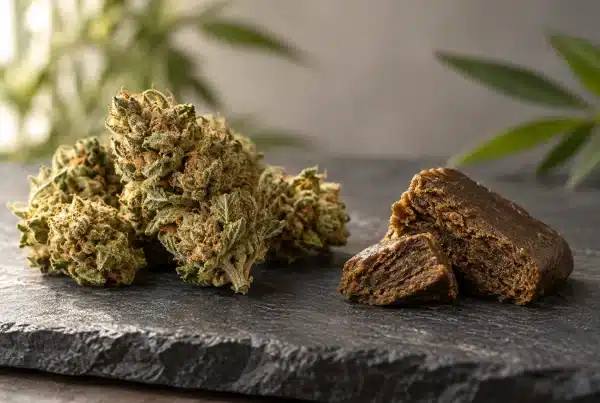
A flower, a resin, and a vape are not interchangeable products. Before comparing compositions, identify the desired format and the specific information for each item. A photograph of plant material does not show the measured concentrations; the texture of a resin does not reveal the entirety of its formula.
In our CBD flower and CBD resin, please read the individual product descriptions to learn about the advertised characteristics. The presence of a category in the catalog does not mean that every item is a cannabinoid blend. The product description will specify this.
Avoid inferring material compatibility from a mixture name. When a product has specific requirements, these must be indicated by its manufacturer. This guide focuses on reading product compositions; it does not provide assembly recipes or protocols for converting a product to another format.
Prices and promotions: keep the comparison clear
The price of a container alone is not enough to compare two offers. Also consider the net contents, the unit of measure, and the type of product. A difference in volume, weight, or presentation can explain part of the price difference. First, compare products that are similar enough to make the comparison meaningful.
A promotion may improve the purchase conditions, but it doesn't compensate for a missing product. Before adding multiple items to your cart, make sure you have the necessary information for each one. You'll save time by clarifying formula and bundle details before comparing discounts or value packs.
Your reading guide before ordering
To review a cannabinoid blend, you can follow a short and repeatable process. This doesn't guarantee the product's quality; it allows you to distinguish the available information from points that need clarification. Consider keeping the seller's answers along with the relevant product reference to avoid attributing them to a different formula later.
- Identify the manufacturer, full name and format.
- List the components mentioned without interpreting the acronyms.
- Note the individual contents and the definition of the total.
- Check the units and the material to which the figures apply.
- Link the documents to the batch and the finished product.
- Ask for the missing information before comparing offers.
If an answer remains vague, rephrase it with a single question. For example: "Does the stated percentage correspond to the finished product sold in this packaging?" You will more easily obtain clarification than by simply asking if the mixture is "good" or "strong." The more precise your question, the easier it is to get a clear answer.
A useful message to request the composition
You can write: "Hello, I am looking at reference [name and format]. Could you please specify the components of the mixture, their stated contents, and the basis for the total percentage? I would also like to know if the available report relates to the finished product and how it is linked to the sold batch. Please indicate any other ingredients or carriers present."
For a reference to The French Hemp Empire, submit your request via the contact page using the link to the relevant product page. If you have already received the product, include the batch number and a clear photograph of the label. This information will allow us to respond regarding the correct item, avoiding confusion with a similar variant.
FAQ: Understanding a cannabinoid blend
Does a cannabinoid blend always have the same formula?
No. The term refers to a mixture in commercial language, not to a universal composition. Check the full product reference, manufacturer, and applicable documentation. A similar name does not prove that two products contain the same substances in the same proportions.
Does a high percentage mean more CBD?
Only if the figure is explicitly defined as CBD content. If it describes a total of several components, you must check their breakdown. The name of the measured parameter and the unit are essential for correctly interpreting the stated value.
Is a mixture of cannabinoids identical to an aromatic profile?
No. Aromatic information and cannabinoid composition describe different aspects. A fruity or strain name does not replace a list of ingredients. Read the ingredients, concentrations, and advertised sensory characteristics separately.
Can two mixtures be compared using only their totals?
The total alone is not enough. Two preparations can show the same total with different proportions. Also check the calculation method, the format, and the identity of the substances. This document comparison alone cannot predict equivalent effects.
Does a certificate of analysis cover all substances?
Not necessarily. Consult the list of parameters actually tested for and the indicated limits. A substance not listed in the table has not automatically been tested. Also ask how the analyzed sample compares to the marketed reference and batch.
What if the formula of a cannabinoid blend remains unclear?
Request the names of the components, their contents, and any documentation related to the finished product. If this information remains unavailable, consider this limitation in your decision. Do not assign a composition to a product based solely on comments or a similar-sounding name.
Choose a composition you understand
A cannabinoid blend becomes easier to compare when its identity, units, and documentation are clearly linked. You can then distinguish a brand name from a substance, a total percentage from an individual concentration, and an ingredient from a finished product. This method provides you with concrete reference points for your future research.
Before placing your order, prioritize verifiable information and ask questions that are truly relevant to the product you've chosen. A clear explanation helps you understand the offer; a well-documented response allows you to appreciate its limitations. This way, you can make an informed decision based on available information, rather than relying on a single figure or a promise of intensity.
Products intended for adult use only. Follow the label instructions. The resins shown are not food-grade; this guide does not recommend any food use. Do not drive or operate dangerous machinery after use.