Cannabinol (CBN) is a minor cannabinoid formed by the oxidation of tetrahydrocannabinol (THC); it is not synthesized directly by the plant, but results from its degradation under the influence of heat, light, and air. Three key points to remember from the outset:
- Chemical origin : CBN is a degradation product of Δ9-THC, found mainly in aged or poorly preserved hemp.
- Non-psychotropic in authorized varieties : at concentrations conforming to the European threshold, CBN does not cause an intoxicating effect.
- Interest in sleep, limited evidence : commercial claims far exceed what human clinical literature allows us to assert at this stage.
Key points
CBN is a minor cannabinoid derived from the breakdown of THC, whose interest in sleep is based on promising preclinical data but still insufficient human evidence to justify therapeutic claims.
| Point | Details |
|---|---|
| Definition of CBN | Minor cannabinoid formed by oxidation of THC, found mainly in aged hemp. |
| Evidence about sleep | One trial (N = 1,793) shows a benefit of CBD alone; the addition of CBN did not significantly improve the results. |
| Security and consultation | 12% of participants reported a non-serious adverse effect; consult a doctor if taking medication. |
| Shopping checklist | Require an independent COA, verify THC ≤ 0.3%, EU varietal origin and batch traceability. |
| Thefrenchhempempire | Offers flowers, resins, oils and vapes compliant with COA accessible by batch number. |
Table of Contents
- What is CBN and how is it formed in hemp?
- CBN, CBD and THC: what are the concrete differences?
- What do studies say about sleep and relaxation?
- What are the side effects and interactions to be aware of?
- How to choose a CBN product that complies with French regulations?
- How to use CBN responsibly?
- Thefrenchhempempire: CBN/CBD products compliant with accessible COA
- Transparency and prudence: why these two requirements are inseparable
- Sources
What is CBN and how is it formed in hemp?
CBN is not present in significant quantities in young hemp plants. Its concentration gradually increases as the plant ages or when the flowers are exposed to air, heat, or ultraviolet light, which degrade THC into cannabinol. Prolonged storage at room temperature is sufficient to accelerate this process.
In terms of formulation, three terms frequently appear. An isolate contains a single cannabinoid (CBN or CBD) without any other plant compounds. A broad-spectrum retains several cannabinoids but eliminates detectable THC. A full-spectrum includes all the cannabinoids present in the plant, including traces of THC, which necessitates rigorous verification of the residual level to remain within legal limits.
CBN, CBD and THC: what are the concrete differences?
The three cannabinoids share the same host plant but differ on points that are crucial for the consumer.
| Cannabinoid | Expected effect | Psychotropic effects / intoxication | Natural presence | Legal status in France/EU |
|---|---|---|---|---|
| THC | Euphoria, cognitive impairment | Yes | Raised on recreational cannabis | Prohibited above 0.3% residual THC |
| CBD | Relaxation, general well-being | No | Grown using permitted hemp varieties | Legal if ≤ 0.3% THC, EU catalogue varieties |
| CBN | Sedation is possible (preclinical data) | No to the prescribed doses | Low, increases with age | Legal if derived from authorized varieties, ≤ 0.3% THC |
From a pharmacological perspective, CBD primarily interacts with serotonergic receptors and indirectly modulates the endocannabinoid system. CBN exhibits partial affinity for CB1 receptors, which could explain its sedative effects observed in preclinical studies, but the precise mechanisms in humans remain poorly understood. THC, on the other hand, is a potent CB1 agonist, responsible for its psychoactive effects.
From a regulatory standpoint, CBN and other minor cannabinoids are not included on the French list of narcotics as long as they come from varieties listed in the European Common Catalogue and the residual THC level remains at or below 0.3%. Extracts intended for food are also subject to the Novel Food Regulation and controls by the DGAL (Directorate General for Food). To delve deeper into the distinctions between these molecules, the article "CBN, CBD, and CBG" by Thefrenchhempempire details the uses and profiles of each cannabinoid.
What do studies say about sleep and relaxation?
CBN's reputation for being soporific far precedes the clinical data that would support it. Two scientific sources allow us to honestly frame the current state of knowledge.
In animal studies, research published in Neuropsychopharmacology showed that CBN increases total sleep time (NREM and REM phases) in rats. The study also identified the metabolite 11-OH-CBN as pharmacologically active, with partial affinity for CB1 receptors, which opens up an interesting mechanistic hypothesis. However, these results remain preclinical: their applicability to humans has not yet been established.
In humans, the most rigorous trial available to date is a randomized, double-blind, controlled trial involving 1,793 adults. However, adding 15 mg of CBN to a CBD base did not show any statistically significant improvement compared to CBD alone. The same lack of difference was observed for formulations combining CBD and melatonin.
Key data: In this trial (N = 1,793), a notable proportion of participants reported a clinically important improvement in sleep according to the formulation received; the addition of CBN did not significantly alter this result.
The methodological limitations are real: studies specific to CBN alone in humans are rare, dosages vary from one study to another, and most measurements are based on subjective self-assessments rather than objective polysomnographic recordings.
What are the side effects and interactions to be aware of?
Warning: The following information is general in nature. Anyone undergoing medical treatment, pregnant, breastfeeding, or suffering from a chronic illness should consult a doctor before using a product containing CBN.
Adverse effects reported in the available literature are mostly non-severe. In the cited randomized trial, 12% of participants reported a non-serious adverse event. The most frequently mentioned effects in preclinical data and usage reports include:
- Residual drowsiness upon waking, especially at high doses.
- Dry mouth, similar to that observed with CBD.
- Possible metabolic interactions via cytochrome P450 enzymes (CYP3A4, CYP2C9), which metabolize many common drugs.
Drug interactions warrant particular attention. Combinations to monitor most closely include drugs metabolized by CYP450 (antiepileptics, warfarin-type anticoagulants, immunosuppressants), central nervous system depressants (benzodiazepines, opioids, sedating antihistamines), and high-dose melatonin. For an overview of general precautions related to concentrated cannabinoids, Thefrenchhempempire's safety guide provides practical guidance.
Pro tip: If you are taking anticoagulant medication or a drug with a narrow therapeutic index, always inform your doctor or pharmacist about the use of any cannabinoid before starting.
How to choose a CBN product that complies with French regulations?
Regulatory compliance and analytical quality are the two non-negotiable criteria. Here is the checklist to apply before any purchase:
- Independent and recent COA : require a certificate of analysis (COA) issued by a third-party accredited laboratory, with a batch number corresponding to the product purchased.
- Residual THC level ≤ 0.3% : check the "total THC" column in the COA, not just CBD or CBN.
- Varietal origin : the hemp must come from a variety listed in the European common catalogue.
- Contaminants : the COA must cover residual solvents, heavy metals and pesticides.
- Extraction method and batch traceability : production date, batch number and extraction method (supercritical CO₂, ethanol) must be indicated.
- Dosage clearly stated : the quantity of CBN per dose or per millilitre must be shown on the label and correspond to the COA.
Regarding product forms: sublingual oils offer relatively predictable absorption (15 to 45 minutes); vapes act more quickly but expose the respiratory tract; flowers and resins require specific preparation and careful attention to the method of consumption. Full-spectrum CBD resins may contain traces of naturally occurring CBN, depending on the age of the raw material.
Pro tip: Store your CBN/CBD products in an airtight container, away from light and at a temperature below 25°C. Prolonged exposure to heat and air accelerates the oxidation of residual THC into additional CBN, which can alter the product's cannabinoid profile over time.
How to use CBN responsibly?
A structured two-week trial allows for the evaluation of the real effect of a CBN product without taking unnecessary risks.
- Start with the minimum dose indicated on the label, usually 5 to 10 mg of CBN, and maintain this dose for at least five days before any increase.
- Choosing the right timing : for targeted use on sleep, taking sublingual oils 30 to 90 minutes before bedtime is generally recommended; vapes take effect in 5 to 15 minutes, allowing for later use.
- Avoid alcohol and CNS depressants on the evening of taking the medication, due to the risk of sedative potentiation.
- Keep a simple tracking diary : note each night the time taken, the dose, the estimated time to fall asleep, the perceived quality of sleep (out of 10) and any adverse effects felt upon waking.
- Space out the doses : avoid systematic daily intake without prior assessment of the effects over at least seven days.
- Regarding melatonin : the available randomized trial did not demonstrate any additional benefit of the CBD/CBN/melatonin combination compared to CBD alone. The combination remains possible but should be discussed with a healthcare professional, as there is a lack of robust evidence of a beneficial interaction.
Thefrenchhempempire: CBN/CBD products compliant with accessible COA
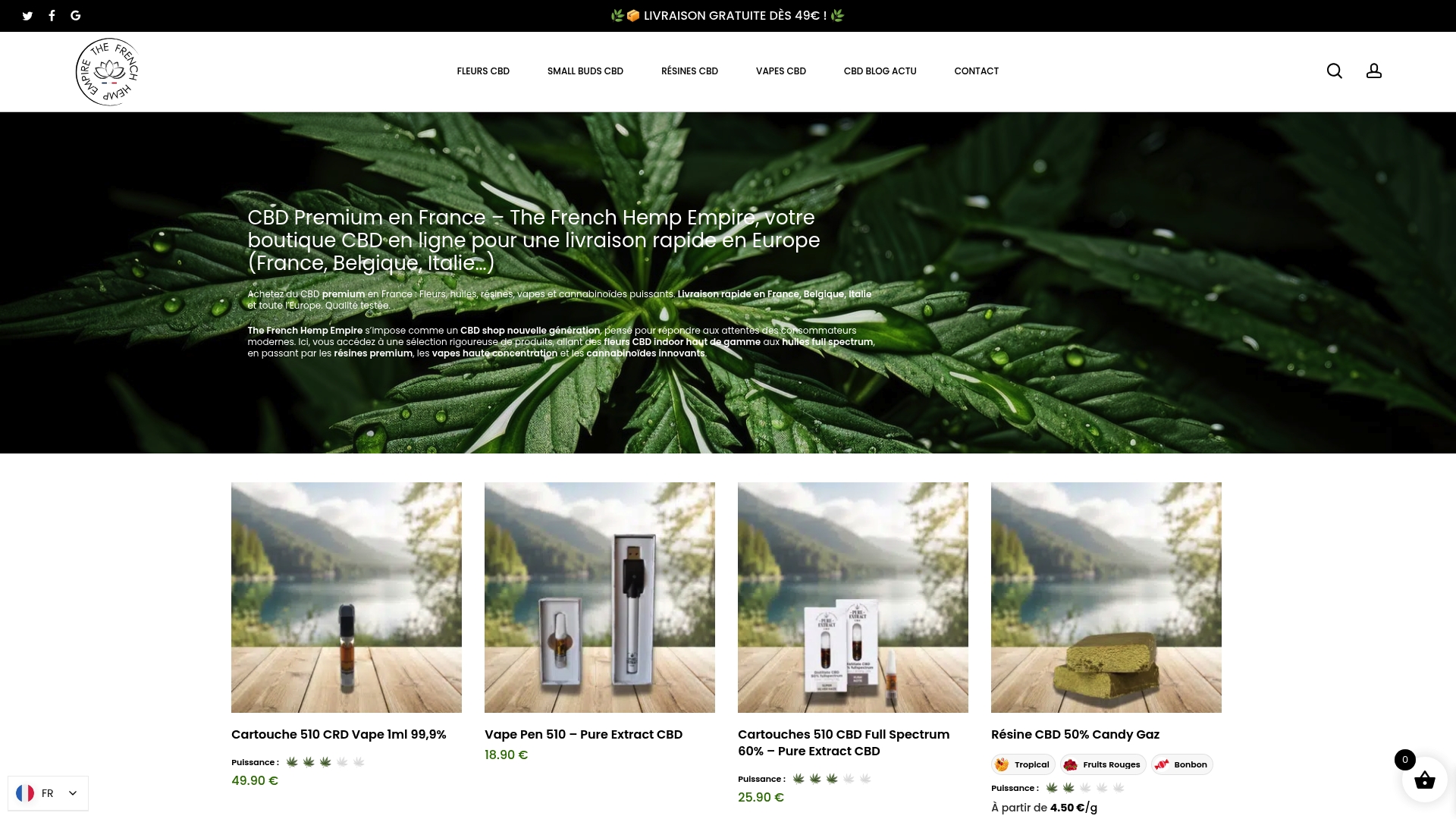
Each product comes with a Certificate of Analysis (COA) issued by an independent laboratory, verifiable by batch number. The analyzed parameters cover CBD and CBN levels, total THC, residual solvents, and heavy metals, in accordance with traceability requirements applicable in France and the European Union. For consumers wishing to explore the available forms, the premium CBD flower page and the selection of CBN and CBG cannabinoids provide a practical starting point. Consult the product sheets and COAs directly on Thefrenchhempempire to verify compliance before making a purchase.
Transparency and prudence: why these two requirements are inseparable
CBN illustrates a tension frequently encountered in the cannabinoid sector: commercial interest precedes clinical evidence, and marketing claims tend to present preclinical data as therapeutic certainties. This trend is not insignificant. A consumer who buys a CBN product believing they are getting a clinically validated sleep aid is making a decision based on inaccurate information.
Prioritizing analytical transparency, particularly through verifiable third-party Certificates of Analysis (COAs), is not just another marketing ploy; it is the minimum requirement for consumers to be able to assess what they are actually buying. No therapeutic claim not supported by robust clinical trials should appear on a CBN product sold in France. The available data warrants caution and interest, but not certainty.
Sources
- The Safety and Comparative Effectiveness of Non-Psychoactive Cannabinoid Formulations for the Improvement of Sleep: A Double-Blinded, Randomized Controlled Trial
- Minor cannabinoids CBN and CBG: the new wave that will take hold in 2026
This article provides general information and is not a substitute for professional medical advice. Consult a qualified healthcare professional about your specific situation before taking any action based on this content.