In France, CBD products sold at retail are reserved for adults, meaning people aged 18 and over. This restriction does not stem from a single, explicit law, but rather from a combination of obligations arising from the Public Health Code, recommendations from the MILDECA ) and the National Agency for the Safety of Medicines and Health Products (ANSM), in addition to the contractual requirements of carriers and payment processors.
Three practical elements confirm this restriction in everyday commerce:
- Age verification requirement : sellers, both in-store and online, are required to ensure that the buyer is of legal age before any transaction.
- The phrase "for adults only" : this indication appears on the packaging and product pages of responsible operators, in accordance with industry practices.
- Verifiable product conformity : each product must be accompanied by a Certificate of Analysis (COA) issued by an independent laboratory, attesting to a THC level of less than or equal to 0.3% and an authorized varietal origin.
Unlike THC, CBD does not cause addiction in the pharmacological sense. Its sale is tolerated under strict conditions: authorized hemp varieties, THC levels ≤ 0.3%, and no medical claims. These conditions do not, however, eliminate the age restrictions applicable to retail sales.
Key points
In France, all CBD products sold at retail are reserved for adults (18+), subject to a THC level ≤ 0.3% and must be accompanied by a certificate of analysis from an independent laboratory to be considered compliant.
| Point | Details |
|---|---|
| Legal age for purchase | The retail sale of CBD is restricted to people aged 18 and over in France. |
| Product conformity criteria | The THC level must be less than or equal to 0.3% on the whole plant, with an authorized variety and a dated COA. |
| Seller's obligation | Every operator must implement an age gate, verify identity and archive COAs by batch number. |
| Consumer alert signal | The absence of an accessible COA, varietal origin, or the presence of medical claims indicates a product at risk. |
| Thefrenchhempempire | Offers CBD products with independent laboratory COA, THC level ≤ 0.3% and age verification upon purchase. |
Table of Contents
- What French and European legal framework applies to CBD?
- Which CBD products are generally reserved for adults?
- What obligations are imposed on sellers in stores and online?
- How can I check that a CBD product is compliant before buying it?
- What are the risks in case of non-compliance or sale to a minor?
- Who should avoid CBD and when should you consult a healthcare professional?
- How Thefrenchhempempire applies the "adults only" rule
- Why restricting CBD to adults protects both consumers and the market
- Thefrenchhempempire: compliant, traceable CBD products reserved for adults
- Sources
What French and European legal framework applies to CBD?
CBD (cannabidiol) is a cannabinoid found in hemp (Cannabis sativa L.). Unlike THC (tetrahydrocannabinol), it is not classified as a narcotic when regulatory conditions are met. In December 2023, the MILDECA (Interministerial Mission for the Fight against Drugs and Addictive Behaviors) published a report detailing the applicable exemption conditions: use of varieties listed in the European catalogue, THC content measured in the whole plant of 0.3% or less, and documented traceability of the production chain.
To further explore the distinction between the two molecules, Thefrenchhempempire's CBD vs THC resource details the differences in effects, legal status, and points of caution.
The applicable reference texts in France are as follows:
- Public Health Code (articles L. 5132-1 et seq.): defines narcotic substances and the conditions of exemption for industrial hemp.
- Order of December 30, 2021 : sets the conditions for the production, processing and marketing of hemp flowers and leaves, including the prohibition of sale in smokable form in certain administrative interpretations, partially challenged by case law.
- Case law decisions : the Court of Cassation issued important decisions in 2023 clarifying the limits of the ban on the sale of CBD flowers, in line with the rulings of the Court of Justice of the European Union (CJEU) on the free movement of products legally manufactured in a Member State.
The key criterion for compliance remains a THC level ≤ 0.3% measured in the whole plant, combined with the use of authorized varieties. A product meeting these two conditions is not considered a narcotic under French law.
The regulatory framework is still evolving. The Senate examined amendments relating to CBD in 2025-2026, illustrating that the regulations may still change. Operators should therefore regularly monitor publications from the ANSM (French National Agency for Medicines and Health Products Safety) and the MILDECA (Interministerial Mission for the Fight against Drugs and Addictive Behaviors).
Pro tip: Consult the official register of authorized hemp varieties published by the Ministry of Agriculture before putting any new product on the market. An unregistered variety renders the product non-compliant, regardless of its measured THC level.
Which CBD products are generally reserved for adults?
The age restriction varies depending on the product format and method of consumption. The types of CBD legal in Europe cover a broad spectrum, and not all are subject to the same levels of regulation.
Products systematically treated as intended for adults only:
- CBD flowers and resins : their visual and olfactory resemblance to recreational cannabis justifies strict age controls. Local businesses publicly state that their hemp products are reserved for adults, illustrating a now widespread commercial practice.
- Edibles (gummies, sweets) : the regional press has documented the production of CBD sweets explicitly reserved for adults, notably because of their attractive format for minors.
- CBD e-liquids and vapes : subject to the same restrictions as vaping products in general; sale to minors is prohibited by the Public Health Code.
- CBD oils and extracts : marketed as food supplements or wellness products, they fall under the European regulation on novel foods and are intended for adults.
Special cases and exceptions:
- Topical cosmetics (creams, balms, massage oils): skin application does not generate significant systemic absorption of CBD. These products fall under European cosmetic regulations (EC Regulation No. 1223/2009) and are not subject to the same age restrictions, although some vendors maintain a policy of selling to adults as a precaution.
- food supplements : their status depends on the Novel Food authorization currently under review by the EFSA. In the absence of final authorization, their marketing remains in a regulatory uncertainty.
Product warning signs to identify:
- No accessible COA or COA undated and without batch reference.
- Origin of the variety not mentioned or not verifiable.
- Medical claims such as "treats anxiety", "cures insomnia": strictly prohibited.
- Abnormally low prices without any justification for quality. Risks associated with cheap CBD products include non-compliant THC levels and undetected contaminants.
What obligations are imposed on sellers in stores and online?
A CBD seller's compliance rests on several levels of obligations, some legal and others contractual. Online sales of CBD are possible but regulated: they require adherence to rules regarding THC levels, the absence of medical claims, and compliance with the conditions of payment methods and shipping carriers.
In physical store
- Clearly display the words "reserved for adults" at the entrance and on the display stands.
- Always check an identity document if there is any doubt about the customer's age.
- Train staff on product compliance criteria and sales refusal procedures.
- Keep the COAs for each batch in the shop, accessible in case of DGCCRF inspection.
In e-commerce: recommended workflow
- Age gate at the entrance to the site : declaration of majority required before any access to the catalogue.
- Capture of date of birth during account creation or checkout.
- Document verification for high-risk orders (high amount, first order, unusual delivery address).
- Adult signature upon delivery : require delivery against signature with identity verification by the carrier.
- Archiving evidence : retain age validation logs and signed delivery confirmations.
Since 2024, DGCCRF controls have become stricter, and payment processors like Stripe and Mollie require users to implement a documented age verification system before accessing their services. A purely self-declared age gate (a simple checkbox) is considered insufficient by several logistics partners.
Documentation requirements to be provided to the consumer:
- Legible COA, dated, with batch reference and name of accredited laboratory.
- Indication of the measured THC level (numerical value, not just "compliant").
- Origin of the variety and country of production.
- Full legal notices and general terms and conditions of sale specifying the age restriction.
Pro tip: Archive each Certificate of Authenticity (COA) by batch number in a shared folder accessible to your logistics team. In the event of a DGCCRF inspection, the ability to immediately produce the COA corresponding to the batch on sale is the first criterion assessed.
How can I check that a CBD product is compliant before buying it?
An informed consumer can assess the conformity of a product in a few steps, without any particular technical expertise.
Buyer verification checklist:
- The COA is accessible directly on the product page or upon request to customer service.
- The laboratory that performed the analysis is identified by its name and, ideally, its accreditation (ISO 17025).
- The analysis date is shown on the document and corresponds to the lot for sale.
- The measured THC level is less than or equal to 0.3%, expressed as a numerical value.
- The stated CBD level corresponds to the value measured in the COA.
- The origin of the hemp variety is mentioned.
- No medical claims are made on the packaging or on the product page.
- The seller displays an explicit age verification policy.
How to read a COA: priority fields
A reliable certificate of analysis must include, at a minimum: the name and address of the laboratory, the analytical method used (HPLC or GC-MS chromatography), the date of the analysis, the batch number of the tested product, and the numerical results for THC and CBD. A certificate of analysis without a batch number cannot be used to link the analysis to the product actually sold.
Practical online checks:
Before buying, check the website's legal notices, verify the presence of a working age gate, read the terms and conditions to confirm the restriction to adults, and ensure the return policy is clearly stated. The absence of complete legal notices is a serious red flag.
Pro tip: Keep your order confirmation and the Certificate of Analysis (COA) for the batch you received. In case of inspection or dispute, these two documents constitute your legal proof of purchase.
What are the risks in case of non-compliance or sale to a minor?
The risks for a non-compliant seller are threefold: administrative, commercial and criminal.
Risks for the seller:
- Administrative sanctions : the DGCCRF (French Directorate General for Competition Policy, Consumer Affairs and Fraud Control) can issue compliance orders, administrative fines, and order the withdrawal of products from the market. Controls have intensified since 2024, particularly regarding online age verification systems.
- Commercial sanctions : Marketplaces may suspend or close a seller's account. Payment processors (Stripe, Mollie) may terminate the processing contract if contractual age verification obligations are not met.
- Criminal risks : If a product contains a THC level exceeding 0.3%, it falls under the category of narcotics. Its sale then becomes subject to criminal prosecution under the Public Health Code, regardless of the seller's intent.
- Selling to a minor : constitutes a specific offense that may increase penalties, especially if the product is considered a psychoactive substance.
Consequences for the buyer:
Possession of a product with a THC content exceeding the legal limit exposes the buyer to prosecution for drug possession, even if the product was presented as CBD. Good faith is not an absolute defense under French criminal law.
Contacts for reporting:
- DGCCRF : to report a misleading commercial practice or a non-compliant product (SignalConso platform).
- Local ARS (Regional Health Agency) : for questions relating to the health safety of products.
- Police or gendarmerie : in the event of a sale to a minor being observed or of a product exhibiting characteristics of a narcotic.
Retaining evidence (COA, invoices, screenshots of the product page) is crucial in the event of an audit or dispute.
Who should avoid CBD and when should you consult a healthcare professional?
CBD is not a medicine in the regulatory sense of the term, except in the case of the pharmaceutical product Epidyolex®, which is authorized for certain forms of severe epilepsy. For non-medical wellness products, AMELI recommends precautions for use for several population groups.
Groups for which non-medical CBD is not recommended:
- Pregnant and breastfeeding women : data on transplacental passage and passage into breast milk remain insufficient to rule out a risk.
- Children and adolescents : the lack of long-term safety studies on pediatric populations justifies a general contraindication.
- People taking anticoagulants (warfarin, heparin): CBD may inhibit certain liver enzymes of cytochrome P450, altering the metabolism of these drugs.
- People taking anticonvulsants : pharmacokinetic interactions have been documented, particularly with clobazam.
- Individuals with a history of psychiatric disorders : caution is advised due to a lack of sufficient data on long-term effects.
For anyone taking regular medication, prior medical consultation is necessary before using any CBD product, even non-medical.
For reliable health information on cannabidiol, consult the information sheet from the French National Health Insurance (AMELI) and the publications of the ANSM (French National Agency for Medicines and Health Products Safety). These two official sources are regularly updated and are the reference for consumers in France.
How Thefrenchhempempire applies the "adults only" rule
Compliance for an e-commerce operator specializing in CBD relies on a structured process, from the selection of raw materials to delivery. Here are the steps implemented by Thefrenchhempempire:
- Varietal selection : only varieties listed in the authorized European catalogue are supplied, with documentation of origin and supplier.
- Independent laboratory analysis : each batch is subject to a COA carried out by an accredited laboratory, attesting to the THC level ≤ 0.3% and the complete cannabinoid profile.
- Compliant labeling : each product displays the statement "for adults only", the measured THC level, the origin of the variety and the batch number allowing the corresponding COA to be found.
- Age gate at the site entrance : a declaration of majority is required before any access to the catalogue, in accordance with sector recommendations.
- Order preparation : COAs are associated with shipped batches and are accessible upon request from customer service.
- Control upon delivery : delivery options with adult signature are offered for orders of age-restricted products.
Elements visible to the consumer on each product page:
- Direct link to the COA of the lot currently being sold.
- Display of the measured THC level (numerical value).
- Mention of the origin of the variety and the country of production.
- Batch number allowing for complete traceability.
- The phrase "for adults only" is visible without scrolling.
A complete Certificate of Analysis (COA) includes: the name of the accredited laboratory, the analysis method (HPLC or GC-MS), the date of analysis, the product batch number, and the numerical results for total THC, total CBD, and the main minor cannabinoids. For any questions regarding product compliance or COA interpretation, Thefrenchhempempire's customer service is available through the website's contact page.
Why restricting CBD to adults protects both consumers and the market
The age restriction applied to CBD products is not an arbitrary constraint. It reflects a logic of shared responsibility between regulators, operators, and consumers, the beneficial effects of which go beyond mere legal compliance.
Markets with rigorous age verification more easily maintain legal access to products for adults. Conversely, scandals involving sales to minors or non-compliant products have consistently triggered restrictive regulatory responses, to the detriment of the entire sector. Transparency regarding the Certificate of Authenticity (COA), origin, and THC content is not merely a legal requirement; it is the mechanism that empowers responsible adults to make informed choices.
An often underestimated point concerns low-priced products lacking traceability. A product sold without an accessible Certificate of Authenticity (COA) is not only a legal risk for the seller but also a real health risk for the buyer, who cannot verify what they are consuming. The legal compliance of CBD in France relies precisely on this documented chain of evidence.
Thefrenchhempempire: compliant, traceable CBD products reserved for adults
Thefrenchhempempire offers a range of premium CBD flowers, legal CBD resins, and CBD vapes selected for their strict regulatory compliance: THC content ≤ 0.3%, authorized varieties, and a Certificate of Analysis (COA) from an independent laboratory available for each batch. All orders are reserved for adults, with a functional age gate and a delivery option requiring a signature.
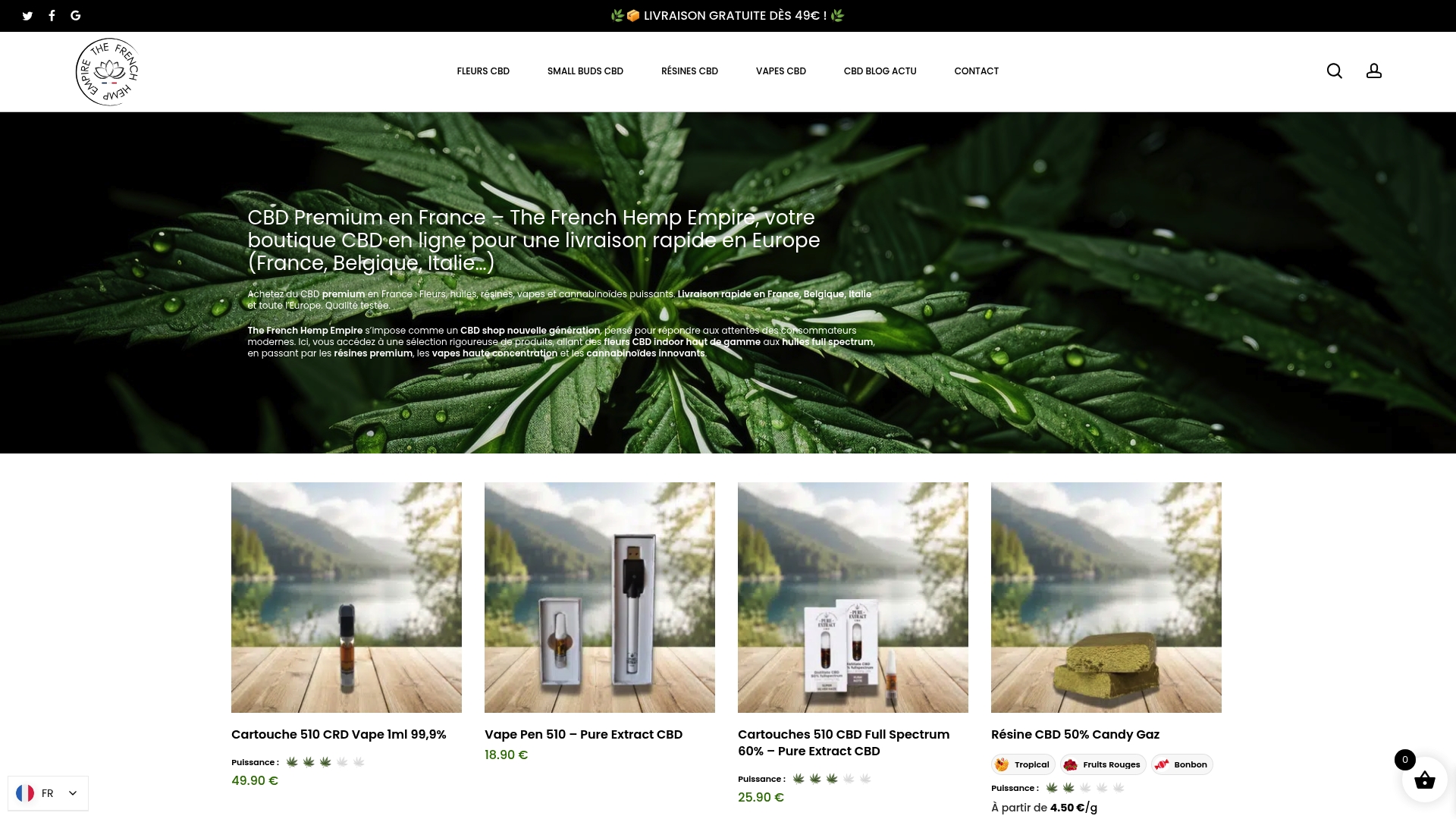
For buyers who want a fully traceable product without having to check each document themselves, Thefrenchhempempire centralizes proof of conformity on each product page. Certificates of Authenticity (COAs) are available upon request from customer service for any specific regulatory questions. Visit the shop to access available products and verify the conformity of each batch before ordering.
Sources
The following resources constitute the primary references for any regulatory verification in France:
- MILDECA | CBD
- AMELI — Non-medical cannabidiol (CBD): definition and precautions for use
- France 3 / Franceinfo — "It's reserved for adults and healthy people…"
This article provides general information for educational purposes. It does not constitute legal, medical, or regulatory advice. For any specific situation, consult a healthcare professional or a specialized lawyer, and verify the applicable regulations with the official sources cited.
This article provides general information and is not a substitute for legal advice. Consult a qualified legal professional regarding your specific situation before taking any action based on this content.