An adult in France can consume CBD responsibly, provided they adhere to three non-negotiable rules: a THC content of 0.3% or less in the product, verifiable traceability via a Certificate of Analysis (COA) issued by an independent laboratory, and the absence of any medical claims from the seller. Furthermore, they must not exceed 50 mg of CBD per day, as recommended by medical professionals for food supplements (medical supervision is advised for prolonged use). Public Health France reports that, according to its 2022 barometer, approximately 1 in 10 French people consumed CBD during the year, with particularly high usage among 18-34 year olds. This level of consumption makes clear information on precautions all the more necessary.
Three immediate actions before any purchase or use:
- Check for the presence of a recent COA (dated, signed, with THC, CBD and contaminant results) on the product sheet or upon request to the seller.
- Avoid driving for at least 12 hours after consumption if drowsy, as saliva tests detect the presence of THC regardless of the legal threshold.
- Consult a doctor or pharmacist if you are taking any medication, including anticoagulants, antiepileptics, or immunosuppressants.
Pro tip: Favor sellers who publish their Certificates of Analysis (COA) online, batch by batch, and who indicate the accredited laboratory that performed the analyses. Purchasing from a pharmacy or a transparent distributor significantly reduces the risk of adulteration, according to recommendations from French authorities.
Key points
Legal and safe CBD consumption in France relies on systematic verification of the COA, compliance with the THC threshold of 0.3%, and adjusting the dosage according to the "start low, go slow" method.
| Point | Details |
|---|---|
| Legal threshold for THC | The product must contain ≤ 0.3% THC, confirmed by a COA from an accredited laboratory. |
| Starting dosage | The Academy of Medicine recommends not exceeding 50 mg/day; start at 0.25 mg/kg per dose. Medical supervision is recommended in case of prolonged use. |
| Drug interactions | Anticoagulants, antiepileptics and immunosuppressants require medical advice before use. |
| Driving and saliva tests | Roadside checks detect the presence of THC; avoid driving for at least 12 hours after consumption. |
| populations at risk | Pregnant women, people with liver failure, minors and people undergoing treatments with a narrow therapeutic index. |
| Thefrenchhempempire | Offers CBD products with COA per batch, THC level ≤ 0.3% and independent analyses available for purchase. |
Table of Contents
- #1. What risks and drug interactions should you be aware of before using CBD?
- ## 2. What is the legal framework for CBD in France: is it permitted or prohibited?
- #3. Which forms of CBD should you choose depending on your use?
- #4. How to check the quality and traceability of a CBD product before buying?
- ## 5. What are the safe starting dosages?
- #6. Driving and traffic stops: what you actually risk
- #7. Who should avoid CBD and what warning signs should be watched for?
- ## 8. French expert guidelines for a secure start
- What we stand for: rigorous information and sales without medical promises
- Thefrenchhempempire: compliant, traceable, and analyzed CBD products
- Sources
#1. What risks and drug interactions should you be aware of before using CBD?
CBD is generally well tolerated (according to the WHO), but this tolerance does not mean the absence of adverse effects. The most frequent are drowsiness, fatigue, digestive problems (nausea, diarrhea), and, in cases of prolonged use at high doses, an elevation of liver enzymes. Neuropsychiatric reactions, including hallucinations or episodes of agitation, have been reported in cases of adulteration with synthetic cannabinoids.
ANSES Alert 2024: Since 2024, ANSEShas observed an increase in poisonings linked to CBD products containing synthetic cannabinoids or THC levels exceeding declared thresholds, with symptoms ranging from severe drowsiness to seizures. A product that causes intense sedation or unusual dizziness should be considered suspicious.
Drug interactions are the most underestimated risk. CBD is metabolized by cytochrome P450 enzymes (CYP3A4, CYP2C19), which are also involved in the metabolism of many common medications. Clinically significant interactions primarily involve:
- Anticoagulants warfarin , rivaroxaban): CBD may increase their plasma concentration and increase the risk of bleeding.
- Antiepileptics (valproate, clobazam): documented interactions exist, including an increase in plasma levels of certain antiepileptics .
- Immunosuppressants cyclosporine , tacrolimus): risk of alteration of therapeutic concentrations.
- Benzodiazepines and hypnotics : potentiation of the sedative effect.
In the event of serious adverse effects after consumption, the official reporting portal allows the event to be reported to the French health authorities, a useful step to contribute to national surveillance.
## 2. What is the legal framework for CBD in France: is it permitted or prohibited?
The legality of CBD in France is based on a set of precise rules, and failure to comply can result in penalties. The central criterion is the THC threshold, set at 0.3% in the finished product, in accordance with French and European regulations. Above this threshold, the product is considered a narcotic.
The parts of the plant authorized for extraction and marketing are the fibers and the seeds. The status of raw flowers and leaves remains special: their sale is strictly regulated, and French case law, although influenced by the European Kanavape ruling and the decisions of the Council of State, has not eliminated all the ambiguities regarding their marketing in their current state.
Key points to remember:
- Food products containing CBD are classified as "novel food" under European Regulation (EU) 2015/2283. No general EFSA authorization is currently in force for their marketing, which makes their sale in France legally uncertain.
- Synthetic cannabinoids ( HHC, THCP, etc.) have been banned in France since the 2023 decrees.
- Sellers are required to provide full traceability: authorized hemp variety (European list), plant origin, extraction method and COA per batch.
Pro tip: On the label of a compliant CBD product, you should find: the CBD concentration (mg/ml or %), the THC level (≤ 0.3%), the batch number, the manufacturing date, and the manufacturer's contact information. The absence of any of these elements is a red flag. For more information on the legal framework, the reference page on the definition and legality of CBD details the applicable regulations.
#3. Which forms of CBD should you choose depending on your use?
The forms available on the French market meet different objectives and risk profiles. Understanding these differences allows you to tailor your choice to both the desired effect and compliance requirements.
- Sublingual oils: rapid absorption through the oral mucosa (15–45 minutes), precise dosing in drops, the most documented form for oral use. Preferred for stress or sleep management. For daily use, broad-spectrum oils offer a complete cannabinoid profile with no detectable residual THC.
- Capsules: slower digestive absorption (1–2 hours), standardized dosage, convenient for regular use. Less suitable for occasional needs.
- E-liquids and vapes: effect is almost immediate (within minutes), but there are specific risks related to the quality of the vaporization devices. Avoid using products from unverified sources.
- Cosmetics (creams, balms): topical use, without significant systemic absorption, therefore without notable drug interactions. Suitable for skin health.
- Resins: concentrated, often used for inhalation or infusion. Their legal status depends on the THC content and batch traceability. To understand the differences between cannabinoids (CBD, CBG, CBN), a comparative guide to cannabinoids can help avoid confusion.
Regarding raw flowers, their sale remains subject to national restrictions despite European case law that favors their free movement. The buyer must ensure that the seller complies with the applicable legal requirements.
Pro tip: Avoid vaping CBD products whose exact composition is not certified by a recent Certificate of Authenticity (COA). Solvent residues or the presence of synthetic cannabinoids in uncontrolled cartridges represent a health risk documented by ANSES (French Agency for Food, Environmental and Occupational Health & Safety).
#4. How to check the quality and traceability of a CBD product before buying?
A Certificate of Analysis (COA) is the key document for assessing the conformity of a CBD product. It must be issued by an accredited laboratory, independent of the manufacturer, and correspond to the batch of the product you are purchasing. The risks associated with low-cost products lacking traceability are well-documented: adulteration, actual THC levels higher than declared, and the presence of heavy metals or pesticides.
Checklist to use before any purchase:
- THC content: less than or equal to 0.3% in the finished product, confirmed by the COA.
- CBD content: corresponds to the concentration stated on the label.
- Contaminants: results for pesticides, heavy metals, residual solvents and mycotoxins.
- Analysis date: less than 12 months for products in stock.
- Batch number: must exactly match the batch of the product received.
- Laboratory: accredited (ISO 17025 standard or equivalent), identifiable and contactable.
- Origin of the plant: variety of hemp appearing on the European list of authorized varieties.
French authorities emphasize the risks associated with buying online without prior verification, and recommend favouring sellers who publish their analyses transparently, batch by batch.
Pro tip: An unusually low price for a high concentration is rarely a good thing. It usually reflects cost savings on testing or extraction quality. Always ask for the Certificate of Analysis (COA) specific to the batch you receive, not a generic one from the range.
## 5. What are the safe starting dosages?
The "start low, go slow" method is the starting principle recommended by healthcare professionals for all CBD use. It consists of beginning with the lowest dose that allows an effect to be observed, then gradually increasing it in stages over several days, noting the effects felt and the times of intake.
The French National Academy of Medicine recommends not exceeding 50 mg of CBD per day for dietary supplements and advises medical supervision in case of prolonged use. For its relaxing effects, available data suggests that doses well below this limit are sufficient for most adults.
Practical calculation guidelines:
- Identify the concentration of the oil (e.g., a 10% oil contains 100 mg of CBD per ml).
- Calculate the dose per drop: a standard pipette delivers approximately 0.05 ml, or 5 mg of CBD for a 10% oil.
- Apply the starting guideline proposed by Professor Authier: 0.25 mg/kg of body weight. For a person weighing 70 kg, this represents approximately 17.5 mg per dose.
- Observe the effects for 3 to 5 days before considering an increase.
- Do not exceed 50 mg/day without medical advice.
For high-concentration uses, additional precautions apply, detailed in the guide on high-concentration CBD.
Pro tip: Keep a simple log: date, time, dose, form used, effects experienced, and duration. This record is useful for adjusting the dosage and provides a valuable basis for discussion with your doctor or pharmacist.
#6. Driving and traffic stops: what you actually risk
Saliva tests used during roadside checks in France detect the presence of THC, not its concentration. A legal CBD product containing up to 0.3% THC can therefore lead to a positive result, with the resulting criminal consequences, regardless of whether the product complied with the legal limit at the time of purchase.
Drug-related driving regulations stipulate penalties for positive THC tests: license suspension, fines, and even criminal prosecution, depending on the circumstances. Case law has confirmed that the presence of THC can lead to criminal liability while driving, even when the driver claims to have used a legal CBD product.
Practical precautions:
- Do not drive for at least 12 hours after consumption, and longer if drowsiness persists.
- Keep the COA and proof of purchase of the product, but do not consider these documents as absolute legal protection against a positive test.
- If in doubt about the residual presence of THC in a product, opt for broad spectrum formulations or CBD isolate, where the THC level is zero or undetectable.
Pro tip: The drowsiness induced by CBD, even without detectable THC, can impair driving ability. The Highway Code also penalizes driving under the influence of any substance that impairs judgment.
#7. Who should avoid CBD and what warning signs should be watched for?
Certain populations are at increased risk and should refrain from consuming CBD without prior medical advice, or even abstain from it altogether:
- Pregnant and breastfeeding women: insufficient safety data; CBD crosses the placental barrier and is excreted in breast milk.
- Liver insufficiency: CBD is metabolized by the liver; impaired liver function increases the risk of accumulation and adverse effects.
- People taking antiepileptic drugs (valproate, phenobarbital, clobazam): documented pharmacokinetic interactions, requiring biological monitoring.
- People on anticoagulants (warfarin, acenocoumarol): risk of INR changes and hemorrhagic complications.
- Immunocompromised patients undergoing treatment (cyclosporine, tacrolimus, mycophenolate): risk of alteration of therapeutic concentrations.
- Minors: no pediatric safety data for non-medical use.
Warning signs requiring immediate cessation and urgent medical attention include: rapid heartbeat, hallucinations, loss of consciousness, seizures, chest pain, or severe mental confusion. These symptoms are characteristic of intoxication from synthetic cannabinoids or a product whose actual THC content exceeds the stated levels.
Pro tip: Before starting regular CBD use, always inform your doctor or pharmacist of your intention. This takes two minutes and can prevent a serious drug interaction.
## 8. French expert guidelines for a secure start
Professor Authier, a pharmacologist, suggests a starting dose of 0.25 mg/kg of body weight per dose, emphasizing the highly individual nature of the response to CBD and the need for medical supervision for any prolonged use. This guideline, reported by Santé Magazine, is not a prescription but a reasonable starting point to limit side effects during the initiation phase.
It is recommended not to exceed 50 mg of CBD per day when self-medicating with dietary supplements, given that clinical evidence remains limited for most of the indications claimed by manufacturers. Medical supervision is advised if use becomes regular or prolonged.
From a health monitoring perspective, the increase in reports of poisoning linked to adulterated CBD products since 2024 reinforces the recommendation to purchase only from vendors who publish their Certificates of Analysis (COA) for each batch. In cases of prolonged use, an annual liver function test is advised by several practitioners, given the hepatic metabolism of CBD.
Pro tip: Tell your doctor not only your daily dose of CBD, but also the form you're using (oil, vape, capsule) and the concentration of the product. This information is essential for assessing any potential drug interactions.
What we stand for: rigorous information and sales without medical promises
The editorial policy of this website is based on a simple principle: CBD is a wellness product, not a medicine. No therapeutic claims can legally be made for it in France, and the available clinical evidence remains limited for most general consumer uses, as the WHO points out. Presenting CBD as a treatment for anxiety, pain, or insomnia would not only be inaccurate but also contrary to the regulatory obligations applicable to sellers.
Prioritizing traceability, independent testing, and legal compliance isn't just a marketing ploy; it's the bare minimum for an adult to make an informed choice. A consumer who checks the Certificate of Analysis (COA) before buying, adjusts their dosage gradually, and informs their doctor about their consumption is truly acting as a responsible adult using CBD.
Pro tip: Combine information and responsible purchasing: read the COA before ordering, compare the advertised concentration with the laboratory results, and prefer products whose batch number on the packaging matches the COA available online.
Thefrenchhempempire: compliant, traceable, and analyzed CBD products
Thefrenchhempempire offers a range of CBD products designed to meet the compliance criteria described in this guide: THC levels ≤ 0.3% verified per batch, authorized hemp varieties, analyses performed by accredited independent laboratories, and Certificates of Analysis available for each product. Whether you're looking for a broad-spectrum oil for daily oral use or premium CBD flowers that comply with French legal requirements, each product page indicates the laboratory, batch number, and analysis results.
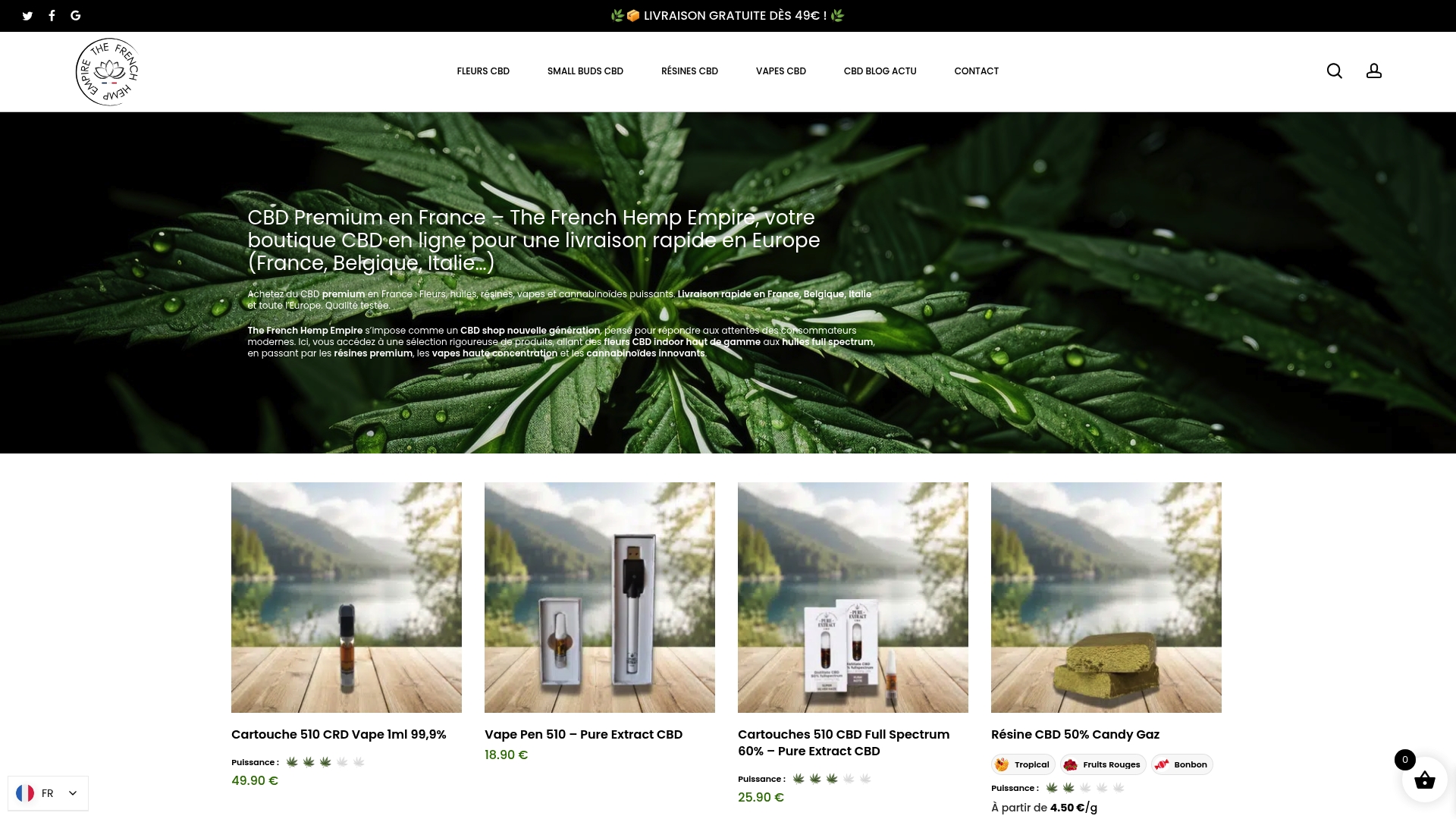
Discreet and fast delivery is available throughout Europe. For users interested in exploring legal CBD resins, the product descriptions detail the extraction method, cannabinoid concentration, and contaminant test results. Visit the shop to check product availability and access the corresponding Certificates of Analysis (COAs).
Sources
The resources below are the primary references for verifying the legality, health safety, and consumption data related to CBD in France:
- CBD (cannabidiol): benefits, risks, and what form to take? | Health Magazine
- CBD: Some recommendations for an informed and responsible approach to its consumption | Addict'AIDE Pro
- Increase in poisonings caused by CBD products containing other substances | ANSES
- Risk-related regulations — drug-impaired driving regulations | Road safety
- CBD legislation in France: What you need to know | French CBD Federation
- CBD and nitrous oxide: what are the consumption levels among adults in France? | Public Health France
- Drugs
- Reporting
Clinical studies on CBD remain limited in number and sample size for most consumer applications. If you have any concerns about an adverse effect or drug interaction, the French health authorities (ANSES, ANSM) and your doctor should be your primary contacts.
This page provides general information and is not a substitute for professional medical or legal advice. Consult a healthcare professional or a qualified lawyer for any personal situation.
This article provides general information and is not a substitute for professional medical advice. Consult a qualified healthcare professional about your specific situation before taking any action based on this content.