Does a CBD resin advertised as 50% actually contain 50% cannabidiol? It depends on the definition of the number and the batch it refers to. The label may state the measured CBD, a "total CBD" calculated from CBD and CBDA, a formulation target value, or sometimes a broader cannabinoid total. Before comparing two CBD hashes, ask for the certificate of analysis for the finished product, check the exact line, and separate the chemical concentration from the effects you might experience.
High percentages are eye-catching. Faced with two resins, one labeled at 30% and the other at 50%, you might assume the latter is necessarily better, more aromatic, and more appealing. However, the first figure may only refer to the CBD actually measured, while the second includes a theoretical conversion to CBDA. The two products may also differ in their manufacturing process, texture, the presence of added ingredients, and their price. The number is only useful if its meaning is clear.
The French Hemp Empire offers resins, some of which are labeled with 50% CBD. This guide is not an independent analysis of these products; it provides a method for interpreting the labeling and requesting documentation for the batch currently on the market. You will find simple calculations, a guide to reading certificates, information on texture, and regulatory precautions. Numerical examples are fictitious unless explicitly stated. Sources verified on September 24, 2026.
50% CBD resin: what exactly are we talking about?
If the term refers to a mass fraction of measured CBD, it means the lab found approximately 50g of CBD per 100g of the same sample, or 500mg of CBD per gram. This is a chemical reading on a defined basis. It does not mean that half of each fragment will be absorbed by your body, that all pieces of the block have exactly the same composition, or that the product has a specific effect on you.
The problem is that "50% CBD" can be used less rigorously on a product information sheet. Some documents refer to "total CBD" and include an estimate linked to the acidic form of cannabidiol, CBDA. Others indicate a "cannabinoid content" which can include several molecules. Finally, a value may be indicative, rounded, or derived from a different harvest. These presentations are not equivalent.
Look at the full wording: "measured CBD," "total CBD," "total cannabinoids," "up to 50%," and "target 50%" all answer different questions. If the information sheet doesn't provide a definition, don't fill in the blank yourself with the assumption that seems most advantageous. Ask for the calculation method and the report pertaining to the batch sold.
A resin might display a 50% concentration because a CBD extract or isolate has been added to a hemp base. Another might be produced through the mechanical processing of trichome-rich plant material. The percentage alone doesn't reveal the process. To understand the nature of the product, you also need to know the ingredients, the stated manufacturing steps, and when the sample was taken.
Percentage, mg/g and "total CBD": making the conversions without error
When a result is expressed as a mass percentage, the conversion between percentage and milligrams per gram is direct: 1% corresponds to 10 mg/g. Thus, 25% corresponds to 250 mg/g and 50% to 500 mg/g, provided that both figures use the same mass base. This operation is used to read two presentations of the same measurement; it does not verify the authenticity of the ratio.
| Display | Mass equivalent | That this does not prove |
|---|---|---|
| 10 % | 100 mg/g | The composition of other cannabinoids |
| 30 % | 300 mg/g | The aromatic profile or the effects |
| 50 % | 500 mg/g | The conformity of all substances |
| 60 % | 600 mg/g | The absence of contaminants and additives |
If the laboratory reports its results on a dry matter basis, as received, or according to another convention, comparison with a report using a different basis requires extra caution. Water content and sample preparation can affect how the numbers are presented. Check the methodological notes, rather than reducing the document to its longest line.
CBD and CBDA: two lines to distinguish
CBDA is an acidic form found in hemp. Laboratories may list it separately from CBD. To calculate a so-called "total CBD" estimate, they may use a formula of the type CBD + (0.877 × CBDA). The coefficient accounts for the difference in molecular mass during a theoretical conversion. Such an estimate does not mean that all of the CBDA will be converted under real-world product usage conditions.
Fictional example: A report shows 42% CBD and 9% CBDA. The calculation 42 + (0.877 × 9) results in 49.893%, or approximately 49.9% total CBD according to the chosen convention. The measured CBD line remains at 42%. A report rounding the total to 50% should ideally indicate that this is a calculated total, so you don't confuse it with 50% measured neutral CBD.
Also, be wary of the "total cannabinoids" formula: it may include substances other than CBD and CBDA. A resin containing 50% total cannabinoids does not necessarily contain 50% CBD. Ask which lines are added together, whether acidic compounds are converted, and how unquantified results are handled.
Is the figure quoted the price of the finished product?
A resin can go through several stages between the raw material and the sold sachet: flower sorting, mechanical separation, pressing, mixing, addition of certain ingredients, or packaging. The concentration measured at one stage does not automatically characterize all subsequent stages. A certificate issued for a concentrated extract before incorporation into a base does not prove the concentration of the final resin.
Conversely, an analysis of a final batch does not necessarily describe another batch sold under the same name. Manufacturing processes can vary between production runs, even when the commercial label remains identical. Therefore, the document date, batch identifier, and sample designation are just as important as the percentage displayed in bold.
You can ask customer service a simple question: "Does the 50% figure refer to the CBD line on the certificate for the batch currently being sold, to a calculated total CBD, or to an indicative value? Does the analysis refer to the resin ready for packaging?" A clear answer often eliminates several ambiguities at once.
In its CBD resin, The French Hemp Empire lists products whose names include "50%". This marketing presentation is useful for identifying products; it should be read in conjunction with the composition information and analyses available for each batch. This article does not attribute any laboratory results to these particular products.
Hash, resin, pollen: does the name say anything about the concentration?
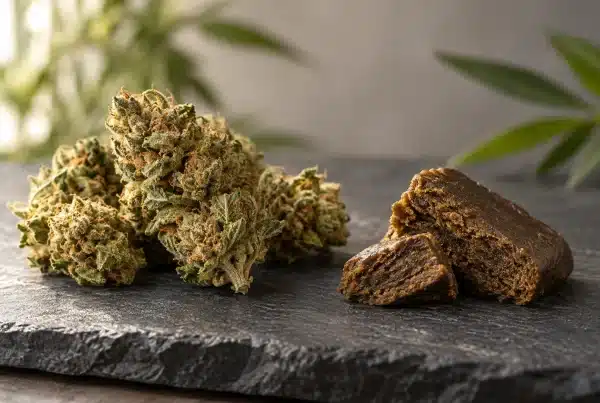
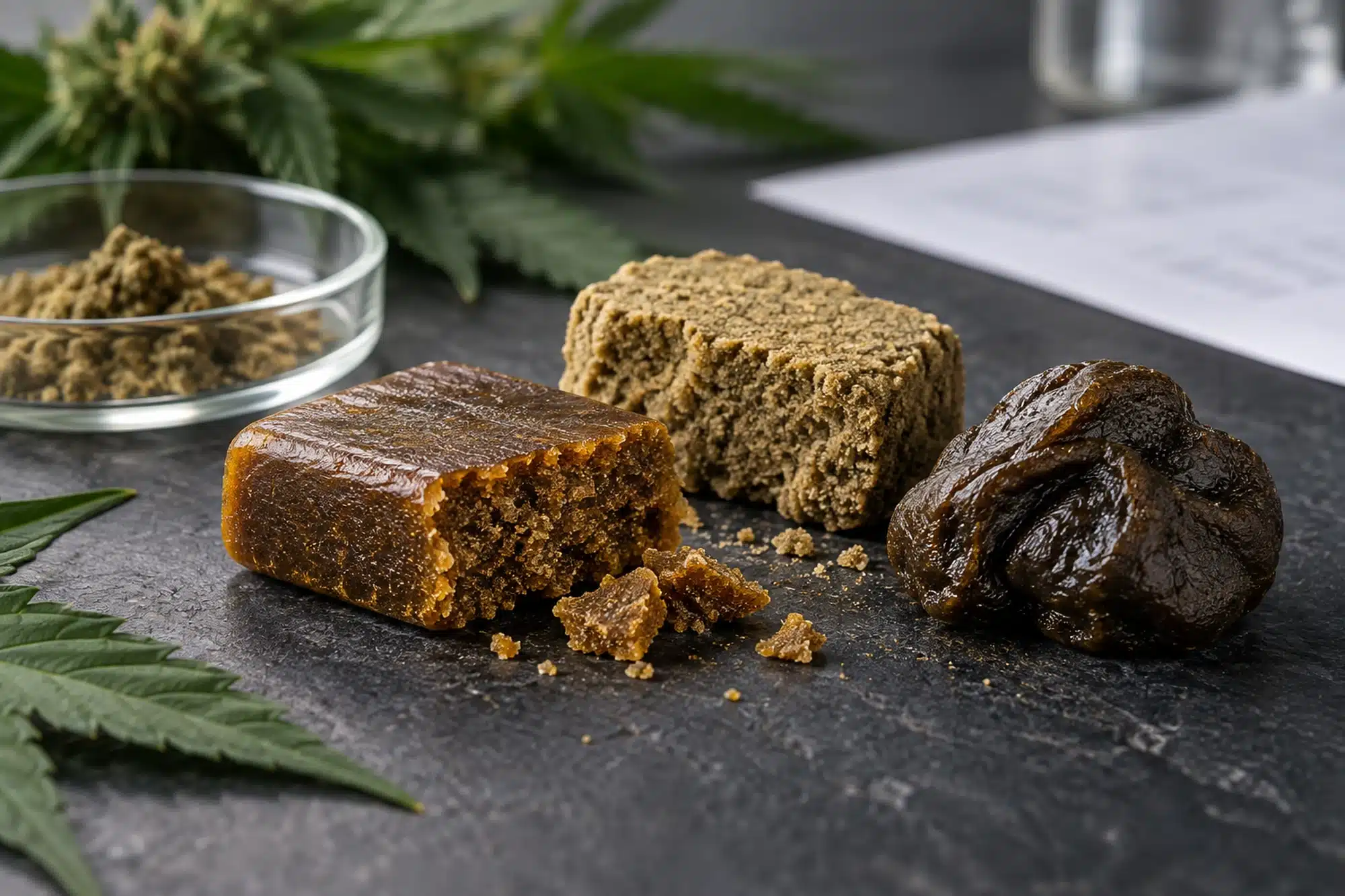
The terms "CBD hash" and "CBD resin" are often used interchangeably in commercial contexts. The word "pollen" can refer to a more powdery substance obtained by sifting, sometimes after pressing. However, these terms are not harmonized analytical categories that would allow for the determination of concentration. Two sellers may use the same term for different products.
Dry sieving mechanically separates a trichome-rich fraction from the plant material. Water and cold processes are also used to recover certain fractions, followed by drying. Other products marketed as resins rely on formulations using extracts or added ingredients. The stated process provides information on the claimed manufacturing process, but only a document specific to the finished product can quantify the cannabinoid profile of the batch.
A scientific study of cannabis resins from another region and with a different chemical profile can help explain product variability, without describing the CBD hash sold in France. For example, research published in 2024 in the Journal of Forensic Sciences separately measured several cannabinoids in 58 traditional resins from the northwestern Himalayas and found differences between samples. These products were predominantly high in THC and should not be confused with the CBD resins in this catalog. The methodological lesson is simply that a "hash" label does not replace a chemical analysis of the sample in question.
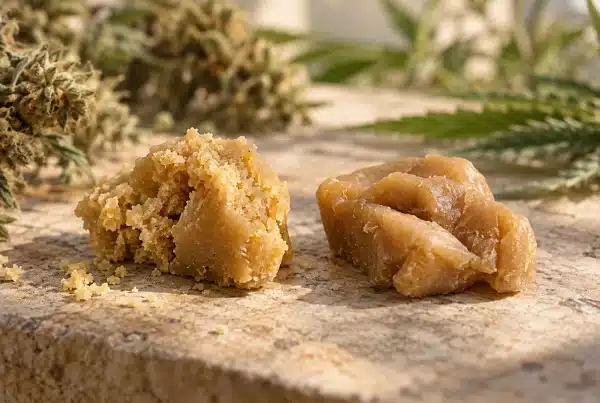
Color alone does not determine the percentage. A light or dark substance can reflect several factors: the raw material, processing, oxidation, pressing, or ingredients. Similarly, a soft texture is not proof of 50% CBD, and a crumbly texture does not prove a lower content. Observation can guide your sensory assessment, but it does not quantify the molecules.
"Powerful" CBD resin: concentration, composition, and effects
The word "potent" is ambiguous. It can describe a strong odor, a high concentration of CBD, the presence of other cannabinoids, or an effect experienced by some people. These four dimensions are not interchangeable. To understand a product description, ask what the term specifically refers to, then look for supporting evidence.
A 50% CBD resin may contain a higher concentration of CBD than a 20% resin when comparing identical products. This simple arithmetic doesn't prove that it produces an effect two and a half times stronger. The actual amount present, the overall composition, and individual differences all play a role. No percentage label can predict a therapeutic outcome or a universally applicable experience.
The presence of added cannabinoids makes interpretation even more challenging. Product names like "next generation," "ultra-strength," or "intense effect" don't identify the substance. Request the full ingredient list, laboratory results of the final product, and the regulatory status of the molecules involved. A CBD concentration of 50% doesn't eliminate the risks associated with other substances present.
Finally, aromas are often described using subjective terms: earthy, fruity, spicy, woody. A strong odor does not necessarily indicate high purity or a particular CBD concentration. If you are primarily looking for an aromatic profile, read the descriptions as sensory indications and check the analytical data separately.
How to read the certificate of analysis for a 50% CBD resin?
Start at the top of the report, before the results table. Note the laboratory, document number, sample receipt date, and issue date. Look for the designation "resin," "hash," or other appropriate matrix, and then the identifier that links this document to the sold lot. If the trade name does not exactly match the sample name, ask for an explanation for the discrepancy.
Next, read the lines for CBD, CBDA, delta-9-THC, and, if tested for, THCA. The lab may display results as percentages, mg/g, or another unit. Some values may be listed as below a limit of quantification; this does not mean the substance is completely absent. Method notes and units help prevent hasty interpretations.
For an enriched product, also review the list of other cannabinoids tested for. A substance not included in the panel was not excluded by a "not detected" line for another substance. A cannabinoid's trade name does not always correspond to a stable chemical name; ask for the claimed identity and which molecules the analysis was able to detect.
Finally, look for any tests that address contaminants relevant to the product: solvent residues if a process uses them, pesticides, metals, or microbiological parameters, depending on the context. A report limited to cannabinoids is not a comprehensive safety report. The applicable criteria and the representativeness of the sample must be discussed to draw any conclusions about the batch.
The CBD certificates and laboratory analyses provides another point of entry. Any laboratory accreditation pertains to specific tests: its logo alone does not certify all the parameters of a document, nor the legal compliance of the resin. If you wish to verify the scope of a French accreditation, a search on the Cofrac website allows you to examine the listed activities.
Fictional example: two resins advertised at "50% off"
Imagine resin A, whose batch ratio indicates CBD: 50.2% and CBDA: 0.8%. Its seller writes "50% measured CBD." Now imagine resin B, with CBD: 42% and CBDA: 9%, presented as "approximately 50% total CBD." Both labels highlight 50%, but they describe different lines in the ratio. Calculating B yields 49.9% according to the convention presented above.
Therefore, you cannot conclude that both products contain the same amount of measured, neutral CBD. Nor can you conclude that A is generally "better": the complete composition, the origin of the raw materials, any added ingredients, the product's condition, the contaminants tested for, and your preferred texture are still missing. This example illustrates the interpretation of a document, not a comparison between two actual products.
Suppose a third product label states "50% cannabinoids" but its report lists 35% CBD, 8% CBDA, and 7% other cannabinoids according to its own totalization convention. The 50% value then refers neither to the CBD line nor necessarily to the total calculated CBD. The exact wording and ingredient list prevent misleading comparisons.
If all three price lists indicate "up to 50%", you encounter another difficulty: this expression can refer to a maximum value or a range. Ask for the result for the current batch and the meaning of the range. The price per gram of a product showing a maximum cannot be directly compared to that of another product whose batch result is documented.
Compare two CBD resins without being guided by a single number
To make a useful comparison, create a short six-line summary sheet: product type, stated composition, batch analysis, described texture and aroma, purchased weight, and final price. The table below will help you request the same information for each resin.
| Question | Data sought | Common mistake |
|---|---|---|
| What 50%? | measured CBD, total CBD, total cannabinoids or target | Treat all totals as identical |
| Which product? | Resin obtained by sieving, mixing, enriched product or other formulation | Deduce the color process |
| Which lot? | Current reference and associated document | Use the report from a previous harvest |
| What other substances? | THC, acidic forms, other cannabinoids and ingredients | Read only the CBD line |
| What controls? | Tests performed, methods and limitations | Assuming that "tested" covers all risks |
| What is the cost? | Price based on selected weight and applicable fees | Comparing two different quantity levels |
To calculate the price, divide the product price by the number of grams purchased. A 2g sachet priced at €14 costs €7 per gram; a 5g sachet priced at €27.50 costs €5.50 per gram. The second is cheaper per gram but requires a higher total cost. Add any applicable fees and discounts to your cart to determine the final cost of your order.
A price difference can reflect the processing method, the level of sorting, the cost of certain materials, the packaging, or the seller's policy. You can't automatically explain it by the CBD content alone. A resin advertised as 50% may be cheaper than one advertised as 40%, without that alone indicating the accuracy of their labels or their quality.
Does the texture allow you to recognize a good resin?
Texture describes how a material feels and is handled: dry, crumbly, supple, compact, or sticky. It can be influenced by preparation, ingredients, temperature, and storage. A texture that one buyer appreciates may displease another. None of these adjectives corresponds to a universal measure of purity or concentration.
If a product description promises "pollen," expect a more consistent description of a powdery substance or a pressing of that type of material. If it promises "cream" or "foam," ask what process or composition explains this description. These words can help you visualize the product, but they shouldn't replace an ingredients list or analysis report.
A slight variation in appearance between two batches does not always indicate a defect. However, a musty odor, visible contamination, damaged packaging, or a significant discrepancy with the description warrants not using the product and contacting the seller. Keep the information on the packaging and the batch number to document your claim.
The color deserves the same consideration. Light and dark shades are encountered for various reasons; a dark resin is not automatically more concentrated in CBD, and a light-colored resin is not automatically cleaner. Prioritize analysis results for measurable aspects and rely on observation to assess the condition of the product received.
Is a 50% CBD resin automatically legal in France?
No. The CBD percentage alone does not constitute a legal passport. Article1 of the decree of December 30, 2021, in its current version, specifically outlines the authorized hemp varieties and sets conditions regarding delta-9-THC for these varieties as well as for extracts and products containing them. The measured result must be considered in relation to the type of product and the applicable regulations.
The often-cited 0.3% delta-9-THC threshold doesn't answer all the questions. Another substance may be classified separately, a product may have an intended use subject to different regulations, or a label may not accurately describe its composition. TheANSM (French National Agency for Medicines and Health Products Safety) publishes decisions concerning certain newly classified cannabinoids ; their names and exceptions should be examined in the current regulations rather than inferred from a marketing slogan.
A chemical analysis documents the parameters it measures. It can contribute to verification, but does not replace an examination of the product's status, its presentation, and its intended market. For shipments outside of France, the regulations of the destination country also require specific verification. Do not assume that a product deemed marketable in a given situation can be shipped anywhere in Europe.
The label "legal CBD hash" in a commercial category does not exempt you from distinguishing CBD from any other substances that may be present. For enriched resin or an unclear molecule name, request the claimed chemical identity and the analytical document of the finished product before concluding that it falls within a specific legal status.
Health, vigilance and the limits of promises of "high concentration"
CBD is not a guarantee of medical benefit. A resin labeled at 50% does not become a treatment for insomnia, pain, or stress. The FrenchNational Health Insurance (Assurance Maladie) reminds consumers of the precautions associated with non-medical CBD, particularly interactions with certain medications and potential discrepancies between the stated and actual composition of commercially available products.
If you are taking medication or have a specific medical condition, consult a healthcare professional. Products containing THC may lead to a positive result in a roadside drug test. Avoid driving and operating machinery after exposure to any product that may impair your alertness. These precautions also apply when the seller emphasizes CBD rather than THC.
Products in this category are intended for adults. A high concentration means that you should pay close attention to the complete ingredient list and batch information. This article does not specify the quantity to use or the method of consumption; these questions cannot be answered based on the percentage shown on a label.
Your seven-point method before buying CBD resin advertised at 50%
- Identify the product. Resin obtained from the separation of plant material, pressed pollen, mixture or enriched formula: ask for a concrete description.
- Define 50%. Note whether the value refers to measured CBD, a calculated total CBD, or another total.
- Check the current batch. Link the certificate of analysis to the available reference and the packaging sold.
- Read the other lines. In particular, examine the results relating to THC, acidic forms, and any added cannabinoids.
- Examine the scope of the controls. A cannabinoid profile does not automatically represent a complete search for contaminants.
- Compare the actual price. Choose the weight you would actually buy, then calculate the price per gram and the total in your cart.
- Check the product received. Verify the reference, the condition of the packaging, the advertised texture and any visible discrepancies; keep the batch identifier.
This method also works for 20%, 30%, or 60% CBD resin. The percentage can be a relevant criterion once defined and supported by evidence, but your decision will depend on several factors. You can explore The French Hemp Empire's selection of CBD resins by applying the same questions to each product that interests you.
Frequently asked questions about 50% CBD resins
Does 50% CBD mean 500 mg per gram?
Yes, if the value means 50% by mass of CBD measured on the same basis: 50% then corresponds to 500 mg/g. If the 50% refers to the calculated total CBD, total cannabinoids, or a formulation target, this equivalence does not necessarily describe the actual measured neutral CBD line. Read the report and its exact title.
Is a 50% resin twice as strong as a 25% resin?
It only shows a CBD concentration twice as high if both figures refer to the same substance, the same base, and comparable batches. This does not predict a "twice as strong" feeling or a medicinal effect. Other components and individual differences prevent this shortcut.
What is the difference between CBD hash and CBD resin?
The two terms are often used interchangeably in shops. Some product descriptions specify a process or texture to differentiate between products; these commercial practices vary. Look for the stated method, ingredients, and batch analysis rather than a supposedly universal definition.
Does a blonde resin contain more CBD?
Color alone cannot quantify CBD. It can depend on several factors related to raw materials, preparation, and storage. Only a relevant analytical measurement can provide a precise figure for the sample being examined.
Is total CBD the same as measured CBD?
Not always. Total CBD is sometimes estimated by adding the measured CBD to a converted fraction of CBDA. The measured neutral CBD remains a separate line item. Check the formula and units provided by the lab.
Does a 50% THC content prove that a resin is THC-free?
No. CBD content does not automatically indicate the presence or absence of THC. Look for specific information regarding the substances involved, the limits of quantification, and the batch. The composition and legal framework cannot be deduced from a single CBD percentage.
Is an analysis of the raw material sufficient?
Not necessarily. If the resin is manufactured, blended, or enriched after this analysis, the final product may differ. Ask which sample was taken and which stage the report corresponds to.
How to choose between two resins advertised at the same percentage?
Compare the definition of the percentage, other substances, traceability, declared method, expected texture, actual price paid, and extent of controls. Two "50%" values can refer to very different data or products.
What a percentage really allows you to decide
A number is useful when you know what it measures, how it was obtained, and which batch it refers to. A 50% concentration in a resin can help you compare one CBD concentration to another defined in the same way. However, it doesn't reveal, on its own, the manufacturing process, the flavor profile, the safety, the full legality, or your individual effects.
For your next purchase, start by reading the product name and ingredients, then the certificate of analysis for the finished product. Next, compare the price of the quantity you choose with the sensory characteristics that interest you. This approach transforms "50% CBD resin" from a simple marketing claim into verifiable information.
Sources and documentary methodology
Article prepared on September 24, 2026 for The French Hemp Empire. The following resources support the analytical, regulatory, and health distinctions. None of the cited studies are independent analyses of the resins sold by the shop. The calculations and fictitious prices are used solely to illustrate the interpretation of the data.
- Chauhan et al., Journal of Forensic Sciences, 2024 : original study on variable profiles of traditional THC-rich resins, cited only for its analytical method and variability between samples.
- Légifrance — decree of December 30, 2021, article 1, current version : certain conditions applicable to hemp, its extracts and products incorporating them.
- ANSM — registration of new cannabinoids on the list of narcotics : need to precisely identify the substances and to consult the updated texts.
- Health insurance — Non-medical CBD: definition and precautions for use : interactions, vigilance and product composition.
- Cofrac — search for accredited bodies : verification of the stated scope of a laboratory accreditation.