Does a THV-N10 flower labeled as containing 20% actually contain 20% of a substance identified by that name? The number alone is insufficient to answer this question. THV-N10 is a trade name found on hemp flowers and resins. To interpret a product information sheet, one must first know the claimed chemical identity, understand what the percentage measures, and verify that the analysis pertains to the finished product of the batch offered.
The difficulty is real. A hemp flower already has its own cannabinoid profile. A formulation marketed under a new name may, depending on the case, have undergone post-harvest processing or contain added substances. The expression "20%" can then refer to a measured concentration in the entire product, a target value for the formulation, a calculated figure, or an ill-defined total. It doesn't tell you how much CBD or THC is present, nor whether the advertised substance has a recognized scientific identity.
In this guide, you will learn to distinguish the carrier flower from the commercially available formulation, to ask the right questions about the analysis, and to avoid shortcuts regarding legality and effects. The goal is for you to be able to examine a specific reference product using a reproducible method, without attributing the composition of a single sample to an entire range. The calculation examples below are fictitious; they do not describe any analysis of a commercially available product.
THV-N10: what does this name actually tell you?
The designation THV-N10 identifies a commercial family. It is not, on its own, sufficient to provide a molecular formula, CAS number, systematic chemical name, or validated assay method for all formulations bearing that name. A seller may describe their product more precisely; this documentation should be examined for the specific product in question and not inferred from the four letters printed prominently.
It is tempting to associate THV-N10 with familiar scientific names due to a few shared letters. THCV, for example, corresponds to tetrahydrocannabivarin, a substance that has been identified and studied. The similarity between "THV" and "THCV" does not demonstrate that products labeled THV-N10 contain THCV. Nor does it establish a chemical derivative. Such a claim requires structural identification and appropriate analysis.
The same principle applies to comparisons with THC, HHC, or other recent cannabinoids. Names can evoke a range of products without revealing a comparable composition. If the chemical identity is not disclosed, this uncertainty should be preserved rather than filled by analogy. Two formulations bearing the same trade name could even differ in their composition.
The French Hemp Empire's THV-N10 page lists several flowers and resins bearing this name. This list indicates the existence of distinct commercial references; it does not prove that they are chemically identical. To understand one of them, start with its product information, ingredients, and batch number.
Flower support and finished product: two stages not to be confused
A "THV-N10 flower" is primarily composed of plant material: a cultivated, harvested, dried, and packaged hemp flower. If another substance is added after harvesting, the result is a formulation different from the original flower. This distinction is important for the composition, analyses, and how the product information sheet describes the product.
Check if the seller specifies the hemp variety, cultivation method, and post-harvest processing. The term "indoor" may describe the environment where the plant was grown. It doesn't tell you about any added substances, how they were obtained, or their dosage. A fruity aroma description could come from the flower's profile, an additive, or a sensory assessment; ask which information corresponds to what.
The commercial website may use terms such as "enriched," "infused," "boosted," or "next generation." These words do not all have a single, clear analytical definition. A flower described merely as enriched reveals neither the actual quantity added, nor the homogeneity of the distribution, nor the identity of all the substances. An ingredient list and an honest description of the formulation process are more useful than a marketing claim.
Product photography is not a measure of composition. A glossy appearance or visible deposits could have several causes; an ordinary-looking flower may also contain an unseen additive. Observation helps detect obvious discrepancies or deterioration, but does not allow for the quantification of a specific cannabinoid.
EUDAdescribes the presence on the European market of plant products marketed with semi-synthetic cannabinoids. This market observation does not automatically describe the process used for each THV-N10 flower. It highlights why the question "are we analyzing the base flower or the final product?" must be asked for each individual product.
“THV-N10 20%”: what interpretations are possible?
A percentage is a fraction. It's essential to know what constitutes the numerator and what forms the basis of the denominator. "20% THV-N10" can be presented as a mass concentration of a substance measured in the finished product. However, the datasheet must specify whether this substance has been identified with sufficient precision, which sample was tested, and which method produced the result.
A value can also be nominal: the formulator may have aimed for a certain percentage during production. A target value does not indicate the quantity present in each batch. Similarly, the phrase "up to 20%" refers to a maximum or a range and should not be interpreted as a specific percentage of the flower you will receive.
If a report displays "total cannabinoids: 20%", you cannot simply translate it as "20% THV-N10" without knowing its component list. The total could include different substances. If the analysis shows CBD, THC, and a line labeled THV-N10 separately, verify how the latter was identified and quantified. The mere presence of a line in a table is not, in itself, proof of the structural identity of a brand name.
In the specific case of a measured and defined mass concentration, 20% would arithmetically correspond to 200 mg per gram of the same finished product. This calculation does not constitute proof of the result, does not describe the distribution of the substance in each part of the flower, and does not predict an individual's actual exposure. It should not be used as an indication of the quantity to consume.
| Mention | What you need to ask | What remains unknown without documentation |
|---|---|---|
| 20% of THV-N10 measured | Analytical identity, method, lot, sample | Full composition and legal scope |
| 20% nominal | Defining the target and measuring the finished product | Result of the lot sold |
| Up to 20% | Actual value observed for the batch | Exact contents of the order |
| 20% cannabinoids | List of molecules included in the sum | Portion attributable to a single substance |
The product information sheets for several flowers in the THV-N10 range display "20%". This repetition does not allow us to assume that all batches have exactly the same analytical result or that they share identical ingredients. Information specific to the chosen variety and batch must be requested.
How can we recognize truly usable compositional information?
A usable description should clearly separate at least five points: the product's trade name, the nature of the flower carrier, the identity of the substances present, the stated quantity of each, and the batch number. It should also explain the stated process, any other ingredients, and the laboratory that performed the tests. The more complex the product, the more important this information becomes to avoid confusion.
The chemical designation of a substance may include a systematic name, a structure, a standardized reference, or verifiable technical documentation. For a new market name, ask what exactly the laboratory method identifies. If the document only addresses known cannabinoids and does not include a method for the claimed component, it cannot confirm the percentage of that component simply by name similarity.
A salesperson may also have information from the raw material supplier. This is useful, but it doesn't necessarily equate to an analysis of the final product. When the extract is added to a flower, the composition of the initial extract and the actual quantity present after formulation are not the same thing. Match each document to the step it describes.
If a THC value below 0.3% is reported, look for the corresponding analytical line and the section in which this number is cited. It indicates a specific parameter of the sample, not the chemical identity of THV-N10 or its potential placement in a regulated category. A true THC figure does not automatically make the entire formula a legal product.
What certificate of analysis should be requested for a THV-N10 flower?
The first check involves identifying the batch. Look for the identifier of the flower sold, the date of sampling or receipt, the name of the laboratory, and the report number. Compare this information to the one on your packaging. If the document concerns a different variety or harvest, it does not automatically describe your purchase.
The second control concerns the matrix and the timing of sampling. An analysis of the flower before enrichment can provide information about the plant base. It does not necessarily verify the product ready for sale. An analysis of the extract before addition provides information about the extract, without demonstrating its final quantity or distribution. The most relevant document for the stated percentage must relate to the finished formulation or be accompanied by an explicit and verifiable method of reconciliation.
The third check concerns the identity of the analyte. Can the laboratory specify the chemical name it uses, the reference standard, and the method employed? A rare or trademarked substance may require more detailed characterization than a well-known molecule like CBD. A single chromatogram or a value without explanation of the method does not always answer this question.
The fourth control concerns the composition surrounding the highlighted substance: CBD, delta-9-THC, acidic forms, and other cannabinoids being investigated. "Not detected" has a limited meaning due to the panel and methodology used. What was not tested for is not excluded by the report. Potential testing for contaminants addresses yet another question, which warrants its own examination.
The fifth check concerns representativeness. An enriched flower may exhibit variable distribution between heads or within a batch. Sampling describes a fraction of the production; the sampling plan and uncertainties must be known before generalizing a value to each unit. The guide dedicated to certificates and analyses will help you read the standard sections of the document.
If the seller cannot provide all these answers, you can at least distinguish between what is established and what is merely a claim. Such a distinction does not automatically judge the quality of a lot; it simply shows the level of evidence available for the "THV-N10 20%" promise.
THV-N10 and THCV: why the similarity in name can be misleading
THCV is a cannabinoid with a known chemical identity. It has its own scientific literature. THV-N10, as it appears in commercial catalogs, should not be treated as another spelling of THCV. The form of the word provides no evidence of equivalence, a common metabolite, derivative, or mechanism of action.
This distinction also has regulatory implications. TheANSM (French National Agency for Medicines and Health Products Safety) outlines conditional exclusions, particularly concerning THCV and THCVA, in its amended 2024 decision. These specific conditions cannot be applied to a product simply because its trade name resembles THCV. It is necessary to know the actual substance present and consult the relevant regulations.
Comparisons of effects are equally unreliable. Even when a study specifically focuses on THCV, it doesn't demonstrate the effects of a THV-N10 formulation whose identity is unestablished. Similarly, a customer's experience doesn't allow for the identification of a molecule. To discuss effects, one would need to know the substance, its overall composition, and relevant human data.
This rule will be useful beyond THV-N10. The names of new cannabinoids are proliferating; a single letter shared with a studied compound can create an impression of familiarity. Verification always begins with chemistry and analytical results, and only then should scientific literature confirm this identity.
THV-N10 flower and THV-N10 resin: why not transfer the numbers?
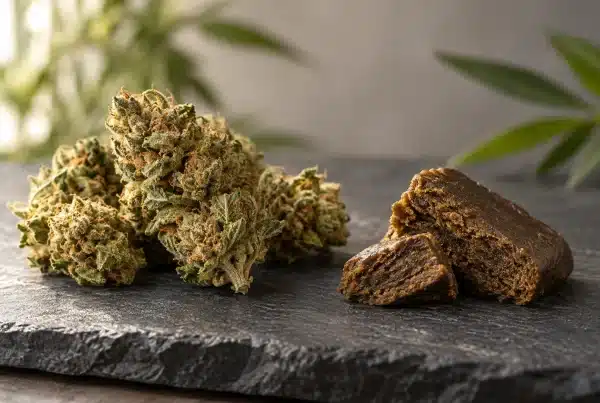
The flower and the resin do not have the same matrix. The flower retains its plant structure; the resin is a processed or otherwise formulated material. A percentage listed for a resin does not describe a flower of the same quality. Conversely, an analysis of the flower does not prove the composition of hash sold under the same brand.
The product range page displays flowers at 20% and resins at higher values. These commercial figures refer to different products. Comparing them as if they measured a universal "potency level" would be misleading: it is necessary to know if the same substance has been identified, if the values are measured on the same basis, and what other components are included in the formulas.
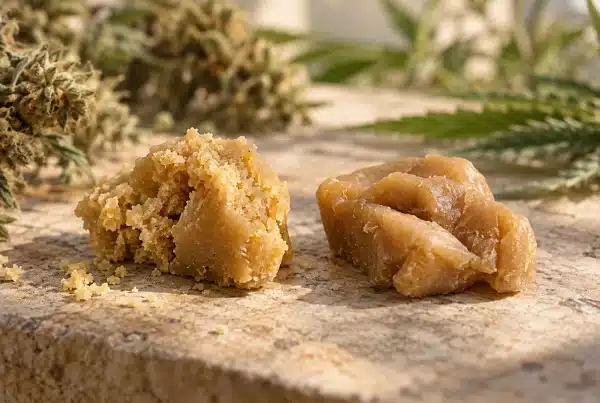
Textures and aromas add further distinct dimensions. A resin described as "foamy" indicates an appearance; a flower bearing a variety name evokes a commercial and sometimes sensory identity. Neither texture nor variety name guarantees the content of the advertised compound. Therefore, separate three columns in your notes: product form, analytical data, and subjective characteristics.
This approach avoids turning the Revuelto collection into a single substance with predetermined effects. Each product and each batch must be evaluated individually, especially since the composition can vary depending on the starting material and formulation.
How to compare two THV-N10 flowers at 20%?
At first glance, two product sheets showing the same percentage may seem comparable. However, the flowers they represent may come from different harvests, cultivation methods, and varieties. Their aromatic descriptions may differ. The value "20%" may have been obtained through different methods or conventions, or may simply represent a common formulation target.
Start by verifying the product details and batch numbers. If each product sheet lists a strain name, ask whether these names correspond to verified genetics or a commercial designation. Next, read the complete composition: the quantity of the designated component THV-N10, CBD, THC, other cannabinoids, and any added ingredients. Finally, compare the date and scope of the analyses.
| Question | Information sought | Conclusion to be avoided |
|---|---|---|
| Same percentage? | Measurement or target, mass basis, batch | "Identical effects" |
| Same trade name? | Documented chemical identity | "Same proven substance" |
| Same type of flower? | Cultivation, harvesting, post-cutting operations | "Same aromatic profile" |
| Same analysis? | Separate samples and dates or common document explained | "One PDF covers all batches" |
| Same legal status? | Exact composition and applicable texts | "The THC level is sufficient." |
A price difference doesn't necessarily reflect a difference in composition. It could be due to packaging, the cost of the material, sorting, the quantities purchased, or a sales policy. If price is important to you, compare the same quantity and the total you actually paid, without letting a very high volume discount overshadow the price of your order.
Is a THV-N10 flower legal because the THC content is less than 0.3%?
A delta-9-THC value alone is insufficient to establish the legal status of a product containing another substance. The law takes into account the exact chemical nature, its possible classification, the formulation, the intended use, and the date. Thedecree of December 30, 2021, in its applicable version, sets certain conditions relating to hemp and delta-9-THC; it does not grant general authorization to any compound marketed with a hemp flower.
The ANSM (French National Agency for Medicines and Health Products Safety) classified cannabinoids in 2024 and subsequently updated them. Some classifications target structural families and include conditional exclusions. Therefore, searching for the single chain "THV-N10" in a text does not allow for definitive authorization or prohibition. It is necessary to identify the structure of the claimed substance, compare this structure to the current wording, and examine the composition of the finished product.
For deliveries to other countries, the regulations of the destination country differ. A claim made on a French website does not constitute proof of compliance in Belgium, Italy, or elsewhere. Monitoring the legal requirements and analyzing the batch serve two complementary functions: determining the product's contents and the applicable regulations.
If the chemical identity is unavailable or if analysis cannot link the finished product to that identity, it would be premature to state unequivocally that the flower is "legal throughout Europe." This caution stems from a lack of information, not from a definitive verdict for all THV-N10 references.
Safety: What do we know about the effects of a THV-N10 formulation?
A reliable human effects profile cannot be deduced from a brand name alone. The composition of the flower, the other cannabinoids present, the actual quantity of the advertised component, and individual differences all play a role. Testimonials may describe sensations, but they do not characterize the molecule or demonstrate a medical benefit.
EUDAmonitors the emergence of new psychoactive substances in Europe and describes the challenges of overseeing a rapidly evolving market. ANSEShas also issued warnings about poisonings linked to products marketed as containing CBD when other substances were involved. These documents are not clinical trials of THV-N10; they explain why clear composition and appropriate precautions are essential.
This product is for adult use only. Avoid driving and operating machinery after exposure to this product, which may impair alertness. If you are undergoing medical treatment, have a medical condition, or are pregnant, consult a healthcare professional. If serious side effects occur, contact emergency services immediately and retain the packaging for future reference.
A flower advertised at 20% doesn't lend itself to a simple equation like "twice the percentage, twice the effect." First, it would be necessary to verify that two figures describe the same substance measured in the same way; the perceived intensity doesn't automatically follow an arithmetic proportion. No promise of relaxation, sleep, or therapeutic benefit can be derived from this percentage alone.
Eight useful questions to ask before interpreting a THV-N10 report
- What does the name THV-N10 refer to here? Request the claimed chemical identity and corresponding documentation.
- What is the flower support? Identify the plant lot, the declared variety and the available cultivation information.
- Was there any post-harvest additives? Ask about the nature of the ingredients and the formulation stage.
- What exactly does 20% mean? Measured mass result, total, target, or maximum value?
- Which sample was tested? Flower before treatment, separate ingredient, or final packaged product?
- Which batch is affected? Compare the references on the certificate, the data sheet, and the bag.
- What other substances were tested for? THC, CBD, added cannabinoids and contaminants are not deducible from the main line.
- What rule is being invoked? Relate the actual chemical identity to the regulations in force in the country concerned.
If several questions are missing, submit a written and specific request to the seller. A detailed response will help clarify the product description; simply repeating "20%", "legal", or "premium" will not provide the missing information.
Frequently asked questions about THV-N10 flowers at 20%
Is THV-N10 the same cannabinoid as THCV?
This equivalence cannot be inferred from the name. THCV is an identified substance; THV-N10 is used as a trade name on recent formulations. To establish a relationship, request a chemical identity and relevant analytical results for the precise reference.
Does a THV-N10 flower with 20% contain 20% THC?
No, these two terms are not interchangeable. The label "20% THV-N10" refers to the advertised value for that name; the delta-9-THC content must be measured and listed separately. It's also important to verify what the seller means precisely by THV-N10.
Does the figure 20% guarantee the same result on all flowers?
No. A lab result is based on a sample taken using a specific sampling method. A formulation target does not guarantee the content of every single head. Ask for the lot result and how the sample represents the packaged products.
Does an indoor-grown flower naturally produce THV-N10?
The term "indoor" describes the growing environment of the plant material. It does not prove the natural or synthetic origin of a substance marketed under another name. Such a claim requires chemical information and documentation of its manufacture.
Can THV-N10 be verified on a standard CBD certificate?
Not automatically. A panel that only measures CBD, CBG, or THC doesn't quantify another substance simply because it's listed in the product description. Check the list of analytes, the method, and the standard used for the advertised component.
Does a THC level below 0.3% mean that the product is legal?
This result alone is not sufficient. The status also depends on the substance declared as THV-N10, the other components, the type of product, and the applicable regulations. Without verifiable chemical identity, a categorical legal judgment would be premature.
Is a flower with 20% less "strong" than a resin with 40%?
The two percentages may refer to different matrices and conventions. Even if they concern the same substance, they describe a concentration, not a predictable individual effect. The complete composition and measurements of each batch must be known before comparing chemical data.
What should I do if the composition received does not match the information sheet?
Keep the packaging, batch number, proof of purchase, and photographs of the product. Contact the seller describing the observed discrepancy. If a serious adverse reaction occurs, seek immediate medical attention and provide the information from the packaging.
Read an enriched flower without confusing the evidence
The trade name helps to identify a product range. The percentage helps to compare measurements only when it is defined. The certificate helps to document a sample within the scope of its tests. Finally, the law classifies the substances actually present according to applicable regulations. These four levels are not interchangeable.
A THV-N10 20% datasheet becomes truly informative when you can identify the finished product, understand the origin of the figure, link the report to the batch, and name the substances regulated by the regulations. You can then accurately compare different products, without attributing the properties of an added ingredient to the plant-based product or misattributing the results of a known molecule to a trade name.
Sources to consult
- EUDA and Europol — European market for semi-synthetic cannabinoids : observed commercial forms and production.
- EUDA — European Report 2026, New Psychoactive Substances : Monitoring and Market Developments.
- ANSM — classification of new cannabinoids and modifications for 2024 : structural families, conditional exceptions and risks.
- Légifrance — decree of December 30, 2021, article 1, current version : conditions relating to varieties of hemp and to certain extracts and products.
- Anses — CBD products containing other substances : reports of poisoning and vigilance regarding composition.