Fruity THV-N10 flowers: Pineapple, Banana, Atomik Apple or Guava Ice?
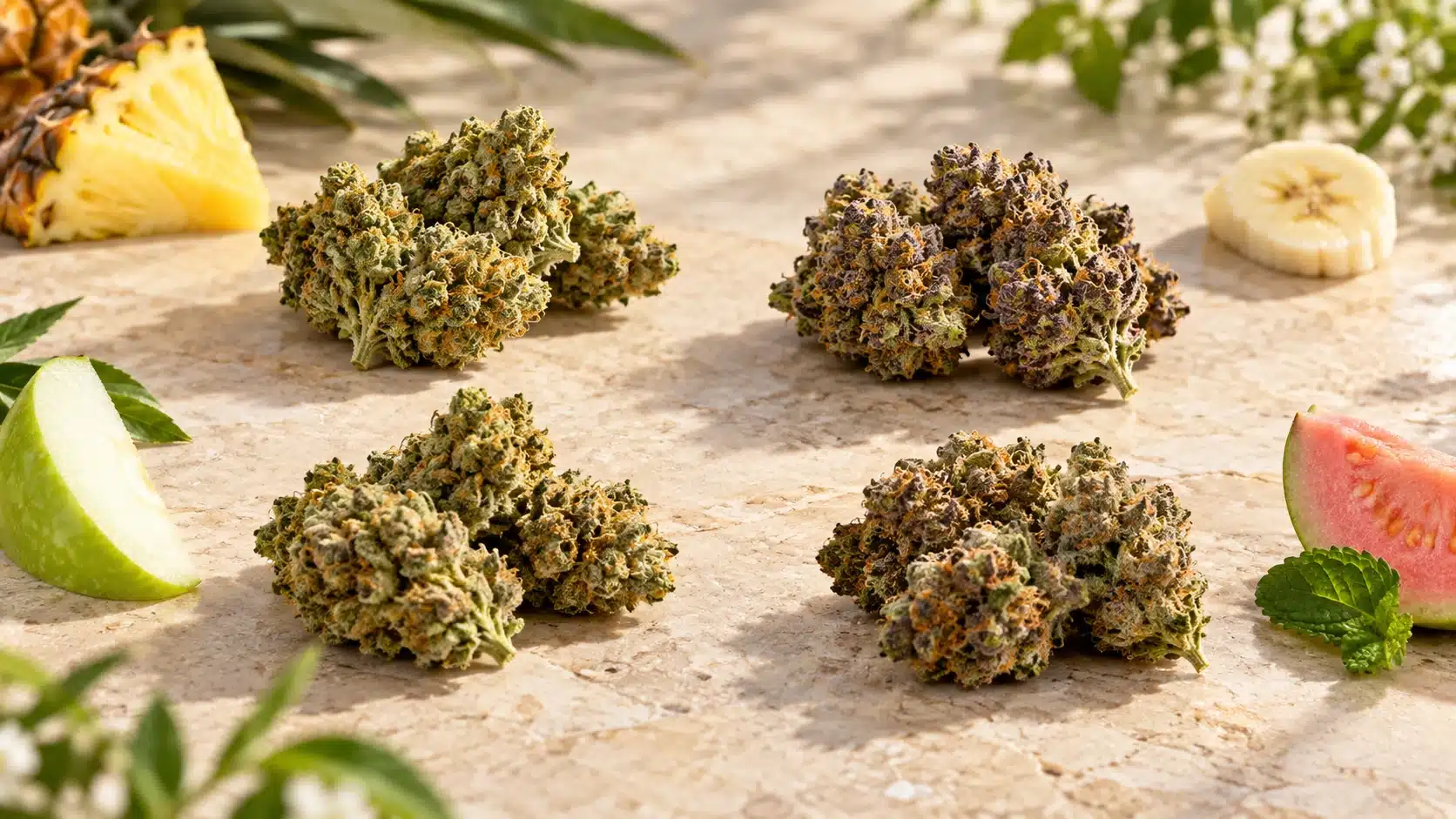
You like flowers with fruity scents, but "fruity" can evoke a ripe banana, a vibrant pineapple, a crisp apple, or guava with a hint of mint. Faced with four such evocative names, choosing solely based on the stated percentage offers little help: all four products presented here list 20% THV-N10. The easiest difference to compare on their product sheets is their aromatic profile.
In The French Hemp Empire's THV-N10 category, Pineapple, Banana, Atomik Apple , and Guava Ice US offer four distinct sensory experiences. Here's how to differentiate between them, compare their weights, and verify batch information before ordering. Product and price information was accessed in September 2026 and is subject to change.
Four fruity profiles, four different directions
The three words placed under each product reference in the category provide an initial point of reference. They summarize a sensory impression described by the seller, without guaranteeing that everyone will experience these notes exactly when opening the package. The table compares these words with the detailed description on each product page.
| THV-N10 Flower 20% | Notes displayed in the category | If you're mainly looking for… |
|---|---|---|
| Pineapple | Tropical, sweet, pineapple | An exotic fruit with a hint of citrus, as stated on the product information sheet |
| Banana | Tropical, sweet, banana | Ripe banana and a creamier feel |
| Atomik Apple | Red berries, apple, floral | An orchard fruit with a floral nuance |
| Guava Ice US | Tropical, guava, mint | Tropical fruit combined with a minty freshness |
The name of a fruit here serves as an aromatic shortcut. "Pineapple" does not prove the addition of pineapple, "Banana" does not guarantee a banana flavor, and "Ice" does not indicate the presence of menthol. To determine if flavorings have been added, the origin of the terpenes, and the ingredients that make up the finished product, an ingredient list and batch-specific documentation are required.
Pineapple: moving towards pineapple and citrus fruits
Pineapple THV-N10 20% puts pineapple at the heart of its presentation. The tasting notes reveal a range of exotic fruits, a sweet smoothness, hints of citrus, and subtle floral nuances. If your idea of a fruity floral whisky is based on a vibrant tropical impression, this is one of the two whisky options to consider first, along with Guava Ice.
The presence of citrus in the description helps distinguish Pineapple from Banana, even though both share the words "tropical" and "sweet" in the category. Someone looking for a fresher, yellow fruit scent might prefer the advertised direction of Pineapple. Someone drawn to round, creamy notes would likely consult the Banana listing. These differences remain descriptive intentions; they are not measures of intensity.
Regarding appearance, the description mentions dense, resinous flowers. This vocabulary describes the expected presentation, but each batch should be examined individually. Ask for recent information about the batch if bud size, trimming, or storage are as important as aroma. The name "Pineapple" alone does not provide information about the botanical genetics or geographic origin of the flowers.
A practical way to decide between Banana flavors is to ask yourself if you prefer pineapple and citrus or ripe banana and vanilla, as described in the other flavor description. This preference test is more useful than comparing their 20% percentages, since they are identical in the marketing descriptions.
Banana: the sweet and creamy side of the tropical
Banana THV-N10 20% is presented with three key characteristics: tropical, sweet, and banana. Its description adds creamy notes and light vanilla accents. It appeals to someone looking for a bouquet reminiscent of ripe fruit and pastry sweetness, rather than a tangy freshness.
A "creamy" note doesn't necessarily indicate the presence of dairy, just as "vanilla" doesn't prove the addition of vanilla. These terms describe the desired impression listed on the product information sheet. For someone attentive to the ingredients, they justify a specific question to the seller: which terpenes and other ingredients produce the advertised profile in the batch currently being sold?
Banana can also serve as a point of comparison with other indulgent florals in the category, such as Monster Cookie, whose defining characteristics are vanilla, biscuit, and caramel. The difference, on paper, lies in the role of the fruit: Banana starts with banana and tropical notes; Monster Cookie starts with the pastry category. If your taste for sweetness doesn't necessarily involve fruit, a "cookie" type fragrance could be another avenue to explore.
The Banana product description, like Pineapple, indicates compact and resin-rich flowers. These descriptions do not guarantee that the two batches will have exactly the same texture. When comparing their appearance upon arrival, observe the actual structure, the possible presence of debris, the condition of the packaging, and its correspondence with the description of the purchased product.
Atomik Apple: apple, red berries and flowers
Atomik Apple THV-N10 20% departs from the banana-pineapple duo for an orchard-inspired profile. The category features red berries, apple, and floral notes. The description mentions crisp apple, slightly tart notes, and a floral touch. If tropical fruit seems too sweet in the descriptions, this combination offers an alternative worth exploring.
The apple can evoke several sensations: a bright green fruit, a sweeter ripe flesh, or the aroma of compote. The description mainly mentions a fresh apple and a slightly tart character, but only the smell of the batch will allow you to see what you're perceiving. The red berries mentioned further complicate the picture: Atomik Apple isn't limited to just one fruit represented in its name.
The floral note also helps distinguish this bouquet from Pineapple and Banana. If you like bouquets where the flower complements the fruit, Atomik Apple is a logical choice. If you prefer to avoid floral notes, this detail should definitely be considered. The term "US," used in the product description, is not sufficient to guarantee that the flowers were grown in the United States: request documented origin if this is important to you.
With the same price displayed across the different price ranges, your decision between Atomik Apple and the tropical varieties will primarily depend on your preferred aroma and the quality of information provided for each batch. Don't assume that an "apple" label implies a product with a lower cannabinoid content: all four product descriptions state 20%, which is not a measure of individual potency.
Guava Ice US: guava and minty freshness
Guava Ice US THV-N10 20% occupies a distinct aromatic profile: tropical, guava, and mint. The description mentions ripe guava and a minty freshness. This is the first description to consult if your preference combines exotic fruit with a refreshing impression. Conversely, if you dislike minty profiles, its third characteristic should be taken seriously, even if guava appeals to you.
The term "Ice" does not indicate the amount of mint or menthol present in the product. Nor does it guarantee that the flavoring comes from a mint leaf. If you are looking for an answer about the ingredients, check the actual product label. Flavor names are not a substitute for a complete ingredient list.
Pineapple and Guava Ice both use the word "tropical," but their descriptions clearly differ: pineapple and citrus for the former, guava and mint for the latter. So you can choose with a simple question: "Do I prefer a tart tropical fruit or one with a minty note?"
The "US" designation belongs to the Guava Ice brand name. It may suggest an aromatic inspiration or product line positioning; it does not guarantee that the product was grown in the United States. If origin is a determining factor in your purchase, ask for the country of origin of the flower and information about the batch formulation.
What weight should I choose to discover a variety?
The four product pages we consulted all offered the same sizes: 2g, 5g, 10g, 25g, and 50g. The price per gram displayed decreases as the selected weight increases. At the time of our check, the visible price increments were €13/g for 2g, €12/g for 5g, €11/g for 10g, €10/g for 25g, and €9/g for 50g. These prices are from product pages and are subject to change; always check the final amount in your shopping cart.
| Displayed format | Price per gram consulted | Indicative cost calculated | Choice situation |
|---|---|---|---|
| 2 g | €13/g | 26 € | Discover an unknown profile |
| 5 g | €12/g | 60 € | Explore an already attractive reference |
| 10 g | €11/g | 110 € | Buy back after an initial check |
| 25 g | €10/g | 250 € | Choose a larger volume knowing the batch |
| 50 g | €9/g | 450 € | Compare the unit price with the storage requirements |
The lowest price per gram isn't automatically the best purchase for a first try. If you dislike the actual flavor of a batch, the price savings on a larger size become less appealing. A small quantity allows you to verify if the sensory description matches your preferences; larger sizes make more sense after this initial step. The costs in the table are simply multiplied by the displayed prices, excluding any fees, discounts, or changes to your cart.
To compare two flowers of identical quantity, select the same weight on both product pages. Then check if the origin, packaging, and analysis documents are comparable. A future price difference could stem from a change in promotion or batch; the price in euros alone does not describe the composition or freshness.
What "20% of THV-N10" actually allows us to say
All four pages highlight the same nominal rate of 20%. In the case of a recent name like THV-N10, this number warrants further investigation: what exactly does the analysis measure under this name? The seller's category page itself points out that the name is not as standardized in scientific literature as CBD or THCV. Therefore, it would be inaccurate to automatically equate "THV-N10" with THCV or a specific chemical structure without supporting documentation.
Request an analysis that links the finished product to its batch, specifies the analyte name, measurement method, quantity detected, and other cannabinoids tested for. A document focusing solely on a single ingredient before enrichment does not necessarily describe the flower as packaged after manufacturing. Results for delta-9-THC and potential contaminants should be examined separately.
The same "20%" on four labels doesn't guarantee four identical compositions. Even when the advertised substance is measured in comparable quantities, the starting plant material, other constituents, and the proportions of the extract can differ. The percentage also doesn't tell you whether Banana will smell more like fruit than Pineapple, or how a person will react to the product.
It's best to keep the two decisions separate: choose an aroma based on your taste, then evaluate a batch based on reliable composition data. An appealing description doesn't establish the actual content; a cannabinoid analysis alone doesn't explain the aromatic profile.
How can freshness and presentation be compared?
The four product descriptions describe dense, select, and resin-rich flowers. These terms give you a general visual expectation, but shop photographs may not accurately represent the delivered batch. If the seller has recent photos or packaging information, this will help you compare the different products more concretely.
Upon receipt, check the integrity of the packaging, the presence of a legible label, that the name and weight match the order, and that the batch identifier is correct. The scent should be assessed under comparable conditions: a sachet that has been open for several days is not directly comparable to a freshly opened one. An overly dry flower may seem less expressive; excessive moisture and a suspicious odor should lead you to discontinue use of the product and contact the seller.
The advertised profiles may change during storage. Air, heat, and light gradually alter the aromatic profile. To store a received product, follow the seller's instructions and keep it in a clean, dry environment, protected from light and out of reach of children. Buying 50g because the price per gram is lower also means ensuring that the quality is properly preserved during storage.
Do the names of fruits prove the presence of added flavorings?
No. A flower can develop aromas reminiscent of certain fruits thanks to its volatile compounds, and an enriched formulation may also contain added terpenes or flavorings. The name and three flavor pictograms do not allow you to distinguish between these situations. For THV-N10 products, check the base flower, the material used for enrichment, and any flavoring ingredients in the recipe.
The words "variety" and "genetics" should also be interpreted with care. A trade name inspired by a famous variety is not proof of botanical lineage, especially when the final product is an enriched flower. If you are looking for specific genetics, ask for information on the cultivated plant. If you are simply looking for a fragrance, sensory descriptions are a better starting point, with the limitations already mentioned.
In studies on the olfactory evaluation of cannabis flowers, families such as fruity, citrus, woody, and herbaceous can be distinguished, but perception varies between individuals. A study characterizing aromas illustrates the usefulness and limitations of a sensory vocabulary. It does not test the four products presented in this article and therefore does not confirm their specific profiles.
What precautions should be taken before making a choice?
A product information sheet intended for adults is not a substitute for a risk assessment. This category lists THV-N10 under an emerging trade name and highlights the need for precise identification of the substance. Publicly available scientific data characterizing the human effects of products with such names are limited. Do not assume that a banana or pineapple flavor indicates a pharmacologically mild formulation.
Product pages advise against driving or operating machinery after use. This precaution should be considered regardless of the chosen flavor or the advertised THC content. A product's compliance is not solely determined by a statement such as "THC less than 0.3%": the exact substance, its classification (if applicable), other ingredients, and relevant analyses must also be verified. If you are undergoing treatment, are pregnant, or breastfeeding, seek medical advice and avoid relying on user testimonials.
This article focuses on choosing between available products and their aromatic descriptions. These flowers should not be interpreted as culinary advice or promises of health benefits. If any key information is missing about the batch or formulation, ask for it before making a purchase.
A four-question shopping journey
- What fruit are you looking for? Pineapple and citrus fruits for Pineapple, ripe banana for Banana, apple and red fruits for Atomik Apple, guava and mint for Guava Ice.
- Which nuance do you want to avoid? Mentholated freshness, creamy roundness, flowers or citrus can differentiate between two tropical profiles.
- What weight corresponds to your certainty? A small format limits the commitment to an unknown aroma; a large format implies knowing the reference and being able to keep it.
- What does the batch document? Match the label and the analysis of the finished product, verifying the substance measured under the name THV-N10.
If you're still hesitating between two fragrances, compare them by weight and note the actual differences stated on their product information sheets. There's no need to invent a hierarchy of "strength" among four flowers listed at 20% to choose a perfume. With the same stated concentration, your personal taste and the quality of the available information become the practical criteria.
Frequently Asked Questions about THV-N10 Fruity Flowers
Do Pineapple and Banana have the same profile because they are "tropical"?
No. They share "tropical" and "sweet" in the category, but their descriptions distinguish pineapple and certain citrus fruits for Pineapple, and ripe banana and creamy notes for Banana. The exact scent of a batch remains to be confirmed.
Does Guava Ice necessarily contain mint?
The category displays "mint," and the product description describes a minty freshness. These words do not provide a list of ingredients. Ask for the formulation if the presence or absence of a specific substance is important to you.
Is Atomik Apple necessarily grown in the United States?
The product information sheet also uses "US" in its marketing materials. This designation alone does not constitute proof of agricultural origin. The origin of the flower used for the label must be verified in the batch information.
Which variety should I choose if I don't like mint?
Of these four descriptions, Pineapple, Banana, and Atomik Apple do not highlight mint. However, the absence of the word in a product description is not a comprehensive analysis of the ingredients, nor a guarantee against any cooling sensation.
Is the 50g format still the best choice?
It displayed the lowest price per gram at the time of verification. For a first try, a smaller format allows you to see if the aroma and batch meet your expectations without immediately investing in a large quantity.
Does the "20% of THV-N10" allow us to classify their effects?
No. All four references display the same number, which itself must be linked to a precisely identified substance and a batch analysis. It measures neither aromatic quality nor a guaranteed individual effect.
Choose the fruit you like, then check the batch
For a tropical profile with citrus notes, start with Pineapple. For banana and a rounder sweetness, look at Banana. If you prefer apple accompanied by red berries and flowers, Atomik Apple best fits this description. If you like guava refreshed by a menthol note, Guava Ice is the most direct route. These four paths simplify the choice, provided you keep the flavor descriptions in perspective: they guide your preferences, while the label and batch analysis document the product you're buying.
Find the references and their formats in the current THV-N10 range, then check the final price and information of the chosen variant when ordering.