Storing your Small Buds CBD: a practical method for 25g to 100g
The 100g bag is eye-catching: on several pages of The French Hemp Empire's Small Buds CBD, the price is listed at €0.99/g, compared to €4.50/g for 2g. However, a large quantity loses some of its appeal if the small buds remain open, exposed to sunlight, or stored in a humid environment. Proper storage of Small Buds CBD therefore becomes a real consideration when purchasing, especially when moving from the smaller introductory sizes to 25g, 50g, or 100g bags.
This guide helps you choose a quantity that suits your needs and organize its storage once you receive your package. It applies to dried hemp flowers sold to adults, and not to oils, edibles, or resins. The price and variety examples were verified against the shop's product pages on September 28, 2026; they are subject to change. The storage advice distinguishes between general findings from studies on cannabis flowers and practical recommendations tailored to the actual packaging delivered.
Why the format changes the way you store your flowers
A 2g sachet is usually opened only a few times before being empty. With 100g, each opening exposes a large quantity of flowers to the ambient air and humidity fluctuations. This difference doesn't imply that a larger format is of lower quality. It simply means that the buyer should consider how often they will open it, the size of the containers, and how long they intend to keep the same variety.
The Skywalker 12% and Sour Diesel 12% both offer 2, 5, 10, 25, 50, and 100g packs. For these weights, they indicate a price range from €4.50 to €0.99/g. The price difference is real on the product sheets, but it says nothing about how long it will take to use a given quantity at home. If you like to alternate between five different flavor profiles, 100g of a single variety doesn't fulfill the same needs as five separate small bags.
Small buds are small in size, hence their name. It's wise to avoid crushing them unnecessarily and to leave them whole during storage. A post-harvest storage study compared, among other things, whole and crushed inflorescences: the physical state can alter the evolution of the compounds studied. While it doesn't provide a universal storage timeframe for all CBD flowers sold in stores, it does support the practical benefit of minimal handling.
What studies really allow us to say
Light, temperature, time, and the type of conditioning all influence the evolution of the composition of cannabis flowers after harvest. Experimental studies have observed changes in cannabinoids and terpenes depending on the conditions used. In one study of inflorescences and extracts, 25°C resulted in greater changes in the phytocannabinoids studied than the cooler conditions tested. Other studies have compared light exposure, darkness, refrigeration, and freezing.
These studies should be interpreted with caution. Varieties, initial drying methods, packaging, and lab results won't necessarily replicate what you experience in your grow room. A study on THC-rich samples doesn't automatically predict the shelf life of a CBD-rich Small Buds Sour Diesel. The results help prioritize factors to control; they don't guarantee that a given bag will retain its exact aroma for a specific number of months.
The most reliable practical rule is to choose a dark, clean, dry place with a relatively stable temperature. This takes into account several factors whose influence can be studied without requiring any special equipment. For home storage, limiting large temperature fluctuations and unnecessary openings is often simpler than trying to achieve the ideal temperature down to the degree. The initial condition of the flower remains crucial: poor drying or a damaged bag cannot be remedied by a pretty jar.
Fragrances can evolve before any change is visually apparent. Volatile aromatic compounds don't all behave the same way over time. So don't wait until a flower turns brown to wonder if the citrus or woody notes are still what you intended. If the aroma is the reason for your purchase, your storage method is part of the true value for money.
Choose between original packaging and a resealable container
Upon receipt, first inspect the delivered packaging. An opaque, undamaged, and properly resealable bag may be suitable for the quantity you will use. Opacity limits light, while an effective seal limits exchange with the surrounding air. However, do not attribute these properties to the product without checking the actual packaging: the shop's photographs show the variety, not necessarily the performance of the bag shipped.
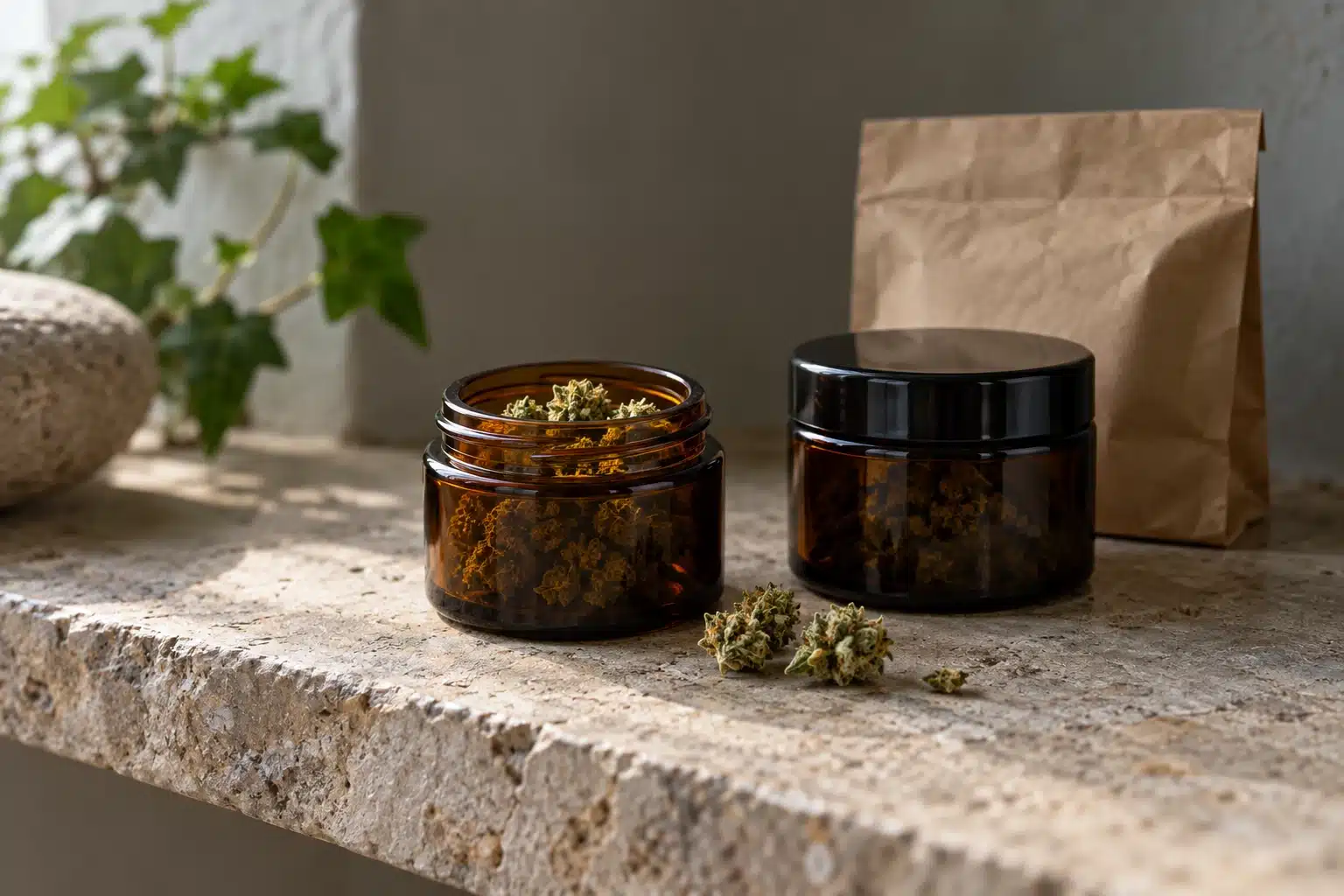
A clean jar with a tight-fitting lid can be helpful if the bag doesn't reseal reliably. Tinted glass or storage in a cupboard protects against light; the container must above all be clean, dry, and adequately sized. A clear jar is fine if kept in a dark place. Conversely, a brown glass jar left on a windowsill all day won't mitigate the effects of heat exposure.
Avoid automatically transferring all the flowers upon receipt simply out of habit. Each handling can break the small buds or mix up batches you wished to keep separate. If the original packaging suits you, you can keep it sealed in a suitable location. If you are dividing a large bag into several containers, use clean, dry containers, and note the variety and batch number found on the label.
Do not mix a new order with the remains of a previous one before examining both products separately. Mixing them makes it impossible to trace their origin and understand why a smell or texture changes. This precaution is especially important when comparing several products advertised as containing 12% CBD: the percentage may be similar, while the batch dates and flavor profiles may differ.
Divide into 50 or 100g portions: a simple method to limit openings
If you buy 50 or 100g of a variety you already know, dividing the quantity can be practical. Keep a small portion in a container that you open frequently and seal the rest, clearly labeled, in one or more separate containers. This organization reduces the number of times your stash is opened. It doesn't replace proper initial drying and doesn't guarantee a long shelf life, but it directly addresses the problem created by large quantities.
For example, 100g of Skywalker can be divided into several portions to suit your habits, rather than remaining in a single container that's opened repeatedly. There's no 10g or 20g fraction that's scientifically optimal for everyone: choose a portion that's consistent with the available space and how often you'll actually open it. The goal is to keep the container closed while you're using the current portion.
Label each container with the variety name, the date of receipt, and, if available, the batch number. This prevents confusion between Skywalker and Sour Diesel after removing the original packaging. Keep the invoice or a photo of the label so you can find the corresponding product information sheet. Do not write "12% measured" if you only have the concentration listed on the product page: the precise figures for a batch are verified by its analysis.
For 25g, dividing the jars may be unnecessary if you rarely open the package and have suitable storage. The goal isn't to have more jars; it's to protect the flowers from factors that accelerate their growth. The more complicated the process becomes, the more likely you are to neglect the simplest step: properly closing the container after each opening.
Light and heat: where to actually place the stock
A cupboard away from windows, radiators, and other heat sources is an easy solution. Avoid storing it near a car, a windowsill, or an appliance that cycles on and off. Even when packaging blocks light, the ambient temperature of the storage location remains a separate factor. Fluctuations can also promote condensation if the container is regularly moved from a cold environment to a warmer one.
Studies comparing storage temperatures don't mean every buyer should refrigerate their hemp. A home refrigerator is frequently opened, contains moisture and odors, and can cause temperature fluctuations when you remove the container. If you're considering refrigeration for a large supply, ask for instructions tailored to your actual storage needs and avoid frequent trips back and forth. For most everyday storage decisions, a dark, temperate location is a simpler solution.
The freezer is not a shortcut to be recommended indiscriminately. Some research has examined chemical stability at very low temperatures, but this information does not address the household challenges of handling, sealing, condensation upon returning to room temperature, or the fragility of small dried flowers. A laboratory study observes compounds under a controlled protocol; it does not guarantee that your bag will withstand multiple freezing cycles.
If your home gets very hot in the summer, carefully consider the quantity you buy and the most stable storage location available. A cheap 100g bag left for several weeks in an overheated room may offer a less satisfying flavor experience than a smaller quantity that is replenished afterward. The cost-benefit analysis only makes sense if you can reasonably store the product.
Humidity: recognizing the risk without inventing a universal figure
A dried flower is not necessarily completely devoid of moisture. An overly humid environment can promote undesirable deterioration, while excessively dry material becomes more brittle and may lose some of its fragrance. It would be unwise to establish a universal moisture percentage applicable to all batches without knowing their drying process, water activity, or packaging. The primary focus should be on the condition observed upon receipt and the cleanliness of the storage area.
Examine the flower before storing it permanently. If it has a distinctly abnormal odor, unexpected moisture, suspicious areas, or visible signs of mold, stop handling it unnecessarily and contact the seller with photos and the batch number. Do not attempt to "save" suspect material by airing, heating, or mixing it with a healthy flower. A normal, pleasant scent is also not sufficient to guarantee the absence of contamination.
Never place flowers in a damp container after washing. Allow the container to dry completely before adding the product. If you use a humidity control device, follow the manufacturer's instructions and ensure its compatibility with the type of product: an accessory should not mask an underlying quality issue. Ideal storage conditions depend on the batch and the seller's recommendations.
Also avoid unnecessary room changes. Regularly moving the same flowers between a cold and a warm place increases the chances of condensation. A stable supply in a suitable location is generally easier to monitor than a series of adjustments aimed at maintaining a perfect temperature on paper.
Whole small flowers or crushed material: what difference does it make during storage?
The small size of a small bud doesn't mean it should be further reduced before storage. The more a flower is fragmented, the greater its surface area exposed to air; its aromatic compounds can then evolve differently. Research has compared whole and crushed inflorescences during storage. To preserve the desired profile as much as possible, keep the flowers whole and limit repeated handling.
This recommendation should not be taken as an absolute guarantee. Two different batches, one with small buds and the other with large flowers, can vary for many other reasons: cultivation, drying, sorting, variety, and packaging. You cannot calculate a "loss of terpenes in small buds" based solely on their size. You must assess the batch information and its actual development, without interpreting a size difference as a chemical diagnosis.
Each time you open the container, take only the amount you need to examine the product and then reseal it. Avoid leaving the container open for extended periods on a sunny table while you're doing other things. Effective practices require neither expensive equipment nor complicated protocols: preserving the physical integrity of the small flowers and reducing repeated exposure are enough to improve the consistency of your system.
Economic calculation: when does 100g at €0.99/g make sense?
On the Skywalker and Sour Diesel product pages viewed on September 28, 2026, the 100g tier is listed at €0.99/g, or €99 for 100g before any applicable bonus conditions. The 50g tier at €1.50/g represents €75; the 25g tier at €2/g represents €50. The 100g tier costs €24 more than the 50g tier while doubling the quantity received. This represents a significant reduction in the unit price, but also an additional expense and a quantity to maintain.
| Format | Price displayed per gram | Total calculated | Conservation issue |
|---|---|---|---|
| 2 g | 4,50 € | 9 € | Do you like the variety enough to buy more? |
| 5 g | 3 € | 15 € | Is a tightly sealed bag enough for you? |
| 10 g | 2,50 € | 25 € | Do you have a dark and dry location? |
| 25 g | 2 € | 50 € | How long will you keep this variety? |
| 50 g | 1,50 € | 75 € | Would a separate storage area be useful to you? |
| 100 g | 0,99 € | 99 € | Can you store the batch without repeated openings? |
Let's say you're hesitating between two varieties. Two 25g bags, at the price you see, would cost €100 for a total of 50g. A 100g bag of a single variety would cost €99, almost the same amount spent for twice the weight, but without any flavor diversity. This comparison doesn't point to a clear winner; it highlights the trade-off between quantity, flavor selection, and how long each bag will last in your home.
Don't calculate shelf life by simply dividing the number of grams by an assumed daily consumption. Your habits may change, the batch may vary, and summer conditions may differ from winter ones. Ask yourself a more concrete question: would you still want this same variety at home after you've used the first small portion? If you're unsure, an intermediate size is a more flexible first step.
Skywalker and Sour Diesel: two profiles to protect differently in your choices
Skywalker 12% highlights wood, citrus, and pine. Sour Diesel 12% features lemon, herbaceous, and citrus notes. Both products share the same price range, the same six weights, and a stated origin in the Rhône-Alpes region. Their main difference lies in the specific flavor profile you're looking for. Therefore, your choice of size may depend more on your preference for this profile than solely on the CBD percentage stated in the product name.
If you already appreciate the woody notes of Skywalker, a larger format can make sense, provided you can store it properly. If you're exploring the herbaceous and citrusy character of Sour Diesel for the first time, start more modestly. The same reasoning applies in reverse, depending on your preferences. No variety inherently keeps better than another simply because its name evokes pine or lemon.
When a sachet starts to lose the intensity you expected, carefully compare it to your memory. The perceived odor also depends on the room temperature and the condition of the product when you open the container. A less pronounced aroma alone does not necessarily indicate a health problem or a different CBD concentration. However, a suspicious odor or abnormal appearance warrants discontinuing use of the batch and contacting the seller.
The labels state "12% CBD," but only batch-specific analysis can accurately document its composition. Storage does not create a new certificate of analysis; it helps limit post-sale alterations. If you store multiple batches for an extended period, note their origin so you can compare their data rather than attributing any differences to storage methods.
Receiving check: five observations before storing the bag
Start by checking that the packaging is intact and that its closure system is working. Then note the variety name, weight, and batch number if provided. Examine a small sample of the flowers in a well-lit area, without emptying the entire order. Note their initial scent and appearance: this personal reference will allow you to observe any changes later, without attempting to conduct a laboratory test.
The third observation concerns the apparent dryness level. A flower that appears excessively damp or has an unexpected appearance warrants questioning the seller before prolonged storage. The fourth concerns the possible presence of foreign matter or suspicious areas. Finally, verify that the documents presented for reference pertain to the batch received. These steps take little time and are particularly useful before dividing 100g into several containers.
Keep your order information and photograph the label if necessary. If a problem arises later, you'll be able to specify precisely which product code and batch are involved. This traceability is more reliable than a memory like "the large lemon-flavored bag I bought last month." It also prevents confusing a change due to storage with a difference between two orders.
The Small Buds CBD category is used to compare products available at the time of purchase. Check the product page for your chosen variety, as stock levels, weight options, and prices may change. If you require specific information about packaging or batch size before placing a large order, please contact customer service before selecting the 50g or 100g option.
Mistakes in storage can quickly ruin a good price
The first mistake is leaving the large bag open because it's used regularly. Each time you forget, it increases the time the flowers are exposed to air and room conditions. Instead, prepare a regular portion and seal the rest. The second mistake is displaying the flowers in a clear jar on a sunny shelf. The visual effect is pleasing, but the light and heat are counterproductive to proper storage.
A third mistake is storing the flower near a source of strong odors. Even if a container seals tightly, it's best to choose a clean, neutral location, free from household products or perfumes. The fourth is washing a jar and filling it before it's completely dry. A damp container introduces a problem the batch may not have had to begin with.
Finally, systematically buying the largest possible weight to take advantage of the price per gram can be counterproductive. A price advantage doesn't necessarily compensate for a variety you'll tire of or unsuitable storage conditions. The advertised savings are one factor in the decision; the quantity you actually enjoy is another. Consider the cost of your stock as you actually use it, rather than just the price displayed on the store's price list.
Frequently asked questions about storing Small Buds CBD
How long can you keep a 100g sachet?
There is no universal shelf life that can be deduced solely from weight. It depends on the initial drying process, the batch, the packaging, and the actual storage conditions. Scientific studies show changes depending on time, light, and temperature, but cannot guarantee that a specific commercial bag will retain its aromatic notes for a given number of months. Purchase an amount consistent with your usual consumption habits.
Is it absolutely necessary to buy a glass jar?
No. An undamaged, opaque, and resealable original bag can be suitable, depending on its quality and the intended storage time. A clean, dry jar is a good option if the bag's closure is inconvenient or if you want to divide a large quantity. Where you store the container is just as important as its material.
Does the refrigerator always preserve flowers better?
Comparative studies have examined cold temperatures and observed differences in chemical stability. These studies do not demonstrate that a home refrigerator is always the best choice for every CBD bag: humidity, odors, repeated openings, and condensation must be considered. For regular use, prioritize storage in a dark, clean, dry, and stable location.
Can several varieties be kept in the same jar?
You risk mixing their scents and losing batch traceability. Keeping Skywalker and Sour Diesel separate allows you to track their evolution and find the corresponding analysis. This is particularly useful if you have purchased several small bottles to discover their profiles.
Does a small flower necessarily degrade faster than a large one?
It's impossible to say for every batch. Size, structure, and surface area can all play a role, but so do variety, drying, packaging, light, and temperature. Keeping small buds whole and minimizing handling is a reasonable precaution, though it doesn't guarantee predicting their exact development.
Buy the right amount, then give it the right place
To discover a new variety, the 2, 5, or 10g sizes prevent you from turning a good deal into a stockpile of flavors you don't like. If you already know your favorite, 25 or 50g can reduce the unit price while remaining easier to store than 100g. The 100g price point at €0.99/g, seen with Skywalker and Sour Diesel, is mainly worth considering if you truly appreciate variety and have suitable storage space.
Upon receipt, check the packaging, the condition of the flowers, and the batch information. Store the stash in the dark, in a dry place, and at as stable a temperature as possible. Keep small buds whole, minimize openings in the stash, and do not mix different batches. These steps won't freeze the flower in time, but they will allow you to get more out of the chosen format and preserve the aromatic qualities that motivated your purchase for longer.