CBD 60% or CRD 99.9% cartridge: compare before you buy
Two 510 cartridges are listed in The French Hemp Empire's CBD Vapes category. One is called CBD Full Spectrum 60% and is priced at €25.90. The other is called CRD Vape 1ml 99.9% and is priced at €49.90. The temptation is strong to immediately interpret these figures as "more CBD for almost double the price." This interpretation would be too hasty: the first product description explicitly states 60% CBD, while the second describes a cannabinoid-rich distillate called CRD, without specifying on the product page which single substance its 99.9% concentration represents.
This comparison helps you choose a cartridge suited to your needs, understand its cost with a battery, and identify any missing information. The store data was accessed on September 28, 2026; prices, variations, and stock levels are subject to change. We are discussing products intended for adults and their product descriptions, without implying that a higher percentage provides a specific benefit or experience.
The two fact sheets at a glance
Both products share a 510 thread : a compatible battery is therefore required if you don't already have one. They differ in their name, their stated concentration, their indicated volume, and their terpene selection. The table separates the information displayed from the points to be confirmed before ordering.
| Criteria | CBD Full Spectrum 60% | CRD Vape 99.9% |
|---|---|---|
| Name of the record | 510 CBD Full Spectrum 60% Cartridges – Pure Extract CBD | 510 CRD Vape Cartridge 1ml 99.9% |
| Price displayed on September 28, 2026 | 25,90 € | 49,90 € |
| Capacity indicated | 0.5 ml or 1 ml depending on the model in the description; variant to be confirmed | 1 ml |
| base of the figure | 60% CBD content | 99.9% advertised for a CRD formulation; analytical details available upon request |
| Presentation of the excerpt | Full spectrum | Cannabinoid-rich distillate, or CRD |
| Visible aromatic choices | Eight terpene options | Four terpene options |
| Material | 510 battery required | 510 battery required |
This table does not establish any equivalency in terms of the actual quantity of CBD delivered. The contents of the 60% cartridge must first be confirmed for the purchased variation. For the CRD (CBD Reference Intake), the identity of the compounds measured by the figure "99.9%" must be explained. Even when two products display 1 ml, this volume alone does not indicate the mass of CBD or the complete nature of the extract.
What does "CBD 60%" mean on a cartridge?
The first label clearly states a 60% CBD concentration in a cartridge described as full spectrum. This provides a reference point for the formulation, which should be verified on the certificate corresponding to the shipped batch. The "full spectrum" designation suggests the presence of other hemp compounds. It does not indicate the exact quantities of each, nor the measured THC content of the variant you will receive. This information requires detailed analysis.
It's also important to avoid a common calculation: "1 ml at 60% = exactly 600 mg of CBD." A milliliter measures a volume, while a percentage can refer to a mass, a volume, or another basis specified by the manufacturer. Without the formulation's density, a defined percentage, and batch analysis, this conversion to milligrams would be nothing more than an assumption. Furthermore, the product information sheet mentions 0.5 or 1 ml depending on the model, whereas the actual quantity charged should be determined in the purchase interface.
The page displays eight terpene names: Kush Note, ZKZ, Sweet Watermelon, Super Lemon Haze, Gelato 41, Amnesia Haze, Wedding Cake, and Super Silver Haze. These are aroma choices. Selecting "Sweet Watermelon" does not automatically change the CBD level; choosing "Super Lemon Haze" does not guarantee that a flower of that strain was used in the cartridge. For a purchase based on a specific strain or origin, ask what the profile name specifically describes.
What does "CRD 99.9%" cover?
The CRD product sheet explains the acronym as Cannabinoid Rich Distillate, meaning a distillate rich in cannabinoids. It presents a 1ml pre-filled cartridge, priced at €49.90, and indicates "concentration: 99.9%" in its specifications. However, the information provided does not include a detailed breakdown of the cannabinoids, which would allow for the assertion that 99.9% of the final product is composed of CBD. The title does not explicitly state "CBD 99.9%": this distinction directly impacts the comparison.
A percentage very close to 100 requires even more clarification: is it referring to the claimed purity of an ingredient before blending, the proportion of a cannabinoid family in the distillate, or the final formulation? If terpenes and a base are included in the extract, their role in the calculation must also be explained. Don't assume these answers are based on marketing. Ask for the composition of the finished product and the batch analysis corresponding to the chosen flavor variant.
The product information sheet also states "THC: 0%". This statement must be interpreted in conjunction with the limits and list of substances analyzed by the laboratory: "0%" on a product page does not necessarily describe the limit of detection of an analytical method. An analysis may indicate a measured value, a value below a limit of quantification, or no detection under the test conditions. These are different formulations, important for interpreting a specific claim.
Four options are visible for this cartridge: Amnesia, Watermelon, Super Lemon Haze, and Gelato. You can identify a flavor family from these names, but you can't deduce the molecular profile of the distillate from them. If your choice of CRD is primarily based on its advertised 99.9% ABV, prioritize analysis over the aroma: it's what will allow you to understand this figure.
Price of the cartridge alone: a difference of €24
At the time of consultation, the CBD Full Spectrum was listed at €25.90 and the CRD at €49.90. The difference is €24 per cartridge. The CRD costs approximately 1.93 times the listed price of the 60%. This calculation describes the expense, not the ratio between their CBD contents. A price difference can reflect positioning in formula, manufacturing, volume, or marketing; the product information alone does not allow us to attribute this €24 difference to a precise additional quantity of CBD.
The price per milliliter of the CRD is easy to calculate from its product page: €49.90 for 1 ml. For the 60% CBD, €25.90 only represents €25.90/ml if the purchased variation contains 1 ml. If it contains 0.5 ml at the same price, the calculation would be €51.80/ml. This is a mathematical calculation, not a statement that the two sizes are actually priced the same. Check the variation and its total in your cart before assuming a price per milliliter.
Another comparison tool, the price per milligram of CBD, would require two reliable pieces of information for each cartridge: the milligrams measured in the finished product and the price of the corresponding variation. Labels like "60%" and "99.9%" are insufficient. Without this data, the most accurate calculation remains the purchase price and, when the volume is confirmed, the price per milliliter.
First purchase: add the actual cost of the battery
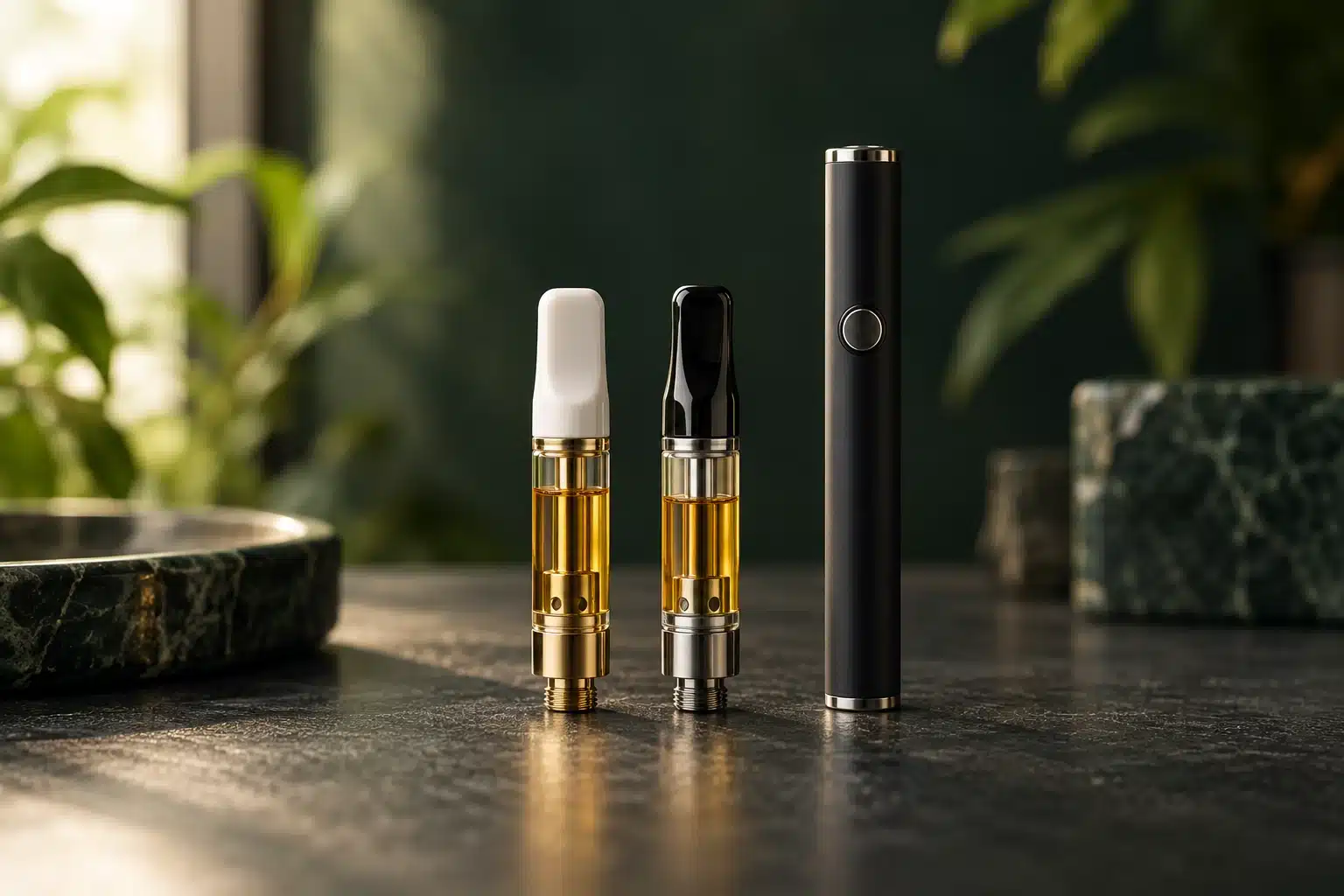
A pre-filled cartridge is not automatically a complete device. The website offers a separate Vape Pen 510 – Pure Extract CBD for €18.90 at the time of our visit. If you don't already own a compatible battery, this cost will be included in your first order. If you already have a 510 device compatible with the chosen cartridge, it doesn't need to be added to each order.
| Calculated scenario | Products | Total excluding fees and discounts |
|---|---|---|
| First purchase of 60% CBD | Cartridge €25.90 + vape pen €18.90 | 44,80 € |
| First purchase CRD 99.9% | Cartridge €49.90 + vape pen €18.90 | 68,80 € |
| Next CBD cartridge | A cartridge, battery preserved | €25.90 at the consulted price |
| Next CRD cartridge | A cartridge, battery preserved | €49.90 at the consulted price |
These totals are indicative sums, not confirmed order simulations. Shipping costs, minimum order amounts, and promotions should be verified at checkout. The site offers free shipping above a certain amount, but this is subject to change; please check your actual shopping cart. A CRD cartridge priced at €49.90 and a 60% CBD kit with a battery at €44.80 do not, in fact, meet the same material needs, even if their prices seem similar.
The vape pen's product description states that it has a rechargeable battery with a 510 thread, while also noting that certain features vary depending on the model: automatic or button activation, charging method, and any other adjustable settings. Before ordering, verify which version you will receive and its compatibility with your cartridge's coil. While a common thread is a starting point, it doesn't guarantee the correct voltage or heating performance.
Full spectrum and cannabinoid-rich distillate: terms that need clarification
"Full spectrum" suggests that an extract retains several families of hemp compounds. This is a formulation guideline, and the precise content depends on the product and batch. To know which cannabinoids are actually present and in what proportions, look for a sufficiently detailed analysis. The presence of the word "spectrum" does not guarantee an identical list of compounds from one product to another, nor does it guarantee a specific experience.
"CRD" here refers to a family of cannabinoid-rich distillates. The term does not define a universal profile applicable to all cartridges bearing it. It is insufficient to indicate the total CBD, the cannabinoid ratio, or the proportion of terpenes. A distillate can be described as concentrated, yet a technical data sheet is still required to precisely explain its final composition.
These two designations are therefore not the two extremes of a simple scale ranging from "weak" to "strong." One cartridge may contain an explicitly quantified amount of CBD and several other compounds; another may highlight a highly concentrated distillate without immediately revealing the breakdown of its constituents. The best question to ask the seller is a concrete one: "How many milligrams of CBD and what other cannabinoids does the cartridge in the batch currently being sold contain?"
If you're looking for a specific composition, also ask for the complete list of ingredients in the e-liquid. Terpenes advertised as flavoring options are part of the information, not necessarily the entire formula. The base, other extracts, and any additives should be described. This is more important than the impression given by a technical name alone.
Reading a cartridge analysis certificate without confusing the units
A relevant certificate must be attached to the batch to be shipped. Verify the product name, batch number, date, laboratory, method, and list of cannabinoids measured. Then compare the units: mass percentage, milligrams per gram, and milligrams per cartridge are not read the same way. Conversion sometimes requires the fill mass, which is not equivalent to the volume shown in milliliters without explanation.
The CBD line on the 60% cartridge should allow for comparison of the advertised percentage with a measurement corresponding to the actual commercially available version. The other lines would serve to understand "full spectrum" and to verify the THC content. For the CRD (Competition Regulations), the priority is to determine precisely what constitutes the 99.9%: the sum of cannabinoids, the purity of an ingredient, or some other basis for calculation. Without a definition of the analyte, a very precise numerical value may remain of limited use.
It's also important to distinguish between testing the distillate used as an ingredient and analyzing the final cartridge. If terpenes or another base are added later, an analysis of the raw material will no longer necessarily describe the finished mixture in the same proportions. Ask at which stage the sample was taken and to which commercial batch the document relates. A photo of a certificate without these links doesn't allow for a proper comparison between two products.
Finally, the analyses only cover the substances specifically tested for and are subject to the limitations of the methods used. "Not detected" for a compound does not mean that its entire composition is known. For vaping products, information on ingredients and any relevant contaminants is particularly useful, since the product is intended for inhalation. Do not assume that a high concentration listed replaces documented quality control.
Aromatic profiles: eight options versus four
The 60% CBD cartridge offers eight terpene options. Some names evoke citrus notes, like Super Lemon Haze; others suggest a sweet or fruity character, such as Sweet Watermelon, Wedding Cake, or Gelato 41. Kush Note, on the other hand, suggests a hemp-inspired profile. These descriptions serve as selection guidelines, but the final result depends on the exact formulation and your personal preferences.
CRD offers Amnesia, Watermelon, Super Lemon Haze, and Gelato. It therefore covers several flavor families found in the other range, albeit with a smaller selection. If you have a specific flavor in mind, check its availability on each product page before making your final choice. The number of options alone is no indication of the e-liquid's analytical quality.
A terpene name or varietal inspiration does not necessarily equate to a certification of botanical origin. "Amnesia" on a selection may indicate a profile inspired by the variety, without guaranteeing that an extract of Amnesia flowers is used in the cartridge. To make an informed choice, distinguish between the sensory description, the source of the aromatic compounds, and the cannabinoid analysis.
If you're new to this product range, fragrance can be a secondary filter after addressing the basic questions: what finished product is sold, with what materials, in what quantities, with what analysis, and at what final price? Once these elements are established, the aromatic options help you choose according to your preferences without requiring them to provide information they don't contain.
510 compatibility: check more than just the thread
Both cartridges are advertised as having a 510 thread. A battery with the same threading is the logical starting point, and the vape pen offered on the website is listed as compatible with 510 cartridges. However, thread compatibility doesn't automatically determine the ideal voltage, power range, or whether an adapter will be needed. The specifications on both the cartridge and the battery must be read together.
The vape pen description lists several features "depending on the model." This means that the exact version should be confirmed if you have specific technical requirements: USB or USB-C charging, automatic or button activation, voltage adjustment or not. The same caution applies if you are using a personal battery. Check its specifications and the cartridge manufacturer's recommendations before combining the two products.
The cartridge should not be treated like a bottle of e-liquid intended for any device. A pre-filled cartridge has its own tank and coil; a loose-fill e-cigarette has a different configuration. Do not attempt to transfer the contents, modify the cartridge, or apply undocumented settings. To resolve compatibility issues, contact the seller with the exact specifications of your device.
Simple thread maintenance, following the manufacturer's instructions, can prevent faulty connections. This does not replace fault identification or technical advice when the battery overheats, the cartridge leaks, or the device appears damaged. In such cases, stop using the device and request instructions specific to your model.
Composition and inhalation: precautions that apply to both options
A vaping product is inhaled; therefore, the composition and quality of the liquid matter beyond just the CBD content. In 2026, ANSES (the French Agency for Food, Environmental and Occupational Health & Safety) published an expert report on vaping products that highlighted potential health risks, including for nicotine-free products. This does not constitute a specific assessment of these two cartridges, but it serves as a reminder that a "CBD" or "nicotine-free" label is not sufficient to establish the safety of an aerosol.
Ask for a clear and understandable ingredient list and avoid assuming that every natural component is necessarily suitable for inhalation. The nature of the carrier, any additives, the extract batch, and the quality controls performed are all useful information. The higher price of CRD alone does not guarantee superior safety; nor does the lower price of 60% CBD demonstrate the opposite.
Safety recommendations regarding the battery and cartridges are important: do not handle a damaged device, keep components out of reach of children, and follow the manufacturer's instructions. If you are seeking an answer to a personal health question, consult a healthcare professional. This comparison is intended to provide an overview of two commercial offers and their documentation, without presenting vaping as a treatment or a guaranteed way to achieve a specific effect.
Which product should you choose based on your purchasing priority?
First, you want a clearly stated CBD level
The 60% Full Spectrum CBD cartridge is a more direct response to this search: its product information explicitly identifies CBD as the main ingredient and associates the 60% concentration with this cannabinoid. However, verify the contents of the selected variation, the price charged, and the batch analysis. The term "full spectrum" also warrants further investigation by detailing the other ingredients.
You specifically want to discover a CRD distillate
The 1 ml CRD cartridge is the product you're looking for, but clarify the meaning of 99.9% before purchasing it for that reason. Check what the distillate contains, the composition of the final product, and the THC measurements. Its four flavor options will then allow you to choose the aroma, without having to answer these analytical questions for you.
Your initial budget is the determining factor
Without a battery, the calculation based on the displayed prices is €44.80 for the 60% CBD cartridge and vape pen, compared to €68.80 for the same vape pen with the CBD cartridge. If you already own a compatible battery, the cartridges alone cost €25.90 and €49.90 respectively. Check for fees and promotions at the checkout; especially compare the actual volume variations.
Are you looking for a specific aromatic profile?
Full Spectrum CBD offers eight visible terpene names, while CRD offers four. If Sweet Watermelon or Wedding Cake are of interest to you, only the first list will display them under those names. If you're looking for Amnesia or Super Lemon Haze, both pages offer a corresponding inspiration option. Ask for a detailed ingredient list if the botanical source of the flavors is a deciding factor for you.
Frequently asked questions before validating the shopping cart
Does a CRD 99.9% cartridge contain 99.9% CBD?
The product information sheet states 99.9% for a CRD formulation, described as a cannabinoid-rich distillate. However, it does not provide any analysis on the page proving that this percentage specifically refers to the CBD content in the final cartridge. To answer this question, the complete composition and certificate for the shipped batch are required.
How many milligrams of CBD does the 60% cartridge contain?
The product information states 60% CBD and mentions capacities of 0.5 or 1 ml depending on the model, without allowing for a precise calculation of the number of milligrams delivered for the chosen variation. Request the quantity measured per cartridge, its fill weight if necessary, and the definition of the percentage unit used.
Is a battery included with the cartridges?
Both listings feature 510 cartridges. The vape pen is offered separately for €18.90 at the time of viewing. Check the exact contents of the package and whether a battery is included in a bundle offer before ordering. Do not assume that an accessory is included based on the photograph.
Does the almost double CRD price prove that it's better?
No. He notes a price difference between two products with distinct presentations. To evaluate what you receive, you need to know the quantities, the analyzed composition, the document quality, the required equipment, and the specific features you are looking for. Price does not measure effectiveness or safety.
Are both cartridges THC-free?
The CRD label states "THC: 0%" commercially, while the CBD Full Spectrum label indicates a level below 0.3%. To determine the actual measurement and its analytical limit for the received variation, consult the batch certificate. Do not transfer the claim from one label to the other.
A good comparison begins with four verified data points
Before purchasing from the CBD vapes category, confirm the exact size and price of your chosen variant, whether or not it includes a battery, the liquid's ingredient list, and the batch analysis. For 60% cartridges, specifically look for the measured amount of CBD and other cannabinoids that justify the "full spectrum" claim. For CRD (Chemical Residue Density), clarify exactly what the "99.9%" claim measures.
At the higher price point, the CBD Full Spectrum cartridge is the cheaper of the two and offers more flavor options; the CRD cartridge contains 1 ml and is advertised as a concentrated distillate. These differences are only relevant if you consider them in relation to your specific needs. A sound decision depends on the finished product you will receive, its total price including necessary materials, and sufficiently precise batch information to make sense of the numbers printed in its name.