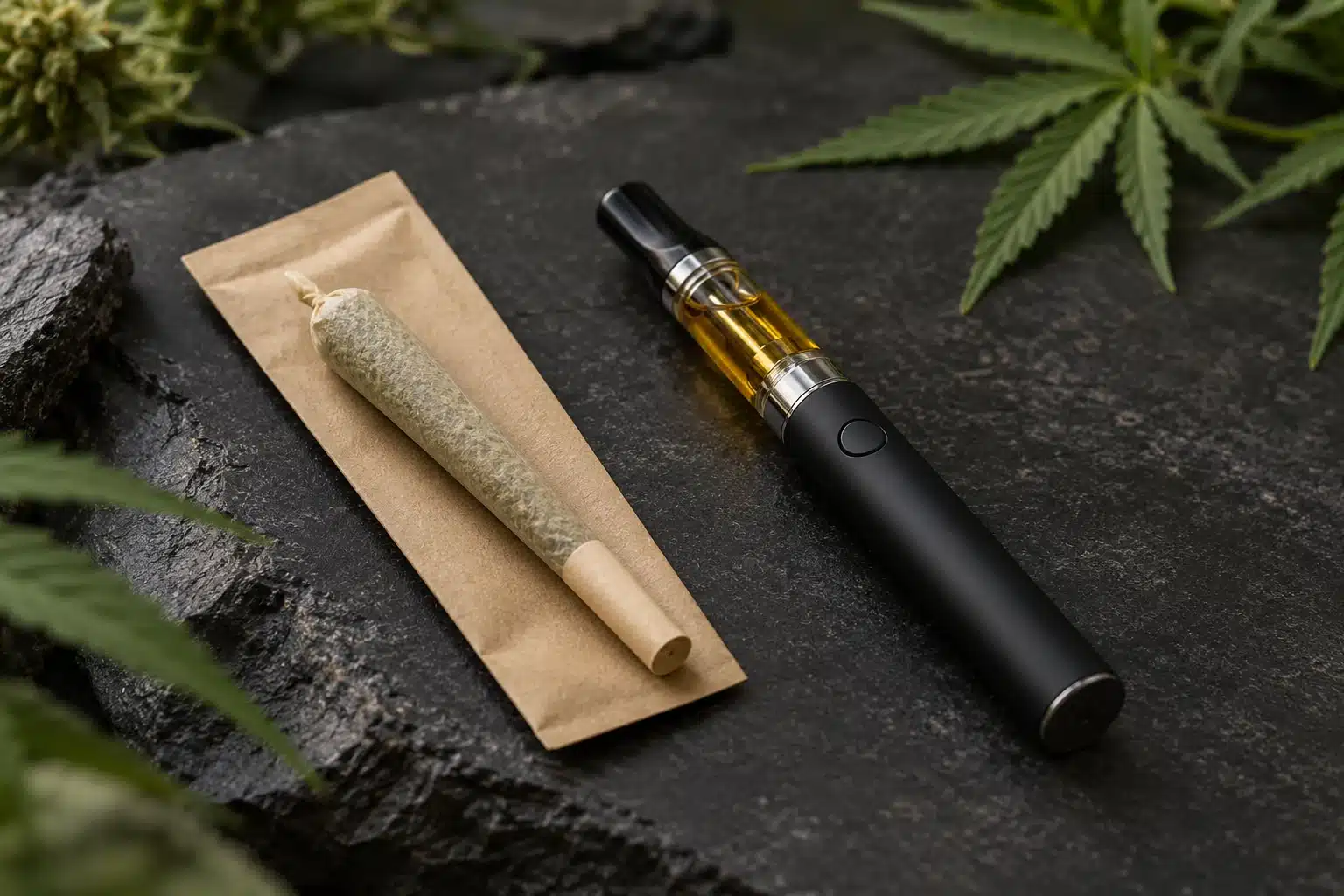
Vape 10-OH or pre-rolled Rollz: which format to compare?
The French Hemp Empire's 10-OH category features two Rollz products that might seem directly comparable: a 1ml 10-OH-HHC 97% vape priced at €39.90 and a 2g 10-OH 50% pre-roll priced at €14.90. The prices immediately catch the eye, but they don't refer to the same units of measurement, nor, to be certain, to the same compound identified in both descriptions. The first name explicitly states "10-OH-HHC," while the second simply states "10-OH."
Before making a choice, it is therefore essential to consider the packaging, the actual composition of the batch, the necessary equipment, the price of each unit, and the available options. This guide reflects the information displayed on September 28, 2026, and indicates what further information is required. Prices are subject to change. Crucially, a product listing and trade name alone do not guarantee the regulatory status of a substance: its chemical identity must be known before any assessment of its compliance in France.
Two Rollz products, two very different items
The vape is described on its product page as a vaporization device containing 1 ml of pre-filled e-liquid. Depending on the version, it could be an all-in-one device or a cartridge requiring a compatible battery; the page uses both possibilities without clearly specifying which corresponds to the variant currently being sold. This difference affects the actual cost and should be confirmed before ordering.
The pre-rolled tobacco, on the other hand, is advertised as a 2g product made with a plant-based preparation and a commercial concentration of 50% 10-OH tobacco. Its weight in grams describes the advertised mass of the product, while a milliliter of vape measures the volume of liquid. A simple "2 is greater than 1" comparison is meaningless without knowing the density, actual mass, and substances present in each finished product.
| Point to compare | Vape Rollz | Pre-rolled Rollz |
|---|---|---|
| Display name | Vape 10-OH-HHC 97% Rollz 1 ml | Preroll 10-OH 50% Rollz 2 g |
| Price raised | 39,90 € | €14.90 for one piece |
| Quantity advertised | 1 ml of formulation | 2g for the pre-rolled |
| Compound or formula named | 10-OH-HHC | 10-OH, shorter designation to be documented |
| Announced concentration | 97 % | 50 % |
| Visible variants | Ten terpene choices | Nine terpene choices in the consulted selector |
| Equipment to be confirmed | Battery included or required depending on the version | A pre-rolled piece |
This table is for reading offers, not for calculating comparative intensity. Percentages do not translate to "97% effect" or "almost twice as strong." Even if both products contained the same substance, their carrier, formulation, other components, and method of application would differ. And the pre-roll's information sheet does not sufficiently specify the chemical identity of its "10-OH" to establish this first condition.
"10-OH" and "10-OH-HHC": the detail that changes the comparison
The vape product name refers to 10-OH-HHC. The pre-rolled product name uses only "10-OH." This abbreviation alone is insufficient to conclude that the two descriptions refer to the same compound. The pre-rolled product page explicitly acknowledges this in its description: manufacturer documentation or analysis is required to identify the substance, rather than automatically assuming the abbreviated name is correct.
This is not a trivial debate about terminology. To compare concentrations, determine the status of a formulation, or interpret an analysis, you must first know the exact compounds. A certificate bearing only the commercial designation "10-OH" would still leave open the question of what was measured. Request the precise chemical name, the analytical standard used, and the lot number corresponding to the reference sent.
The prefix "hydroxy" in 10-OH-HHC suggests a structural relationship with HHC. It does not, however, provide all the necessary information about isomers, the composition of the mixture, or the legal classification of the identified substance. Do not infer pharmacological equivalence with HHC or authorization for sale simply because the name contains additional letters. Official decisions apply to substances and, in some cases, to chemically defined families.
If you're specifically looking for 10-OH-HHC, the vape's description will make this clearer in its title, subject to analytical verification. If you're examining pre-rolled tobacco, first ask what its "10-OH" designation means. Until this is clarified, referring to "97% versus 50% of the same molecule" would be an unjustified oversimplification.
97% and 50%: what does each percentage measure?
The vape product information sheet states 97% 10-OH-HHC for a 1 ml formulation. Even here, a check is still necessary: does the figure refer to the distillate used, the final contents of the cartridge after adding terpenes, or some other basis for measurement? To know the exact quantity of compound in a device, you need to know the unit of the analytical result and, where applicable, the actual mass of the cartridge. A volume of 1 ml and a percentage are not always sufficient to obtain reliable milligrams.
For the pre-rolled product, the label states 50% "10-OH" and 2 g of product. One might be tempted to write "1 g of 10-OH per pre-roll." This would imply that the 2 g is exactly the mass of the analyzed preparation, that the concentration is by mass, homogeneous throughout the finished product, and linked to a clearly identified substance. These conditions are not all met in the label. Presenting this number as a guaranteed quantity risks misleading the buyer.
The numerical difference between 97 and 50 is 47 percentage points. This provides no measure of the effects, their duration, or equivalence to THC. The specific clinical studies available for these commercial formulations are insufficient to establish such claims. A percentage listed in a catalog is primarily a stated ingredient, which should be compared with a relevant analysis.
The best use of these percentages is therefore to formulate precise questions. For vaping: what is the profile of the finished formulation, and is the 97% percentage verified after the terpenes are added? For pre-rolled tobacco: what is the identity of the compound, which portion of the 2 grams was analyzed, and does the sample accurately represent the products sold? A seller who can link their figures to reliable documentation makes a truly valid comparison.
Price: €14.90 per unit or €39.90 per vape
The displayed price of the vape is €25 than that of a pre-rolled joint. Two pre-rolls at the displayed unit price would cost €29.80; three would cost €44.70 before any potential discount. The pre-roll product page also indicates a discounted price of €13.30 per unit for three, totaling €39.90 if this condition is indeed applied to the shopping cart. The final price should be verified for the chosen variants.
The fact that €39.90 for vaping and €39.90 for three pre-rolls at the promotional price are similar does not make these purchases equivalent. In one case, you are buying 1 ml of a formulation intended for an electronic device; in the other, three 2 g packs. The actual usage time, the measured composition, and the included equipment remain different or are not specified. The same price does not allow for a direct comparison of the amount of a compound consumed.
Vaping can also incur a battery cost if the version sold is a cartridge only. The product description mentions an all-in-one device or a compatible cartridge depending on the version; this should not be interpreted as a guarantee that a battery is always included. The website also offers a 510 vape pen separately in another category. Do not automatically include it in your calculations: first, confirm the exact contents of the Rollz box and the advertised compatibility.
For pre-rolled cannabis, the unit of sale is one piece. The price of €14.90 does not correspond to a price per gram of identified cannabinoid, nor to a price per milliliter. Use the correct units: euros per piece and, for purely arithmetic purposes, €7.45 per gram of stated weight if the 2g refers entirely to the product sold. This last calculation says nothing about the distribution of the active compound in the preparation.
Terpene variants: the lists actually visible
On the vape's product page, the selector displays ten profiles: Amnesia Haze, Blackberry Kush, Blue Dream, Gelato Drip, Chem Dawg, Jet Fuel, Midnight Octane, Skunk, Sugar Dough, and Tahoe OG. These names allow you to search for a flavor family, but they don't prove that an extract from the corresponding genetics is used. Terpenes primarily describe an olfactory characteristic and don't automatically change the main compound advertised.
The pre-roll selector displays nine profiles: Amnesia Haze, Cali Octane, Jet Fuel OG (Granddaddy Purple), Grape Ape, Cherry Gelato, LA Kush Cake, Maui Wowie, Super Lemon Haze, and White Fire OG. However, part of its description indicates that no specific profile is defined and advises against creating variations. Therefore, the nine options visible on the page at the time of viewing should be the primary consideration, with a final check of availability in the shopping cart.
This internal inconsistency is worth noting, especially if you're looking for a very specific aromatic variety. A selector and a product description may not have been updated simultaneously. The list of actually selectable options, the shopping cart summary, and, if necessary, a response from the seller will clarify which variant will be shipped. Don't rely solely on a mention found in an older paragraph.
Some names are similar between the two products, such as Amnesia Haze or Jet Fuel and Jet Fuel OG. However, these should not automatically be considered identical recipes. Vaping and pre-rolling are different products; even a shared flavor name can correspond to different terpene compositions and flavor profiles. Choose your flavor after clarifying the substance, batch, and format.
Vaporization and combustion: distinct routes of exposure
Vaping involves heating a liquid or viscous formulation in equipment designed to produce an aerosol. Pre-rolled tobacco is a format intended for combustion. This technical distinction prevents them from being treated as two interchangeable packages of the same product. The medium, the temperature reached, the inhaled components, and the quality of the device or the preparation all contribute to actual exposure.
However, it would be wrong to conclude that either format is risk-free. ANSES (the French Agency for Food, Environmental and Occupational Health & Safety) has identified potential health risks associated with vaping products, including nicotine-free ones. Combustion, for its part, produces compounds linked to the smoke, in addition to those listed on a plant material data sheet. The choice of format should not be presented as medical advice or as a guarantee of relative safety applicable to any given individual.
The quality of the inhaled formulation requires information specific to each product. For vaping, request the complete list of ingredients, the composition of the distillate, any additives, and the relevant controls for the final cartridge. For pre-rolled tobacco, inquire about the plant material, the stated enrichment method, the composition of the finished product, and the batch results. The same logo on two products does not guarantee interchangeable analyses.
People who don't want to inhale combustion products shouldn't confuse pre-rolled tobacco with raw flower in a bag. Those who don't want to use electronic devices should check what vaping actually requires. These are format preferences; they don't necessarily mean that one of the two listed concentrations is a healthier option.
Four documents to obtain before a serious comparison
The first is a composition sheet . For vaping, it must specify what fills the tank and any added terpenes. For pre-rolled tobacco, it must describe the material inside the pouch and explain what the "50%" percentage refers to. A vague list of ingredient families can be a starting point, but it doesn't provide the chemical identity of the highlighted compound.
The second document is the batch analysis certificate, including the laboratory, date, and method used. The results must clearly distinguish between 10-OH-HHC, "10-OH," and other cannabinoids being tested for. Verify the unit of measurement for each line and the correlation between the batch number on the document and the batch number of the delivered product. A certificate for a raw material should not be presented as a certificate for the finished product without explanation.
The third point is a description of the actual packaging. Does the vape include a battery? Which version is sold for each terpene option? Does the pre-roll claim 2g of preparation or the total weight of the device including the paper and mouthpiece? These answers help determine the quantity purchased and the total cost. They prevent us from establishing a value-for-money ratio based on ambiguous data.
The fourth factor is the legal identification of the compound, established based on its chemical name and applicable French regulations. ANSM (French National Agency for Medicines and Health Products Safety) decisions have classified several cannabinoids and also define certain families by structure. The presence or absence of an abbreviated name in a search engine is not sufficient to determine its legality. If the seller cannot precisely identify the substance present in one of the products, a categorical assertion of its legality would be unfounded.
Status in France: what trade names don't reveal
HHC was classified as a narcotic in France in 2023. In 2024, the ANSM (French National Agency for Medicines and Health Products Safety) also made decisions concerning cannabinoid families defined by their structure. These texts are not simply a list of marketing names. Their application to a specific formulation requires chemically identifying the compounds present, then examining the texts and any amendments in force.
It would therefore be unwise to write "10-OH-HHC is legal because it doesn't say HHC" or, conversely, to automatically deduce the classification of every commercially available variant solely from the label "10-OH." The level of evidence required for responsible purchasing is higher: the exact formula, analyses, and interpretation of the applicable regulations. The product pages do not provide all of this information in the details provided.
This uncertainty has a concrete consequence for the comparison: the availability of an "Add to cart" button does not constitute independent regulatory validation. A buyer can request documentation from the seller regarding the batch and the substance before ordering. For content published by a shop, avoiding unsubstantiated claims of legality also protects the clarity of the information provided to customers.
Both products are marketed as being for adults only. The pre-rolled cigarette's information sheet advises against driving after exposure. The same caution applies to vaping products that may impair alertness. Keep these products out of reach of children; do not attribute any therapeutic benefits or guaranteed performance to them based on their percentages.
How to read reviews and mentions of "power"
The potency pictograms shown on the product information sheets are not a harmonized pharmacological scale. They do not describe a clinical trial or a comparable dose between one milliliter of liquid and one plant part. Customer reviews may express preferences regarding fragrance, material, or presentation; they do not replace chemical analysis, health assessment, or regulatory verification.
A comment like "very intense" lacks context: batch number, quantity used, other substances used, expectations, and individual differences. It doesn't allow for generalization to all buyers. For an emerging product, prioritize information you can verify independently of the reported experience: batch number, composition, substances measured, and consistency between the product name, the device used, and the delivered product.
If a product information sheet promises a strength calculated from a percentage, ask for the calculation method. A 97% strength rating for a liquid and a 50% rating for a plant-based preparation are not equivalent to two points on the same effect scale. Clinical data specific to commercially available formulations do not allow for a simple conversion in terms of intensity, duration, or effect for each individual product.
Three possible baskets and the questions they raise
Just one piece to discover the pre-rolled format
The listed price is €14.90 for a 2g piece. The initial price is lower than that of the vape; you can choose a profile from the nine available options. But before placing your order, be sure to clarify the identity of the "10-OH," the correct weight, and the batch composition. A low starting price does not eliminate any ambiguity about the substance.
A Rollz vape to choose a profile from ten
The product is priced at €39.90 per ml, and its name lists 10-OH-HHC at 97%. Confirm whether the selected version includes the complete device or just a pre-filled cartridge. Also, ask if the certificate covers the final liquid of the chosen variant. The ten terpene options are an advantage for flavor selection, but do not specify the complete composition of the aerosol.
Three pre-rolled ones to take advantage of the advertised price
The product description states €13.30 per unit for orders of three or more, totaling €39.90 for three units. Verify that the discount is actually applied and that the profiles can be mixed. This represents three units advertised at 2g each, not the equivalent of the vape at €39.90. Check if the three products are from the same batch and if the provided analyses apply to all variants.
Frequently asked questions about the two 10-OH formats
Does 10-OH pre-rolled tobacco necessarily contain 10-OH-HHC?
Its product information sheet doesn't confirm this solely through its title. It uses the abbreviation "10-OH" and specifies that the identity must be documented. Request the chemical name and batch certificate before assuming that the two Rollz references have the same main component.
Is the 97% vape almost twice as intense as the 50%?
No. The percentages describe concentrations advertised in different forms and, in the case of pre-rolled tobacco, a substance whose identity is not fully established on the product information sheet. They do not allow for the calculation of perceived intensity, duration, or equivalence with THC.
Can we compare 1 ml and 2 g to determine which contains more cannabinoid?
Not with titles alone. A milliliter is a volume, a gram a mass. We would need the mass of the formulation in the vape, the exact basis of the percentages, the relevant net weight in the pre-rolled product, and analyses of both finished products.
Is a battery included in the price of the vape?
The product description mentions an all-in-one device or a cartridge, depending on the version. It doesn't guarantee that every variant sold includes a battery. Clarify the exact contents of the package before comparing the initial cost with that of pre-rolled cigarettes.
Which flavors are actually selectable for pre-rolled cigarettes?
The selector displays nine choices, including Amnesia Haze, Grape Ape, and Super Lemon Haze, despite a descriptive paragraph mentioning the lack of specific profiles. Choose from the available options at checkout and review your shopping cart summary.
Compare the evidence first, then choose the format
The Rollz 1ml vape and the Rollz 2g pre-rolled tobacco do not offer the same presentation, quantity, or starting price. The former explicitly names 10-OH-HHC; the latter simply states "10-OH." To make a meaningful comparison between the two products, obtain the composition and batch certificate, confirm the supplied materials, and verify the actual available variations.
These factors will help you decide if your preference for a particular size, fragrance, or price range aligns with what is actually being sold. They are also essential before drawing any conclusions about the substance's status in France. The figures of 97% and 50% become informative when linked to a chemical identity, an analytical method, and a clearly defined finished product; on their own, they are not a sufficient buying guide.