You chose Small Buds CBD for their convenient size, variety, or price per gram. Once the bag is opened, another crucial question arises: how do you store Small Buds CBD without losing their aroma too quickly and without exposing them to moisture? These small flowers are dried plant inflorescences. Their appearance, aroma, and composition can change under the influence of air, light, heat, and storage conditions.
The small size of flowers often leads to frequent handling, opening the same bag every day, or buying a larger quantity. These habits don't necessarily compromise the quality of the product, but they do make choosing the right container and storage location more important. Here you'll find a simple method, concrete examples, and the signs that should prompt you to stop using a potentially problematic flower. The goal is to preserve a properly dried batch, not to try and salvage a product that's damp or spoiled upon delivery.
Why the storage of Small Buds CBD deserves special attention
A Small Bud is a small, identifiable hemp flower, distinct from trim or manicure bits. Its size alone says nothing about its age, cleanliness, or CBD content. What changes most after purchase is how a cluster of many small buds interacts with its packaging and the surrounding air. The more you open and handle the container, the more you expose the batch to the variations in your living environment.
It would be an exaggeration to claim that small flowers always spoil faster than large ones: the available scientific data doesn't allow us to establish a universal rule based on size. Shape, density, initial drying, packaging condition, and exposure time all play a role. The practical consequence is simpler: judge the actual batch rather than deducing its shelf life solely from its size.
Studies on Cannabis sativa show that drying and storage conditions influence the profile of volatile compounds and cannabinoids. A study published in 2024 in Analytical and Bioanalytical Chemistry compared several storage methods: sealed glass preserved the initial volatile profile better than some other containers tested under the conditions of this experiment. This result informs the choice of container, without guaranteeing that a household jar will indefinitely maintain all the molecules intact.
Proper storage therefore has two distinct objectives. The first is sensory: to limit the loss or alteration of aromas. The second is sanitary: to prevent humidity and improper handling from creating conditions favorable to mold. Trying to maximize one without considering the other sometimes leads to bad ideas, such as hermetically sealing a flower that is still damp.
The four factors that cause small flowers to evolve
Lighting: Choose a dark place
A shelf in direct sunlight is tempting for displaying a pretty jar, but it's not suitable for storage. The light often causes the container to heat up. Aromatic compounds and certain cannabinoids change under the influence of ambient conditions; it's safer to keep the flowers in a closed cabinet and only open the container when needed.
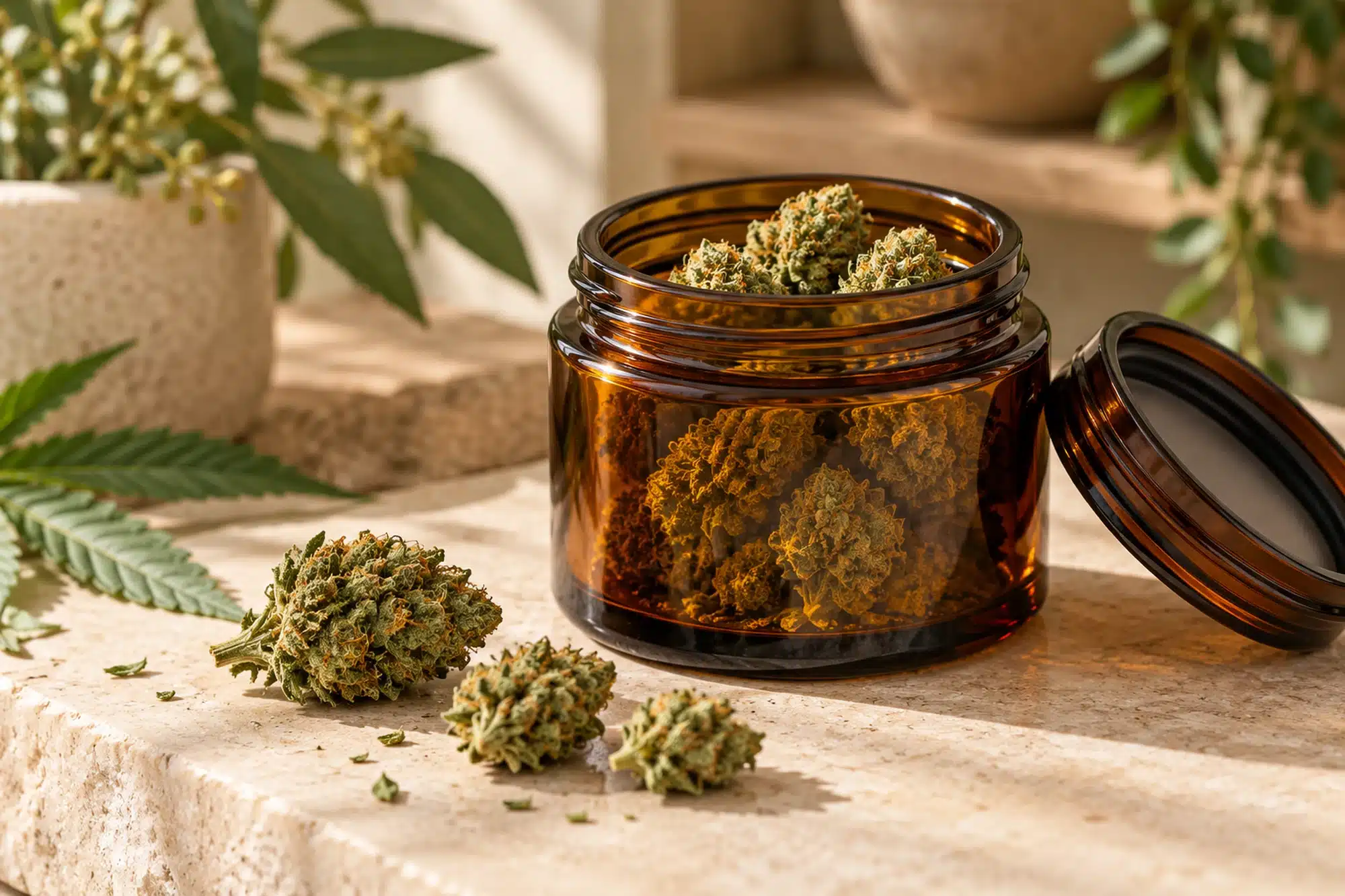
Amber or opaque glass limits light exposure. A clear jar is also suitable if it will be kept in a cupboard. The color of the glass isn't some kind of magic trick; it simply helps when the product is likely to be exposed to light. A well-stored clear container is better than an amber jar left near a warm window.
Heat: avoid repeated fluctuations
Choose a room with a relatively stable and moderate temperature. The top of a refrigerator, a car, a windowsill, or a cupboard directly above an oven all experience fluctuating temperatures. Heat can accelerate chemical changes and the loss of volatile substances. You don't need to turn your entire house into a climate-controlled room; simply moving the product away from heat sources is a good first step.
The temperature displayed in a room doesn't tell the whole story. A jar placed in direct sunlight or next to an appliance can become significantly warmer than the surrounding air. That's why the storage location is just as important as the container itself.
Air: limit openings and unnecessary space
Each opening refreshes the air inside the package. Repeated exposure can alter the flavor profile and diminish the perceived freshness. Choose a lid that closes properly and reseal it immediately after handling. If you have a large quantity, it can be helpful to keep a small portion separate for frequent openings, leaving the rest in its sealed packaging.
A gigantic jar for just a few grams isn't ideal: it contains a lot of air for very little product. Conversely, crushing small buds in a container that's too narrow can damage their structure. Look for a suitable size, with enough space to handle the flowers without compacting them.
Humidity: the factor to monitor most closely
The flowers were dried before being sold; preserving them does not involve freely moistening them. An overly humid environment encourages microbial growth. An excessively dry product can become brittle and lose some of its sensory appeal. Between these two extremes, the prudent approach is to store an initially healthy product in suitable packaging and avoid adding water.
A 2023 study published in Frontiers in Microbiology investigated yeasts and molds in cannabis inflorescences and identified inadequate drying, along with certain temperature and humidity conditions, as factors associated with higher microbial levels. This study does not provide a universal home threshold for all CBD buds. Its main point is that an airtight container does not guarantee the safety of flower that was already too moist.
What container should I choose to store Small Buds CBD?
A good container must meet three basic requirements: remain clean and dry, seal properly, and protect its contents in its storage location. For preservation after opening, a small, clean glass jar with a suitable lid is often practical. Glass is easy to clean, doesn't retain odors well, and allows you to inspect the contents if you open the jar under the right conditions.
However, it's best to start with the simplest option: the original packaging can be perfectly adequate if it's resealable, sufficiently protective, and properly stored. Transferring the contents isn't mandatory. Changing containers increases the handling; choose this option only if the original packaging doesn't close properly, tears easily, or is no longer suitable for the intended storage.
| Solution | Practical interest | Point of vigilance |
|---|---|---|
| Original resealable bag | Preserves the label and batch number; prevents transfer. | Check that it is closed after each opening and protect from light. |
| Small closed glass jar | Stable storage, simple cleaning and good inspection of contents. | Choose a suitable volume and store the clear glass in the dark. |
| Clean rigid food container | Protects flowers from being crushed during storage. | Check the material for leaks and the absence of residual odor. |
| Thin sachet left open | No preservation benefit after opening. | Repeated exposure to air and ambient conditions. |
Never put flowers in a jar that is still damp after washing. Allow the container, its lid, and any seals to dry completely. Do not reuse a pot that smells of perfume, cleaning products, or strongly scented food: flowers can absorb foreign odors, which will then make it difficult to assess their own aroma.
Keep the bag label or note down the product name, receipt date, and batch number on a separate sheet of paper. This information makes it easier to compare with the certificate of analysis and to communicate with the seller if you notice a problem. Avoid mixing two purchases from different dates in the same jar: you would lose traceability and no longer know which batch has an anomaly.
Should a humidity-regulating sachet be used?
Some consumers add a sachet designed to regulate the moisture content of dried flowers. This accessory can be useful in a suitable container, but it is not a substitute for professional drying and does not sterilize the product. If the batch arrives noticeably damp, smells musty, or shows any suspicious marks, adding a sachet will not solve the problem.
A sachet should not be confused with a sponge, a piece of fruit, a citrus peel, or a few drops of water. These "tricks" introduce moisture that is difficult to control and can also alter the scent. For a dried plant product, improvisation is a poor way to preserve its quality.
It is also important to distinguish between therelative humidity of the air in a container and thewater activity measured in a product. These concepts are related, but they are not interchangeable. A small household hygrometer can provide information about the air in a jar; however, it does not constitute a microbiological analysis or a professional measurement of water activity in flowers.
The right routine from the moment the package is received
Start by checking the external condition of the packaging. Verify that the bag is sealed, that the received item matches the one ordered, and that the batch identification is accessible if provided. Delivery in the middle of summer, packaging left in the sun, or a damaged bag do not automatically mean that the product is spoiled; they warrant a closer inspection.
Open in a clean, dry place. Examine several flowers, not just the one at the top of the package. Their color can vary depending on the variety and the drying process; a difference in shade alone does not prove a defect. Look especially for an unusual odor, distinctly damp areas, unusual clumps, or fuzzy growth that would suggest mold.
If everything seems normal, quickly reseal the bag or transfer the contents to a clean, completely dry container. Store it in a cupboard away from light, children, and pets. Note the opening date. This simple step is often more useful than an abstract rule about shelf life: you'll be able to track the evolution of your actual batch over the weeks.
If you notice any issues upon opening, photograph the product and the label, set the batch aside without mixing it with your other flowers, and contact the seller. Further handling of a questionable product in the hope of "airing it out" can disperse contaminants and destroy evidence useful to customer service.
Where should I store Small Buds in the house?
The best place is usually an indoor cupboard that is dry, clean, dark, and away from strong heat sources. Choose a stable location that you can easily access to avoid having to move the container from a warm room to a cool room every day.
The kitchen requires some discretion. A piece of furniture away from the hob, sink, and food odors may be suitable; a shelf above a kettle or near the oven is less ideal. The bathroom, often humid and subject to temperature fluctuations, is a poor choice for dried plant products.
Do not leave the package in a car, even if the box appears closed. The car interior can heat up quickly in the sun and then cool down. Transport is not a method of storage. At home, also store the products out of reach of children and pets, in a location that avoids confusion with food.
Refrigerator or freezer: is it a good idea?
For the amount you regularly open, a standard refrigerator presents more problems than it solves: frequent openings, food odors, and the risk of condensation during temperature changes. A cold jar opened in a warm room can develop condensation on surfaces. If you can't precisely control the conditions, a cool, dark cupboard is a simpler solution.
Freezing is not a universal solution for small flowers intended for everyday use. It requires proper storage and precautions when returning them to room temperature; repeated handling can also weaken the plant material. Avoid repeatedly removing and refreezing them as needed.
Studies on drying methods or controlled atmospheres follow specific protocols. They should not be interpreted as a general promise that home freezing will systematically better protect a batch. For everyday purchases, simple and consistent storage is more important than a sophisticated, poorly used system.
How can you tell if a batch has changed?
Odor is a useful indicator, but should be interpreted with caution. If the initial scent profile gradually weakens, some of the volatile compounds may have changed or dissipated. A different smell doesn't automatically mean the product is dangerous; it simply prompts you to compare it with your first impressions and other observable signs.
A musty, musty, or moldy smell warrants extra caution. Examine several small buds in good light, without inhaling them directly. Natural trichomes can give a shimmering appearance; a whitish, cottony, filamentous, or irregular area should not be ignored. It is sometimes difficult to determine with the naked eye: if you have serious doubts, do not try to "save" the product by simply removing a suspect flower.
Texture also matters. Flowers that become very brittle may have lost moisture and some of their sensory qualities. At the other extreme, pieces stuck together by unusual humidity, visible condensation, or a jar that smells must be discarded. Natural variations in resin alone are not enough to identify a problem.
A duller color may accompany aging, but varieties and harvest conditions already produce a wide range of hues. Never use a promotional photo as your sole standard. Compare the flowers to the condition of the batch upon opening and combine your observations: aroma, texture, apparent moisture, possible presence of filaments, and storage history.
If mold is visible or suspected, do not use the flowers. Home remedies such as removing the affected area, warming the product, or masking the odor do not guarantee the elimination of contaminants. Contact the seller with the batch number and clear photos to document the situation.
How long can you keep Small Buds CBD?
There is no universal shelf life that applies to every bag, every variety, and every household. The packaging date, the condition of the product at the time of purchase, the quality of the drying process, the protection afforded by the packaging, and the frequency of opening all affect the actual shelf life. Any printed date, when present, should be read in conjunction with the storage conditions specified by the manufacturer.
Don't confuse three questions: Does the product still have a pleasant odor? Has its composition remained close to that measured initially? Is it free from visible or microbial alteration? A diminished odor does not allow for the calculation of CBD loss. Conversely, a still pleasant odor does not replace batch inspection.
If you buy several packs, open them one after the other rather than all at once. This rotation limits handling and allows you to compare your actual consumption to the volume purchased. For occasional use, a smaller pack may be preferable to a large purchase that you would store for a very long time under uncertain conditions.
A certificate of analysis typically describes a sample at a specific date. It's useful for verifying the declared composition and batch traceability, but it doesn't guarantee that your jar opened months later will have the exact same profile. To learn what a report actually measures, refer to our page dedicated to CBD certificates and analyses.
Case studies: three common situations
You buy a sachet that you open every day
Keep the product in an easy-to-reclose container and always store it in the same place. Avoid leaving the bag open while comparing varieties. If using a jar, choose a size appropriate for the remaining quantity. After each use, reseal the jar and store immediately away from light.
You buy several different products to compare their aromas
Keep each variety separate, labeled with its name and batch number. Separate containers prevent the mixing of aroma profiles and simplify the detection of an anomaly in a single batch. When comparing, remove only the small amount needed for observation instead of opening all the jars for an extended period.
You will receive a large-format offer
Before purchasing, consider your actual usage frequency and available storage space. Upon receipt, dividing the batch into two clean, dry containers can limit the number of times the main stock is opened. However, maintain traceability: use the same product code, batch number, opening or transfer date, and avoid any confusion with other purchases.
The most common storage errors
- Keep the flowers near a window. Sunlight and the heat from the container add unnecessary stress. Store the bunch in the dark.
- Transfer to a container that is still damp. Dry the pot, lid, and seal completely before placing the flowers inside.
- Adding pieces of fruit or water. The added moisture is difficult to control and can create a problem instead of correcting a perceived dryness.
- Mixing several batches means you lose the ability to verify which product corresponds to which analysis and date.
- Keep the package in the car or bathroom. These environments experience too many variations in temperature or humidity.
- Relying solely on the smell. A pleasant aroma profile is not enough to prove the absence of contaminants; a faint odor does not demonstrate a precise loss of CBD.
- Ignoring a sign of mold is not recommended. If there is serious doubt, it is advisable to set the item aside and contact the seller, without attempting to clean it yourself at home.
Choosing easy-to-store Small Buds starts before you buy them
Successful preservation also depends on the initial quality. On a product page, look for a precise description of the reference, suitable packaging, batch information when available, and a relevant analysis. A low price may be appealing, but the economy size doesn't eliminate the same quality concerns as for larger flowers.
The Small Buds CBD category on The French Hemp Empire allows you to compare several varieties. The aroma profiles listed on the product pages serve as a starting point; the scent you perceive will also depend on the batch and its storage conditions. If you're hesitating between small and large buds, our selection of CBD flowers provides another point of comparison. In both cases, prioritize the information for the currently available product.
The terms "indoor," "greenhouse," or "outdoor" indicate the stated growing method, not the guaranteed quality of post-harvest storage. A small flower from a renowned grower can lose its aroma if improperly stored; a simpler variety can still be enjoyable if the batch has been correctly dried and preserved. Upon receipt, your specific observations will supplement the information on the product sheet.
FAQ: storage of Small Buds CBD
Can Small Buds CBD be kept in their original packaging?
Yes, provided the bag remains intact, is properly resealed, and is stored in a cool, dry, and dark place. Transferring to a jar is not always necessary. Keep the label and batch number readily accessible.
Is a clear glass jar not recommended?
It's suitable if you store it in a closed cupboard. The amber glass helps limit light when the container is on display, but this advantage is lost if the jar remains constantly in the dark. A good lid and the absence of moisture are also essential.
Should the small flowers be put in the refrigerator?
For a batch used regularly, this is generally not necessary. Temperature fluctuations, humidity, and food odors complicate handling. A stable, dry, and dark place at home is easier to manage.
How can I tell if my flowers are too dry?
They can crumble easily and appear less aromatic. This makes it impossible to calculate their current CBD content. Do not pour water or add fruit to the container to try to rehydrate them.
Is a whitish flower necessarily moldy?
No: natural trichomes can give a clear or glossy appearance. However, cottony filaments or a musty smell should raise a red flag. If the appearance is ambiguous, set the batch aside and contact the seller rather than risk using it.
Is the batch number useful for preservation?
Yes. It allows you to compare the product to its analysis and to precisely report any problems observed after opening. It becomes particularly important if you have several varieties or if you divide a large bag into several containers.
A simple method to keep in mind
To preserve your Small Buds CBD, remember these five steps: inspect upon receipt, keep each batch separate, choose a clean and dry container, store away from light and heat, and watch for the appearance of moisture or a suspicious odor. No jar can perfect a batch that was initially poorly dried; proper storage is key to preserving the qualities of a healthy product for longer.
Before building up a stash, ask yourself how long it will actually take to use it. A small bag, clearly labeled and opened carefully, can be more satisfying than a large quantity handled too often. Smaller flowers are best treated as what they are: hemp flowers in their own right, whose quality deserves to be monitored after purchase.