On CBD vape product information sheets, three numbers often appear: 1 ml, 60% , and sometimes a number of puffs. They seem to describe the same thing, but they answer three different questions. The first indicates a volume of liquid or extract, the second a stated percentage, and the third an estimated usage. None of these numbers, taken out of context, definitively reveals the actual amount of cannabidiol in your cartridge or the amount inhaled with each puff.
To compare two CBD vapes without confusing the units, you need to go back to the basics: which cannabinoid is being measured, in what unit, in what volume, and in which batch? This guide helps you understand labels like "1 ml CBD vape," "60% CBD," "mg/ml," and "600 puffs," with usable calculation examples. You'll also see why a concentrated cartridge and a regular e-liquid can't be compared simply by price or volume.
Vape CBD 1 ml: what exactly does this number measure?
A milliliter is a unit of volume. On a pre-filled cartridge, it generally indicates the stated quantity of the formulation. It does not correspond to one gram of substance in any case, nor to 1,000 mg of CBD. Converting between volume in ml and mass in mg requires knowing the formulation's density. This depends on its composition: a fluid e-liquid mixture and a highly concentrated, viscous extract are not interchangeable.
The assumption that "1 ml = 1 g" comes from water under normal conditions. A cartridge does not contain pure water. Without measured density or a total CBD content directly stated by the manufacturer, this approximation should not be presented as a certified result. It can be used to illustrate a calculation, provided it is clearly stated as an assumption and not used to compare products of different types.
The volume also doesn't tell you how much is actually available, down to the last drop. A small amount of liquid may remain in the tubes or at the bottom of the cartridge, depending on its design and the condition of the device. This doesn't necessarily mean the stated volume is incorrect: the nominal capacity and the amount inhaled during use are two separate measurements.
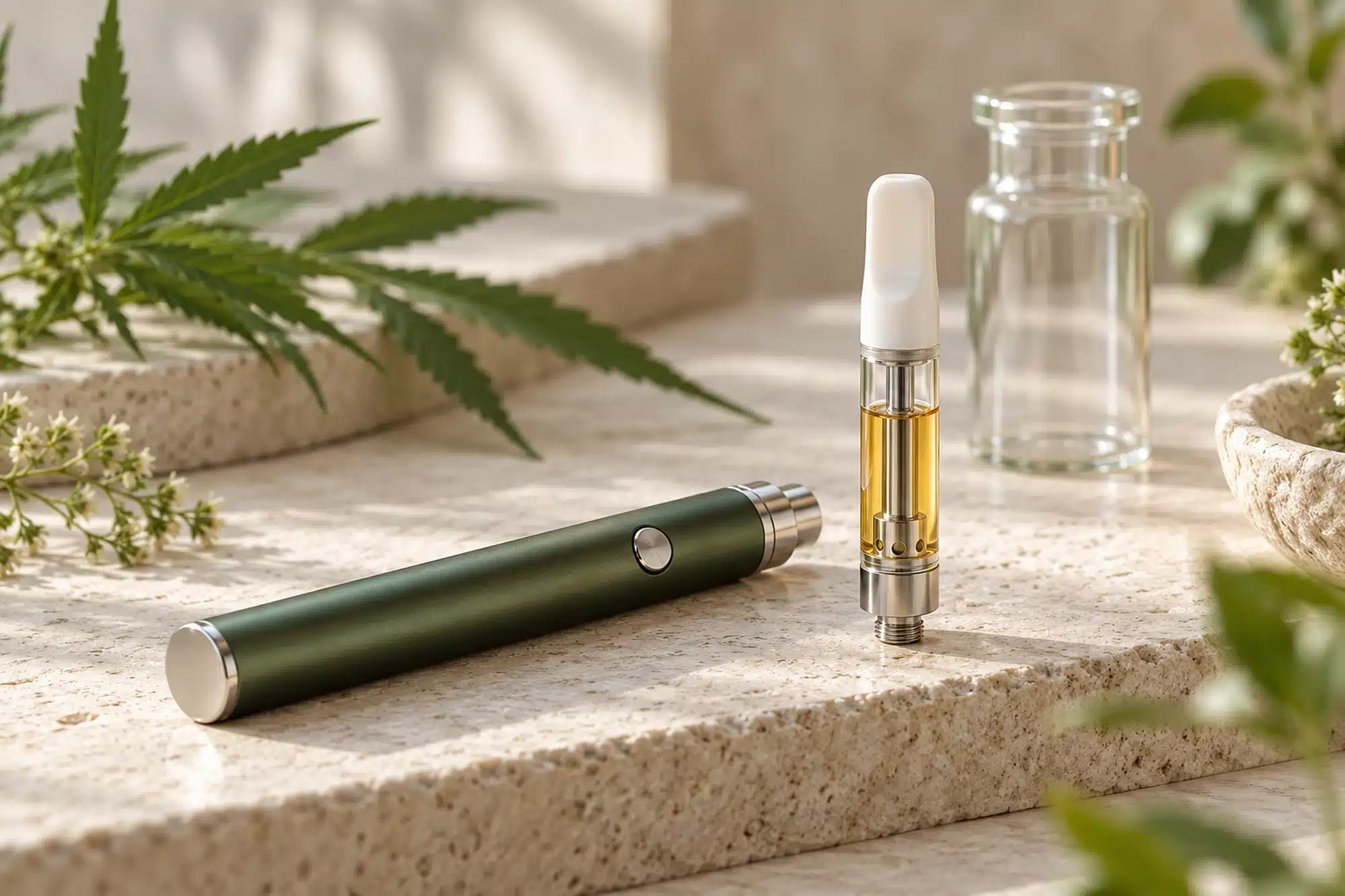
In The French Hemp Empire's CBD Vapes selection, you'll find various formats, including cartridges and vape pens. Always check the product details for your chosen item: the category name doesn't guarantee that all products have the same volume, cannabinoid content, or concentration.
What does "60% CBD" mean on a cartridge?
A percentage indicates a ratio between a part and a whole. To understand "60% CBD," you need to check what constitutes the denominator and whether the percentage expresses a mass fraction of the finished product, a volume fraction, the purity of an ingredient, or a rounded commercial value. In laboratory analysis, cannabinoid concentrations are often expressed as a mass percentage, but the label should confirm the convention used.
If a final formulation has a mass of 900 mg and a measured CBD content of 60% by mass, the theoretical calculation gives 900 × 0.60 = 540 mg of CBD in that mass. If the final mass is 1050 mg at the same concentration, it gives 630 mg. These examples show why "1 ml at 60%" does not automatically mean "600 mg": volume and mass are related only by the actual density.
Another ambiguity concerns the substance being measured. Does the stated percentage represent CBD alone? The total CBD and CBDA converted according to a specific formula? All cannabinoids combined? A product label stating "60% full spectrum" without specifying its content does not provide the same information as an analysis indicating "CBD: 60.0% by mass." Therefore, two products can display the same figure while having significantly different compositions.
Finally, the term "full spectrum" describes a commercial formulation intended to retain several constituents of hemp; it does not, on its own, allow for the deduction of THC, CBD, or other cannabinoid concentrations. Only proper analysis of the product in question can verify the stated values.
mg, mg/ml and percentage: three ways to present concentration
Milligrams (mg) describe the mass of CBD. Printed on a cartridge, they can indicate the total theoretical quantity contained in the unit. Milligrams per milliliter (mg/ml) describe a mass concentration relative to the volume: if a liquid contains 50 mg/ml of CBD and its bottle has a volume of 10 ml, its total theoretical quantity is 500 mg. Finally, the mass percentage represents the mass of CBD relative to the total mass of the formulation.
The simplest formula is: total CBD quantity (mg) = concentration (mg/ml) × volume (ml). This works when the product provides a measured or accurately declared concentration in mg/ml. For example, a 10 ml e-liquid at 30 mg/ml theoretically contains 300 mg of CBD in the bottle. A 1 ml bottle at 30 mg/ml would contain 30 mg, assuming a homogeneous formulation.
To convert a mass percentage to mg, you need to know the mass of the contents: CBD (mg) = total mass of the formulation (mg) × CBD percentage ÷ 100.If the only available data is the volume, you must first obtain the density, expressed for example in g/ml. The calculation becomes: volume (ml) × density (g/ml) × 1000 (mg/g) × CBD mass fraction.
These calculations describe the contents of the formulation, not a dose received by the body. It would be misleading to use the formula on the bottle to guarantee the same amount inhaled with each use. Vaporization introduces losses and variability related to the equipment and how it is used.
| Label | What she indicates | What remains to be verified |
|---|---|---|
| 1 ml | Nominal cartridge volume. | Mass or density of the contents and composition. |
| 60% CBD | Advertised proportion of CBD, if the basis for the percentage is specified. | Mass percentage or other convention; batch analysis. |
| 600 mg CBD | Total quantity of CBD declared in the unit. | Analytical basis, tolerance and correspondence with the lot. |
| 30 mg/ml | Mass of CBD per millilitre of formulation. | Total volume, homogeneity and measurement method. |
| 600 puffs | Estimated performance based on conditions defined by the brand. | Duration of puffs, device, battery and quantity actually delivered. |
Three examples for comparing product descriptions
Example A: a 10 ml bottle advertised as containing 300 mg of CBD
The calculated concentration is 300 ÷ 10 = 30 mg/ml. This unit allows you to compare the bottle to another e-liquid of a different volume. If a second brand advertises 500 mg in 20 ml, its concentration is 25 mg/ml: its bottle contains more CBD overall, but its liquid is less concentrated per milliliter.
This comparison is limited to the advertised quantity. The base type, ingredients, taste, analysis, and suitability for the equipment still need to be examined separately. A larger bottle may also cost less per milligram while being less suited to your preferences.
Example B: a 1 ml cartridge advertised as containing 60% CBD
You cannot accurately calculate the total milligrams without mass or density. Using a hypothetical final mass of 900 mg, the result would be 540 mg. With another hypothetical mass of 1050 mg, it would be 630 mg. The correct data to look for is the total declared amount of CBD or the net mass of the contents associated with an analysis result expressed as a mass percentage.
It's also important to verify that "60%" actually refers to the CBD content of the finished product. Some product information sheets may list the content of a distillate used in the recipe, while terpenes or other ingredients have been added later. Analyzing the ingredient does not replace analyzing the final cartridge.
Example C: a 1ml vape advertised as containing 80% cannabinoids
The figure doesn't necessarily mean 80% CBD. It can include CBD, CBG, CBN, and other compounds. A product with 80% total cannabinoids and 50% CBD is different from a product containing 80% CBD alone. To compare the two, request a breakdown by molecule on a common measurement basis.
This verification becomes even more important when the same commercial category includes references to THCA, 10-OH, or other names. "Vape" describes a device or format; the word never replaces the list of its active substances.
Is it possible to know the amount of CBD per puff?
Not based solely on the concentration indicated on the label. A puff is not a standardized unit of volume in everyday practice. It varies with its duration, inhalation intensity, device power, resistance, battery status, liquid viscosity, and cartridge design. The amount of formulation heated, the amount that becomes an aerosol, and the amount actually inhaled are not the same.
A calculation such as "600 mg of CBD ÷ 600 puffs = 1 mg per puff" only provides a theoretical arithmetic mean of the advertised content. It assumes that all the CBD in the tank is vaporized, that each puff uses the same fraction of the liquid, and that the promised amount is accurate. These assumptions are not guaranteed. Therefore, this result should not be published as an individual dose or as an amount absorbed.
An experimental study of CBD liquids heated in e-cigarettes examined the compounds produced and the amount of CBD remaining after vaporization under laboratory conditions. This type of result highlights the importance of distinguishing between the composition of the initial liquid and that of the resulting aerosol. It does not provide a universal value applicable to all vaping devices on the market.
If a brand advertises a yield per puff, ask for the protocol: what device, what power, what inhalation time, and what method of aerosol analysis? Without this information, consider the figure a marketing indicator of capacity, not a dosage or a guarantee of accuracy.
Why is the number of puffs so variable?
Manufacturers can test their products using standardized laboratory sequences. In everyday life, one person might take short, spaced-out puffs, while another takes longer draws. Two similar devices can also perform differently as the battery charge decreases or the coil ages. Therefore, the total amount of vapor produced before the tank is empty will vary.
The number must also be considered in relation to the contents. A promise of "1,000 puffs" does not automatically mean that the cartridge contains more CBD than one advertised as having 500 puffs. Manufacturers may use different assumptions to define a puff. The best way to compare composition remains the amount of CBD measured in the finished product, in a clearly identifiable unit.
Some devices stop working even when only a small amount of liquid remains visible. Conversely, a worn-out coil can alter the experience before the tank is empty. This is one of the limitations of a format that combines both chemical and electronic components: a liquid's label doesn't describe all of the device's performance.
Read the certificate of analysis for a CBD vape
A useful certificate of analysis links a tested sample to a reference and a batch. Start by comparing the product name, batch number, date, and laboratory name. Then check the list of molecules actually tested for and the units for each result. "Total CBD," "CBD," "CBDA," and "total cannabinoids" are not interchangeable terms.
On a 60% concentration cartridge, look for the following: the CBD measured in the finished product, the other cannabinoids listed, the delta-9-THC content when relevant, and how the report addresses any potential limit of quantification. A "not detected" statement does not mean "absolute absence": it means the result is below the limit indicated for the method used.
Analyzing a concentrate before formulation can provide information about the raw material; however, it does not automatically verify the values of the filled cartridge. Added terpenes or a base will alter the final concentration. Request documentation on the finished product or a traceable explanation of the correlation between the analyzed ingredient and the commercially available batch.
The cannabinoid report doesn't necessarily cover all quality parameters. Depending on the recipe, it may be relevant to check for other contaminants, residual solvents, or device materials. To learn how to identify the limitations of a report, see the CBD certificates and lab analyses.
Concentrated cartridge and e-liquid: don't just compare milliliters
A concentrated extract cartridge and a PG/VG base bottle can have very different formulations and behaviors. Even when both label "CBD," they are not necessarily used with the same equipment. The viscosity, ingredients, and manufacturer's recommended operating range all affect how the device vaporizes the product.
The price per milliliter may seem easy to calculate, but it doesn't reflect the amount of CBD. For a comparison of concentrations, start by asking for the number of milligrams of CBD per full unit or per milliliter. For an economic comparison, the stated price per milligram can be informative, provided both figures are reliable and you consider the device, flavorings, ingredients, and quality of testing separately.
A purely mathematical example: a cartridge sold for €30 with a declared 500 mg of CBD works out to €0.06 per theoretical mg. A bottle costing €20 containing 200 mg works out to €0.10 per mg. This calculation says nothing about the aromatic experience, vaporization efficiency, or the actual quantity delivered; it only helps to compare the advertised product, if the data is verifiable.
Do not pour an extract intended for a cartridge into an e-liquid tank without explicit instructions from the manufacturer. Similarly, do not treat oral CBD oil as a vaping liquid. The presence of CBD in two products does not make their other ingredients or their uses interchangeable.
The complete composition matters as much as the concentration
A CBD vape can be formulated with an isolate, a distillate, a larger extract, a dedicated base, or terpenes. Each of these terms should be considered in relation to the complete recipe. The word "natural," the advertised flavor, or an image of hemp is not enough to define what is being inhaled. Ask for the ingredient list and verify that the product is designed for the specified device.
The warning issued by ANSES regarding products marketed as CBD but containing other substances illustrates the importance of this transparency. It does not mean that all CBD vapes are identical, nor that a particular product necessarily contains these substances; it simply serves as a reminder that a brand name and the actual composition can differ.
If a product information sheet lists several cannabinoids, don't reduce everything to a single "CBD percentage." Distinguish the proportion of each, including those that may be subject to specific restrictions. Compliance with the hemp regulatory framework for THC does not automatically determine the status of all other molecules: the composition and applicable regulations must be verified together.
Check compatibility without guessing the settings
A 510 cartridge requires a battery compatible with its connection and operating parameters. However, the threading alone does not guarantee that a given power output will be suitable for the e-liquid. Excessive heating can alter the flavor or the liquid; insufficient heating can prevent proper vaporization. Follow the instructions for both the cartridge and the battery, rather than trying to replicate the settings from another brand.
For details on threading, battery type, and how to read a technical datasheet, our article dedicated to the range of CBD vapes serves as a starting point. The key rule in this guide is to avoid confusing chemical concentration with device performance: "60%" does not specify a voltage or a number of puffs.
In case of burnt taste, leakage, abnormal heating, or damage to the device, discontinue use and consult the manufacturer's or seller's instructions. Do not attempt to compensate for a hardware problem by extending the draw. Retain the packaging and batch number, as they are useful for identifying the product.
Precautions for adults who choose a CBD vape
Inhaling an aerosol is not a harmless act. The risk depends in particular on the composition, the device, and the usage. A transparent product information sheet should identify what is heated; it does not make vaping a risk-free product. CBD is not a medical treatment based on a marketing claim.
If you are taking medication, are pregnant or breastfeeding, or have a respiratory condition, consult a healthcare professional before using this type of product. Avoid driving or operating machinery if you experience any impairment of alertness. Products containing trace amounts of THC or other cannabinoids require extra caution; a label alone does not guarantee the absence of risk during an inspection.
Vaping products must be kept out of reach of children and animals. Store cartridges according to the manufacturer's instructions, away from excessive heat and damage. If you experience an unusual or severe reaction after use, discontinue use and seek prompt medical advice; if symptoms are severe, call emergency services.
Questions to ask before ordering a 1ml CBD vape
- What is the exact cannabinoid targeted by the percentage? CBD alone, total CBD, or a sum of several substances?
- Does the percentage refer to the finished product? The raw material content is not automatically the same as the cartridge content.
- What is the total amount of CBD in mg contained in the unit? If not given, can it be calculated using the net mass or the density and mass percentage?
- Which certificate corresponds to the batch currently being sold? Check the values, units, and molecules being sought.
- What ingredients make up the formulation? Also ask for what device the product is designed for.
- On what protocol is the number of puffs announced based? Without a method, this figure remains indicative.
You don't need all this data to admire a design or compare flavors. However, it becomes essential as soon as the promise involves a precise concentration, a price comparison per quantity of CBD, or a dose per inhalation. A clear answer from a seller is more useful than a spectacular percentage without any definition.
FAQ: Percentages and milligrams in a CBD vape
Does a 1ml cartridge at 60% contain exactly 600mg of CBD?
Not necessarily. If 60% is a mass percentage, you need to know the total mass of the formulation; 1 ml is a volume. The exact result depends on the density and what the percentage represents. Ask for the total in mg or the data needed to calculate it.
What is the difference between 50 mg/ml and 50% CBD?
50 mg/ml means 50 mg of CBD per milliliter of liquid. "50% CBD," if expressed as a mass fraction, means that half the product's mass is CBD. Without density information, these two values cannot be considered equivalent. They generally refer to formulations with very different concentrations.
Can the mg of CBD be divided by the advertised number of puffs?
Yes, to obtain a theoretical mathematical average of the advertised content per puff. No, to deduce the actual dose inhaled or absorbed with each use: the inhalation time, the device, and losses are not taken into account.
Does a higher percentage mean a better vape?
Not on its own. The complete composition, batch quality, compatibility with the device, flavor profile, and analyses also matter. A high concentration does not guarantee a more pleasant experience or greater safety.
Does "Full spectrum 60%" mean 60% CBD?
It's impossible to know for sure without the manufacturer's definition. The figure could refer to CBD, total cannabinoids, or the purity of an extract. Only a detailed product sheet, ideally corroborated by analysis of the finished product, can provide a definitive answer.
Are CBD vape and CBD oil calculated in the same way?
Mass, volume, and concentration calculations use the same units, but the products are not designed for the same purpose. Oral oil is not e-liquid. Never transfer oil intended for ingestion into a vaping device.
The correct order for comparing two references
Start by identifying the format and the cannabinoid. Then note the volume and the total quantity of CBD in mg, or the percentage and mass used to calculate it. Verify that the values correspond to the finished product and the batch sold. Only then, compare the price, other ingredients, compatible equipment, and flavorings.
This method avoids turning "1 ml," "60%," and "600 puffs" into three separate pieces of evidence for the same performance. Each number indicates a specific dimension. When considered together, they help you make a more informed choice within the CBD vape category ; when considered separately, they can give a misleading impression of precision.