


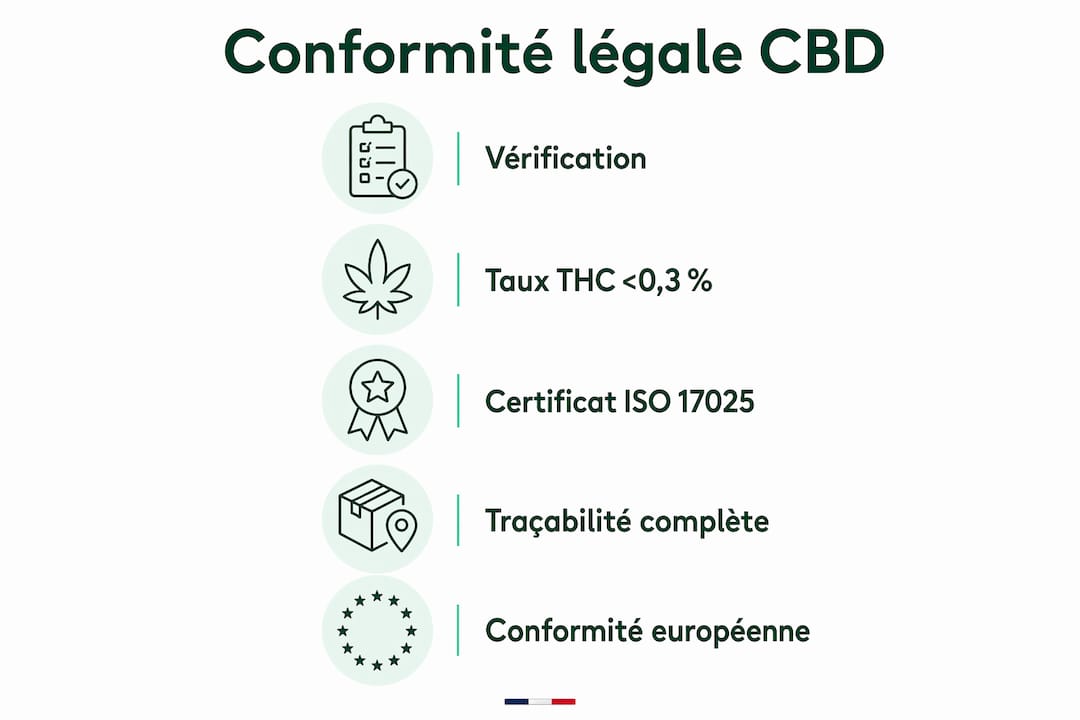
Potent CBD products are defined by their high cannabinoid concentration, while remaining compliant with European and French regulations thanks to a THC level of less than 0.3% in the finished product. Cannabidiol (CBD) refers to the non-psychoactive active ingredient extracted from hemp, the legal sale of which is based on specific criteria set by the decree of December 30, 2021, and Article R.5132-86 of the French Public Health Code. Choosing legally compliant potent CBD products therefore requires simultaneously verifying the cannabinoid concentration and the validity of the certificates of analysis issued by an ISO 17025 accredited laboratory. Thefrenchhempempire offers a premium range that meets all of these regulatory requirements.
What are the legal criteria for marketing potent CBD products?

The sale of CBD products in France and Europe is governed by a specific regulatory framework. Failure to comply with this framework exposes the seller to criminal penalties and the consumer to health and legal risks.
The fundamental legal obligations are as follows:
- Total THC threshold : the combined level of THC and THCA must not exceed 0.3% in the finished product, in accordance with the decree of December 30, 2021 and Article R.5132-86 of the Public Health Code.
- Valid Certificate of Analysis (COA) : Each marketed batch must be accompanied by a COA issued by an ISO 17025 accredited laboratory, dated less than 12 months prior and corresponding to the product's batch number.
- European free movement : The Court of Justice of the European Union confirmed, in theKanavape ruling of 2020, that Member States cannot prohibit the sale of CBD products legally produced in another Member State, provided that they do not present a risk to public health.
- Mandatory legal information : the seller must display their SIRET number, a verifiable physical address and contact information in accordance with French commercial law.
- No medical claims : any therapeutic claim about CBD is prohibited without specific authorization from the competent health authorities.
The legality of CBD in France therefore rests on the articulation of these five criteria. A potent product that does not meet all of these conditions cannot be legally marketed, regardless of its CBD concentration.
How to check the compliance of a CBD product before purchase?
Verifying the compliance of a potent CBD product rarely takes more than two minutes, but it is crucial for consumer safety. A methodical, multi-step approach helps avoid non-compliant products.
-
Check the Certificate of Analysis (COA) carefully. The certificate must be from an ISO 17025 accredited laboratory, be less than 12 months old, and include the exact batch number of the purchased product. The label alone has no legal value without this document.
-
Calculate the total THC content. A product may list 0.2% THC and 0.2% THCA separately, exceeding the combined legal limit of 0.3% after decarboxylation. The sum of these two values is the only relevant measurement for compliance.
-
Check the seller's legal information. The presence of a SIRET number, a real physical address, and verifiable contact details is a indicator of legitimacy . The absence of this information is a major red flag.
-
Examine the origin and production labels. Organic certifications and European origin of hemp guarantee enhanced agricultural quality. The European regulation on organic production, applicable since 2022, governs these labels and prohibits unauthorized chemical treatments.
-
Analyze the product communication. A reputable seller does not display any unauthorized medical claims. Prohibited therapeutic claims constitute an immediate disqualification criterion.
Pro tip: Download the Certificate of Analysis (COA) directly from the seller's website and verify the laboratory's accreditation number in the official COFRAC (French Accreditation Committee) database. This verification takes less than a minute and eliminates fake certificates.
To delve deeper into the criteria for CBD quality and traceability, Thefrenchhempempire publishes detailed guides accessible to all consumers.
Power and quality: two distinct concepts not to be confused
The potency of a CBD product refers to its concentration of cannabinoids, specifically CBD, CBG, or CBN. This concentration determines the intensity of the effects felt, but it does not guarantee the product's safety.
A product with a high concentration of CBD can simultaneously contain dangerous contaminants if quality controls are insufficient. A complete certificate of analysis must therefore include, in addition to the THC level alone, the results for:
- Pesticides : residues from unauthorized agricultural treatments.
- Heavy metals : lead, cadmium, mercury, arsenic.
- Residual solvents : used during certain extraction processes.
- Mycotoxins : fungal contaminants present in poorly preserved plant materials.
The distinction between potency and quality is fundamental. A highly concentrated product must be completely free of contaminants to be considered safe. A Certificate of Analysis (COA) that only indicates the CBD and THC levels is insufficient to guarantee the product's complete safety.
Pro tip: Choose products whose Certificate of Analysis (COA) includes a separate section for contaminants, distinct from the cannabinoid section. A seller who only publishes a partial analysis is likely hiding unfavorable results.
The concentration of CBD directly influences the experience: a 30% CBD oil produces more pronounced effects than a 10% oil, at the same dosage. However, the intensity of the effect never compensates for a lack of regulatory compliance or a health risk.
What powerful CBD products are legally available?
High-concentration CBD products legally available in France and Europe fall into several categories, each subject to the same THC compliance requirements.
| Format | Typical CBD concentration | Specific points of vigilance |
|---|---|---|
| Flowers and small buds | 10–25% CBD | Check the COA for each batch; THC levels vary depending on the variety |
| CBD resins and hash | 20–50% CBD | Extraction and residual solvents must be strictly controlled |
| Oils and extracts | 10–40% CBD | Check the spectrum (isolate, broad spectrum, full spectrum) |
| Vapes and e-liquids | 30–60% CBD | Additives and flavorings to check; regulations on devices |
The selection criteria, based on the intended use, are as follows:
- For relaxation and sleep : full spectrum oils or flowers with a high concentration of CBD and terpenes are generally preferred.
- For a fast effect : vapes and e-liquids offer higher bioavailability than oral forms.
- For occasional use : high concentration CBD resins allow for precise and controlled dosing.
The free movement of certified CBD products within the European Union improves the variety of options available to French consumers. However, this diversity necessitates increased vigilance: comparing the Certificates of Analysis (COAs) of several products before purchase remains the most reliable method for choosing a legal and safe product.
Key points
Potent CBD products are legally compliant only when they meet the 0.3% total THC threshold and are accompanied by a full ISO 17025 certificate of analysis covering cannabinoids and contaminants.
| Point | Details |
|---|---|
| Legal threshold for THC | The combined THC + THCA level must not exceed 0.3% in the finished product. |
| COA required and complete | The certificate must cover cannabinoids, pesticides, heavy metals and residual solvents. |
| Seller verification | Check the SIRET number, physical address and the absence of unauthorized medical claims. |
| Power ≠ quality | A high concentration of CBD does not guarantee the absence of dangerous contaminants. |
| European free movement | The 2020 Kanavape ruling protects consumers purchasing legal CBD products in the EU. |
What the market doesn't always say clearly
As a professional who has followed the CBD market for several years, I've observed a recurring phenomenon: consumers consistently confuse a product's potency with its reliability. A high percentage of CBD displayed on the packaging attracts attention, but this figure says nothing about the product's actual quality.
The illegal market exploits precisely this confusion. Products with very high concentrations circulate without a valid Certificate of Authenticity (COA), without legal disclosure from the seller, and sometimes with THC levels far exceeding the legal limit. Consumers who purchase solely based on concentration expose themselves to real health risks and an uncomfortable legal situation.
What I've learned over time is that a seller's transparency is the best indicator of their product quality. A seller who publishes their Certificates of Analysis (COAs) in batches, clearly displays their legal information, and makes no unauthorized medical claims deserves trust. A seller who conceals this information, even with attractive prices, represents a risk.
By 2026, the maturity of the European CBD market will allow consumers to demand this transparency. The criteria for recognizing high-quality CBD are now well-documented. Using them consistently before each purchase is the only sensible approach to reconciling potency and safety.
— Vanessa
Thefrenchhempempire: a powerful and traceable range
Thefrenchhempempire offers a selection of high-concentration CBD products, each accompanied by a full certificate of analysis issued by an ISO 17025 accredited laboratory. The range covers premium CBD flowers, high-concentration CBD resins and compliant CBD vapes, all certified with a THC level of less than 0.3%.
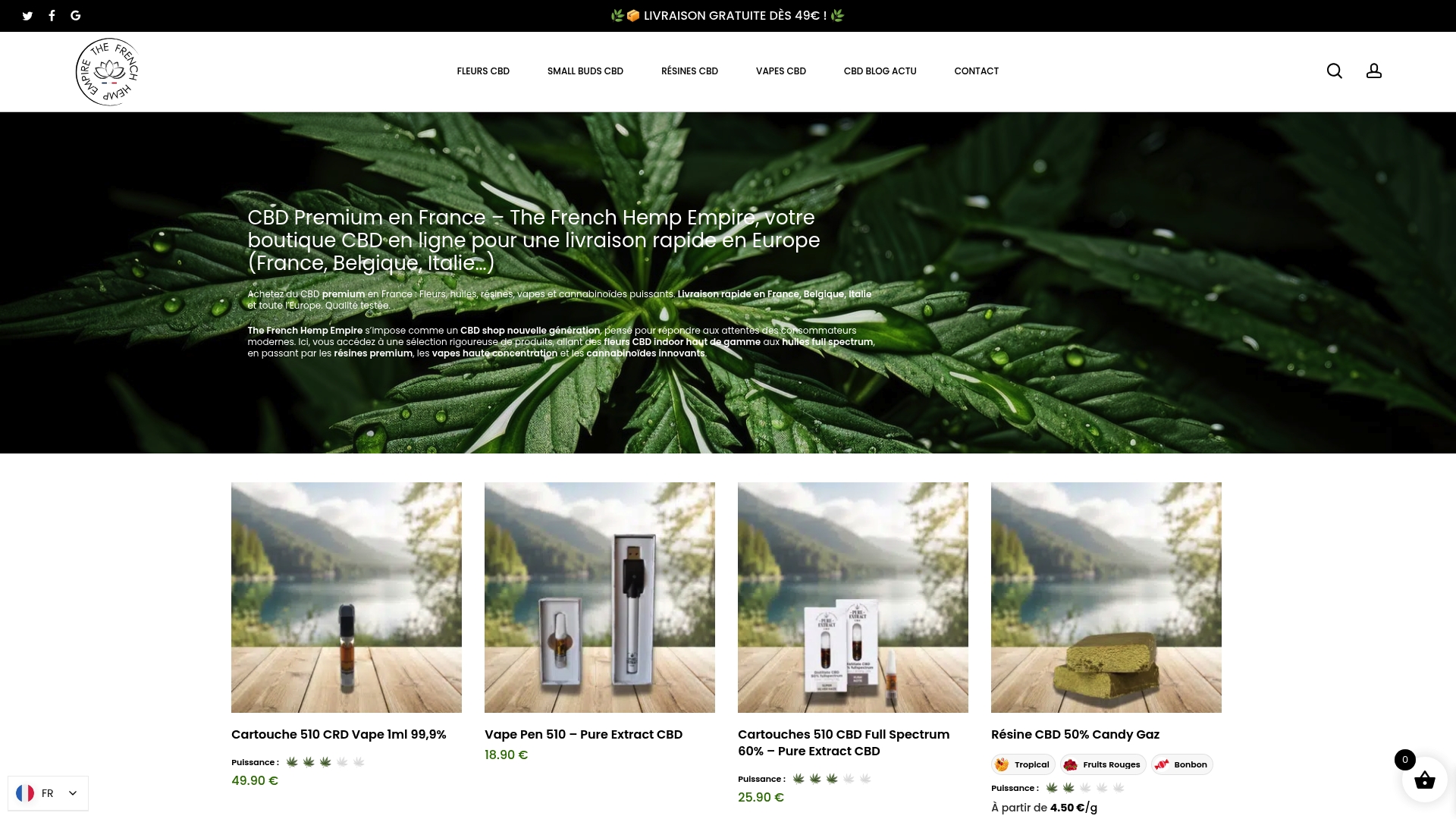
Each product is traceable from cultivation to finished product, with controlled European origin and analyses covering cannabinoids, pesticides, and heavy metals. Certificates of analysis are accessible directly on the website, by batch number, for immediate verification before purchase.
Frequently Asked Questions
What is the legal THC limit for CBD products in France?
The legal threshold is 0.3% of total THC, calculated by adding the THC and THCA in the finished product, in accordance with the decree of December 30, 2021 and article R.5132-86 of the Public Health Code.
What is an ISO 17025 certificate of analysis?
An ISO 17025 certificate of analysis is a document issued by a laboratory accredited according to the international standard ISO 17025, guaranteeing the reliability of the analytical results. It must be dated within the last 12 months and correspond to the batch number of the product tested.
How to calculate the total THC content of a CBD product?
The total THC level is obtained by adding the free THC and the THCA measured in the COA. A product showing 0.2% THC and 0.2% THCA exceeds the legal limit of 0.3% after decarboxylation, even if each value taken separately seems acceptable.
Are potent CBD products legal throughout Europe?
Yes, provided that the total THC content remains below 0.3% and that the product is accompanied by a valid Certificate of Authenticity (COA). The 2020 Kanavape ruling by the Court of Justice of the European Union confirms the free movement of legally produced CBD products between member states.
How to identify a reliable CBD seller online?
A reputable seller publishes their Certificates of Analysis (COA) by batch number, displays a SIRET number (French business registration number) and a verifiable physical address, and makes no unauthorized medical claims. The absence of any of this information is a sufficient red flag to disqualify the seller.


