


Organic CBD certification refers to all the guarantees attesting that cannabidiol comes from hemp cultivated according to the strict standards of European organic farming. This regulatory framework, defined by Regulation (EU) 2018/848, prohibits synthetic pesticides, chemical herbicides, and unauthorized mineral fertilizers. For French consumers, understanding the meaning of organic cannabis certification means being able to distinguish a traceable and controlled product from one without any real guarantee. Official labels such as AB, the Euroleaf, and Ecocert provide concrete indicators of this requirement. The transparency and traceability of the CBD supply chain rely entirely on these certifications.
What is organic CBD certification and what do the official labels mean?
Three official labels are recognized in France for organic CBD: the AB (Agriculture Biologique) logo, the European Euro-leaf, and Ecocert for cosmetics and food supplements. Each covers a specific scope and guarantees distinct requirements.
The AB (Organic Farming) logo
The AB logo is issued by the French Ministry of Agriculture. It certifies that the hemp was grown without synthetic pesticides, without GMOs, and using soil-friendly practices. This label applies primarily to the agricultural raw material, that is, the hemp plant itself.
The European Euro-leaf
The Euro-leaf is the official European Union logo for organic farming. Its presence on a CBD product guarantees that cultivation complies with Regulation (EU) 2018/848, applicable in all Member States. This label offers cross-border recognition and is the strongest regulatory benchmark for the European market.
The Ecocert label
Ecocert certifies the entire manufacturing process of cosmetics and supplements, going beyond simply cultivating hemp. This label therefore verifies not only the agricultural origin, but also the processing methods and the ingredients used in the finished product. For CBD oil or CBD cream, Ecocert provides a more comprehensive guarantee than the AB organic logo alone.
The following table summarizes the guarantees of each label:
| Label | Scope | Main guarantees |
|---|---|---|
| AB (Organic Farming) | Hemp cultivation | No pesticides, GMOs, or chemical fertilizers |
| Euro-leaf (EU) | European culture and conformity | Compliance with Regulation (EU) 2018/848, traceability |
| Ecocert | Manufacturing and finished product | Processing methods, certified organic ingredients |
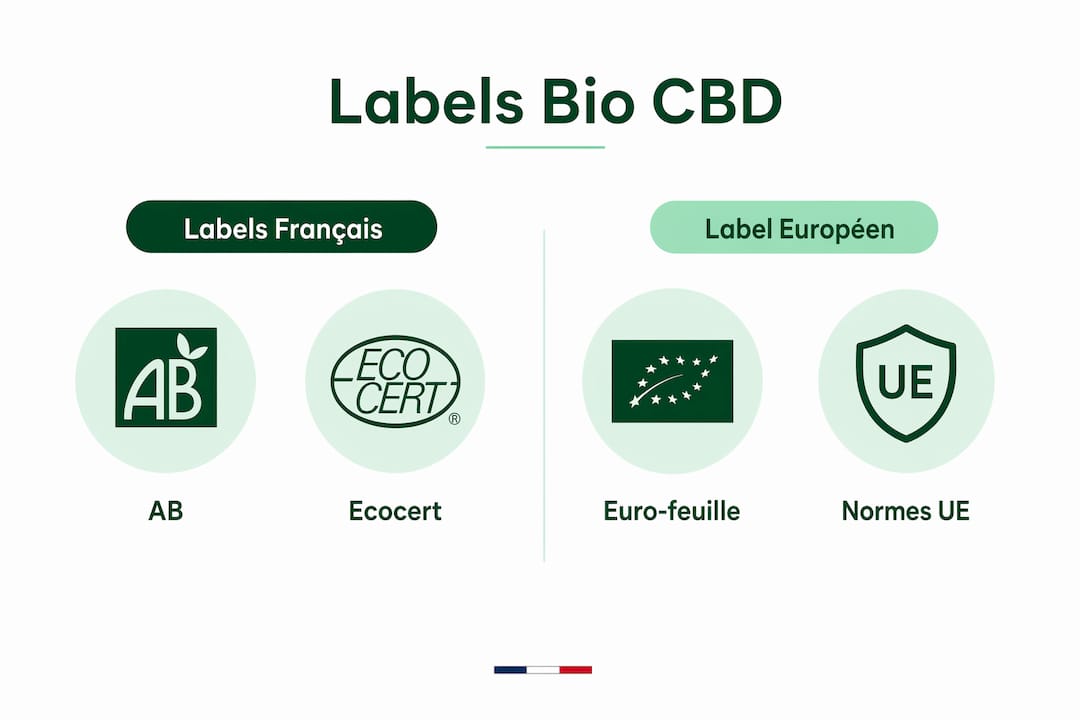
These three certifications are complementary. A product can display the Euro-leaf for its cultivation and Ecocert for its manufacture, which constitutes the highest level of guarantee available on the French market.
How does a CBD product obtain organic certification?
Obtaining organic certification for a CBD product follows a rigorous process overseen by accredited certification bodies. This process goes beyond a simple declaration from the producer.
-
Compliance with Regulation (EU) 2018/848 : Hemp producers must demonstrate that their agricultural practices exclude all synthetic pesticides, chemical herbicides, and unauthorized mineral fertilizers. This compliance is verified upon the first application for certification.
-
Initial audit and soil analysis : An accredited certification body (such as Ecocert or Bureau Veritas) conducts a comprehensive audit of the farm. The checks include soil analyses, crop inspections, and verification of inputs used.
-
Unannounced visits : Certification bodies conduct unannounced inspections throughout the agricultural season. These visits ensure that the declared practices correspond to the reality on the ground.
-
Analysis of the finished product : The processed product undergoes laboratory analysis to confirm the absence of pesticide residues and contaminants. The THC level must remain below 0.3% in accordance with French and European regulations.
-
Annual renewal : Organic certification is not permanent. It must be renewed every year, which involves new audits and analyses.
Pro tip: Before buying an organic CBD product, ask to see the producer's organic certification. This document, separate from the certificate of analysis, confirms that the certification is valid and has not expired.
The extraction method also plays a role in organic compliance. Supercritical CO2 extraction is recommended for organic CBD oil, as it guarantees optimal purity without the use of chemical solvents. Extraction using solvents such as hexane would be incompatible with the requirements of a certified organic finished product.
What is the difference between an organic label and a certificate of analysis for CBD?
The organic label certifies the cultivation method, while the certificate of analysis (COA) proves the chemical composition of the batch produced. These two documents answer different questions and are both essential for assessing the quality of a CBD product.
The organic label answers the question: "How was this hemp grown?" It guarantees the absence of synthetic pesticides and adherence to organic farming practices. However, it says nothing about the precise composition of the finished product.
The Certificate of Analysis (COA) answers the question: "What exactly does this batch of product contain?" Certificates of Analysis prove, on a batch basis, the absence of contaminants and compliance with the legal THC limit. Controlled contaminants include:
- Heavy metals (lead, cadmium, mercury, arsenic)
- Pesticide residues
- Residual solvents from extraction
- Mycotoxins and molds
- The exact CBD and THC levels
Pro tip: Always check that the Certificate of Authenticity (COA) is issued by an accredited independent laboratory, not by the manufacturer. A third-party laboratory guarantees the objectivity of the results.
A brand's transparency is precisely measured by its ability to publish these two types of documents in an accessible way. A reputable producer makes its Certificates of Analysis (COAs) available online, ideally with a QR code on the packaging allowing direct access to the report for the batch in question. The absence of these documents is a clear red flag.
What technical criteria determine whether a CBD product is truly certified organic?
Organic certification for a CBD product goes beyond simply cultivating hemp. Several technical and ecological criteria must be met for the finished product to fully deserve this label.
Hemp cultivation
Organic hemp is grown without synthetic pesticides, using healthy soil management practices that include crop rotation and the use of permitted organic fertilizers. These practices preserve biodiversity and the quality of agricultural land in the long term.
The extraction method
Supercritical CO2 extraction is the preferred method compatible with organic certification. It preserves the integrity of the cannabinoids and avoids any contamination by chemical solvents. Ethanol extraction may be acceptable if the ethanol used is itself of organic origin.
Carrier oil
This point is often overlooked. For a truly certified organic CBD oil, both the hemp and the carrier oil must be certified organic. Common carrier oils include coconut MCT oil, olive oil, and hemp oil. If any of these are not certified organic, the finished product cannot legally claim a full organic label.
The following table illustrates common scenarios:
| Component | Certified organic | Not certified organic | Impact on the final label |
|---|---|---|---|
| CBD extract | Yes | No | Product not eligible for organic certification |
| Carrier oil (MCT, olive) | Yes | No | Product not eligible for organic certification |
| CBD extract + carrier oil | Yes | Yes | Product eligible for the full organic label |
Regulatory labelling
An organic CBD product must clearly state the organic origin of each component on its label. The presence of the AB logo or the Euro-leaf without mention of the organic carrier oil should raise a red flag for the consumer. The presence of the AB logo on a finished product does not guarantee that the CBD extract was produced using a fully certified organic process if the carrier oil is not also certified organic.
Key points
Organic CBD certification guarantees the agricultural quality of the hemp, but only the combination of an organic label, extraction without chemical solvents and an independent certificate of analysis ensures the complete safety of the finished product.
| Point | Details |
|---|---|
| Regulation (EU) 2018/848 | This text defines the organic farming requirements applicable to hemp used for CBD. |
| Officially recognized labels | AB, Euro-leaf and Ecocert cover respectively cultivation, European conformity and manufacturing. |
| Dual certification required | Both the CBD extract and the carrier oil must be certified organic for a compliant finished product. |
| Role of the COA | The independent certificate of analysis proves the absence of contaminants and compliance with the legal THC threshold. |
| Alarm signal | An abnormally low price and the absence of published COAs are indicators of a lack of seriousness. |
What field experience reveals about organic CBD certification
By Vanessa
The organic CBD market in France is growing, but confusion between labels and genuine guarantees remains common. After analyzing numerous products and speaking with producers, one conclusion is clear: many consumers buy based on an AB (organic) logo without verifying whether the oil itself is also certified. This detail, however, completely changes the true value of the displayed label.
Another often overlooked point: organic certification does not replace GACP (Good Agricultural and Collection Practices) or GMP (Good Manufacturing Practices) standards, which ensure quality and traceability on an international scale. A product can be organic but poorly manufactured. These standards are complementary, not interchangeable.
My concrete recommendation: favor brands that publish their Certificates of Analysis (COAs) by batch, mention the certifying body on their website, and indicate the precise geographical origin of the hemp. A producer who doesn't display this information probably doesn't have the certifications they claim to possess. The French organic CBD sector is gradually structuring itself, and reputable players are distinguished precisely by this level of transparency. Be wary of very low prices associated with organic claims lacking documented evidence. Properly certified organic CBD has a real production cost that is reflected in its price.
— Vanessa
The French Hemp Empire's organic products: guaranteed traceability and compliance
Thefrenchhempempire selects its CBD products according to strict quality and regulatory compliance criteria. Each product is accompanied by certificates of analysis issued by independent laboratories, accessible directly on the website.
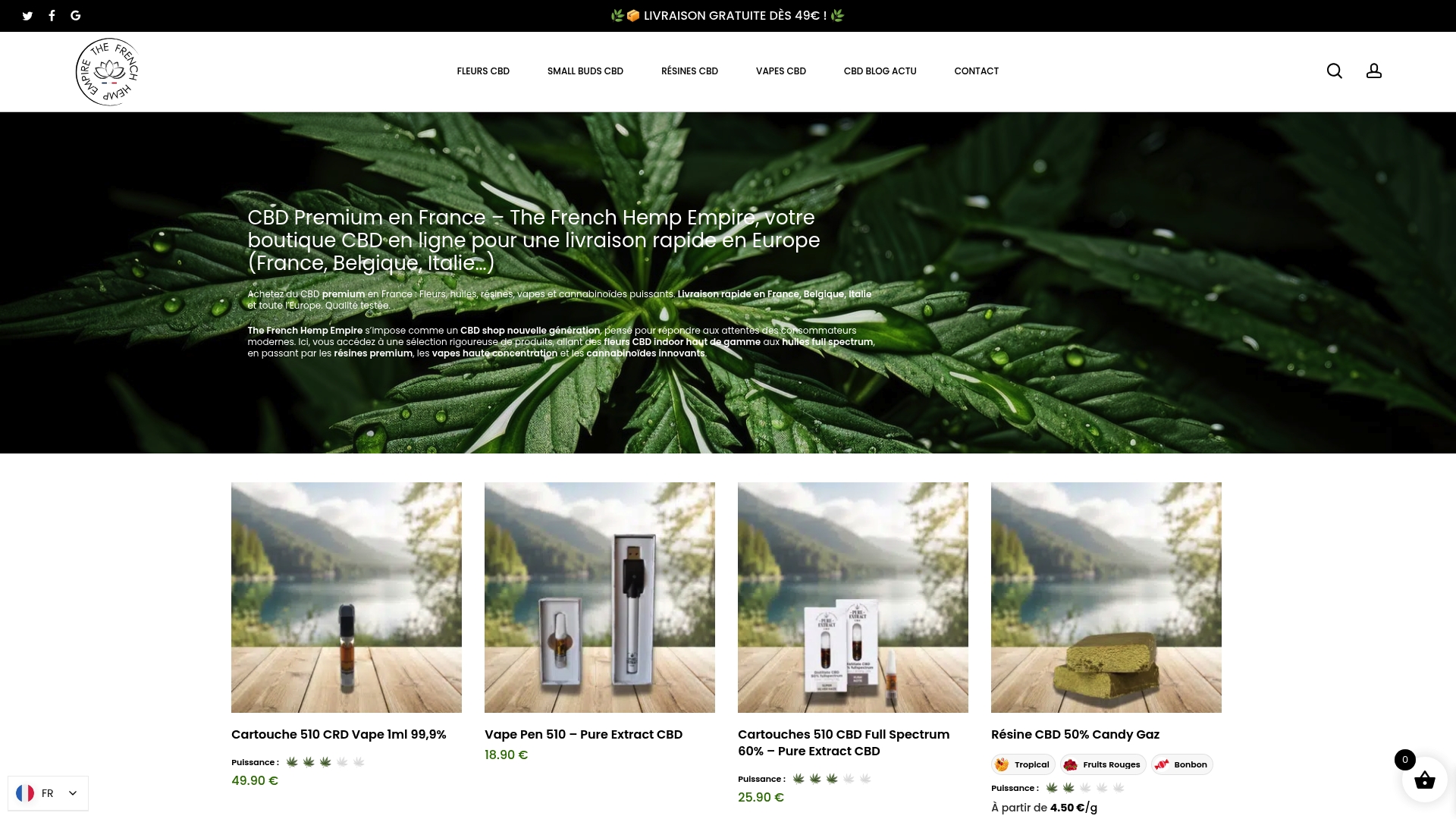
The range includes certified organic CBD flowers made from hemp grown according to European organic farming standards, with a THC content of less than 0.3% verified per batch. The quality and traceability of each product are documented and verifiable before purchase. Thefrenchhempempire is committed to listing only products with valid and up-to-date labels and certificates, ensuring that every purchase is an informed and responsible choice.
Frequently Asked Questions
What does organic CBD certification actually mean?
The organic CBD certification attests that the hemp has been grown without synthetic pesticides, chemical herbicides or unauthorized fertilizers, in accordance with Regulation (EU) 2018/848. It guarantees organic farming practices verified by an accredited certification body.
What is the difference between the AB label and the Euro-leaf for CBD?
The AB label is a French certification issued by the Ministry of Agriculture, while the Euro-leaf is the official logo of the European Union, recognized in all member states. Both certify the organic cultivation of hemp, but the Euro-leaf offers broader European recognition.
Does an organic CBD product need a certificate of analysis in addition to the organic label?
Yes. The organic label only certifies the cultivation method, while the certificate of analysis (COA) proves the chemical composition of the batch, the absence of contaminants and compliance with the legal THC level of less than 0.3%.
Why does the carrier oil also need to be certified organic?
For a CBD oil to legally display a full organic label, every component of the finished product must be certified organic. If the MCT, olive, or hemp oil used as a carrier oil is not certified organic, the finished product cannot claim full organic certification.
How can you verify that an organic CBD product is truly certified?
Request the certification number from the accredited body (Ecocert, Bureau Veritas, etc.) and consult the Certificates of Analysis (COAs) published for each batch on the seller's website. The absence of these documents or a COA issued by the manufacturer itself are warning signs that should be taken seriously.


