Full-spectrum CBD is suitable for those seeking the complete botanical synergy of hemp, while CBD isolate is for those who require maximum purity and a complete absence of detectable THC. Broad-spectrum CBD offers a compromise between the two : it retains certain cannabinoids and terpenes, but without THC. In France, all finished products must comply with a THC threshold of 0.3% or less, in accordance with European regulations. Thefrenchhempempire offers products in all three categories, each accompanied by independent laboratory analyses (COA) to verify compliance.
To quickly guide your choice:
- Full spectrum : favor it for complex objectives such as chronic pain, persistent anxiety or sleep disorders, provided that you are not subject to doping controls.
- Isolate : choose it if you want a precise dosage, a neutral taste, or if you need to avoid any risk of residual THC.
- Broad spectrum : intermediate option to benefit from partial synergy without detectable THC, particularly for athletes or professionals subject to testing.
Preclinical and clinical studies suggest that full-spectrum extracts are often more effective than isolates at equivalent doses, partially supporting the concept of the entourage effect. However, comprehensive clinical evidence is still being established.
Table of Contents
- What is full-spectrum CBD?
- What is CBD isolate?
- What is broad spectrum?
- The entourage effect: evidence and practical implications
- Full spectrum, broad spectrum and isolate comparison
- How to check the quality and conformity of a product in France
- How to choose according to your objective
- Safety, starting dosage and drug interactions
- Key points
- What most guides don't tell you about choosing the spectrum
- Verified full-spectrum and isolate products, available in France
- Recommended sources for further reading
What is full-spectrum CBD?
Full-spectrum CBD is a hemp extract that retains all of the plant's natural compounds: minor cannabinoids (CBG, CBC, CBN), terpenes (myrcene, limonene, beta-caryophyllene), flavonoids, and legal traces of THC within regulatory limits. This phytochemical richness is precisely what distinguishes full-spectrum CBD from other forms.

Organoleptically, full-spectrum cannabis has a herbaceous, sometimes earthy, taste and aroma directly linked to the presence of terpenes. Myrcene contributes woody and musky notes; limonene, citrus nuances; and beta-caryophyllene, a slight spicy touch. These aromatic profiles vary depending on the hemp variety and the extraction method used.
Supercritical CO₂ extraction is the gold standard for preserving the integrity of these compounds. It operates at low temperatures, which limits the degradation of heat-sensitive terpenes. A Certificate of Analysis (COA) issued by a third-party laboratory must list not only CBD and THC, but also minor cannabinoids and major terpenes to attest to a genuine full-spectrum profile.
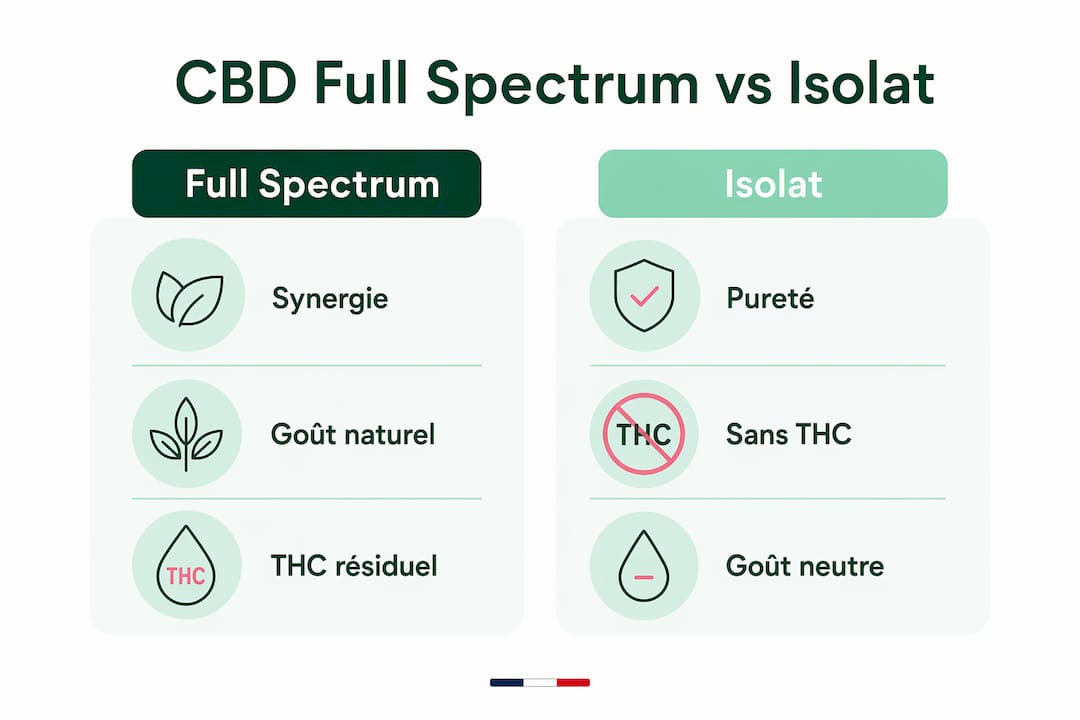
The formats available in full spectrum are varied: sublingual oils, CBD flowers, resins, and 60% vape cartridges. Each format implies a different bioavailability and sensory experience, which is detailed in the dosage section later.
Pro tip: Check that the Certificate of Analysis (COA) for your full-spectrum product explicitly lists the terpenes and minor cannabinoids with their respective concentrations. A COA that only indicates CBD and THC is not sufficient to confirm a full-spectrum profile.
What is CBD isolate?
CBD isolate is purified cannabidiol (≥ 99%), presented as crystals or a white powder. It contains no terpenes, minor cannabinoids, or THC. It is the purest form of CBD available on the market.
Its main practical advantages are:
- Precise dosage : the known concentration at 99%+ allows for the calculation of exact doses in milligrams, which is useful for food formulations, cosmetics or e-liquids.
- Taste neutrality : without terpenes, the isolate has no taste or smell, which facilitates its integration into preparations where the aromatic profile of hemp would be undesirable.
- No detectable THC : suitable for people subject to doping controls or particularly sensitive to THC.
Its main limitation lies in the absence of an entourage effect. The dose-response curve of the isolate tends to show a peak in efficacy at a specific dose, beyond which the effect may plateau or even decrease. This behavior differs from that of full-spectrum extracts, whose efficacy appears more linear over a wider dose range according to available preclinical data.

What is broad spectrum?
Broad spectrum is a multi-component extract from which THC has been removed through technical processes such as selective distillation or preparative chromatography. The goal is to retain some of the cannabinoids and terpenes present in hemp while removing THC to an undetectable level.
This is the most suitable format for people who want to benefit from a partial synergy without risking a positive doping test. WADA allows CBD but prohibits other cannabinoids, and any residual trace of THC can lead to a positive result in a saliva or urine test.
The technical limitations of broad-spectrum cannabis are real: THC purification processes can lead to a partial loss of terpenes, reducing aromatic richness and potentially synergy compared to full-spectrum cannabis. Therefore, quality varies more from one manufacturer to another.
Pro tip: On a broad-spectrum COA, look for "ND" (not detected) or a value below the limit of detection (LOD) for THC. A simple "< 0.3%" does not guarantee the complete absence of detectable THC in a drug test.
The entourage effect: evidence and practical implications
The entourage effect refers to the supposed synergy between cannabinoids, terpenes, and other hemp compounds, which is believed to produce effects superior to those of CBD alone. This concept is based on the idea that the molecules interact with the endocannabinoid system in a complementary way.
The preclinical data is robust: several studies published on PubMed, including reviews on cannabinoid synergy, show that whole-plant extracts produce more pronounced effects than isolated CBD at equivalent doses. Clinical trials remain limited, and definitive evidence in humans has not yet been established. Therefore, its application should remain pragmatic.
In practical terms, full-spectrum isolates tend to be preferred for complex issues such as chronic pain, severe anxiety, or persistent sleep disorders, where the synergy between compounds can play a role. Isolates, on the other hand, are better suited to targeted and controlled uses, particularly when precise dosage is more important than phytochemical richness.
Pro tip: To assess the quality of a full-spectrum extract, read the Certificate of Analysis (COA) and look for at least three quantified minor cannabinoids (CBG, CBC, CBN) and at least two terpenes with their concentrations. A low profile of these compounds suggests inadequate extraction or preservation.
Full spectrum, broad spectrum and isolate comparison
| Criteria | Full spectrum | Broad spectrum | Isolate |
|---|---|---|---|
| Expected effect / recommended use | Complete botanical synergy; pain, anxiety, sleep | Partial synergy; daily use without THC risk | Precise dosage; formulations, anti-doping tests |
| Cannabinoids and terpenes | CBD + CBG/CBC/CBN + terpenes + flavonoids | CBD + minor cannabinoids + terpenes (partial) | Pure CBD only |
| Residual risk of THC | Present (≤ 0.3%); possible risk of a positive test | Not detectable if COA is valid | None |
| Purity / dosage precision | Complex profile; less linear dosage | Intermediate profile | Purity ≥ 99%; precise dosage |
| Traceability and analysis | Full COA required (cannabinoids + terpenes + THC) | COA with THC "ND" required | COA purity ≥ 99% |
| Available forms | Oil, flower, resin, vape, gummies | Oil, e-liquid, gummies | Powder, crystals, e-liquid, cosmetics |
Typical use cases can be broken down as follows:
- Athletes and professionals subject to controls : broad spectrum verified or isolate, with COA attesting to the absence of THC.
- People sensitive to THC : isolate or broad spectrum with "ND" mentioned on the COA.
- Chronic pain or severe anxiety : full spectrum, subject to the absence of anti-doping restrictions.
- Food or cosmetic formulations : isolate, for its neutrality and precision of dosage.
A word of caution regarding drug tests: even a product that complies with the legal THC limit of ≤ 0.3% can, depending on the dose consumed and individual metabolism, produce a positive result on a saliva or urine test. Variability between batches underscores the importance of always checking the Certificate of Authenticity (COA) before purchase.
How to check the quality and conformity of a product in France
Verification of a CBD product in France relies on several documentary and organoleptic elements. The COA (Certificate of Analysis) issued by an independent accredited laboratory is the reference document.
| Item to check | What he needs to indicate |
|---|---|
| Third-party COA | Accredited laboratory, date of analysis, batch number |
| Cannabinoid profile | CBD, THC, CBG, CBC, CBN with concentrations in mg/ml or % |
| Terpene profile | At least 2–3 quantified terpenes for a full spectrum |
| THC | ≤ 0.3% for French compliance; "ND" for broad spectrum |
| Origin of hemp | Variety, country of origin, organic certification if applicable |
| Extraction method | supercritical CO₂ or distillation; extraction temperature |
| Labeling | Concentration in mg/ml, spectrum indicated, expiry date |
Additional signals of confidence include consistency between the concentration stated on the label and that measured in the COA, clear mention of the spectrum (full, broad or isolate), and airtight packaging practices to protect against light and preserve terpenes.
Pro tip: A credible Certificate of Analysis (COA) for a broad-spectrum product should state the laboratory's limit of detection (LOD) for THC, usually expressed in ppm or %. If this limit isn't specified, the "ND" designation loses its evidentiary value. Request this information from the seller.
To further explore the interpretation of certificates of analysis, Thefrenchhempempire's analysis and traceability page details the criteria for a reliable COA
How to choose according to your objective
A simple decision flow helps guide the choice between the three formats:
- Define your primary objective : chronic pain management, sleep improvement, anxiety reduction, or occasional general wellness use.
- Assess your tolerance to THC : if you are sensitive to residual psychoactive effects or have a history of reaction to THC, opt for broad spectrum or isolate.
- Identify the risk of doping tests : licensed athletes, regulated professions, or frequent roadside checks imply choosing a broad spectrum with a COA attesting to "ND" for THC, or an isolate.
- Consider your sensory preferences : if the grassy taste of hemp is a deal-breaker, isolate or a well-formulated broad spectrum will be more suitable.
- Check the COA before purchase : regardless of the format, demand a recent certificate (less than 12 months old), with a batch number corresponding to the product received.
Questions to systematically ask the seller: Is the spectrum clearly indicated on the label? Is the Certificate of Analysis (COA) available online or upon request? What extraction method was used? Is the concentration in mg/ml consistent between the label and the COA?
Warning signs to watch for: absence of a Certificate of Analysis (COA) or an undated COA, a vague "THC-free" claim without a specific value or LOD (Limit of Discharge), an abnormally low price compared to the market, or an unspecified spectrum on the packaging. An inexpensive CBD product without analytical documentation poses a real risk, both to legal compliance and to public health.
Safety, starting dosage and drug interactions
The recommended starting dose for an adult not currently taking any medication is generally 5 to 10 mg of CBD per day, with a gradual increase over two to four weeks depending on tolerance and observed effects. This cautious approach is consistent with recommendations available in the scientific literature accessible on PubMed.
| Administrative route | Relative bioavailability | Action deadline | Duration of effect |
|---|---|---|---|
| Sublingual (oil) | Moderate | 15 minutes | 4 hours |
| Oral (gummies, capsules) | Weak | 1–2 hours | 6 hours |
| Inhalation (vape, flower) | High | 5 minutes | 2–3 hours |
CBD is metabolized by the CYP450 enzyme system, specifically the CYP3A4 and CYP2C19 isoenzymes. This metabolic pathway is shared with many medications, including anticoagulants (such as warfarin), antipsychotics, antiepileptics, and certain immunosuppressants. An interaction is possible, resulting in a change in the plasma concentration of the medication in question. Anyone taking medication should consult a healthcare professional before introducing a CBD product into their routine.
Regarding residual THC in full-spectrum products, the risk of a positive drug test depends on the dose consumed, the frequency of use, and individual metabolism. Those subject to regular testing should opt for isolate or a broad-spectrum product with a Certificate of Authenticity (COA) confirming the absence of THC.
This article provides general information and does not constitute medical advice. For any questions specific to your personal situation, consult a qualified healthcare professional.
Key points
Full spectrum offers the most complete botanical synergy, but involves a residual risk of THC; isolate guarantees purity and dosage accuracy without any other cannabinoids.
| Point | Details |
|---|---|
| Full spectrum for synergy | Prefer it for chronic pain, anxiety or sleep, without anti-doping constraints. |
| Isolate for precision | Very high purity, exact dosage, neutral taste, no risk of residual THC. |
| Broad spectrum as a compromise | Partial synergy with no detectable THC; check "ND" on the COA with the LOD indicated. |
| COA required before purchase | Demand a recent certificate from an accredited laboratory, with a complete cannabinoid and terpene profile. |
| Thefrenchhempempire as a reference | Offers all three formats with third-party analysis, traceability and compliance with the THC threshold ≤ 0.3%. |
What most guides don't tell you about choosing the spectrum
The comparison between full spectrum and isolate is often presented as a debate between "natural" and "chemical," which is a misleading simplification. Isolate is also derived from hemp; its purity results from extensive refining, not artificial synthesis. Reducing the choice to an ideological opposition between purity and naturalness obscures the real question: which format best suits your specific objective and actual constraints?
The tendency to overestimate the entourage effect also deserves to be qualified. Preclinical data are compelling, but they don't allow us to conclude that full-spectrum CBD is consistently superior for all uses. For someone simply looking to incorporate a fixed dose of CBD into their daily routine without the constraints of taste or doping tests, isolate may be perfectly suitable, or even preferable.
What truly matters is the traceability of the chosen product. A full-spectrum product without a complete Certificate of Analysis (COA) is worth less than a well-documented isolate. Analytical transparency is the only objective criterion a consumer can rely on, regardless of the spectrum.
Verified full-spectrum and isolate products, available in France
Thefrenchhempempire offers a selection of CBD products covering all three spectrums, each accompanied by a third-party laboratory analysis certificate accessible before purchase. The traceability of the hemp's origin, the extraction method, and the concentration in mg/ml are indicated on each product page, in accordance with the legal THC threshold of ≤ 0.3%.
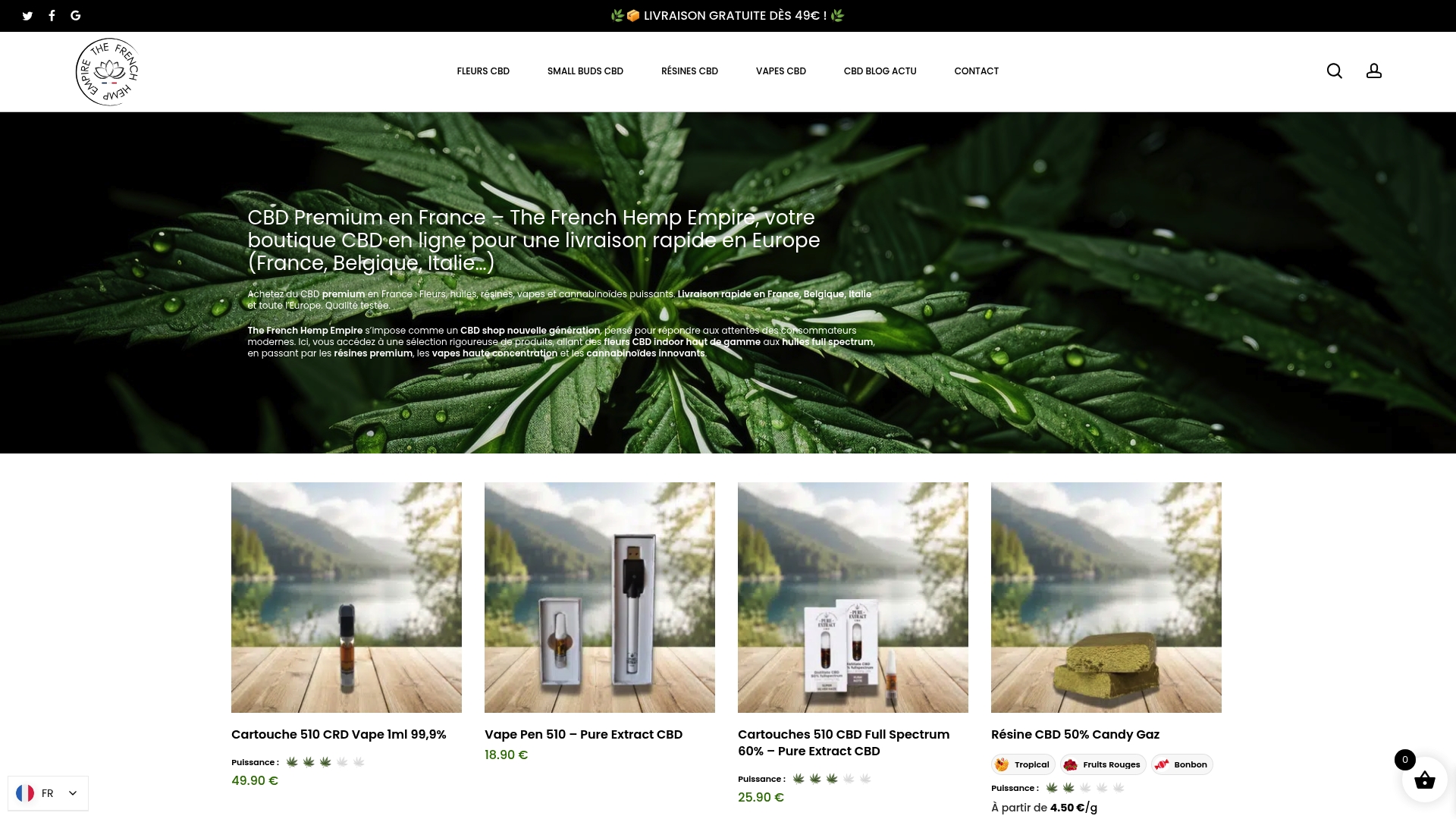
Depending on your goal, you can explore full-spectrum CBD flowers for a complete botanical experience, or CBD vapes for rapid bioavailability with concentrated full-spectrum cartridges. For concentrated formats, CBD resins offer a rich phytochemical profile with detailed Certificates of Analysis (COAs). Browse the full range at Thefrenchhempempire.fr and check the certificates of analysis directly on the product page before placing your order.
Recommended sources for further reading
- Cannabinoid Synergy Study (PubMed): scientific review on the entourage effect and comparative efficacy of full spectrum extracts vs isolate; primary reference for the clinical evidence section.
- Review of cannabinoids and the endocannabinoid system (PMC): analysis of CBD mechanisms of action and drug interactions via CYP450; useful for the dosage and safety section.
- Frontiers in Pharmacology — cannabinoids and terpenes : a reference article on terpenes and their role in the entourage effect; scientific basis for understanding the composition of full spectrum.
- Gallily et al. study (SCIRP): foundational preclinical study on the superiority of whole plant extracts compared to isolated CBD at equivalent doses.
- Drogues.gouv.fr — CBD : official page of the Interministerial Mission for the Fight against Drugs and Addictive Behaviors (MILDECA); reference for the French legal framework for CBD.
- Certificates of Analysis Thefrenchhempempire : page dedicated to the COAs of the shop's products; useful for understanding how to read a certificate of analysis.
- The French Hemp Empire Quality and Traceability Guide: article detailing the criteria for a reliable CBD product, with explanations of origin, extraction and analysis.
- Minor cannabinoids: CBG, CBN and CBD : a practical guide to the differences between minor cannabinoids present in full spectrum; a useful supplement for understanding the composition of extracts.