In Europe, a CBD product is legal when it is derived from Cannabis sativa L. varieties listed in the European Union's Common Catalogue of Varieties of Agriculture, and when its delta-9-tetrahydrocannabinol (THC) content does not exceed the applicable regulatory threshold. This common framework coexists with national legislation that varies considerably from one Member State to another, particularly regarding food products, advertising, and customs regulations.
The main categories of CBD products and their general legal status in Europe:
- CBD flowers : tolerated in many European countries, but subject to significant restrictions in France and several Member States; their status remains a legal grey area.
- CBD resins : status varies by country, requiring traceability and laboratory analysis to be compliant.
- Sublingual oils : subject to the Novel Food (EU) Regulation 2015/2283; their marketing requires prior authorization in the majority of Member States.
- CBD cosmetics : allowed in the EU since 2021 under certain conditions, with registration in the CosIng database.
- Food and edible products : governed by the Novel Food regime; placing on the market without authorization remains prohibited in most European countries.
- CBD e-liquids : generally outside the scope of the Novel Food regulation because they are inhaled and not ingested, but subject to compliance with the THC threshold.
Despite this European framework, each country retains some national discretion. Checking the specific rules of the destination country remains essential before any purchase or sale.
Table of Contents
- What is the legal basis for CBD in Europe and France?
- What types of CBD products are legal in Europe?
- What European regulatory developments can we expect in 2025 and 2026?
- How can we guarantee the compliance and quality of premium CBD products in France?
- Thefrenchhempempire: compliant CBD products, delivered throughout Europe
- Key points
What is the legal basis for CBD in Europe and France?
The legality of CBD in Europe rests on a landmark ruling by the Court of Justice of the European Union (CJEU). In November 2020, in theKanavape ruling (Case C-663/18), the Court established that cannabidiol extracted from the whole hemp plant does not constitute a narcotic under EU law. Member States therefore cannot prohibit its marketing in general, unless they justify such a restriction with overriding public health reasons, duly demonstrated.
This ruling paved the way for a legal CBD market in Europe, while leaving member states some leeway to regulate specific commercial forms.
The THC threshold and permitted varieties
The primary condition for legality concerns the THC content. In France, thedecree of December 30, 2021, sets the delta-9-THC threshold at 0.3% for hemp extracts and finished products, thus aligning French regulations with the European Union's Common Agricultural Policy (CAP) standard. Only varieties of Cannabis sativa L. listed in the EU's Common Catalogue of Varieties of Agricultural Plant Species are authorized for cultivation and processing.

legislation on hemp precisely defines which varieties can be legally cultivated within the Union. Producers and importers must be able to prove the varietal origin of their raw material at any time.
National disparities persist
Despite this common framework, regulatory fragmentation between Member States remains significant. Some countries still apply a lower THC threshold, but the European reform aims to harmonize the threshold at 0.3% in the majority of Member States from 2025, gradually reducing national disparities. Slovakia and Lithuania, for example, still classify certain CBD extracts in categories subject to special authorization. This disparity makes a country-by-country analysis essential for any operator wishing to operate in several Member States.
Pro tip: Before any import-export operation of legal CBD in Europe, always consult the customs authorities of the destination country, as tariff classifications and documentary requirements vary from one state to another, independently of the common European framework.
What types of CBD products are legal in Europe?
The distinction between raw flower, concentrated extract, and finished product directly determines the applicable legal framework. The same cannabinoid may be legal in cosmetic form but subject to prior authorization in food form. Here is a detailed analysis by category.
CBD flowers and resins
CBD flowers are tolerated in more than twenty European countries, but their legal status remains a gray area in several member states, including France. Marketing is permitted there under strict conditions: a THC content of less than 0.3%, full traceability of the cultivated variety, and a prohibition on any use that could be considered narcotic. Packaging information is also regulated to avoid any confusion with recreational cannabis.
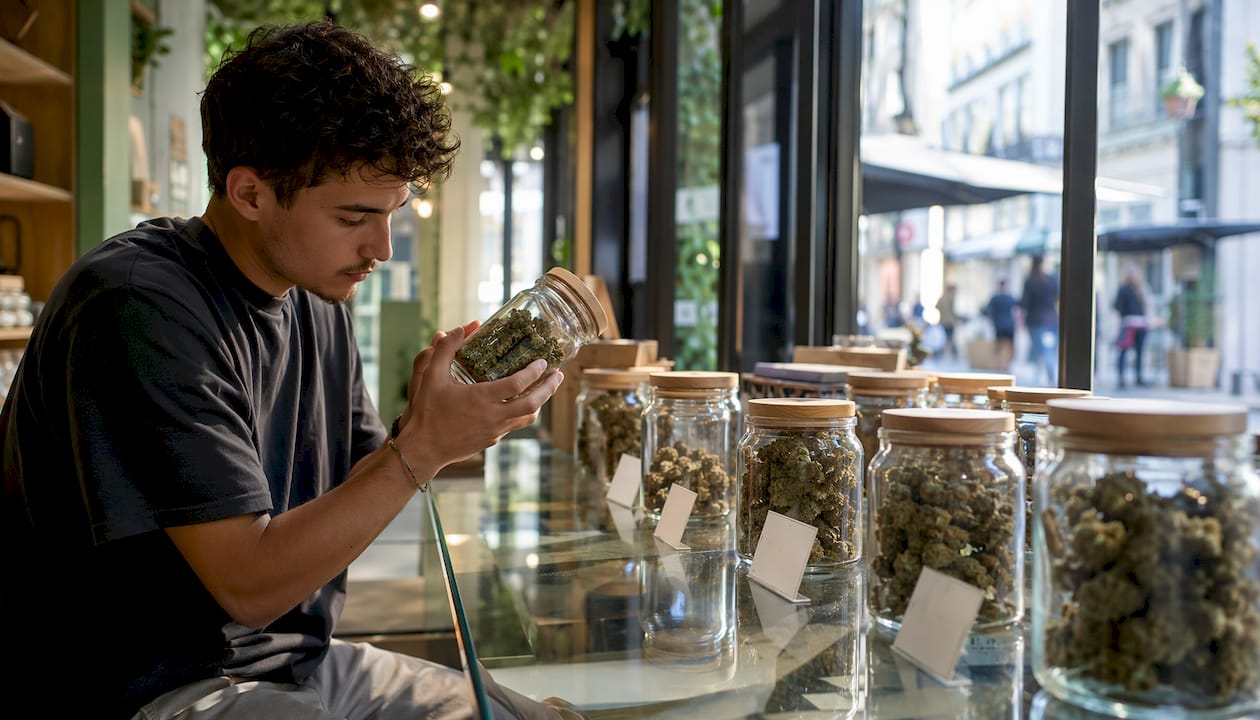
CBD resins are subject to the same traceability and analysis requirements. Their status varies more significantly between countries, with some states classifying them as concentrated extracts subject to stricter controls. Independent laboratory analyses confirming the THC content and the absence of contaminants (pesticides, heavy metals, residual solvents) are required for any compliant marketing.
Sublingual oils and extracts
CBD oils intended for oral or sublingual consumption fall under the Novel Food Regulation (EU) 2015/2283. The European Food Safety Authority (EFSA) has suspended the evaluation of several Novel Food applications relating to CBD, pending further toxicological safety data. In practice, this means that no CBD oil intended for consumption has yet received formal authorization at the European level, making its legal marketing complex in most Member States.
CBD cosmetics
Cosmetics containing CBD have been permitted in the European Union since 2021, provided that the CBD is derived from legal hemp varieties and that the product complies with the safe THC levels defined by Regulation (EC) No 1223/2009. The registration of CBD in the European Commission's CosIng database forms the regulatory basis for this authorization. Manufacturers must nevertheless ensure that each formulation complies with the maximum permissible concentrations and that the product information file (PIF) is complete.
CBD e-liquids
CBD e-liquids and vapes occupy a unique position: being inhaled rather than ingested, they generally fall outside the scope of the Novel Food Regulation. Their commercial availability is therefore broader, subject to compliance with THC limits and national regulations on tobacco products and inhalation devices. However, the lack of a harmonized European framework specific to this category creates uncertainty from country to country.
Food and edible products
Food products containing CBD (infusions, capsules, food supplements) are subject to the Novel Food regime. Without prior authorization from the European Commission based on an EFSA assessment, their marketing is prohibited in almost all Member States. The French Ministry of Agriculture has also reiterated that these products must be withdrawn from the market if they do not have such authorization.
Summary table of CBD product types in Europe
| Product type | Legal status in Europe | Main conditions | Notable restrictions |
|---|---|---|---|
| CBD flowers | Grey area, conditional tolerance | THC ≤ 0.3%, authorized variety, traceability | Restrictions in France, ban in some countries |
| CBD Resins | Varies by country | THC ≤ 0.3%, laboratory analysis | Similar to concentrated extracts in some states |
| Sublingual oils | Subject to Novel Food | Prior authorization from EFSA required | No European authorization has been granted to date |
| CBD cosmetics | Authorized since 2021 | CosIng registration, safe THC | Maximum concentrations to be respected |
| Food products | Subject to Novel Food | Prior authorization required | Prohibited without authorization in most countries |
| CBD e-liquids | Excluding Novel Food (inhalation) | THC ≤ 0.3%, national regulations | Lack of a harmonized European framework |
Key criteria to check for any compliant CBD product:
- Certified varietal origin (Cannabis sativa L. registered in the EU common catalogue)
- Delta-9-THC content less than or equal to 0.3% in the finished product
- Independent laboratory analyses available (cannabinoids, contaminants)
- Identified regulatory category (cosmetic, food, inhalation device)
- The labeling complies with legal requirements and contains no unauthorized therapeutic claims
What European regulatory developments can we expect in 2025 and 2026?
The regulatory framework for CBD in Europe is undergoing several significant changes, the effects of which will unfold between 2025 and 2026.
-
Harmonization of the THC threshold at 0.3% : As part of the 2023–2027 CAP reform, the European Union aims to align the maximum THC threshold accepted for industrial hemp at 0.3% in the majority of Member States. This harmonization, expected by 2025, puts an end to the coexistence of different thresholds (0.2% in some countries, 0.3% in others) which complicated the import and export of legal CBD in Europe.
-
Scientific assessment of CBD in cosmetics : In 2023, the European Commission tasked the Scientific Committee on Consumer Safety (SCCS) with defining precise safety criteria for CBD and THC in cosmetic formulations. The SCCS's opinion is expected in early 2026 and could lead to the establishment of binding maximum concentrations for manufacturers.
-
Novel Food Process and Food Outlook : EFSA has suspended the evaluation of several Novel Food applications related to CBD pending the submission of additional toxicological data. The resumption of these evaluations, contingent upon the submission of new data by the applicants, will determine whether CBD food products will be legally permitted on the European market in the coming years.
-
Regulatory differentiation between extract types : European authorities are working towards a clearer distinction between full -spectrum extracts , broad -spectrum extracts , and pure CBD isolates. This differentiation will have direct consequences on the documentation requirements and authorizations needed depending on the commercial form.
-
Strengthening of labelling requirements : several Member States are anticipating strengthened obligations for reading CBD product labels, including the mandatory indication of cannabinoid concentration, geographical origin of hemp and batch number associated with laboratory analyses.
-
Clarification of the status of flowers : discussions are underway at European level to define a more precise framework for hemp flowers intended for direct sale to the consumer, in order to reduce the grey areas that persist in several Member States.
-
Impact on cross-border online sales : the gradual harmonization of national rules should facilitate the sale of CBD online across Europe, but industry players will need to adapt their compliance procedures to new documentary requirements and strengthened customs controls.
How can we guarantee the compliance and quality of premium CBD products in France?
The compliance of a CBD product is not simply a matter of respecting the THC threshold. It involves a complete chain of control, from varietal selection to sale, including processing and labeling.
The essential quality standards for legal CBD products are based on several pillars:
- Traceability of origin : each product must be traceable to a certified hemp variety, cultivated in accordance with European regulations. The geographical origin and the name of the variety must be included in the technical documentation.
- Independent laboratory analyses : Certificates of Analysis (COAs) issued by accredited laboratories attest to the cannabinoid content and the absence of pesticides, heavy metals, and residual solvents. These documents must be accessible to consumers.
- Compliant labeling : In Europe, a CBD product label must clearly identify the CBD concentration, THC level, list of ingredients, batch number, and contact information for the person responsible for placing the product on the market. Any unauthorized therapeutic or medical claims are prohibited.
- Advertising restrictions : In France and most member states, advertising for CBD products cannot mention health effects not validated by the relevant authorities. Commercial communications must remain factual and comply with the rules applicable to food supplements or cosmetics, depending on the product category.
- Authorized use contexts : CBD is legally usable in three main contexts in Europe: cosmetic use (skincare, cream, serum), food supplement (subject to Novel Food authorization), and restricted medical use (CBD-based medicines authorized by national drug agencies, such as Epidyolex in France for certain forms of epilepsy).
Thefrenchhempempire applies these requirements to its entire product range. Every product sold, whether premium CBD flowers, resins, vapes, or oils, comes with accessible certificates of analysis, and the origin of the hemp is systematically documented. The brand also provides educational resources on its dedicated CBD news blog, allowing consumers to stay informed about regulatory developments and make informed purchasing decisions.
Thefrenchhempempire: compliant CBD products, delivered throughout Europe
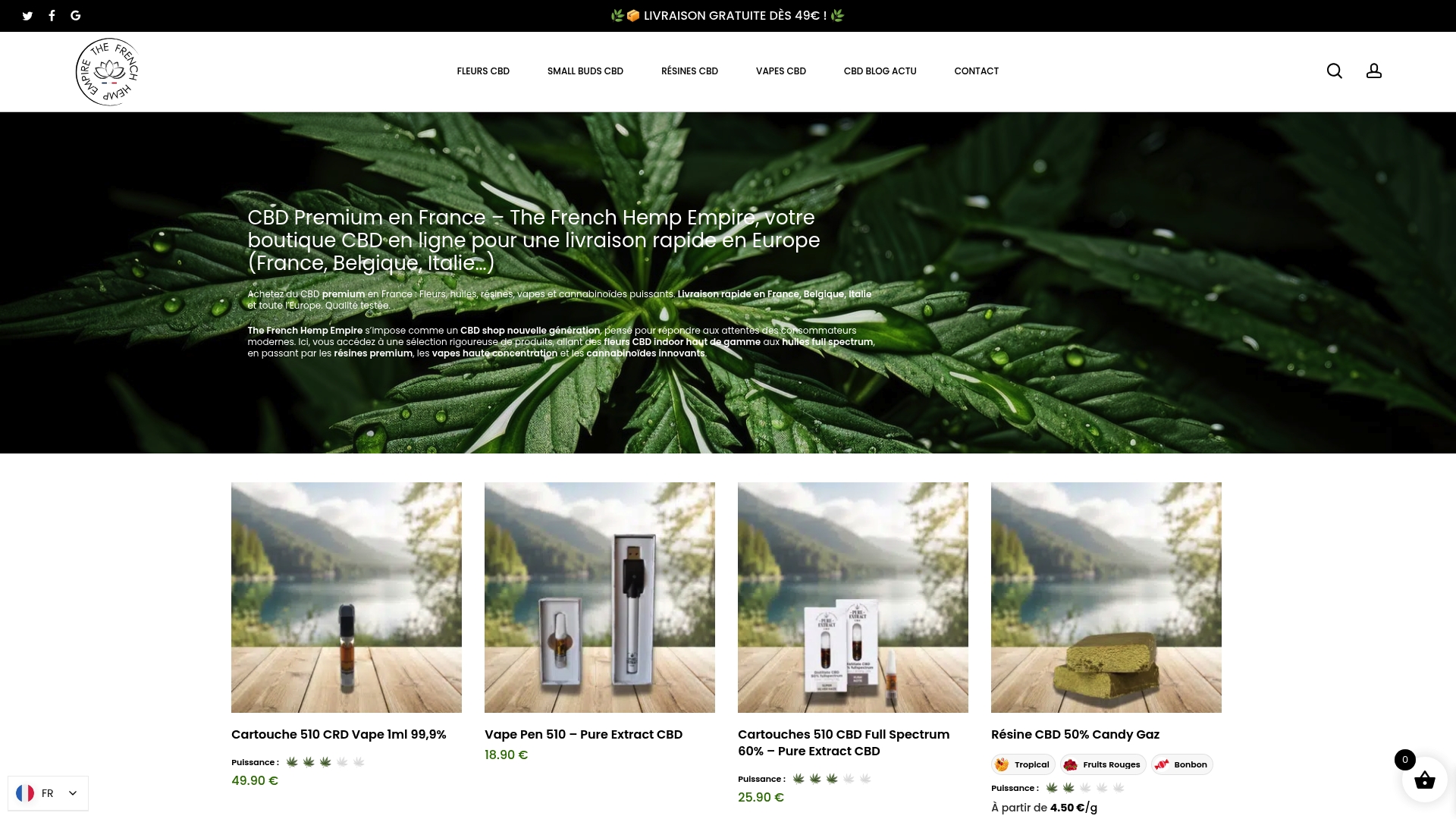
For consumers who wish to buy legal CBD in Europe without having to navigate the regulatory complexities on their own, Thefrenchhempempire offers a range selected according to strict compliance criteria: THC levels verified at a maximum of 0.3%, certified hemp varieties, independent laboratory analyses available for each reference.
The shop covers the main categories of legal CBD products: CBD flowers and edibles, certified CBD resins, and vapes and e-liquids that comply with European regulations. Each product page includes the necessary regulatory information for an informed purchase, and discreet delivery is guaranteed throughout Europe.
For consumers who wish to learn more before buying, the page dedicated to CBD regulations in France and Europe details THC thresholds, authorized varieties, and key points to consider. Browse the full range on Thefrenchhempempire to find the product best suited to your needs, in full compliance with current legislation.
Key points
In Europe, the legality of a CBD product depends simultaneously on the variety of hemp used, the THC level of the finished product and the regulatory category to which it belongs.
| Point | Details |
|---|---|
| THC threshold determining | Delta-9-THC must remain at a maximum of 0.3% in the finished product, in accordance with the French decree of December 30, 2021 and the European PAC standard, a harmonization expected in the majority of Member States from 2025. |
| Kanavape's ruling as a basis | The CJEU established in 2020 that CBD is not a narcotic, prohibiting member states from any general prohibition without public health justification. |
| Novel Food blocks food | No CBD oil or food product has been granted European Novel Food authorization; their marketing remains prohibited without this prior authorization. |
| Cosmetics permitted under certain conditions | CBD cosmetics have been legal in the EU since 2021 via Regulation (EC) No 1223/2009 and registration in the CosIng database, subject to safe concentrations. |
| Thefrenchhempempire | Offers compliant CBD flowers, resins, vapes and oils, with accessible certificates of analysis and delivery throughout Europe. |