Flowers and resins remain the categories most subject to control, especially outside the European Union. Always keep the purchase invoice and certificate of analysis (COA) readily available, and limit the quantities transported to strictly personal use.
In short:
- Only CBD flowers and resins from outside the EU require a purchase invoice and a certificate of analysis accessible during inspections.
- The legal limit in France is 0.3% THC in the original plant; beyond that, the product becomes considered a narcotic.
- Customs controls prioritize the detection of anomalies, particularly through rapid tests or laboratory analyses, mainly on business shipments.
- Traveling with CBD by plane imposes a restriction of 100 ml for oils, and flowers or resins are strongly discouraged in luggage.
- Presenting a certified analysis sheet and a consistent invoice significantly reduces the risk of seizure or delay during an audit.
Table of Contents
- Legal framework for CBD and customs in France
- How French customs controls CBD products
- Traveling with CBD depending on the mode of transport
- What documents should be presented in case of a customs inspection?
- What to do in practical terms after a CBD seizure
- Reduce the risks before buying or going on a trip
- What traceability really changes in the face of control
- Travel with peace of mind using compliant CBD products
- Sources
Legal framework for CBD and customs in France
French law sets a clear limit: a CBD product cannot contain more than 0.3% THC, calculated from the original plant. Beyond this threshold, the product legally falls into the category of narcotics, regardless of the buyer's intention or the product's commercial presentation. This threshold, and this threshold alone, determines the legality of a bottle of oil or a bag of flowers during an inspection.
The French Council of State's ruling of December 29, 2022, changed the game for CBD flowers and resins by overturning the general ban on their sale. This decision redefined customs practice, which now relies on the actual THC content rather than simply the product's form. The official summary published by MILDECA details this system and reiterates that the legal status still varies depending on the intended use.
Three systems coexist and are not applied in the same way:
- Food products containing CBD fall under the European regulation on “novel foods”, with prior authorization required before being placed on the market.
- CBD cosmetics are subject to separate regulations, focused on the safety of the finished product rather than the THC level alone .
- e -liquids and vapes must comply with both tobacco and vaping product standards, and the THC threshold.
- Any substance classified as a narcotic (THC above the threshold, unauthorized synthetic cannabinoids) falls under the public health code, with criminal consequences.
For a professional importer, compliance goes beyond the THC level. A solid import dossier requires the correct tariff classification via the product's CN code, the declared origin, and proof of analytical conformity. European regulations governing the movement of goods complement this national framework, particularly for trade between member states.
How French customs controls CBD products
The French Directorate General of Customs and Indirect Taxes (DGDDI) intervenes at three levels: parcels from countries outside the European Union, travelers' luggage at borders, and commercial freight. Its role is not to systematically search every bottle of CBD, but to identify anomalies: lack of documentation, suspicious levels, or volumes incompatible with personal use.
The procedure generally follows a progressive logic:
- Visual inspection of the package or luggage, often triggered by the appearance of the product (dried flowers, resin) or an incomplete customs declaration.
- Rapid on-site testing , using a detection kit, to assess the presence of THC.
- Laboratory analysis is required if doubt persists, which may immobilize the product for several weeks.
- Written notification to the traveller or recipient, stating the reason for the detention or seizure.
The decisions of the Council of State have helped to refocus customs practice on undeclared trade flows rather than on the lone traveler carrying a bottle of oil for personal use.
Seizures related to CBD have decreased since the December 2022 ban, but they haven't disappeared. Current controls focus on poorly documented business shipments and synthetic cannabinoids, which are considered a priority by customs officials. An individual traveling with two or three bottles of oil legally purchased in France remains in a very low-risk zone, provided they can prove it.
Traveling with CBD depending on the mode of transport
The practical rules vary considerably between air, rail and postal delivery, and each mode imposes its own material constraints.
- On airplanes : CBD oils in the cabin fall under the liquids limit of 100 ml per container. Flowers and resins are strongly discouraged in both carry-on and checked baggage, as their appearance almost always triggers stricter security checks, especially on international flights.
- By train : checks remain random, but are becoming more frequent on international routes, particularly to Switzerland or Germany. Clear product labeling and an available invoice prevent the worst misunderstandings.
- Postal parcels and freight : this is the most closely monitored channel. A shipment from a non-EU country without an accompanying certificate of analysis is almost guaranteed to be held. For orders placed from France, the delivery terms specify the applicable delivery times and guarantees.
Pro tip: Photograph the invoice and the Certificate of Authenticity (COA) before leaving, then save these images in a separate folder on your phone. If you're stopped for a check, being able to show a clear and legible document in a few seconds often changes the officer's attitude towards you.
Labeling plays an underestimated role: a product sold in its original packaging, with the THC level displayed and the name of the analysis laboratory, arouses significantly less suspicion than a bag transferred without any indication.
What documents should be presented in case of a customs inspection?
The Certificate of Analysis (COA) remains the most crucial document. A reputable COA, issued by an accredited laboratory, indicates the exact THC level, the CBD level, the date of analysis, and the product's batch number. This document, more than any verbal explanation, is what allows for a swift and decisive victory in an inspection.
The commercial invoice completes the file. It must include the purchase date, the seller's identity, the batch number corresponding to the Certificate of Authenticity (COA), and the exact quantity purchased. Without this correspondence between the invoice and the certificate, even a perfectly compliant product can raise suspicion.
To justify personal use, no quantity threshold is set in a single text, but observed practice provides useful guidelines:
- A few bottles of oil or a small quantity of flowers rarely lead to prosecution when accompanied by supporting documentation.
- The total absence of documents, however, transforms a routine situation into a lengthy procedure, even for a modest quantity.
- A volume that is clearly disproportionate to individual use attracts attention, regardless of the papers presented.
Professional operators have a tool that few use yet: the customs ruling, or binding tariff information (BTI), which secures the classification of a product for three years and avoids unpleasant surprises with each new shipment.
What to do in practical terms after a CBD seizure
A seizure is never final without a procedure, and certain reflexes limit the consequences.
- Demand a written receipt stating the precise reason for the detention, the department involved, and its contact details. This document forms the basis of any subsequent appeal.
- Gather your evidence immediately : Certificate of Analysis (COA), invoice, transport document, and all correspondence with the seller. If possible, request an independent counter-analysis of the seized batch.
- File an administrative appeal with the relevant interregional customs directorate. This step precedes any legal proceedings and sometimes allows for a quick resolution without going to court.
- Consider legal action before the judicial court if the administrative appeal fails, particularly when the product was compliant and the seizure was based on an error of judgment.
A lawyer specializing in customs law becomes useful as soon as the value of the seized shipment is significant, or when the authorities raise the possibility of drug trafficking. Administrative appeals typically take weeks, which allows time to build a strong case, but also makes responsiveness essential.
Reduce the risks before buying or going on a trip
A few simple habits can prevent the vast majority of unpleasant surprises. Opt for products purchased in France or the European Union, whose traceability and origin can be verified even before ordering.
- Always check that a COA accompanies the product, with a THC level clearly displayed below 0.3%.
- For travel outside the EU, avoid flowers and resins: a labeled oil or isolate is easier to justify than a product with a plant-like appearance.
- Only carry the amount necessary for your stay and always keep a digital copy of your receipts.
- Before leaving, check the regulations of the destination country with its embassy or customs services, because a product that is legal in France is not automatically legal elsewhere.
Never assume that more lenient foreign legislation will protect you once you cross the French border.*
What traceability really changes in the face of control
The difference between a check that's resolved in five minutes and a seizure that drags on for weeks rarely lies in the quality of the product itself. It lies in the traveler's ability to prove, on the spot, what they are carrying. A Certificate of Authenticity (COA) displayed on a product label, a detailed invoice, a clearly indicated origin: these are details that seem administrative until the day a customs officer asks for them.
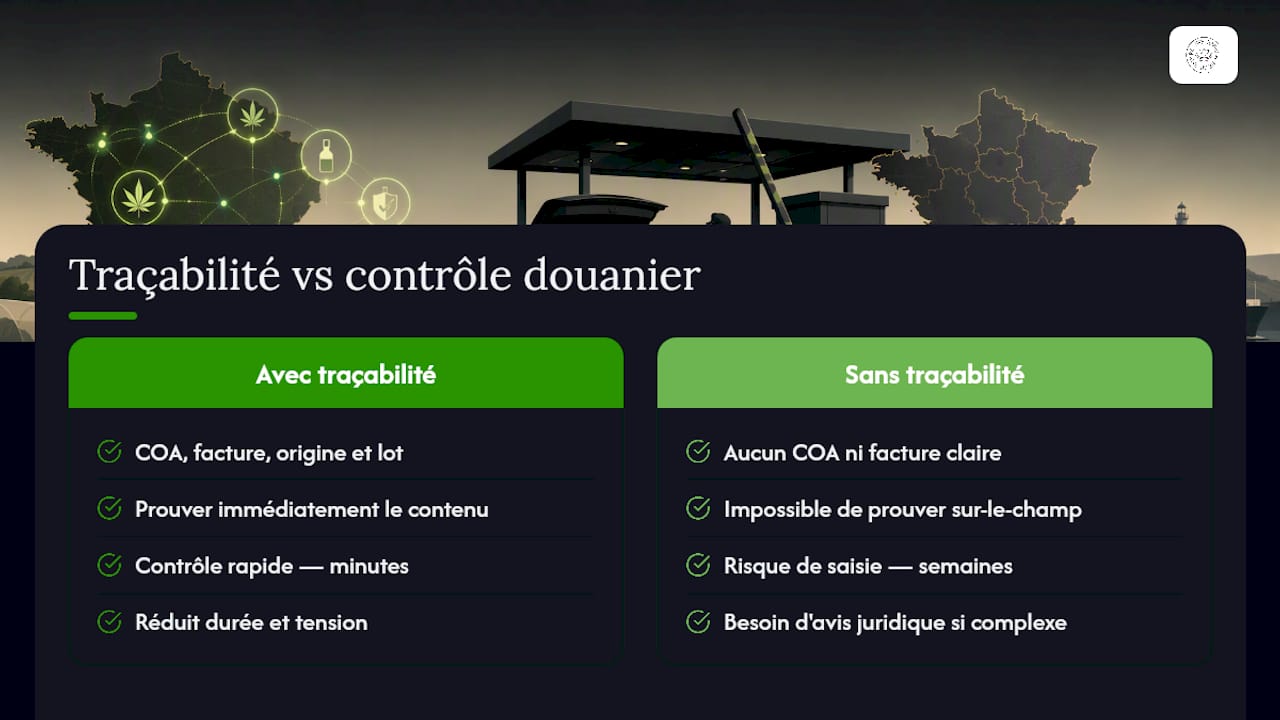
The French Hemp Empire publishes its independent lab analyses directly on its product pages, with traceability of origin and batch. This isn't a marketing ploy: it's precisely the type of documentation an audit would require. Presenting a consistent Certificate of Analysis (COA) and invoice never guarantees the absence of an audit, but it significantly reduces the time and stress of dealing with an agent.
For more complex situations, such as large quantities, shipments to destinations outside the EU, or doubts about the nature of a cannabinoid, no product information sheet can replace expert legal advice. While documentation offers protection, it is never a substitute for professional guidance when the issues extend beyond simple personal use.
— Vanessa
Travel with peace of mind using compliant CBD products
Choosing a product whose conformity can be verified at the time of purchase avoids many complications when crossing a border. Thefrenchhempempire offers premium and legal CBD flowers accompanied by their certificate of analysis, which significantly simplifies the compilation of the evidence mentioned above: invoice, COA, batch traceability—everything is gathered at the time of ordering rather than having to be searched for in a hurry before departure.
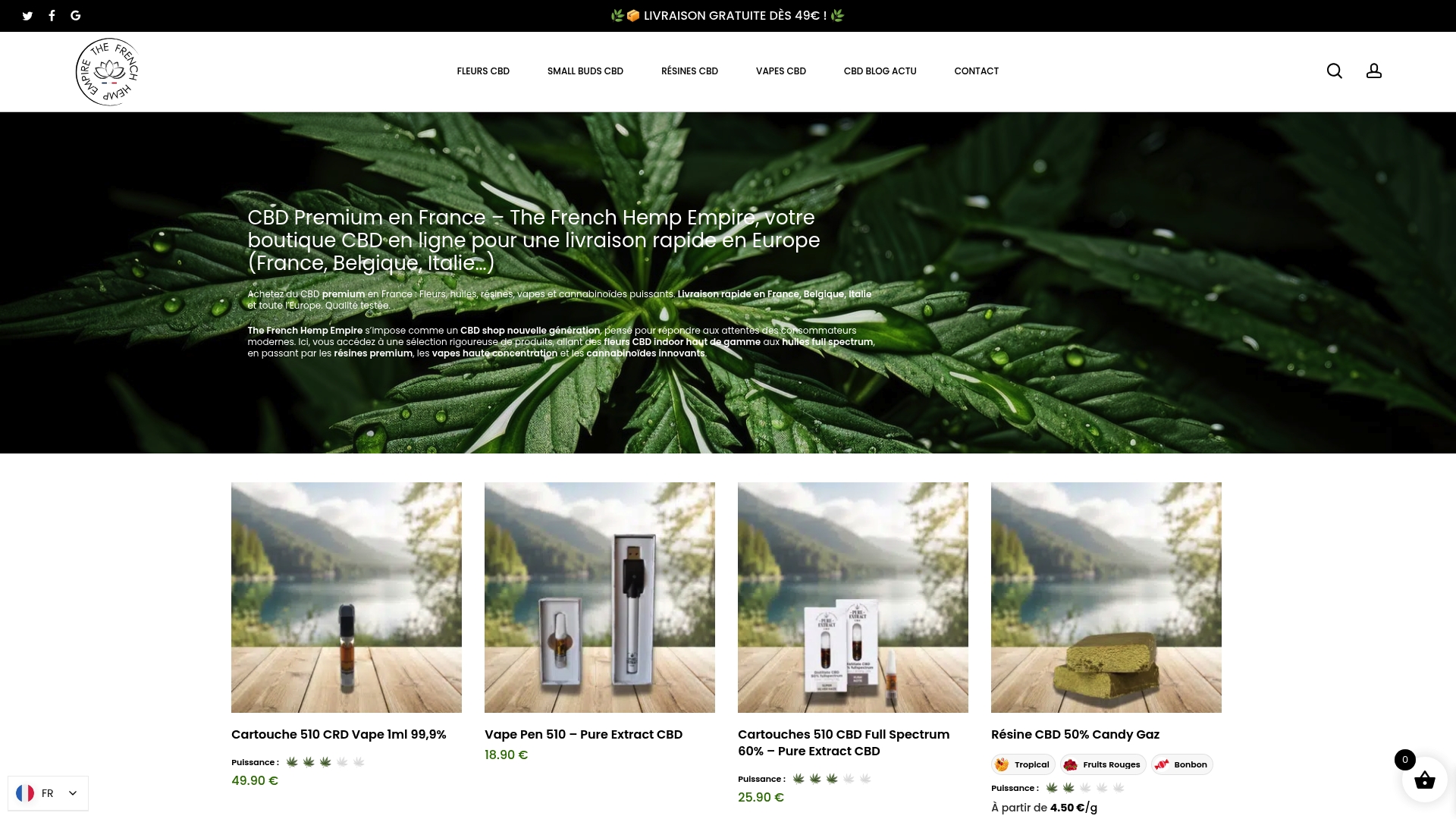
For readers who prefer a format less exposed to visual inspection, oils and high-THC alternatives are often easier to justify than dried flower, while maintaining the same analytical rigor. Each product page on the site indicates the measured THC level and the laboratory responsible for the analysis—information you can print or save before traveling.
Consult the catalogue of compliant flowers and oils to prepare for your next trip with documents ready to present in case of inspection.
Sources
These sources allow for direct verification, without intermediaries, of the rules mentioned in this article: