Yes, it is generally possible to travel with CBD, in France as in most European countries, provided that the product complies with the legal THC limit, remains in its original packaging, and is accompanied by an invoice and a certificate of analysis. Two formats pose a problem almost everywhere: flowers and resins. And some destinations, with a zero-tolerance policy on cannabis, require you to travel without any CBD at all.
In short:
- CBD products are generally permitted in France and Europe, provided that their THC content does not exceed 0.3%, but this limit varies from country to country.
- When travelling by plane, strict rules must be followed regarding liquids, vapes and batteries, favouring oils, capsules or cosmetics to avoid prolonged checks.
- CBD flowers and resins pose an increased risk of control because of their similar appearance to cannabis, which suggests they should be reserved for home use.
- Before travelling, it is advisable to present the invoice, certificate of analysis, original packaging and to check the regulations of the transit and destination countries.
- In the event of an inspection, calm cooperation and the provision of supporting documents can limit complications, but it is best to travel without CBD in countries where zero tolerance is in force.
Table of Contents
- Traveling with CBD: what does the law say in France and Europe?
- Traveling by plane with CBD: liquids, vapes and luggage
- How to pack your suitcase before a flight with CBD?
- What to do in case of a customs inspection involving CBD?
- Which countries should you avoid travelling to while using CBD?
- Why documentary rigor makes all the difference in the event of an audit
- Which CBD formats should I choose for worry-free travel?
- Where can I check the regulations before leaving with CBD?
- Sources
- Frequently Asked Questions
Traveling with CBD: what does the law say in France and Europe?
France authorizes the sale and possession of hemp-based products with a THC content not exceeding 0.3%, a threshold set by the Public Health Code and its associated articles. This threshold is measured on the finished product, not the raw plant, which makes a significant difference for processed oils or capsules. The official website service-public.fr details the procedures and reminds consumers that the legality of a product depends as much on its composition as on its presentation.
The problem is that this French threshold is not universally applicable. The European Union has not harmonized the rules on CBD, and each member state applies its own tolerance levels.
- Some countries, such as Switzerland, may tolerate a higher THC level than the French threshold.
- Some Scandinavian countries apply a much stricter policy, close to zero tolerance in practice.
- Italy has experienced several regulatory reversals on hemp flowers, making the situation unstable from year to year.
Pro tip: before any departure, check the THC limit in force in the country of destination AND in the countries of transit or stopover, legality in France does not protect in Frankfurt or Dubai.
This lack of harmonization explains why a product that is perfectly legal in Paris can become problematic at the next border. It is also why the Ministry for Europe and Foreign Affairs remains the primary source of information to consult before any trip, on a country-by-country basis.
Traveling by plane with CBD: liquids, vapes and luggage
The airport remains the place where the rules are strictest, not because CBD is specifically targeted there, but because aviation security standards apply to all liquids and batteries without distinction.
- In the cabin, each liquid container (CBD oil, spray, e-liquid) must not exceed 100 ml and must fit in a transparent one-liter bag, as with any other liquid.
- Capsules and solid cosmetics are exempt from this constraint and are easier to transport, both in the cabin and in the hold.
- Vapes and their lithium batteries must travel in the cabin, never in the hold, in accordance with IATA recommendations on batteries and European Aviation Safety Agency rules on dangerous goods .
- associations like FIVAPE also recommend partially emptying tanks before flying to avoid leaks related to cabin pressure.
Flowers and resins, however, present a different problem: their appearance and smell are identical to those of illegal cannabis, which increases the risk of prolonged inspection even when the product is perfectly legal. A saliva test detects THC, but never CBD itself, though the security officer inspecting your luggage may not be aware of this. It's therefore best to reserve these forms for home use and opt for oils, capsules, or cosmetics when traveling.
How to pack your suitcase before a flight with CBD?
A simple checklist limits most of the inconveniences during inspections.
- Bring the purchase invoice and the certificate of analysis (COA) of the product, preferably printed and saved on your phone.
- Keep the product in its original packaging, with the label indicating the THC level and the instructions for use.
- Limit the quantity carried to what clearly corresponds to personal use over the duration of the stay.
- Scan all supporting documents before departure, while also keeping the originals easily accessible in your hand luggage.
- Check the airline's policy on hemp products, as well as the regulations of transit countries, not just those of the final destination.
This last point is often overlooked. A stopover in Doha or Singapore can be enough to turn an uneventful trip into a diplomatic incident, even if the final flight lands in a country where CBD is perfectly legal.
What to do in case of a customs inspection involving CBD?
When faced with an inspection, the best attitude remains calm and documented cooperation.
- Present the invoice, COA and original packaging immediately, without discussing the legal basis with the agent.
- In the event of a seizure, always request a receipt stating the identity of the agent or the department concerned.
- Contact the embassy or consulate if the situation goes beyond simple administrative confiscation, and keep all your proof of purchase.
- Consult a local lawyer if criminal proceedings are initiated; confiscation of a product does not always result in prosecution, but it is best not to rely on ambiguity.
The difference between administrative confiscation and criminal proceedings often lies in the quantity transported and the nature of the product. A clearly labeled bottle of oil almost never leads to the same consequences as a bag of flowers with no traceability.
Which countries should you avoid travelling to while using CBD?
Some destinations apply a zero tolerance policy on any cannabis derivative, regardless of the THC level displayed on the label.
- The United Arab Emirates and Singapore heavily penalize the possession of cannabinoids, including in the form of oil or cosmetics.
- Several Southeast Asian countries apply severe penalties without distinction between CBD and regular cannabis.
- The United States remains a special case: legality varies from state to state, and federal law continues to classify cannabis as a controlled substance despite more flexible local laws.
A practical guide on the subject reminds us of a simple rule that applies to all uncertain destinations: in case of persistent doubt about local legality, the safest solution remains to travel without CBD and to buy some more, if possible, once there.
Why documentary rigor makes all the difference in the event of an audit
Having a Certificate of Authenticity (COA) on hand never guarantees you won't be tested, but it significantly reduces the time and stress involved, as confirmed by numerous traveler accounts. Many travelers also underestimate the importance of choosing broad-spectrum or THC-free products, a precaution that deserves to be treated with the same seriousness as medical medication transported abroad. This level of rigor is what some shops apply to every product they sell, through independent laboratory analysis and complete traceability of origin.
— Vanessa
Which CBD formats should I choose for worry-free travel?
Some formats are designed for life on the go, while others unnecessarily complicate travel. CBD oils and capsules fit easily into a toiletry bag, comply with carry-on liquid regulations as long as the bottle remains under 100 ml, and pose no visual problems during security checks.

At Thefrenchhempempire, every product, from CBD flowers and resins to cannabinoids like THCA, comes with its own independent certificate of analysis, accessible directly on the product page. This traceability is what distinguishes a legitimate purchase from a risky gamble at the airport. Before you travel, always check the regulations in your destination and transit countries, then consult our product pages to choose an oil or capsule format suitable for your trip.
Where can I check the regulations before leaving with CBD?
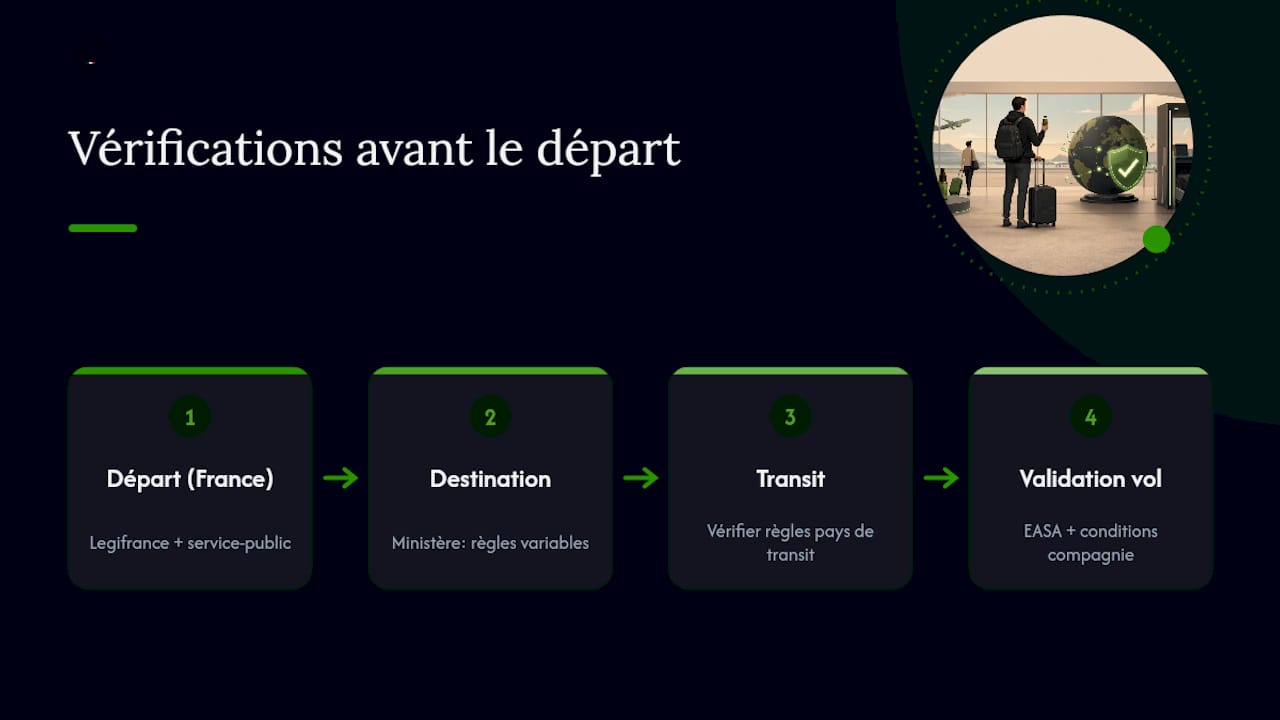
Four resources are all you need to ensure a safe departure: Legifrance for the French legal framework, service-public.fr for practical information, the Ministry of Foreign Affairs website for country-by-country updates, and EASA for guidelines on batteries and liquids during flights. Remember to also check your airline's transport conditions.
Sources
- Legifrance — Code and relevant articles
- Service-public.fr — practical information on hemp/CBD
- EASA — Dangerous Goods Rules and Air Transport Directives
Frequently Asked Questions
Can CBD be transported in a car?
Yes, under the same conditions as on a plane: product conforming to the 0.3% THC threshold , original packaging, invoice and certificate of analysis within reach in case of roadside check.
How does the police detect CBD during a check?
Saliva and urine tests detect THC, but never CBD itself. A product that complies with the legal limit should therefore not trigger a significant positive result, except in cases of very high consumption.
Can CBD be transported on an Air France plane?
Yes, Air France applies standard airline regulations: oils and capsules are permitted in the cabin in containers of up to 100 ml, while vapes and batteries are only allowed in the cabin. Always check the airline's specific conditions before your flight.
What fine do you risk for possessing CBD in a non-compliant manner?
A product exceeding the legal THC limit or considered cannabis-like can lead to criminal penalties, the severity of which varies depending on the quantity and circumstances. Consult the relevant legislation on Legifrance or a lawyer to determine the exact risk associated with your situation.