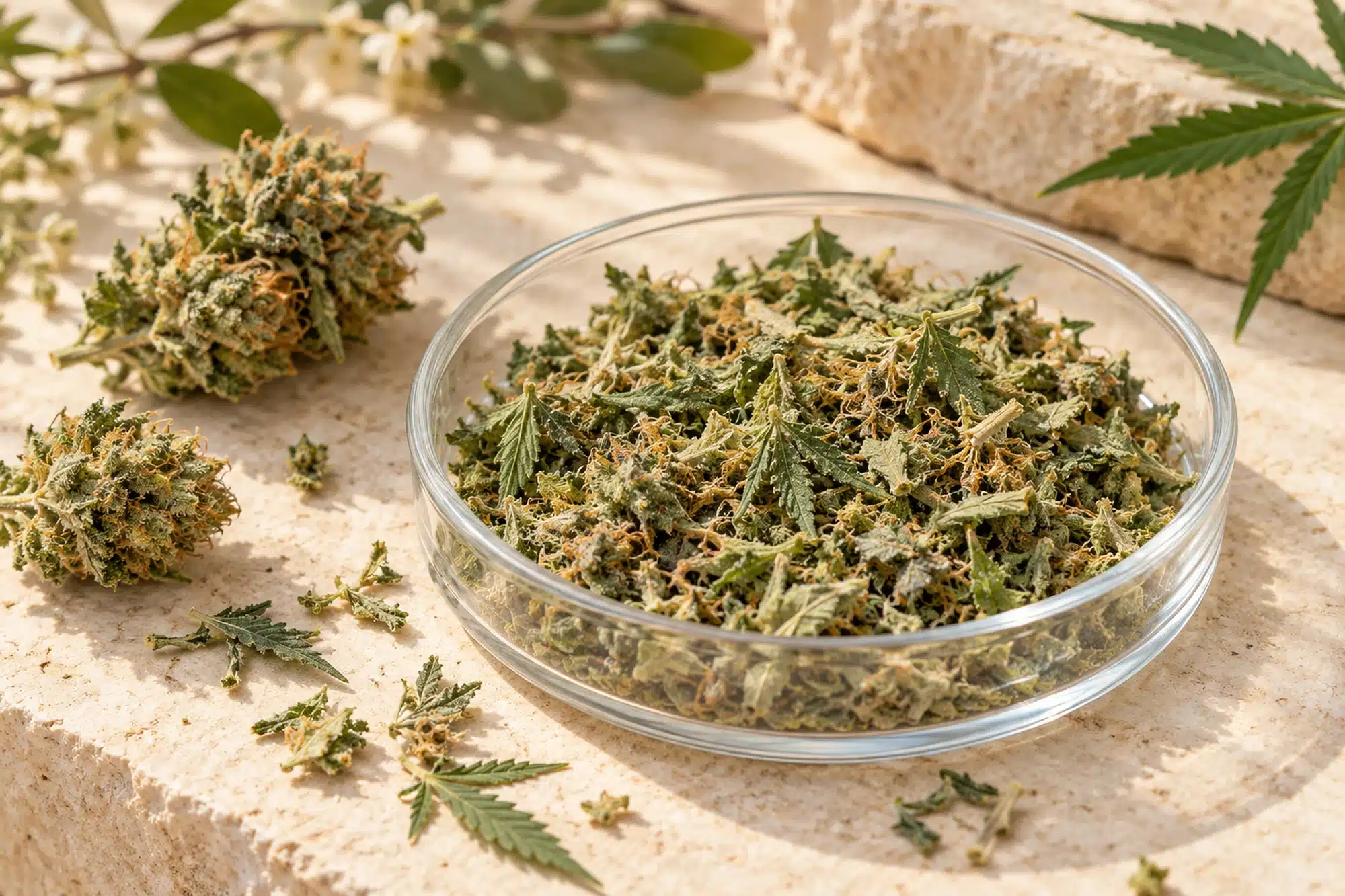
A bag of trim doesn't look like a large hemp flower. Instead, you see small floral fragments, leaves of varying sizes, and sometimes finer particles. In The French Hemp Empire's DC10, the Trim DC10 Ultra Premium 20% adds another number to this visually heterogeneous mix. What does this 20% mean for the entire bag? And how can you verify that a lab analysis accurately describes a product made up of different pieces?
The answer requires separating three levels of information: what you observe, what the product information sheet states, and what the laboratory measures. A fragment that appears very resinous does not necessarily represent the entire batch. Conversely, a photograph of small leaves does not prove that the overall resin content is low. This guide helps you understand trim DC10, its difference from small flowers and resins, and then the specific questions to ask about composition and traceability.
Trim DC10: what exactly are we talking about?
The term "trim" generally refers to the elements recovered during the preparation and sorting of hemp flowers. This can include small leaves, pieces of flowers, and other plant fragments. The proportion of each varies depending on the starting material, how it is processed, and the sorting criteria. Therefore, the product is not intended to consist of identical, whole buds.
In the product under review, "DC10" is the name of the advertised formulation. This alone is insufficient to identify a standardized molecule as clearly as "CBD" or "delta-9-THC." The complete composition must be verified in the batch documentation. The term "Ultra Premium" reflects a marketing strategy; it does not specify a precise proportion of flowers, a processing method, or laboratory certification.
The "20%" figure deserves the same clarification. It refers to the stated concentration of DC10 in this reference product, not to a THC content of 20%. To understand what was measured, one must know the compound(s) designated by DC10, the basis for the percentage, the sample, and the analytical method. The name and number are starting points for querying a product sheet, not a comprehensive description of the substance.
This caution doesn't diminish the appeal of the format. A mix of fragments might be sought after for its price per gram or because the appearance of large heads isn't a priority for the buyer. The key is to understand the product you receive, with its physical variations and inherent limitations in terms of documentation.
Why does a sachet of trim seem so variable?
When we observe a whole flower, we see a relatively coherent plant structure. In a trim, the elements have been separated or fragmented. Some pieces may come from floral areas, others from the leaves. The sizes, colors, and visible surfaces vary from one piece to another. Transportation can also move the finest particles to the bottom of the packaging.
This visual heterogeneity does not automatically imply a defect. Nor does it allow us to assume that all fragments have the same composition. Cannabinoids are notably associated with the glandular trichomes of cannabis: a study conducted on isolated trichomes documents their major role in the production and presence of cannabinoids. However, examining a few fragments with the naked eye does not allow us to calculate the content for the entire bag.
Plant dust, floral fragments, and small leaves can be distributed differently depending on handling. A sample taken only from the surface may therefore contain a proportion of components that differs from that of the rest of the batch. This does not necessarily mean that the DC10 reference is irregular; this methodological possibility explains why sampling and sample preparation must be adapted to the format.
A study on the degree of manicuring of cannabis inflorescences shows that leaf removal and other post-harvest decisions can influence the composition results measured in an experimental setting. Its data do not describe the DC10 trim in this catalog. They simply serve as a reminder that a change in the proportion of plant parts is not insignificant when comparing analyses.
Trim, Small Buds and Whole Flowers: three distinct appearances
A Small Bud is typically a small, identifiable flower head. It may be compact or more open, but its floral structure remains visible. A full-sized flower sold in a larger size also retains a recognizable structure, often with a stronger visual appeal.
Trim is distinguished by its collection of fragments. A single bag may contain some small pieces that resemble miniature flowers and others that look more like leaves. The presence of a floral fragment does not automatically make the entire package a bag of Small Buds. Conversely, the presence of small leaves does not automatically render it worthless: the quality of the batch depends on its actual composition, condition, and honest presentation.
These categories do not constitute a universal hierarchy of cannabinoids. A large, beautiful bud does not guarantee a certain level; a less photogenic trim does not necessarily imply the absence of desired compounds. The two products may also have different formulations. Therefore, compare batches and analyses, not just the appearance in photos.
| Format | Expected appearance | Quality question to ask |
|---|---|---|
| Whole flower | Identifiable and relatively large floral head. | Do the advertised rate and origin correspond to the batch of flowers? |
| Small Buds | Small heads that are always identifiable. | Does the reference come from a defined batch, with a corresponding analysis? |
| Trim | A mixture of floral and leaf fragments of varying sizes. | Does the analyzed sample represent this final mixture? |
If your primary criterion is the appearance of whole flowers, trim may not meet this expectation. If you wish to compare a fragmented format, carefully read the description of the material and the price per gram. In any case, do not equate two products simply because they both display "20%": the basis of the percentage must be verified for each.
20% DC10: percentage of an extract or of the mixture sold?
The question of the denominator is crucial. A data sheet may state the percentage of an ingredient, an intermediate preparation, or the final product. For the customer, the most meaningful result is a measurement of the mixture as sold. If an extract stated at 20% is added to other materials, the final concentration may differ; conversely, a final formulation analyzed at 20% describes the mixture under the conditions and limitations of the test.
To illustrate the logic without describing the product on the site, let's assume that an ingredient weighs 100 g and contains 20 g of a precisely identified substance. Its concentration is 20%. If this ingredient is then mixed with 100 g of a base that does not contain this substance, the resulting 200 g mixture will still contain 20 g, or 10%. It would be incorrect to transfer the "20%" of the ingredient to the mixture without further verification.
The reverse calculation requires the same caution. A sachet sold as "trim DC10 20%" does not guarantee that every leaf, every floral fragment, and every fine particle contains exactly 20%. The percentage, even if established by a representative analysis, describes the sampled material according to a convention and an uncertainty, not a guarantee for every single milligram.
It's also important to understand what "DC10" actually means. A lab result labeled "total cannabinoids: 20%" isn't enough to confirm "DC10: 20%". Ask for the full names of the substances, their individual results, and their correspondence to the trade name. If the method doesn't test for the claimed compound, the certificate may be genuine but still insufficient to substantiate that claim.
Sampling: how does a laboratory represent a mixture?
An analysis measures the sample the laboratory receives, not every gram of every bag produced. For it to provide information about the batch, the sample must be representative. This involves identifying the batch, considering possible variations within the product, and preparing the sample using an appropriate method. These operations are the responsibility of the producer and the laboratory, not something to be done at home.
Imagine a bag where the top contains more visible floral fragments and the bottom more fine particles. If these fractions have different compositions, a sample limited to one of them could yield a result distinct from the bag's average. This phenomenon is possible in various plant mixtures; it cannot be confirmed or ruled out for a given reference based solely on its photograph.
Ask the seller if the report relates to a composite from the final batch and how the batch number is linked to the shipped bags. A manufacturer can describe their procedure in a way that respects the confidentiality of their operations while still providing the necessary traceability information. The date of the analysis and the exact matrix must also be included in the documentation.
A very precise value, such as 20.00%, does not eliminate questions about sampling. It may reflect the laboratory's numerical presentation, with inherent uncertainties to consider. When assessing heterogeneous material, the quality of the sample is as important as the number of decimal places displayed.
What should you check when you receive the packet?
Start with the product reference and the weight ordered. The Trim DC10 Ultra Premium 20% product sheet offers several sizes; check the one you received and keep the batch identification if provided. The condition of the packaging matters: it must protect the fragments from moisture, excessive heat, and external contamination.
Upon opening, observe the normal diversity of the pieces. Varying proportions of small leaves and floral fragments may exist; compare the whole to the description and photographs, without requiring that every single piece resemble a small flower. Look especially for obvious anomalies: musty odor, unexpected moisture, foreign debris, traces of mold, or damaged packaging.
Do not draw any conclusions about the "20%" based solely on color or shine. The visible presence of trichomes is not a quantitative measure of DC10, the identity of which must also be specified. If the appearance of the received batch differs significantly from the product description, photograph the product and contact the seller with the order and batch numbers.
Avoid mixing different sachets before checking their reference numbers. Two batches with the same name may have different appearances. Keeping the original label and sachet facilitates exchanges and prevents attributing the analysis of one product to another.
Particle size distribution and fine particles: what they say, and what they don't say
Particle size refers to the size of the fragments. A trim can contain a mixture of relatively large pieces and very small particles. Movement during transport can partially sort this mixture, notably by accumulating the fines in certain areas of the bag. Their presence alone does not prove low quality or a high concentration of cannabinoids.
Highly fragmented material exhibits fewer recognizable floral structures. This can make visual inspection more difficult: one can describe a color or odor, but it is less easy to identify the origin of each particle. Here again, the documentation of the batch becomes more important than appearance alone.
To compare two trims, ask if the size description matches the batch offered. A finer trim might be preferred for its size or less appreciated by someone who wants to see more floral fragments. This choice is based on sensory and commercial considerations. It does not automatically provide a ranking of the chemical composition.
Don't confuse "kief," "powder," "trim," and "Small Buds" when a shop uses these terms. They can refer to different materials and processing methods. If a product description is vague, ask about the proportions and general nature of the ingredients, without assuming that a fine powder is necessarily a pure extract.
Why can the aromas vary from batch to batch?
The DC10 trim description lists commercial notes such as diesel, fruity, and earthy. These guide the aromatic imagination, but the perception of a batch depends on its raw material and storage conditions. If the fragments come from different plant sources, the profile can be more complex than a flower identified by a single variety name. Without documentation, it's unwise to assume a common genetic makeup for all the pieces.
Aromatic compounds are distinct from the declared value for a cannabinoid. Two batches with the same percentage may smell different; two batches with a similar odor may have different test results. A strong odor does not guarantee a 20% concentration, and a fainter odor does not prove that the batch is non-compliant.
Store the product in a clean, dry, and tightly sealed container, away from direct sunlight and temperature fluctuations. Do not add water or fruit pieces to alter its moisture content. If an unusual musty odor develops, remove the product from the container and contact the seller. Aromas are helpful in assessing a product, but they are not a substitute for analysis or inspection for signs of spoilage.
Trim DC10 20%, flower DC10 20% or resin DC10 40%?
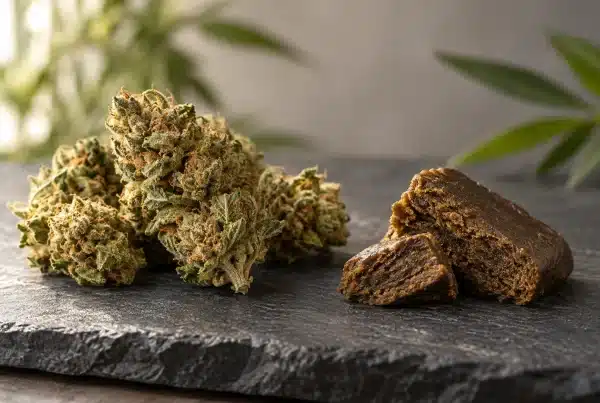
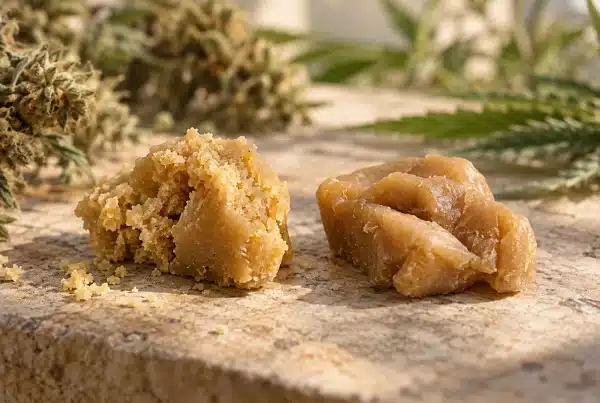
These figures appear on different physical formats. Trim is a fragmented mixture, flower retains an identifiable floral structure, and resin forms a distinct, concentrated matrix. Even if both trim and flower claim 20%, it's essential to verify that their figures refer to the same substance, using the same method, and to the final product.
A 40% DC10 resin should not be described as automatically producing "twice the effect" of a 20% trim. If the figures were confirmed as mass percentages of the same substance, they would indicate a difference in proportion among the materials analyzed. They would not, on their own, determine individual effects, ingredient quality, or safety.
The price per gram can help you choose between formats. Trim is sometimes offered for a more affordable price, while flower might be chosen for its appearance and resin for its texture. For a useful comparison, consider the prices in relation to the weight, the characteristics you're looking for, and the batch analysis. The supposed cost per milligram of "DC10" is only meaningful if the substance and its concentration are defined in a comparable way.
Within the DC10 category, there are many floral and resinous profiles. The best approach is to compare detailed product sheets rather than reducing the entire range to a single potency scale.
Key points of a certificate of analysis for trim
- Product identity: does the report name correspond to Trim DC10 Ultra Premium and not to another flower or resin in the range?
- Batch number: does the document allow us to link it to the sachet currently being sold?
- Nature of the sample: did the laboratory test the representative final mixture or only one ingredient?
- Substances sought: Are the component(s) designated by "DC10" clearly named and measured?
- Units and method: Is the rate indicated as a mass percentage or in another unit, with an appropriate method?
- Other findings: Are complementary cannabinoids, delta-9-THC and contaminant controls present when advertised?
A cannabinoid certificate does not necessarily cover pesticides, heavy metals, solvent residues, or microbiological analyses. Read the list of parameters actually tested for. The CBD certificates and lab analyses explains more generally how to read a report and its limitations.
A "not detected" rating is linked to the method's threshold; it does not constitute proof of absolute absence. A dated analysis describes the batch and sample concerned at a specific point in time. If the formulation or batch changes, the document's relevance must be reassessed.
The question of the regulatory status of the DC10
The name DC10 alone is insufficient to determine the legal status of this sachet. It is necessary to identify the precise substance(s) behind this commercial name and then verify their status under the regulations in force in the country of sale. In France, theANSM (National Agency for Medicines and Health Products Safety) has classified several cannabinoids and certain chemical families ; the fact that a marketing acronym does not appear in a decision title does not automatically demonstrate that its components are authorized.
The delta-9-THC content must also be examined according to the applicable hemp regulations. However, a THC declaration of less than 0.3% does not, in itself, determine the status of any other cannabinoid added or present in the preparation. The DC10 and the batch results must be compared with the relevant regulations at the time of marketing.
A shipment to another country requires separate verification. National frameworks are not automatically identical. The conclusion must be based on a known composition and a specific market, not on the abstract term "trim DC10".
Precautions for a product containing new cannabinoids
Trim DC10 is intended for adults. Without a precisely documented composition and sufficient human data on the formulation, it would be misleading to promise a uniform experience. If a product can impair alertness, do not drive or operate machinery after exposure. Also avoid combining it with alcohol or other substances that alter perception.
If you are taking medication, are pregnant, breastfeeding, or have a health problem, consult a healthcare professional. A brand name and advertised concentration do not prove any therapeutic benefit. ANSES (the French Agency for Food, Environmental and Occupational Health & Safety)has reported cases of poisoning linked to products marketed as containing CBD but actually containing other substances, highlighting the importance of verifying the actual ingredients of new formulations.
Keep the product out of reach of children and animals, in its original packaging. If you notice a severe reaction after exposure, contact emergency services and provide the product reference and batch number. If the material shows signs of mold or an unusual odor, do not attempt to clean it yourself.
FAQ about the DC10 20% trim
Is DC10 trim the same as Small Buds?
No. A Small Bud is a small, identifiable flower; trim is a mixture of fragments that may include floral and foliar parts. The presence of a few small pieces of flower in the trim does not make the entire bag Small Buds.
Does the 20% figure apply to each fragment?
Not necessarily. A rate established on a representative sample describes the analyzed material according to a method and an uncertainty. It does not guarantee that every sheet and every particle has exactly the same concentration.
Is a cheaper trimmer necessarily of lower quality?
No. The price also reflects the format and visual appeal of the product. Quality should be assessed based on the condition of the batch, the stated composition, traceability, and available controls.
Can DC10 be identified by smell or color?
No. Odor and color can help describe the material, but they do not allow for chemical identification of the component(s) designated by DC10 nor for confirming a rate of 20%.
Does an extract analysis confirm the final trim rate?
It provides information about the tested extract. If the extract was subsequently incorporated into plant material, the content of the final mixture may differ. Request a clear documentary link to the commercially available batch of trim.
Is a DC10 trim with less than 0.3% THC automatically permitted?
No. The exact composition, the status of other substances, and the applicable market regulations must be examined. The delta-9-THC level is important information, but it doesn't answer all the questions on its own.
The most useful reflex before comparing formats
A trim should be judged on what it truly is: a mixture of plant fragments, with a variable appearance and a stated concentration that must be documented. Begin by identifying the batch, the definition of "20%", and the nature of the sample analyzed. Then compare the trim to flowers and resins according to your criteria of format, presentation, and budget.
On the Trim DC10 Ultra Premium 20% product sheet, the name allows you to find the reference; the relevant certificate should allow you to understand its composition. The best question to ask remains practical: "Does the analysis of the final blend shipped correspond to the batch number on my sachet, and what exactly does the DC10 line measure?"