Which Small Buds CBD should you choose according to your aromatic preferences?
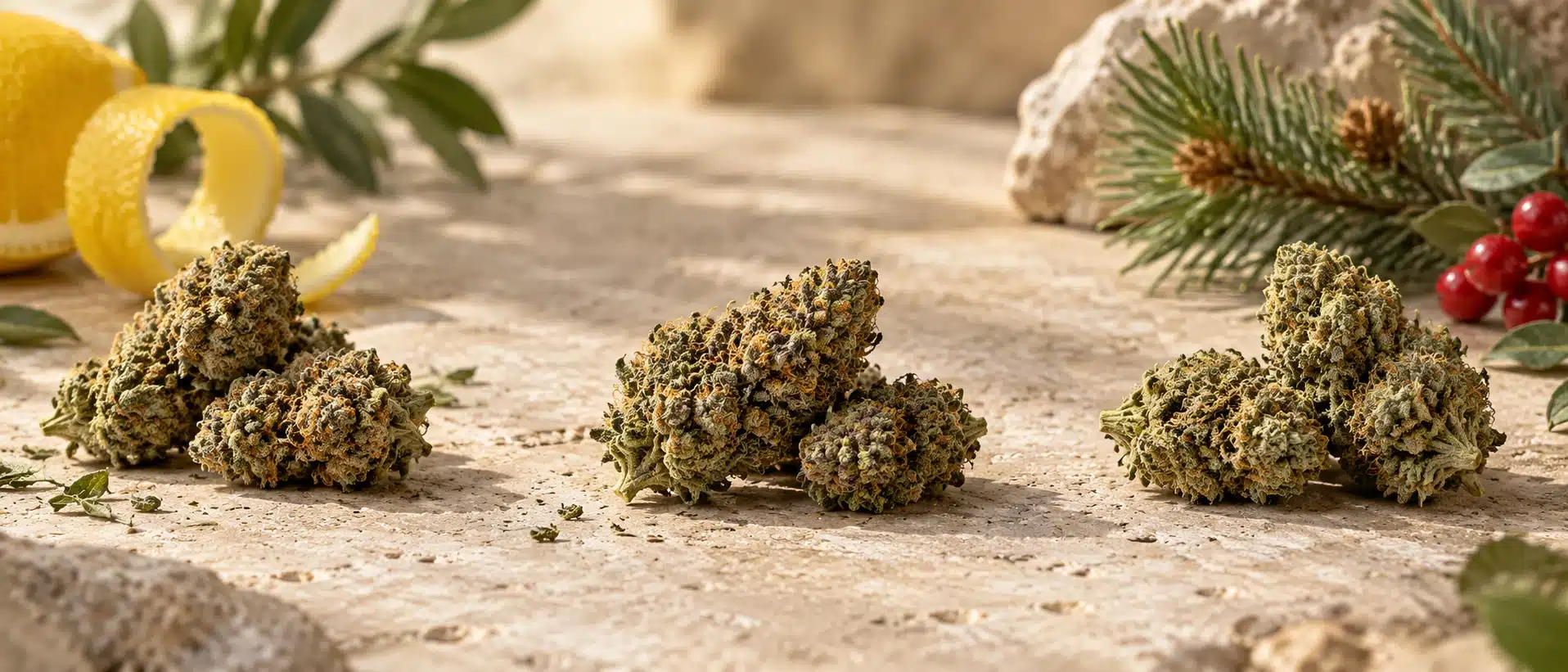
Bright lemon, pine, red berries, biscuit, or spices: faced with several bags of small CBD flowers, the crucial question is often much simpler than a percentage printed on a card. "Will I like this scent?" The Small Buds format allows you to explore different profiles at a price that's generally more affordable than that of larger flowers. But you still need to know how to read the words used to describe these profiles.
At The French Hemp Empire, the nine products currently featured in the Small Buds CBD category cover a wide range: from citrus and herbaceous blends to woody notes, tropical fruits, gourmand aromas, and a spicy floral mix. This guide transforms this list into concrete references. It is based on product descriptions consulted in September 2026; availability and batch characteristics may change.
Before choosing: what is meant by an aromatic note?
An aromatic note is a way of describing an olfactory impression. "Lemon" means that the scent is reminiscent of lemon; this proves neither the presence of added lemon nor a specific quantity of limonene. Similarly, "biscuit" evokes a range of gourmand sensations, without guaranteeing that a pastry ingredient is part of the fragrance composition. These terms are useful for guidance, provided they are interpreted as sensory descriptions.
Hemp emits numerous volatile compounds. Terpenes contribute to its aroma, along with other fragrant molecules. Studies on the sensory analysis of cannabis show that it is possible to group flowers according to their woody, herbaceous, lemony, or sweet character, while reminding us that a single chemical measurement does not perfectly predict a person's perception. The sense of smell remains subjective; shop descriptions are starting points, never the result of detailed analysis. To delve deeper into this distinction, one can consult this olfactory characterization study and this research on the sensory vocabulary of inflorescences.
Finally, a Small Bud is a small, identifiable flower, not a miniature aroma. Its size partly explains its market positioning, but it alone cannot predict what you'll smell when you open it. Cultivation, drying, curing, packaging, and batch date all contribute to the final experience. A variety's commercial name, however evocative, is no substitute for examining the product or checking its traceability.
The nine references at a glance
The table reproduces the three aromatic benchmarks displayed by the store. These are the notes advertised on the sales pages, without ranking by intensity or guarantee that everyone will perceive them in the same way.
| Small Buds CBD | Ratings displayed | If you especially like… |
|---|---|---|
| Skywalker 12% | Woody, citrus, pine | Forest accents with a fresh touch |
| Girl Scoot Cookie 12% | Vanilla, biscuit, caramel | The gentle and pastry-loving profiles |
| Green Crack 12% | Lemon, tropical, citrus | Citrus fruits and exotic fruit |
| Hawaiian Haze 12% | Tropical, pineapple, citrus | The impression of yellow fruit and freshness |
| Bruce Banner 12% | Lemon, tropical, herbaceous | The fruit combined with a plant base |
| Permanent Marker US 12% | Spicy, floral, fruity | A less overtly lemony or sweet profile |
| Sour Diesel 12% | Lemon, herbaceous, citrus | The lemony vegetable |
| Runtz US 11% | Tropical, red berries, candy | The fruit and a confectionery impression |
| Amnesia 11% | Lemon, herbaceous, citrus | A fresh and plant-based classic framework |
Note one specific detail: the Sour Diesel product page opens with an address containing "11", while its name in the category states "12%". If the precise percentage is important to you, check the label and batch analysis before purchasing. This difference in display does not affect the aromatic descriptors used here.
Do you like citrus fruits? Choose between four options
Citrus fruits appear in several descriptions. However, they do not all refer to the same product. The best approach is to read the second and third words in the description, then ask yourself which direction appeals to you most: exotic fruit, vegetable, or resinous.
Green Crack: lemon and tropical notes
With its "lemon, tropical, citrus" notes, Green Crack is a logical choice if you want a clear understanding of the fruity profile. One can imagine the lemon as the dominant note and the tropical notes as a counterpoint, without turning this hypothesis into a promise about the scent of the bag you receive. The strength of this description lies in the coherence of its three markers: each leads to a fresh, fruity, or tangy sensation.
If you prefer distinctly vegetal scents, the presence of only fruity notes in these three words might lead you to consider another fragrance. Conversely, if woody notes put you off, Green Crack offers a useful point of comparison with Skywalker, whose structure leans towards pine.
Bruce Banner: lemon with a herbaceous base
The Bruce Banner combines lemon, tropical, and herbaceous notes. This last note changes the interpretation: a buyer attracted to fruit but wanting to retain a vegetal character has an interesting compromise to consider. It's not a measure of the intensity of each scent; it's a way to distinguish the aromatic intention described by the seller.
Between Green Crack and Bruce Banner, the practical question becomes: "Do I prefer to stay with citrus, or add an impression of fresh plants?" Two recipes that include lemon can satisfy quite different tastes when their other descriptors diverge.
Sour Diesel and Amnesia: two profiles that look similar on paper
Sour Diesel and Amnesia both list lemon, herbaceous, and citrus notes in their category. Based on just these three words, it would be misleading to claim that one is more acidic, more intense, or more complex than the other. Their similarity on paper is precisely why it's worth asking for more details about the batch, its origin, its freshness, and, if possible, some concrete sensory observations.
To distinguish between these two names, also check the product information when ordering: available size, packaging, batch images, and any analyses. If your goal is simply to explore the lemon and herbaceous families, both will suffice. If you're looking for a very specific nuance, the names alone won't be enough.
Do you prefer fruity flavors: pineapple, red berries, or a lemony mix?
The word "fruity" encompasses very different sensory images. A pineapple note evokes a yellow fruit and a certain vibrancy; "red berries" might suggest a rounder character; "tropical" is a much broader term. None of these imply that any food flavoring has been added. These are guidelines to be confirmed for each individual batch.
Hawaiian Haze: the pineapple and citrus option
The Hawaiian Haze page describes it as having "tropical, pineapple, and citrus" notes. Pineapple is the most distinguishing characteristic here. If you're hesitating between this strain and Green Crack, both have citrus and tropical notes, but only Hawaiian Haze specifically highlights pineapple. This is a matter of preference, not an indicator of superior quality.
A simple way to decide is to name what you're looking for without looking at the products: "I want something that reminds me of pineapple" leads to Hawaiian Haze; "I want lemon first" leads to Green Crack. If you don't have a preference, compare the small quantities available to explore without committing your entire budget to a single flavor.
Runtz US: Red berries and candy
Runtz US stands out thanks to three terms: tropical, red berries, and candy. For someone who enjoys scents reminiscent of sweets, these descriptions are more relevant than the single number "11%" in the title. "Candy" is a sensory image: it says nothing about the presence of sugar and doesn't guarantee a consistent scent from one batch to the next.
Runtz US is also a good counterpart to Hawaiian Haze in a small selection: both contain "tropical," but one leans more towards pineapple and citrus in its description, while the other emphasizes red berries and sweetness. This comparison helps to understand its flavor profile without assuming that brand names alone are sufficient to trace the plants' genetics.
Looking for a sweet treat? Try Girl Scoot Cookie
Among the nine profiles, Girl Scoot Cookie occupies a unique position: vanilla, biscuit, caramel. None of these three markers immediately brings to mind lemon, grass, or pine. If you like profiles presented as sweet and pastry-like, this is the first description to look at.
It's important to maintain a realistic level of expectation. A biscuit note in a flower is an olfactory comparison, not the literal taste of a cake. The product remains a hemp flower, with its plant base. The described indulgence may be subtle, most noticeable upon opening, or more perceptible to some than others. This discrepancy between description and sensation explains why purchasing a small size can be a wise choice for a first-time experience.
If you're torn between Girl Scoot Cookie and Runtz US, ask yourself a very specific question: "Does my idea of indulgence sound more like a vanilla pastry or a basket of fruit and candy?" Both descriptions speak to someone attracted to sweetness, but they don't describe the same family of scents.
Do you like wood, pine, or spices? Two different paths
The Skywalker profile combines wood, citrus, and pine. The pine provides a clear reference point for those who appreciate resinous scents or walks in the woods; the citrus adds a fresher touch. If you're looking to move away from descriptions like "candy" and "caramel," this fragrance offers a distinctly different approach. The "woody" note doesn't refer to a wood treatment or a specific drying method; it simply describes an impression.
Permanent Marker US , for its part, advertises spices, floral notes, and fruitiness. The contrast with Skywalker is noteworthy: one leans towards pine and wood, while the other juxtaposes spices, flowers, and fruit. If you find purely citrusy profiles too predictable, Permanent Marker US offers another avenue for comparison.
The suffix "US" appears in the trade name. However, this alone does not prove that the flowers sold were grown in the United States. The product information sheet indicates cultivation in the Rhône-Alpes region of France. Similarly, the reputation of a similarly named variety in another market does not allow us to deduce the exact composition of this batch of CBD. The label, the stated origin of the product, and the batch analysis remain the appropriate indicators.
How to build your own discovery journey?
The most effective way to make a better choice next time is to compare sufficiently distinct profiles. Buying three products described as "lemon, herbaceous, citrus" provides fewer points of reference than a trio combining a lemony, a gourmand, and a woody profile. Start with a familiar category; add a related category, then a contrasting one. This will allow you to identify what you truly like without mistakenly attributing all the difference to the CBD content.
For example, a trio of Green Crack, Hawaiian Haze, and Runtz US explores three fruity variations: tropical lemon, citrus pineapple, and candy-like red berries. Another trio, Amnesia, Girl Scout Cookie, and Skywalker, offers a distinct contrast of lemony vegetal notes, pastry, and woody pine. For a more unusual profile, replacing one of the strains with Permanent Marker US introduces a floral and spicy dimension. These suggestions are for comparison, not consumption recommendations or promises of specific effects.
Upon receipt, make a short note with three words: first scent perceived, secondary nuance, intensity felt. Also note the product name and, if available, the batch number. A few words are enough to realize that "lemon" doesn't mean the same thing to everyone. Avoid basing a future decision on a vague memory or a single picture of a flower.
Compare products stored under similar conditions. A long-opened bag and a freshly packaged flower do not provide a fair comparison. Air, heat, and light can gradually alter the bouquet. If an odor seems unusually damp or shows visible signs of mold, do not rely on the aroma description for reassurance: contact the seller and do not use the suspect product.
What CBD percentages don't tell you about the smell
Seven of the products in this category are advertised as containing 12% CBD, while Runtz US and Amnesia appear at 11% among the nine listed. This small variation highlights the key point: the CBD percentage describes a stated concentration, not a fragrance family. A 12% CBD product might be described as citrusy, woody, or gourmand. An 11% CBD product might be fruity or herbaceous. Neither of these figures demonstrates that the aroma will be more pleasant, fresher, or more expressive.
To determine the composition of a batch, request an analysis report for that batch, including the date, the product analyzed, and the method used. A cannabinoid certificate does not automatically constitute an analysis of aromatic compounds. If you are looking for terpene data, verify that a suitable analytical profile actually exists; do not assume its presence simply from the title "terpenes & flavors.".
The names and figures displayed on a page may also be updated. Take the time to check the weight, the stated percentage, and the labeling when ordering. For Sour Diesel in particular, the historical address of the product sheet and its current name do not match "11" or "12"; the lot-specific documentation is the appropriate level of verification if this information influences your choice.
Should we choose based on "indoor", "greenhouse" or "outdoor"?
Cultivation potentially influences the development and appearance of a flower, but these three words alone don't provide a complete list of aromas. A greenhouse-grown Small Bud can be fruity, while an indoor-grown flower can also exhibit herbaceous notes. The category indicates that batches may come from different growing methods; therefore, don't assume that all strains share the same production environment.
If this criterion is essential for you, check the product information sheet and the batch details. Do the same for the term "organic" appearing in several descriptions: ask for details to understand what it covers and, if you are looking for organic certification, the appropriate supporting documentation. A marketing claim, a regional origin, and formal certification are not interchangeable documents.
From a sensory perspective, the question remains practical: "What are the current aromas of the product?" A well-executed cultivation method alone doesn't guarantee that the resulting bouquet will match your preferences. The value of a comparison by aromatic family lies precisely in highlighting the product description, then supplementing it with information on origin, batch, and packaging.
Reading a product description in five points
- Identify the main family. Lemon, pine, biscuit, red fruits or spices: choose the word that immediately speaks to your olfactory memory.
- Look at the other notes. "Lemon and herbaceous" doesn't suggest the same orientation as "lemon and tropical." The combinations avoid false equivalences.
- Check the batch. Compare the name, the advertised rate, the label, and the availability of the analyses. A discrepancy between two listings warrants a question to the seller.
- Choose the appropriate paper weight. A small quantity makes it easier to explore an unknown profile; a larger format becomes more relevant when you already know the reference and the batch.
- Keep track of your impressions. Your own vocabulary becomes more useful over time than just the brand names.
This approach also helps to avoid two common pitfalls. The first is to assume that a famous name guarantees the same scent from all sellers. The second is to consider the "strongest" profile as the most appealing: a very strong scent may be less desirable than a subtle but harmonious bouquet. The best choice is the one whose description and batch information match your preferences.
Frequently asked questions about the flavors of Small Buds CBD
Do two varieties labeled "lemon, herbaceous, citrus" smell the same?
Not necessarily. These words group impressions and don't indicate the proportions of the odor compounds or the perceived intensity. Sour Diesel and Amnesia share this same combination in the category, but each batch can have its own nuances. To make a more informed choice, ask for a description of the current batch or compare small quantities.
Does the word "bonbon" mean that the flower is flavored?
No, that word alone indicates a sensory comparison. It proves neither the addition nor the absence of a flavoring. If the question of added ingredients is important to you, look for a clear declaration on the product information sheet or ask the seller directly what goes into the batch.
Does a flower with 12% CBD smell stronger than a flower with 11%?
CBD content and aroma intensity describe two different dimensions. Freshness, volatile compounds, preservation, and your olfactory sensitivity all play a role in perception. Runtz US, Amnesia, or 12% CBD products cannot be ranked by aroma strength based solely on these percentages.
Which product should I choose if I don't like sweet notes?
Skywalker, described as woody, citrusy, and piney, is one possibility. Sour Diesel and Amnesia, described as lemony and herbaceous, are two others. Permanent Marker US adds spices, floral notes, and fruity aromas, which might also appeal to someone looking to move beyond the pastry category. However, these descriptions don't guarantee the absence of any sweet notes.
Does small size necessarily diminish the aromas?
No. Size alone doesn't predict aromatic profile. The batch's origin, drying quality, and storage conditions must also be considered. A small bud can offer a pleasant profile; a large, poorly stored flower may have lost some of its freshness.
An aromatic preference, followed by concrete checks
To choose from the Small Buds CBD range, start with the flavor family that appeals to you: lemon and herbs, pineapple and citrus, red berries and candy, vanilla and biscuit, pine and wood, or spices and flowers. Only then should you compare two or three product sheets, check the batch information, and choose a quantity that aligns with your level of confidence. The nine varieties presented by The French Hemp Empire offer sufficiently distinct contrasts to guide this selection, without claiming that a single name or percentage tells the whole story.
These flowers are intended for adult use. CBD flowers may contain traces of THC; exercise caution before driving and check the product's safety information. If you are taking medication, pregnant, or breastfeeding, consult a doctor before use. To find the products mentioned, see the current selection at Small Buds CBD.