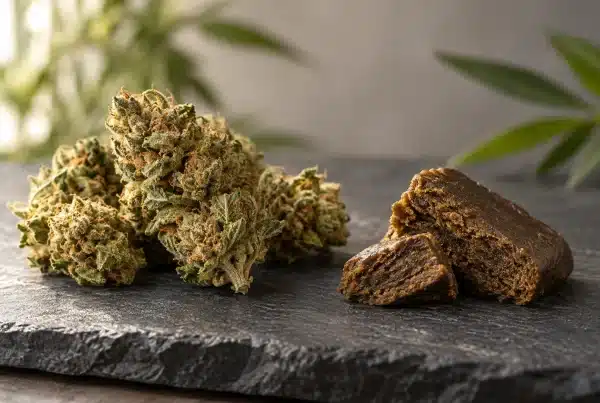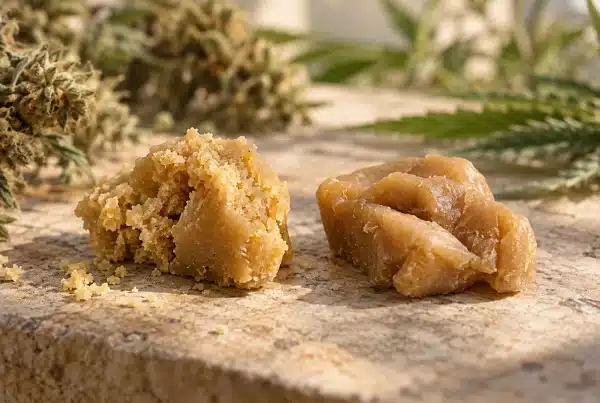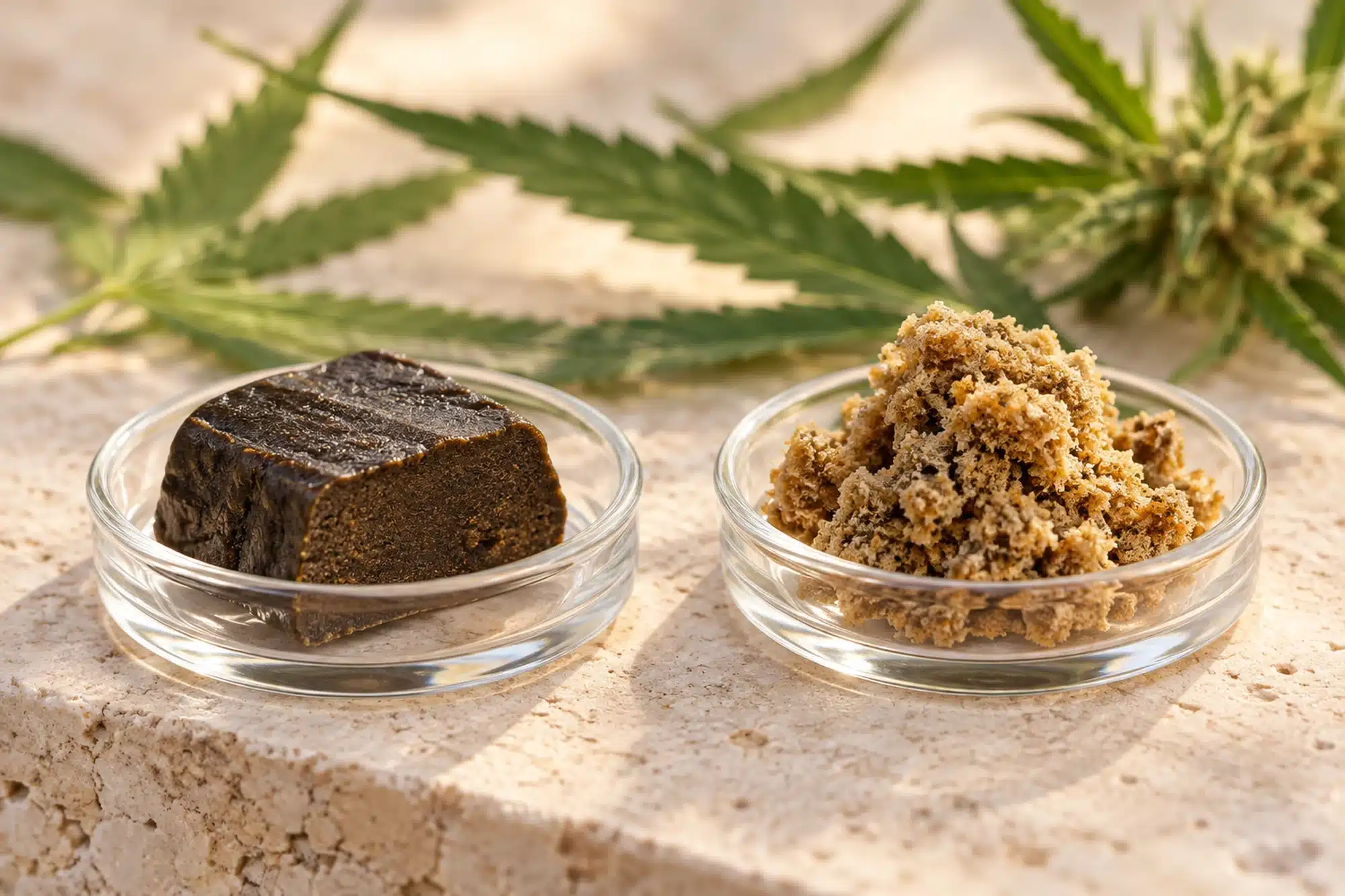
In The French Hemp Empire's THV-N10 range, several resins have names that reflect their presentation: "4x filtered," "foamy yellow," and "foamy Peach Cream." Their product descriptions also list concentrations, such as 40% or 50%. When comparing these products, a question immediately arises: is a filtered THV-N10 resin necessarily better than a foamy one? The answer depends on what you're comparing: appearance, texture, measured composition, advertised aromas, or batch traceability.
A word describing texture is not an analytical method. A stated percentage alone does not describe the manufacturing process. And the commercially used designation THV-N10 must be accompanied by precise information on the composition before any claims are made regarding the product's effects or status. This guide helps you read product information sheets without attributing properties to resins that are not documented.
What is THV-N10 resin?
Hemp resin is generally found in a concentrated, moldable, or crumbly form, unlike a whole flower. In a collection advertised as "THV-N10," the product may combine a resin base with a cannabinoid formulation specific to the manufacturer. The name of the product line does not automatically indicate the origin of the raw materials, their separation process, or how the final concentration was achieved. This information must be provided in a technical data sheet and, for the specific percentages, in an analysis tailored to the finished product.
The distinction from a flower is important. The THV-N10 flowers in the collection are often listed at 20%, while several resins are advertised at 40% or 50%. Comparing these numbers is useful for identifying different commercial concentrations; it doesn't demonstrate that the resin comes from the same plants as the flower, nor that an experience will be proportionally twice as intense. The matrix and overall composition differ.
Studies on cannabis resins show that their cannabinoid profiles can vary depending on the sample and the processing method. This general observation is documented by chromatographic studies on the distribution of cannabinoids in resin blocks. These studies do not characterize the THV-N10 products from the site; they explain why a representative batch analysis is more valuable than an inference based on color or consistency.
"4x filtered": an indication that needs clarification
The name THV-N10 4x Filtered Revuelto 40% Resin suggests a selection or repeated separation process. However, "4x filtered" is not a universal analytical standard. Without a description from the manufacturer, it cannot be concluded that it refers to exactly four passes through four sieves, four particle sizes, a given yield, or a guaranteed purity.
In the production of certain resins, the mechanical separation of plant trichomes may involve the use of sieves. A publication on trichome separation describes sieving as one of the mechanical methods used in this field. However, it would be misleading to attribute this general process to a specific commercial product without evidence of its manufacturing method.
The useful question for the seller is therefore: "What exactly does '4x filtered' mean for this product and batch?" An answer can describe the starting material, the actual steps taken, and the resulting quality controls. If the product information sheet doesn't specify the process, simply keep the expression as the trade name. Don't automatically translate it as "four times purer": the supposed repetition of a process doesn't provide a measured purity level.
Similarly, a compact texture or a clean cut does not guarantee a level of filtration. Pressure, temperature, humidity, and other potential components can alter the final appearance. Batch analysis remains essential for comparing composition.
"Foamy": a texture, not a laboratory result
In the industry, "foamy" suggests a resin that is more airy, crumbly, or easily dispersed. This helps to visualize the desired texture, but it doesn't correspond to a regulated chemical category. Two resins described as foamy can differ in their starting material, moisture content, ingredients, and aromatic profile.
Revuelto THV-N10 Sparkling Yellow 50% Resin combines this presentation with a stated color and concentration. The word "yellow" indicates the visual identity being promoted. It does not, on its own, guarantee a gentler extraction, superior freshness, or the absence of added components. The color of a resin can depend on several factors; it should be determined in conjunction with the batch information sheet.
THV-N10 Peach Cream Foamy 50% Resin adds an aromatic world reminiscent of peach and cream. This description outlines a commercial sensory profile. It does not guarantee that the resin contains a specific botanical variety, particular terpenes, or a measured quantity of a given aroma without a detailed composition.
Finally, friability is not a reliable indicator of a sound resin. A very dry material can disintegrate; a damp material may present other preservation risks. Texture is useful information for choosing a format, but quality also requires traceability and appropriate controls.
40% or 50%: what are we really comparing?
A percentage is a proportion, not a dose, and certainly not a quality rating. If two products were analyzed according to the same convention, on the finished product, and if "THV-N10" does indeed refer to the same substance identified in both reports, 50% represents a higher declared mass proportion than 40%. These conditions must be established before making a precise comparison.
A simple calculation illustrates the discrepancy: in one gram of finished product actually measured at 40% of an identified substance, there would theoretically be 400 mg of that substance; at 50%, 500 mg. This difference of 100 mg per gram is a conditional mathematical result, not a measurement of Revuelto products or an absorbed dose. If one of the percentages refers to an ingredient before mixing and the other to the finished resin, the comparative calculation becomes meaningless.
It is also necessary to ask what the name THV-N10 on the certificates means. A trade abbreviation is not sufficient to establish structural identity, the content of any isomers, or the status of each component. The report line must clearly state what was analyzed and measured. A value labeled "total cannabinoids" does not prove that the entire fraction corresponds to a single molecule.
For the customer, correctly reading a rate involves four questions: what substance are we talking about, in what matrix, with what unit and on which batch ? This method is valid for both a compact resin and a foam resin.
Compare the references without confusing texture and concentration
| Displayed reference | What the name indicates | What needs to be confirmed |
|---|---|---|
| 4x Filtered Revuelto 40% | A so-called "filtered" presentation and an announced rate of 40%. | Meaning of the process, composition of the finished product and batch analysis. |
| Revuelto Sparkling Yellow 50% | One color, one texture as advertised, and a 50% content. | Ingredients, texture of the batch received, measured molecule and actual content. |
| Peach Cream Mousse 50% | A commercial aromatic profile and a promised texture. | Aromatic composition, detailed cannabinoids and batch number. |
This table summarizes information found in the product range titles; it does not replace any analysis and does not classify products by quality. If you prefer a compact resin, the term "filtered" may be of interest. If you are looking for a more airy appearance, "foamy" provides an initial indication. Confirmation of the actual appearance and composition should be made by referring to the specific product and batch number at the time of purchase.
Profile names like "Mochi," "Peach Cream," or "Fast & Furious" help identify references. They are not automatically certified botanical varieties. If a product description lists woody, fruity, or spicy notes, consider this a stated sensory description; individual perception varies, and a cannabinoid analysis does not necessarily measure the terpenes responsible for those notes.
How the lot changes the comparison
A product sheet may retain the same commercial name from one production run to another. However, the initial plant material, the aromatic profile, and laboratory measurements can vary between batches. A customer review written several months ago may describe a different batch than the one currently being shipped. This is why batch identification is the first piece of information to request when a concentration or appearance is important to you.
The batch number should allow you to compare the packaging, the technical data sheet, and the certificate of analysis. If the report provided relates to a raw material, it provides information about that material; it does not automatically certify the content of the final mixture. If the report concerns another product in the range, it also does not allow you to attribute its results to the resin you choose.
A representative analysis is particularly important for a formulated resin. The distribution of a substance can differ between the core and the surface, or between different portions, when the mixture is heterogeneous. Previous analytical studies have indeed observed variability in cannabinoid distribution within certain resins. This should not be interpreted as meaning that all THV-N10 resins are heterogeneous; it simply justifies the need for rigorous sampling and quality control methods.
A single figure with two decimal places does not resolve the issue of representativeness. The tested matrix, the sampling plan, and, when available, the measurement uncertainties must all be known. For the buyer, comparing two consistent reports is far better than comparing two slogans.
Information to look for on the certificate of analysis
Start with the document title and the laboratory name. Then look for the commercial reference, batch number, sampling or analysis date, and the nature of the sample. The document should explain whether the resin being sold, an intermediate extract, or a raw material was tested. This last point determines what the stated value can prove.
Read the cannabinoid table line by line. Which substance corresponds to "THV-N10"? Are the other cannabinoids listed separately? What is the delta-9-THC value? The notation "not detected" should be interpreted in light of the method's limit of quantification. A report that does not test for the reported substance cannot certify its level, even if it correctly measures CBD or THC.
Also check the units. A mass percentage is not directly comparable to a value expressed in mg per unit or mg/ml. For a resin, 1% by mass corresponds to 10 mg/g; however, this value must refer to the final product and not to a previous dilution or extract.
Finally, a cannabinoid profile does not necessarily cover pesticides, heavy metals, residual solvents, synthetic impurities, or microbiological parameters. Depending on the composition and manufacturing steps, other controls may be relevant. The page dedicated to certificates of analysis helps you understand the scope of each document, beyond just the large printed percentage.
Does a frothy appearance guarantee more aromas?
No. An airy texture can influence how you perceive the resin by touch or when opening the bag, but it doesn't measure terpene concentration. A compact resin can have a strong odor; a clear resin may have a more subtle profile. Aromatic notes depend in particular on the materials used and how they are stored.
If you are looking for a specific profile, consult the product description and, if available, request an analysis of the aromatic compounds. Do not infer the presence of myrcene, limonene, or any other terpene from a name that evokes a well-known fruit or variety. Added aromas and the plant's terpenes do not necessarily have the same origin.
Proper storage is also important after purchase. Close the container securely, avoid heat and light, and keep the batch label. If the resin changes odor significantly, has abnormal moisture, or looks suspicious, set it aside and contact the seller. A strong fragrance is not proof of the absence of contaminants.
Is a light color a criterion of purity?
Color is immediately visible and often influences first impressions. However, light doesn't automatically mean pure, and dark doesn't automatically mean poor. Pigments, the starting material, mechanical processing, oxidation, conditioning, and time can all contribute to differences in hue. A universal rule based on a single photograph should be avoided.
The color of the image on a product sheet also depends on lighting, screen settings, and sometimes the specific batch being photographed. To understand a "foamy yellow" reference, the photo helps to visualize the desired appearance, while the product sheet and analysis help to understand the composition. If the color is a determining factor for you, ask if the photographs correspond to the batch being shipped.
A product with a uniform surface can have a different composition at its core. Conversely, an uneven color is not automatically a sign of a problem. The most useful information comes from material testing, traceability, and the possible presence of signs of deterioration.
THV-N10: Why the trade name calls for chemical verification
The market uses several new acronyms to present its formulations. Some correspond to a precisely identified substance; others designate a range or blend. The chemical structure of THV-N10 cannot be deduced from a visual resemblance to "THCV," "THC," or "THCA." A similar-looking acronym is not proof of molecular identity.
If the analysis uses a full name, request an explicit correlation with the commercial name. If it indicates a sum of molecules or a non-specific result, the information remains limited. This requirement is particularly important when a 50% rate is highlighted: it is essential to know exactly what the 50% represents.
The same caution applies to the effects. The available human data on a product sold under that name does not allow for the deduction of a universal intensity or duration from the percentage alone. A resin advertised as 50% is not necessarily "25% stronger" than another at 40% in a customer's experience; the numbers express a proportion, not a scale of clinical effect.
It is also important to avoid turning a commercial category into a legal statement. In France, theANSM (National Agency for Medicines and Health Products Safety) has classified several cannabinoids and certain chemical families. A product's status depends on its exact components and the regulations applicable at the time of its sale. A declared delta-9-THC level of less than 0.3% is not sufficient to establish that every other substance in the resin is authorized.
Compare the price of THV-N10 resin
The price per gram is a good starting point, especially if the sales formats differ. However, a higher price doesn't necessarily mean a more thorough analysis, and a lower price doesn't necessarily indicate lower quality. For an informed comparison, consider the format, the documented concentration, the texture description, the available controls, and your flavor preferences.
Calculating a price per milligram may seem more technical. It only makes sense if both products measure the same substance, with the same definition of percentage, and are based on the finished product. Otherwise, dividing the price by a commercial figure provides a falsely accurate comparison.
For example, if the same mass is used and analyses confirm 40% and 50% respectively of the same molecule in the final product, one gram would theoretically represent 400 mg or 500 mg. This reasoning says nothing about the aromatic profile, homogeneity, or the amount actually absorbed. It simply helps to establish a common basis for the reported levels, provided there is reliable documentation.
For which choice is the distinction between filtered and sparkling useful?
The distinction is primarily useful for describing a preference for texture. Some customers appreciate a compact resin, others a more crumbly texture. Someone drawn to woody and spicy notes might look at the corresponding references; another might be curious about a Peach Cream profile. The descriptions are starting points for selecting a product, not promises that everyone will perceive the same notes.
If your priority is transparency, first compare the available certificates. If your priority is visual accuracy, examine the images and ask for confirmation of the batch being sold. If your priority is precise concentration, verify the substance, matrix, and date. None of these criteria replaces the others; they address different questions.
A resin labeled "4x filtered 40%" should not be automatically ranked above or below a "50% foamy" resin. The first term refers to a claimed process that needs clarification; the second to a stated texture; the percentages must be analytically confirmed. The best choice depends on the documented information you actually want to receive.
Precautions specific to recent cannabinoid products
These resins are intended for adults. Products that may alter attention or perception should not be used before driving or engaging in any activity requiring sustained alertness. Individual variability and the exact composition make any promise of a standardized effect misleading. Avoid combining this type of product with alcohol or other substances that impair alertness.
Data on drug interactions specific to new cannabinoids remains limited. If you are undergoing treatment, are pregnant, breastfeeding, or have a health problem, seek medical advice. Hemp resin is not a treatment, and its commercial name does not allow for any therapeutic claims.
Smoke inhalation, when it is a contributing factor, also presents respiratory risks distinct from those associated with cannabinoids. Commercial compliance and health risks are two issues to be assessed separately. If a severe reaction occurs, contact emergency services immediately and retain the packaging and batch number to facilitate product identification.
FAQ: THV-N10 filtered or foamy resin
Is a resin that is 4x filtered four times purer?
The name doesn't allow for this conclusion. "4x filtered" must be defined by the manufacturer; the number of possible passes does not correspond to a measured purity level. To determine the composition, consult the analysis of the finished product.
Does a foamy resin contain less cannabinoids?
The texture alone does not allow for the calculation of content. The range includes foaming resins advertised at 50%, while a so-called filtered version displays 40%. Only an analysis specific to the batch can confirm the levels.
What is the difference between 40% and 50% of THV-N10?
Based on the same mass and for the same clearly identified substance, 50% represents a proportion greater than 40%. This does not demonstrate a proportional difference in the effects felt and does not describe the other constituents.
Does the yellow color prove that the resin is of better quality?
No. Color can contribute to the product's visual identity, but it does not certify its composition, purity, or the absence of contaminants. Check the batch and its documentation.
Is a CBD and THC certificate sufficient to confirm 50% of THV-N10?
No, if the method does not measure the substance declared. The report must identify the line corresponding to the trade name and specify the value obtained for the product in question.
Can the legality be inferred solely from the 0.3% THC threshold?
No. This data concerns delta-9-THC within the framework applicable to hemp; other components must be identified and examined according to the regulations in force for the country concerned.
The correct order for choosing a reference
Start by identifying the profile that interests you: compact, filtered appearance, foamy texture, or a specific aromatic profile. Then, examine the documentation: the chemical identity behind THV-N10, the percentage definition, the batch number, the analysis of the finished resin, and other measured constituents. Finally, compare the format and price based on truly equivalent criteria.
The THV-N10 collection includes 40% and 50% cannabinoids, whose names help with identification. Their actual differences must be determined on a product sheet basis. For a product containing newer cannabinoids, a simple question remains the most useful: "What exactly does this percentage measure in the batch you're going to send me?"