Neo-cannabinoids do not form a homogeneous scientific family. In commercial terms, this expression encompasses cannabinoids less well-known than CBD or THC, substances obtained through chemical transformation, and sometimes formulations marketed under a proprietary name. To understand what you are looking at, three questions need to be addressed: what is the molecule, how was it produced, and what is actually known about the finished product?
A substance can exist in cannabis in trace amounts and be manufactured in a laboratory to supply the market. Conversely, a name suggesting innovation doesn't prove that a new molecule has been discovered. Between these two situations, words like "natural," "potent," "next generation," or "derived from hemp" often provide fewer answers than you might think.
In this first installment of The French Hemp Empire dedicated to neo-cannabinoids, you'll find a method for reading available information without confusing origin, effects, and marketing authorization. The goal is to help you ask the right questions, recognize the limitations of a study, and understand what a certificate of analysis actually verifies.
What is a neo-cannabinoid?
The prefix "neo" means new. But novelty can refer to a scientific discovery, the appearance of a product in a store, an industrial process, or simply a marketing strategy. These events are not equivalent. A substance studied for several years may seem new because its name becomes visible on social media or on labels.
It is therefore preferable to consider "neo-cannabinoids" as a gateway to a topic rather than a chemical definition. To precisely identify a substance, researchers employ a structure, a nomenclature, and analytical methods. A store category serves a different function: it organizes the offering. It does not replace scientific nomenclature.
If you're new to these concepts, our article on the differences between hemp, cannabis, CBD, and THC will help clarify the initial terminology. You'll then be able to discuss each cannabinoid without automatically attributing the properties of just one of its substances to all hemp.
A molecule, a mixture, and a brand name do not all mean the same thing
The name of a molecule describes a chemical identity. The name of a mixture can refer to several ingredients in specific proportions. A brand identifies a product or a product line. When consulting a product sheet, start by determining at what level the highlighted term appears.
This distinction avoids a common mistake: searching for scientific publications on a brand name and then concluding, in the absence of results, that researchers are necessarily unaware of all its components. First, the precise composition must be obtained. Without this step, it is impossible to properly link the product to the scientific literature, even with a long list of references.
Natural, semi-synthetic, and synthetic cannabinoids: three distinct concepts
Natural cannabinoids or phytocannabinoids
Phytocannabinoids are cannabinoids found naturally in the plant. CBD and delta-9-THC are the best-known examples. The word "natural" here describes a biological presence; it does not demonstrate the safety, medical efficacy, or legal compliance of a product. The NCCIH's dossier on cannabis and cannabinoids helps to place these substances in their scientific context.
To evaluate a claim like "natural cannabinoid," ask what exactly it describes. Is it referring to the molecule found in the plant, the raw material used, or the process applied to the batch being sold? A thorough answer should differentiate between these elements rather than conflating them into a single promise.
Semi-synthetic or hemisynthetic cannabinoids
Semi-synthesis involves chemically transforming a starting substance. In its analysis of the European market, EUDA explains that semi-synthetic cannabinoids are primarily produced from CBD extracted from hemp. The key point is the change in chemical identity: starting with CBD does not necessarily mean that the final product is still CBD. Source: EUDA and Europol, analysis from June 2024.
A plant-based origin for the raw material can therefore coexist with a laboratory processing stage. Presenting only the first part of this story is not enough to describe the final product. For you, the useful information must cover both: what served as the starting point and what is actually present at the end.
Synthetic cannabinoids
Chemical synthesis is a method of manufacturing. In drug monitoring publications, the term "synthetic cannabinoids" also refers to substances developed to act on cannabinoid receptors, sometimes with structures very different from those of phytocannabinoids. EUDA has a specific section.
Two oversimplifications should be avoided: considering all synthetic products as identical, or assuming that all products derived from a plant share the same profile. The manufacturing process matters, but it does not replace the identification of the substance. A useful comparison must specify the molecules involved, the impurities being sought, and the available knowledge.
Comparative table: what the different terms help to understand
| Name | What it reveals | What she does not prove |
|---|---|---|
| Phytocannabinoid | A presence in the plant that has been scientifically documented. | That the lot sold comes from a direct extraction. |
| Hemp extract | A declared origin of matter. | The absence of subsequent transformation or addition. |
| Semi-synthetic | A chemical transformation starting from a starting substance. | The effects are identical to those of the original compound. |
| Summary | A mode of production, or a category used in a specific context. | A uniform risk or potency for all compounds. |
| Trade name | The identity of a product range or formulation. | A universal and stable chemical composition. |
| Analyzed in the laboratory | An analysis has been announced, the scope of which needs to be examined. | A sales authorization or a medical guarantee. |
This table is designed to help you organize your reading. It does not rank products from best to worst, nor is it a list of permitted substances. Its purpose is to show you that a label may answer one question correctly while leaving others unanswered.
Why can a cannabinoid found in nature also be manufactured in a laboratory?
The discovery of a substance in a plant and supplying a market are two separate issues. A scientific publication establishes its presence and describes its identification. Industrial documentation must explain the origin of a batch. You cannot deduce this origin simply because a molecule has been found in cannabis.
THCP illustrates this difference. A study by Citti and colleagues published in 2019 in Scientific Reports reported its isolation from Cannabis sativa. This discovery documents its existence as a phytocannabinoid. However, it does not guarantee the origin of all products subsequently bearing this name.
If a product description claims natural extraction, the real question becomes: what documentation links this claim to the product in question? An academic reference cannot trace the manufacturing process of a bottle, resin, or flower marketed several years after the study. This link must be established through product-specific documentation.
Effects of neo-cannabinoids: how to read studies without exaggerating their results?
A biological interaction is not a proven benefit
CB1 and CB2 receptors are part of the endocannabinoid system. However, simply explaining that a substance interacts with a biological target is not enough to predict a clinical outcome. Our guide to the workings of the endocannabinoid system provides the necessary vocabulary to understand this research.
When you encounter a claim about sleep, pain, or anxiety, look for the type of evidence presented. Cellular observation, animal experiment, anecdotal evidence, and a clinical trial answer different questions. To discuss a benefit in humans, it's essential to know who participated, which product was studied, and what it was compared to.
A helpful article also points out what wasn't measured. If research focuses on a molecular interaction, it alone cannot draw conclusions about sleep quality or the safety of repeated use. Reading the results within their broader context protects against misleading advertising.
Why "33 times more powerful" is a misleading claim
The 2019 study on THCP reports a binding affinity to the CB1 receptor approximately 33 times greater than that used to compare it to delta-9-THC. This experimental result is regularly presented as a promise of a "33 times stronger" effect in humans. This claim is not supported by the measurement: receptor affinity is not a universal scale for the perceived effect.
Keep in mind the methodological question: "more powerful" according to what criterion? A data sheet should specify whether it refers to an experimental value, a measured concentration, or an eyewitness account. Without this clarification, you are potentially comparing quantities that do not describe the same phenomenon.
A percentage is not a ranking of intensity
As a hypothetical example, a product advertised as containing 20% of substance A cannot be classified against a product containing 40% of substance B based solely on these figures. The definitions differ, and the percentage itself can refer to an individual concentration or a mixture. It is essential to first verify what is being measured.
Also ask whether the percentage refers to the finished product or an ingredient before incorporation. These are not interchangeable. A clearly defined concentration is descriptive information; it does not automatically become a recommendation for use or proof of effectiveness.
What do we know about the risks and limitations of knowledge?
The European technical report on HHC and related substances highlights the information gaps surrounding this market. The European Drug Report 2026 continues to monitor synthetic and semi-synthetic cannabinoids among new psychoactive substances. Therefore, a commercial presence does not necessarily mean that a complete safety dossier is available.
In France, the national health insurance system (Assurance Maladie) has reported cases of poisoning following the consumption of products marketed as containing CBD, particularly those containing undeclared cannabinoids or excessive levels of THC. Serious symptoms have been described. This alert concerns the actual composition of the products and does not allow for all incidents to be attributed indiscriminately to pure CBD. Source: Ameli file on non-medical CBD.
CBD itself can cause side effects and drug interactions. If you are taking any medication, consult your doctor or pharmacist before use. In case of loss of consciousness, seizures, or difficulty breathing after using this product, call 15 or 112 and keep the packaging for emergency medical personnel.
When reviewing the information sheets, clearly distinguish between "no problems reported in the documents consulted" and "no risk demonstrated." The first statement describes the available information. The second would require much stronger evidence. The silence of a sales page should not artificially fill in the gaps that are still unknown.
Are neo-cannabinoids legal in France?
There is no general authorization attached to the term "neo-cannabinoid." Its status depends on the substance and the applicable regulatory framework. The French Council of State's decision of June 6, 2025, No. 494779, reiterates the 2024 classifications, which notably concern H2-CBD, H4-CBD, and certain derivatives defined by their chemical structure.
This text also describes exclusions with conditions, particularly for THCA and THCV. These should not be summarized as "all THCA products are legal." Similarly, a delta-9-THC level below 0.3% does not invalidate the classification of another substance.
These references are documentary points of reference, not a comprehensive legal audit of every formulation at the time of your purchase. For a specific product, you must verify its composition, the applicable regulations, and the rules relevant to its intended use. An old screenshot or the name of a commercial category is not sufficient.
The three questions to ask before accepting a statement of legality
First question: Is the substance identified with sufficient precision to allow verification? Second question: Which text is cited, and in which version? Third question: Does the statement refer to this isolated substance or to the finished product in its intended use?
This framework allows you to request a documented answer without having to interpret a chemical structure on your own. If someone only answers "less than 0.3%" to all questions, there are still points that need clarification. The right document must correspond to the right subject: an analysis for the composition, a text for the rule, and a justification for its application to the case under consideration.
How to read a cannabinoid analysis certificate?
A certificate of analysis, often called a COA, should be read as a report on a sample. Our grid below is a method for reviewing documentation. It does not assume that every product on the market has been tested and does not replace laboratory interpretation.
1. Link the report to the reference and the batch
Note the product name, batch number, date, and sample identification. Compare this information to that on the packaging. If they do not match, ask for an explanation before considering the certificate as representative of the product you are examining.
An authentic document can be of little use if it relates to another source. The graphic quality of the PDF, an impressive logo, or a long list of figures does not resolve this matching problem. The first check, therefore, is to establish the document link, even before discussing the result.
2. Look at which substances were tested for
A table limited to a few common cannabinoids doesn't necessarily answer a question about an unusual compound. Look for the exact list of analytes, that is, the substances being tested for. If the main ingredient being reported isn't there, the report doesn't document its content.
Also, distinguish between targeted testing and broader research. You can ask the laboratory what its method covers and what its limitations are. This clarification is more useful than the general expression "comprehensive test," the meaning of which remains vague without an associated scope.
3. Understanding the units and references in the report
Check whether the results are expressed as a percentage, milligrams per gram, or another unit. Do not directly compare two figures presented in different units. Consult the key to understand abbreviations and any detection or quantification thresholds.
The notation "not detected" is interpreted within the context of the method used; it is not a universal declaration of absence at all scales. If the distinction is not explained, request written clarification. This will provide you with actionable information instead of an approximate interpretation.
4. Separate composition and contaminants
A cannabinoid analysis is not necessarily a search for pesticides, metals, or residual solvents. Check the sections included. Do not attribute to the report any tests it does not mention. If multiple documents are provided, identify how they complement each other and how they relate to the batch.
This review alone does not guarantee product safety. It improves the quality of the questions you can ask. The difference is crucial: a composition document, a contaminant test, and a safety study serve distinct purposes.
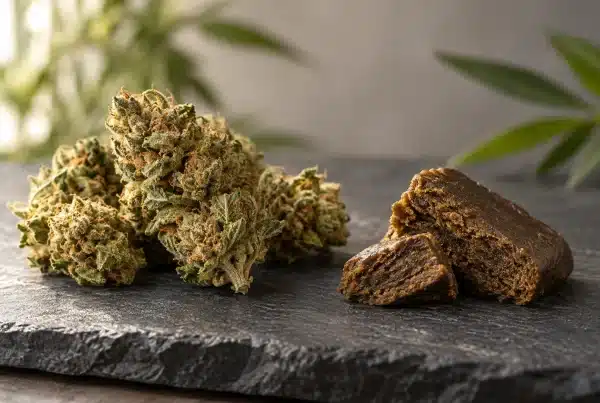
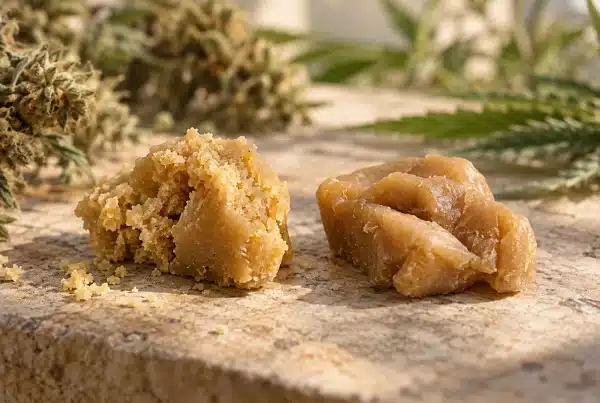
Flowers, resins and vapes: appearance is not enough to identify the contents
EUDA describes products in which hemp is mixed or processed with semi-synthetic cannabinoids, as well as vapes and edibles. A plant-like appearance, therefore, does not guarantee that all constituents are naturally derived from the flower. This observation is documented in its June 2024 market analysis.
For you, the practical consequence is to read the formulation description before interpreting the photograph. A flower, an extract, and a base to which a substance has been added do not tell the same story. The visible format provides information about the presentation; the composition must be documented separately.
The same requirement applies to aromatic qualifiers. A strain name or a terpene description does not replace cannabinoid identification. Keep this information in its respective role: aromas describe a sensory dimension, while analyses seek to characterize substances and their concentrations.
A five-question method for comparing information
- What is the precise name of the substance? Separate the chemical identity from the range name.
- What origin is actually documented? Distinguish between natural occurrence and provenance of the batch.
- What composition is being measured? Consult a report attached to the finished product.
- What evidence supports the reported effects? Identify the type of study and its limitations.
- What regulatory verification is provided? Look for a relevant and dated reference.
You can keep these five questions and apply them to each new piece of information. They prevent you from starting from scratch when names change. A partial answer doesn't preclude continuing your research, but it should remain visible as a limitation: an unknown composition doesn't become known simply because another document is convincing.
Frequently asked questions about neo-cannabinoids
Is a natural cannabinoid necessarily less risky?
No. The word "natural" describes an origin or presence in the plant. It doesn't summarize the properties of the substance or those of the finished product. To assess information, look instead for a clear identity, relevant data, and a documented composition. The claim of origin should not replace evidence.
Is CBD a neo-cannabinoid?
CBD is a well-defined cannabinoid. The commercial term "neo-cannabinoids" is generally used to refer to other compounds or new products on the market, without a universally accepted definition. Our article on the scientific definition of cannabidiol helps us return to a precise substance rather than a variable commercial category.
Are HHC and CBD interchangeable?
No. They are different substances. The fact that a product can use CBD as a starting point does not automatically transfer the characteristics of CBD to the final product. Each substance must be examined separately. The European technical report on HHC is a relevant reference for understanding this distinction.
Does the name of a product tell you what its ingredients are?
Not necessarily. A name can evoke an experience, a product line, or a proprietary formulation. Ask for a precise list of ingredients and a document corresponding to the batch. Avoid deducing a composition from an acronym similar to that of another molecule: a similar name is not chemical proof.
Does a laboratory certificate prove legality?
It can provide useful data for verification, but it does not replace regulatory analysis. A laboratory measures parameters within a defined scope. Compliance also depends on the rules applicable to the product. You must be able to distinguish the analytical result from its legal interpretation.
Can we predict the effects based on customer reviews?
A review describes a reported experience, often with little information about the conditions. It doesn't provide a standardized measurement and can't predict your reaction. To understand a general statement, give more weight to a study specifically addressing the question, while keeping in mind its limitations and the product actually being studied.
Why avoid rankings of the "most powerful cannabinoid"?
Lacking common criteria, these rankings frequently mix concentration, biological affinity, and subjective assessment. A serious comparison must clearly state what it measures. If this is missing, the ranking primarily gives you an impression of precision. It does not allow you to draw a reliable conclusion about two different products.
What information should be requested first when a description is vague?
Start by verifying the complete identity of the substances and the composition of the finished product. This information is essential for all subsequent checks. You can then request the origin, batch reports, and references cited. Accumulating documents before understanding what they are meant to prove makes the process more difficult.
Understanding new features without being guided solely by their name
The market for new cannabinoids can give the impression that you have to memorize a new acronym every week. However, a consistent method is more useful than a catalog of names: identify the substance, distinguish its origin from its method of manufacture, examine the evidence, and request documentation specific to the product.
As you continue reading The French Hemp Empire journal, keep in mind the distinction between what is established, what is announced, and what remains to be verified. This will allow you to understand the upcoming articles molecule by molecule, with precise vocabulary and concrete questions.
Sources and documentary methodology
This dossier is based on institutional resources, an original scientific publication, and a court decision. The documents describe different periods and objects. They do not constitute analyses of the products sold by The French Hemp Empire. This article is published in the context of a commercial website; its explanations do not constitute independent validation of its catalog.
- EUDA, formerly EMCDDA — HHC and related substances, April 17, 2023 : Technical report and limits of knowledge.
- EUDA and Europol — Semi-synthetic cannabinoids, June 27, 2024 : production and observed commercial forms.
- EUDA — European Drug Report 2026 : Monitoring New Psychoactive Substances.
- EUDA — Synthetic cannabinoids : resources on synthetic cannabinoids.
- Citti et al., Scientific Reports, 2019 — Original study on THCP : identification and experimental results.
- Council of State, June 6, 2025, No. 494779 : classifications and conditional exclusions examined by the judge.
- Health insurance — Non-medical CBD : precautions, interactions and warnings about product composition.
- NCCIH — Cannabis and Cannabinoids: What You Need To Know : general scientific benchmarks.