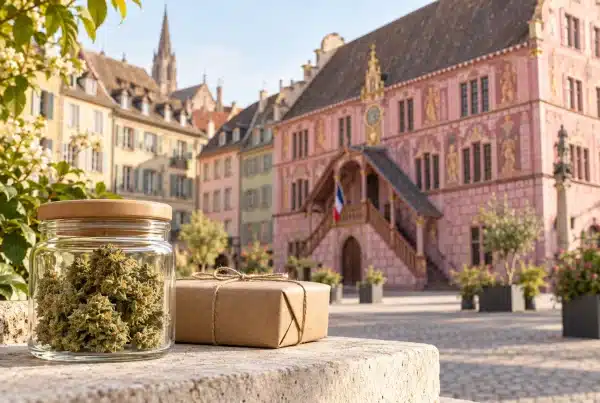
CBD may help you fall asleep after a long flight and reduce travel anxiety, but there's no evidence that it resets your body's internal clock. The most recent meta-analysis on the subject found no significant effect of CBD alone on overall sleep quality. Light and melatonin remain the most effective ways to combat jet lag, with CBD acting only as a supplement. Before you travel, try a low dose at home and verify the traceability of your chosen product.
In short:
- CBD alone does not significantly improve sleep quality during travel, unlike formulations combining several cannabinoids.
- To alleviate jet lag, it is better to prioritize natural light and taking melatonin rather than CBD alone.
- It is advisable to test a low dose of CBD at home several days before departure, avoiding doing so upon arrival.
- Legislation regarding CBD varies greatly between countries, and even the slightest presence of THC can cause problems with customs.
- The best approach is to comply with local regulations, provide a certificate of analysis, and choose traceable products with low THC content.
Table of Contents
- Understanding jet lag: mechanisms, symptoms and priorities for action
- What do studies really say about CBD and sleep?
- How to use CBD while traveling: forms, dosage, and preliminary testing
- Traveling with CBD: what the law and customs require you to know
- What routine should you adopt before, during, and after the flight?
- Our opinion on CBD as a travel companion
- Where to find traceable CBD products to prepare for your trip
- Sources
- Frequently Asked Questions
Understanding jet lag: mechanisms, symptoms and priorities for action
Jet lag occurs when the body's internal clock remains stuck in the departure time zone while it is already operating on a new day/night cycle. The threshold generally considered to be around three time zones crossed: beyond that, the symptoms become much more noticeable.
The CDC Yellow Book reports that a large proportion of international business travelers regularly feel its effects.
The symptoms affect several areas at once:
- sleep disorders (difficulty falling asleep, waking up during the night);
- a decrease in daytime alertness and difficulty concentrating;
- gastrointestinal disorders related to meal timing;
- Irritability or mood swings in the first few days.
The best-documented measures remain light exposure adapted to the direction of travel, meal timing, taking an adjusted dose of melatonin, and well-placed short naps. The CDC and the American Academy of Sleep Medicine agree on this point: light and melatonin remain the two most reliable tools for resetting the circadian rhythm.
What do studies really say about CBD and sleep?
The most robust data available today comes from a meta-analysis of 1,077 participants, published in 2025. It concluded that cannabinoids taken as a whole improved subjective sleep quality compared to placebo, but that interventions using only CBD showed no significant effect (SMD 0.13; p = 0.61). Conversely, formulations combining several cannabinoids showed a much more pronounced result (SMD 0.82; p = 0.005).
Isolated CBD has not demonstrated a statistically significant effect on overall sleep quality, unlike formulations combining several cannabinoids.
This nuance matters to a traveler: it is not CBD as a molecule that fails to convince science, but specifically products that contain only CBD, without other active cannabinoids.
The systematic review by Suraev et al. reaches a similar conclusion: current evidence remains insufficient to recommend routine clinical use of cannabinoids for sleep disorders, due to a risk of bias and overly small sample sizes in most trials.
It's important to distinguish between two things that are often confused: a subjective improvement in falling asleep (which some users report) and a real reset of the circadian clock (which only light and melatonin directly influence). CBD can provide the former without affecting the latter.

How to use CBD while traveling: forms, dosage, and preliminary testing
Not all forms of CBD behave the same way once absorbed. Sublingual oil and gummies offer more precise dose control than vaping, which has a rapid effect but is difficult to calibrate on a long-haul flight. For sleep-related use, therefore, choose a form that allows you to dose consistently.
- Test the product at home, several days before departure, never on the first night there.
- Start with a conservative dose, between 5 and 15 mg, and only increase after observing your own reaction.
- Take the dose approximately 60 to 90 minutes before the desired bedtime, at the local time of destination, starting from the first night.
- Always leave at least two to three hours between taking CBD and consuming alcohol.
- If you are undergoing chronic treatment, speak to your doctor before combining CBD and medication, as some interactions may alter the effect of both substances.
Pro tip: Note how you feel during the day after the home test, especially any lingering drowsiness the next morning. This is the signal, more than the dose itself, that should guide your choice for the day of your flight.
Our article on CBD dosage for sleep details this gradual adjustment method.
Traveling with CBD: what the law and customs require you to know
Regulations surrounding CBD vary widely from country to country, and traces of THC pose a real risk even in products advertised as "THC-free." The CDC points out that some products labeled as having zero THC actually contain levels exceeding the legal limit, as the FDA does not strictly regulate the entire CBD market in the United States, where the legal threshold remains at 0.3% THC.
Concrete examples illustrate this regulatory ambiguity: Hong Kong authorities, for instance, intercepted and tested shipments of CBD products that were presented as THC-free. The TSA also points out that marijuana and certain infused products remain illegal at the U.S. federal level, even when the state of origin permits them.
Several principles limit the risk:
- favour products accompanied by a verifiable certificate of analysis (COA);
- avoid the most exposed formats (flowers, resins) for zero-tolerance destinations;
- buy locally if local legislation allows it, rather than transporting your own stock;
- Check the laws of the transit countries, not just those of the final destination.
Our guide to travelling with CBD by plane details the rules to know depending on the areas crossed, and the page on the types of CBD legal in Europe specifies the thresholds applicable on the continent.
What routine should you adopt before, during, and after the flight?
An eastbound flight requires advancing your internal clock; a westbound flight requires delaying it. This detail directly influences when to take melatonin and light.
- Three days before departure, gradually shift your sleeping and meal times in the direction of the destination time zone.
- When flying, limit naps to short periods of 20 to 30 minutes rather than long sleep which further disrupts the clock.
- Upon arrival, expose yourself to daylight at times that correspond to your new desired rhythm.
- On the first night there, taking low-dose CBD can support sleep, in addition to melatonin and not instead of it.
- Avoid driving or making important decisions in the hours following CBD intake, until you have confirmed the absence of residual drowsiness at home.
Our opinion on CBD as a travel companion
CBD is by no means a miracle cure for jet lag, and the caution expressed in the scientific literature on this subject deserves to be taken seriously rather than dismissed by industry marketing. Thefrenchhempempire's takeaway from this data is that prioritizing products that have been lab-tested, with verifiable traceability and compliance with the 0.3% THC threshold, significantly changes the level of confidence one can place in a dose before traveling. The best approach remains testing at home, never upon arrival, and treating CBD as a complement to proven measures, such as light and melatonin, never as a replacement.
— Vanessa
Where to find traceable CBD products to prepare for your trip
Unlike a last-minute impulse purchase at the pharmacy, choosing a traceable CBD product before you leave makes all the difference: you know exactly what you're testing, with a certificate of analysis to back it up. Some websites offer a selection of products accompanied by independent laboratory analyses and complete traceability of origin, strictly adhering to the legal THC limit.

For sleep-related use while traveling, low-dose CBD oils and discreet formats like CBD vapes allow for easier dosage control than raw flower. Read our article on CBD dosage for sleep, then test your product at home several days before departure: it's the only way to know how your body reacts before relying on it at 30,000 feet.
This article provides general information and is not a substitute for professional medical advice. Consult a qualified healthcare professional about your specific situation before taking any action based on this content.
Sources
- Effectiveness of cannabinoids on subjective sleep quality in people (meta-analysis 2025)
- Jet Lag Disorder | CDC Yellow Book™
- Cannabinoid therapies in the management of sleep disorders: A systematic review
- TSA — What can I bring?
Frequently Asked Questions
Does CBD pass through customs without any problems?
It depends entirely on the country you're traveling through and the actual THC content of the product, which may differ from what's on the label. The CDC notes that some products advertised as THC-free still contain THC, which can lead to seizure even if you acted in good faith.
How to effectively limit the effects of jet lag?
The most reliable measures remain exposure to light adapted to the direction of flight and well-timed melatonin intake, according to CDC recommendations. Short naps and a gradual shift in meal times before departure are useful complements to these two approaches.
What are the actual effects of CBD on sleep?
CBD alone has not demonstrated a significant effect on overall sleep quality in the most recent meta-analysis on the subject, unlike formulations combining several cannabinoids. Some users nevertheless report that it helps them fall asleep, likely due to a calming effect on anxiety rather than a reset of their biological clock.
Is it safe to fly with CBD?
While this is still possible in some cases, the TSA reminds travelers that certain cannabis products remain illegal at the U.S. federal level, even when permitted in the state of departure. The safest approach is to check the laws of your country of origin, any transit countries, and your final destination before bringing anything with you.