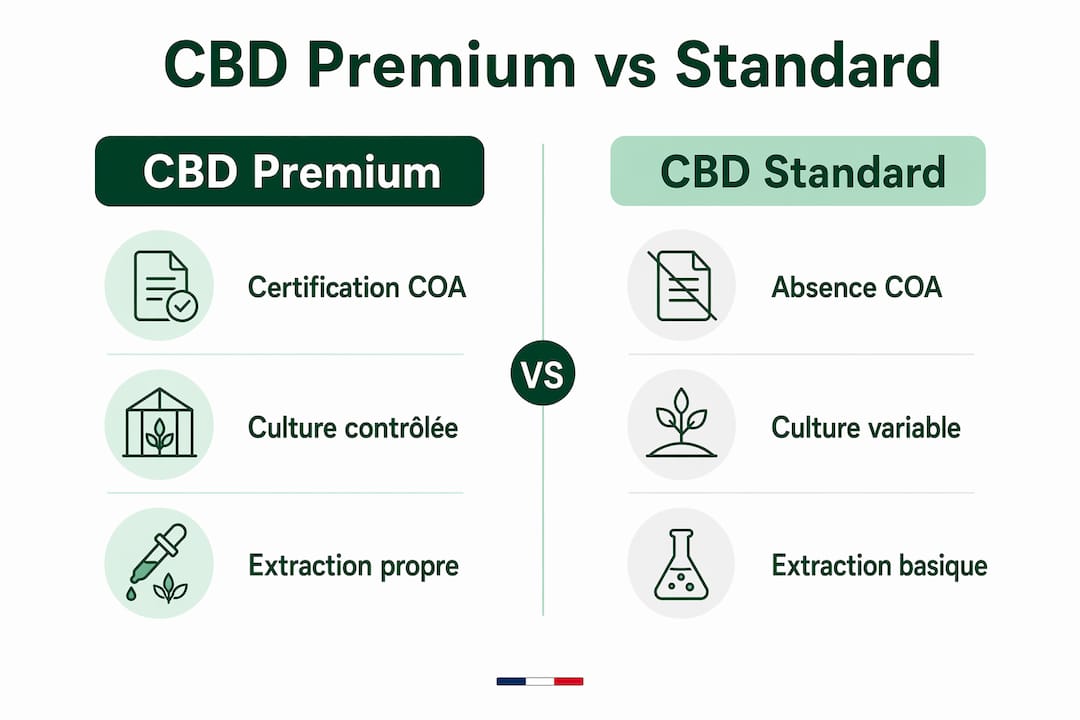
So-called "premium" CBD is defined by cultivation, extraction, and quality control choices aimed at sensory consistency and traceability—not just by price. Specifically, this encompasses four measurable criteria: the genetic selection of the hemp variety, control of the growing environment (indoors, greenhouse, or outdoors), the extraction method (supercritical CO₂ or pharmaceutical-grade ethanol), and the availability of a Certificate of Analysis (COA) for each batch, attesting to compliance with the legal threshold of 0.3% THC in France and the absence of contaminants. In terms of indicative prices on the French market, so-called discount products are generally much less expensive than premium ranges, which have higher prices.
Premium CBD products primarily cater to demanding users: regular relaxation protocols, the pursuit of sensory consistency, or specific therapeutic needs. For occasional use or a first experience, a standard CBD product with a verifiable Certificate of Analysis (COA) may suffice. Thefrenchhempempire exemplifies this approach by making its Certificates of Analysis available by batch, with traceability of origin and batch number accessible before purchase.
Table of Contents
- What exactly do we mean by "premium CBD"?
- What technical criteria define a superior quality CBD?
- Premium CBD vs. Standard CBD: Price, Safety, and Effects Compared
- Is premium CBD necessarily more potent?
- Legal framework in France: what to check before buying
- How can you verify that a product is truly premium before buying it?
- When does premium become necessary, and when is standard sufficient?
- How does Thefrenchhempempire guarantee premium quality?
- Key points
- What the premium CBD market really reveals
- Thefrenchhempempire: a premium range with proof to back it up
- Useful sources and official texts for further reading
What exactly do we mean by "premium CBD"?
The term "premium" is frequently used for commercial purposes without corresponding to precise technical criteria. An operational definition is therefore necessary: a CBD product can be classified as premium when it simultaneously meets several verifiable conditions—traceable origin, documented extraction method, certified molecular spectrum, and a Certificate of Analysis (COA) accessible for each batch.
The distinction between classic CBD, premium CBD and CBD+ deserves clarification:
- Classic (standard) CBD : product from conventional cultivation, often in isolate or simplified broad spectrum form, with basic laboratory tests mainly covering CBD and THC levels.
- Premium CBD : Hemp selected for its terpene profile, controlled cultivation (indoors or greenhouse), extraction with supercritical CO₂ or pharmaceutical ethanol, full COA including pesticides, heavy metals and residual solvents.
- CBD+ : products enriched with minor cannabinoids (CBG, CBN, CBC), displaying higher total concentrations and aiming for a more pronounced action than CBD alone.
There are three verifiable signs of a premium product: the availability of a Certificate of Authenticity (COA) by batch number, complete traceability (country, variety, extraction method), and a clearly identified molecular spectrum (full spectrum, broad spectrum, or isolate). The absence of any of these elements on the product page or the seller's website is a red flag.
What technical criteria define a superior quality CBD?
Genetics and varietal selection
The hemp variety largely determines the final terpene profile. Premium growers select stable phenotypes rich in specific terpenes (myrcene, limonene, linalool), which gives the flowers distinctive aromas and a consistent composition from batch to batch. An unstable variety produces heterogeneous batches, making any comparison between purchases difficult.
Cultivation methods and their impact
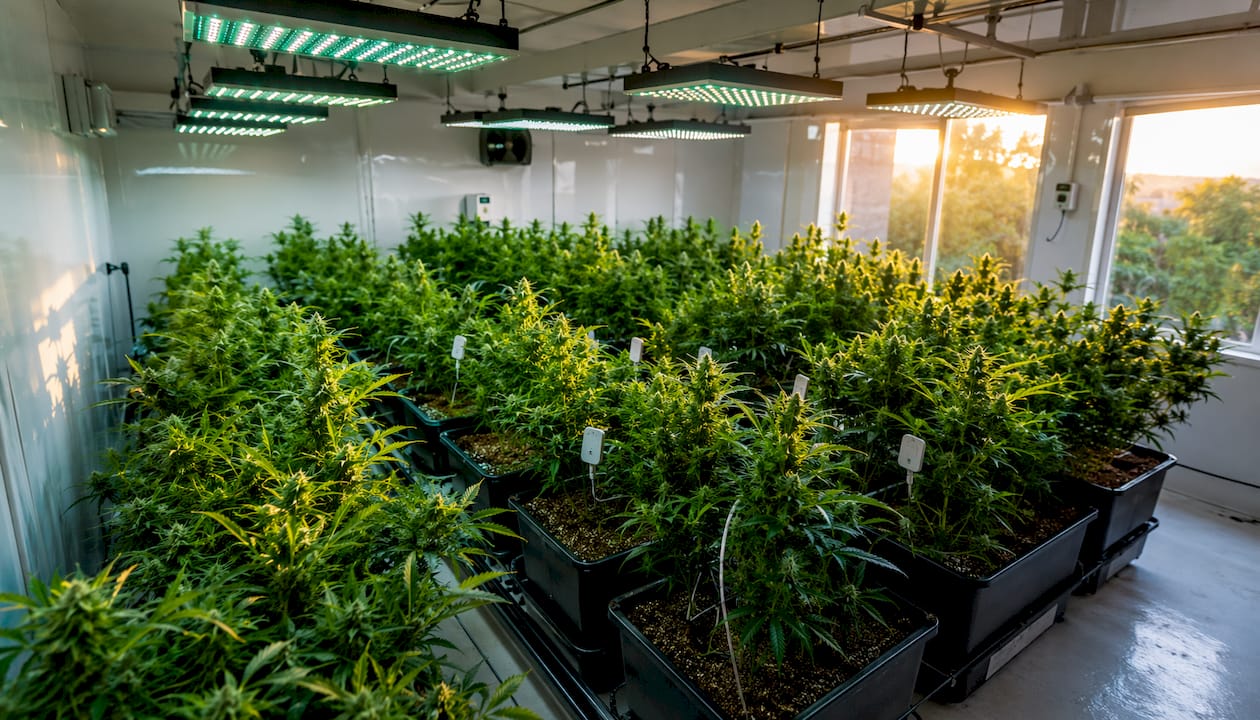
Indoor cultivation offers the strictest control over light, humidity, and temperature, resulting in dense buds, a pronounced terpene profile, and a reduced risk of fungal contamination. Greenhouse cultivation represents a good compromise: partially controlled natural conditions, lower production costs, and quality often close to that of indoor cultivation. Outdoor cultivation remains the least expensive but exposes the plant to climatic variations and the risk of contamination by pesticides or heavy metals present in the soil.
Drying and curing
Slow drying and curing (aging over several weeks) stabilize the terpenes and preserve the cannabinoid structure. Drying too quickly degrades the aromas and weakens the flower. This is one of the least visible steps for the consumer, but one of the most crucial for the final quality.
Extraction method
Supercritical CO₂ extraction is preferred by premium brands for its ability to preserve terpenes and cannabinoids without leaving residual solvents. Pharmaceutical-grade ethanol is an acceptable alternative, provided that the ethanol is completely removed from the final product—a fact that the Certificate of Authenticity (COA) must confirm. Chemical solvents such as butane or propane, sometimes used in discount production, can leave toxic residues.
Cannabinoid spectrum and entourage effect
- Full spectrum : retains all cannabinoids, terpenes, and flavonoids, including trace amounts of THC within legal limits. Promotes the entourage effect, i.e., the synergy between compounds.
- Broad spectrum : similar profile to full spectrum, but with THC eliminated or reduced to an undetectable level.
- Isolate : Pure CBD, over 99%, with no other cannabinoids or terpenes. Less expensive to produce, but lacks the entourage effect.
Quality controls: what the COA must cover
A premium Certificate of Analysis (COA) goes beyond simply stating CBD and THC levels. To recognize a reliable product, it must include:
- CBD, THC and minor cannabinoid (CBG, CBN, CBC) levels
- Pesticide residues
- Heavy metals (lead, cadmium, mercury, arsenic)
- Residual solvents
- Microbiological contaminants (molds, yeasts)
- Batch number and date of analysis
Pro tip: Always check that the COA is issued by an independent third-party laboratory, identifiable by its name and accreditation. A certificate produced internally by the manufacturer does not offer the same guarantees of objectivity.
Premium CBD vs. Standard CBD: Price, Safety, and Effects Compared
Price ranges in France
The French market presents a significant gap between the two ranges. Discount products are priced between €0.50 and €2/g, while premium ranges fluctuate between €5 and €12/g. This additional cost covers substantial expenses: indoor or greenhouse cultivation, manual bud selection, extended curing, CO₂ extraction, and comprehensive laboratory testing. A portion also funds marketing and profit margins, which justifies always requesting a Certificate of Authenticity (COA) before purchasing.
Risks associated with low-priced products
French customs officials remind consumers that the absence of a Certificate of Authenticity (COA) and the potential presence of contaminants are more likely with very low-priced products. The risks associated with inexpensive CBD include solvent residues, heavy metals, and variability in concentration from batch to batch. A low price does not necessarily mean danger, but it does increase the likelihood of shortcuts being taken in the inspection process.
Summary comparative table
| Criteria | Premium CBD | CBD standard/discount |
|---|---|---|
| Indicative price (France) | between €5 and €12/g | between €0.50 and €2/g |
| Extraction method | supercritical CO₂ or pharmaceutical ethanol | Chemical solvents or undocumented methods |
| COA available by lot | Yes, accredited third-party laboratory | Absent or incomplete |
| Cannabinoid spectrum | Documented full spectrum or broad spectrum | Often isolated, spectrum not certified |
| Contaminant tests | Pesticides, heavy metals, residual solvents | Basic or absent |
| Traceability (origin, batch) | Complete, available for consultation | Partial or opaque |
| Terpene profile | Well-documented, pronounced aromas | Variable, poorly documented |
When the difference is truly noticeable
Consumer comparisons show that premium products excel primarily in terpene profile and aesthetics. For basic chemical criteria (CBD content, THC compliance), a reputable seller offering standard products can provide equivalent results. The difference becomes significant for regular use requiring consistency and reproducibility, or for consumers sensitive to aroma and texture.
Is premium CBD necessarily more potent?
CBD concentration and product quality are two distinct aspects. A 99% CBD isolate is technically very concentrated, but it lacks terpenes and minor cannabinoids. Conversely, a full-spectrum flower with 15% CBD can produce a more pronounced entourage effect thanks to the synergy between its compounds.
CBD+ products enriched with CBG, CBN, and CBC alter bioavailability and recommended use. CBG is associated with complementary calming properties, CBN with a sleep-promoting effect, and CBC with potential anti-inflammatory action. These products aim for a more pronounced effect without increasing THC, making them suitable for users who have developed a tolerance to CBD alone. To learn more about the differences between these molecules, the resource on CBG, CBN, and CBD details their respective effects.
resins and extracts often offer a better effect-to-price ratio than premium flowers for those primarily seeking potency. A 50% CBD resin requires significantly smaller quantities for a similar effect.
- Start with a low dose and observe the individual response before increasing.
- Prefer microdosing for enriched (CBD+) products with a high total cannabinoid concentration.
- Do not confuse stated concentration with actual bioavailability, which also depends on the method of consumption and the formulation.
Pro tip: For highly concentrated products, keep a diary for two weeks: note the dose, the time, and the effect felt. This allows you to precisely adjust your dosage without overconsumption.
Legal framework in France: what to check before buying
In France, the sale of CBD is regulated by European and national laws. The legal THC limit is set at 0.3% in the hemp plant at harvest, in accordance with the European regulation on novel foodstuffs and applicable national decrees. This limit must be verified on the Certificate of Authenticity (COA) of the purchased product, and not just on the label.
Information to look for on the label and the seller's website:
- Origin of hemp (country, region, variety)
- Batch number used to locate the corresponding COA
- Extraction method mentioned
- THC level certified by third-party laboratory
- Contact details of the manufacturer and distributor
For official information on applicable regulations, reference texts can be consulted at the French customs office and on theAmeli/ANSM website for precautions for use. These sources allow you to verify legal limits and conditions for placing on the market.
Pro tip: Always refuse any product whose Certificate of Authenticity (COA) cannot be traced by batch number. A generic, undated COA or one not linked to a specific batch does not guarantee the conformity of the product you receive.
How can you verify that a product is truly premium before buying it?
A four-step procedure allows a product to be validated, whether the purchase is made in a physical store or online.
- Verify the COA by batch : access the certificate of analysis corresponding to the product's batch number. Confirm that it comes from an accredited third-party laboratory, that it covers pesticides, heavy metals, and residual solvents, and that it is dated within the last 12 months.
- Check the origin and traceability : the country of cultivation, the hemp variety, and the batch number must be indicated. An opaque origin or an evasive response from the seller on these points is a red flag.
- Identify the extraction method : supercritical CO₂ or pharmaceutical ethanol are the reference methods. If the method is not mentioned, ask for it explicitly.
- Check the terpene profile and spectrum : a premium product will document its main terpenes and specify whether it is full spectrum, broad spectrum, or isolate. The absence of this information on the product sheet suggests a basic formulation.
Questions to ask the seller: "Can you provide me with the Certificate of Analysis (COA) for the batch currently for sale?", "What extraction method was used?", "Is the hemp grown in Europe?"
Warning signs not to ignore: unfounded medical claims (a CBD product cannot legally be presented as a medicine), lack of accessible COA, undocumented origin, very low price without any justification of the production chain.
To further understand the analysis certificates, the guide on quality and traceability details the essential fields to check.
Pro tip: On online sites, look for a direct link to the COA from the product page, ideally with a QR code on the packaging. If the COA is only accessible upon request via email, that's acceptable but less transparent.
When does premium become necessary, and when is standard sufficient?
Situations where premium is relevant
- Recurrent sleep disorders or chronic anxiety requiring a regular and reproducible protocol.
- Seeking sensory consistency (aromas, texture, effect) from one purchase to the next.
- Recreational or collection uses where the terpene profile and the aesthetics of the flower matter.
- Gifts or purchases for people sensitive to contaminants or additives.
Situations where the standard is sufficient
- First experience with CBD, without a defined protocol.
- Occasional consumption without any requirement for consistency.
- Tight budget, provided you choose a seller who publishes a COA even on their budget ranges.
Three questions to guide your choice: Do you need a consistent effect with each dose? Do you use it regularly (several times a week)? Are you sensitive to contaminants or flavorings? If the answer to at least two of these questions is yes, then a premium product is justified. Otherwise, a standard product with a verifiable Certificate of Analysis (COA) is a reasonable choice, especially considering the more economical alternatives that maintain essential safety standards.
How does Thefrenchhempempire guarantee premium quality?
The French Hemp Empire structures its quality control process around three pillars: batch-based Certificate of Analysis (COA), complete traceability, and systematic contaminant testing. Each product sold is associated with a batch number that allows retrieval of the corresponding Certificate of Analysis, issued by an independent third-party laboratory.
| Control element | What the consumer can check |
|---|---|
| COA per batch | Batch number on the packaging, link to the certificate on the product page |
| Origin of hemp | Countries and cultural regions mentioned on the website |
| Extraction method | As indicated in the product description |
| Contaminant tests | Pesticides, heavy metals, residual solvents covered in the COA |
| THC Compliance | Certified rate ≤ 0.3% by accredited laboratory |
The quality characteristics of CBD oils and flowers are receiving increasing attention from quality control specialists, who emphasize the importance of end-to-end traceability. Thefrenchhempempire applies this principle to its entire range, from premium flowers to high-concentration resins.
Customer commitment includes a transparent return policy, customer service available to answer technical questions about COAs and batches, and secure delivery throughout Europe.
Key points
Premium CBD is distinguished from standard CBD by verifiable technical criteria, not just price: COA per batch, documented extraction, full traceability and contaminant tests are the evidence to demand.
| Point | Details |
|---|---|
| Criterion #1: COA per batch | Demand a third-party certificate of analysis covering pesticides, heavy metals, and residual solvents. |
| Price difference in France | Discount ranges are priced between €0.50 and €2/g; premium ranges between €5 and €12/g. |
| Spectrum and entourage effect | Full spectrum and broad spectrum offer a synergy between cannabinoids that is absent from isolate. |
| When to choose premium | Regular use, relaxation protocols, or sensitivity to contaminants justify the additional cost. |
| Thefrenchhempempire | Offers searchable batch COAs, full traceability and contaminant testing across its entire range. |
What the premium CBD market really reveals
The debate between premium and standard CBD often masks a more fundamental issue: the seller's transparency. A product priced at €3/g accompanied by a complete Certificate of Authenticity (COA), issued by an accredited laboratory and linked to the specific batch being sold, offers more guarantees than a flower priced at €10/g with a certificate that is either untraceable or generic.
The premium price difference is real and justified for some buyers, particularly those who use the product regularly and for whom consistent results are a priority. However, paying more doesn't excuse you from verifying the evidence. The French market includes sellers who use the term "premium" as a marketing tool without adhering to its technical specifications. The only truly effective protection remains systematically reading the Certificate of Analysis (COA) before any purchase.
Individual experience trumps classifications. Some consumers achieve the desired effects with a well-tested standard broad-spectrum vape; others require a full-spectrum vape with a documented terpene profile. Testing both ranges over a defined period, noting the effects, remains the most reliable method for identifying what suits each situation.
Thefrenchhempempire: a premium range with proof to back it up
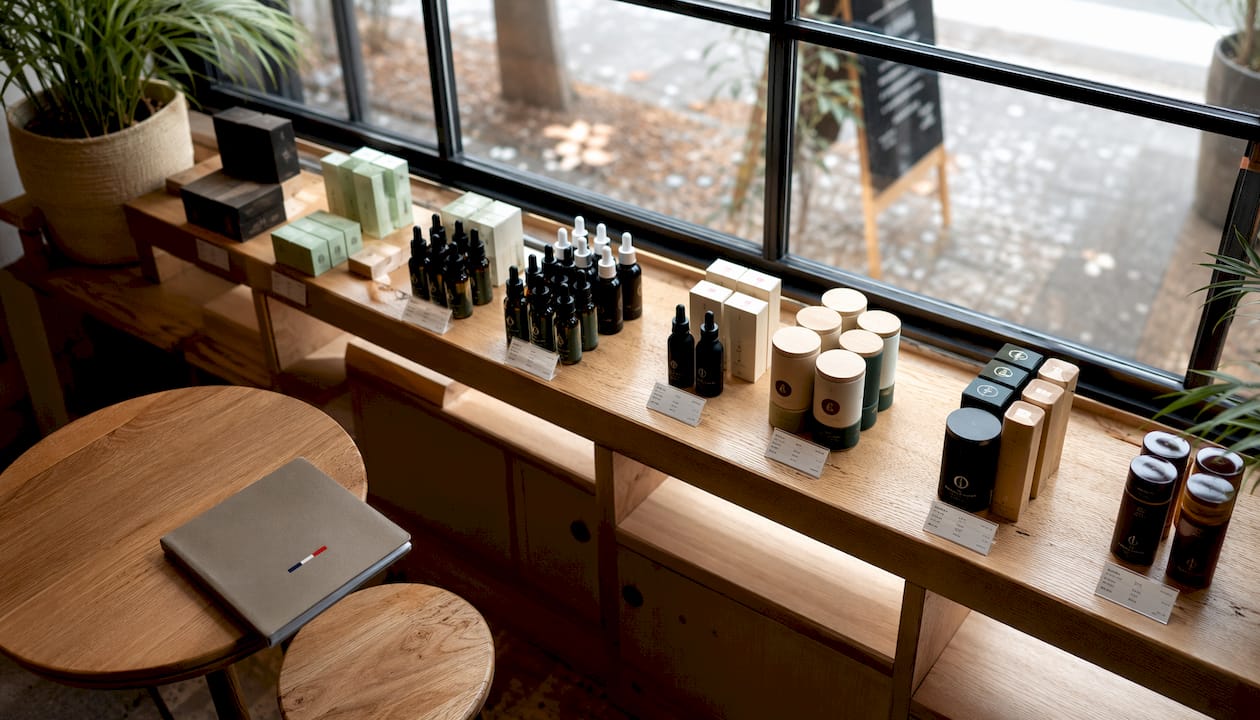
For those seeking documented quality products, Thefrenchhempempire offers a selection of premium CBD flowers, high-concentration resins, and CBD vapes, each accompanied by a Certificate of Analysis (COA) for each batch and complete traceability from origin to finished product. The certificates systematically cover pesticides, heavy metals, and residual solvents, in accordance with French market requirements.
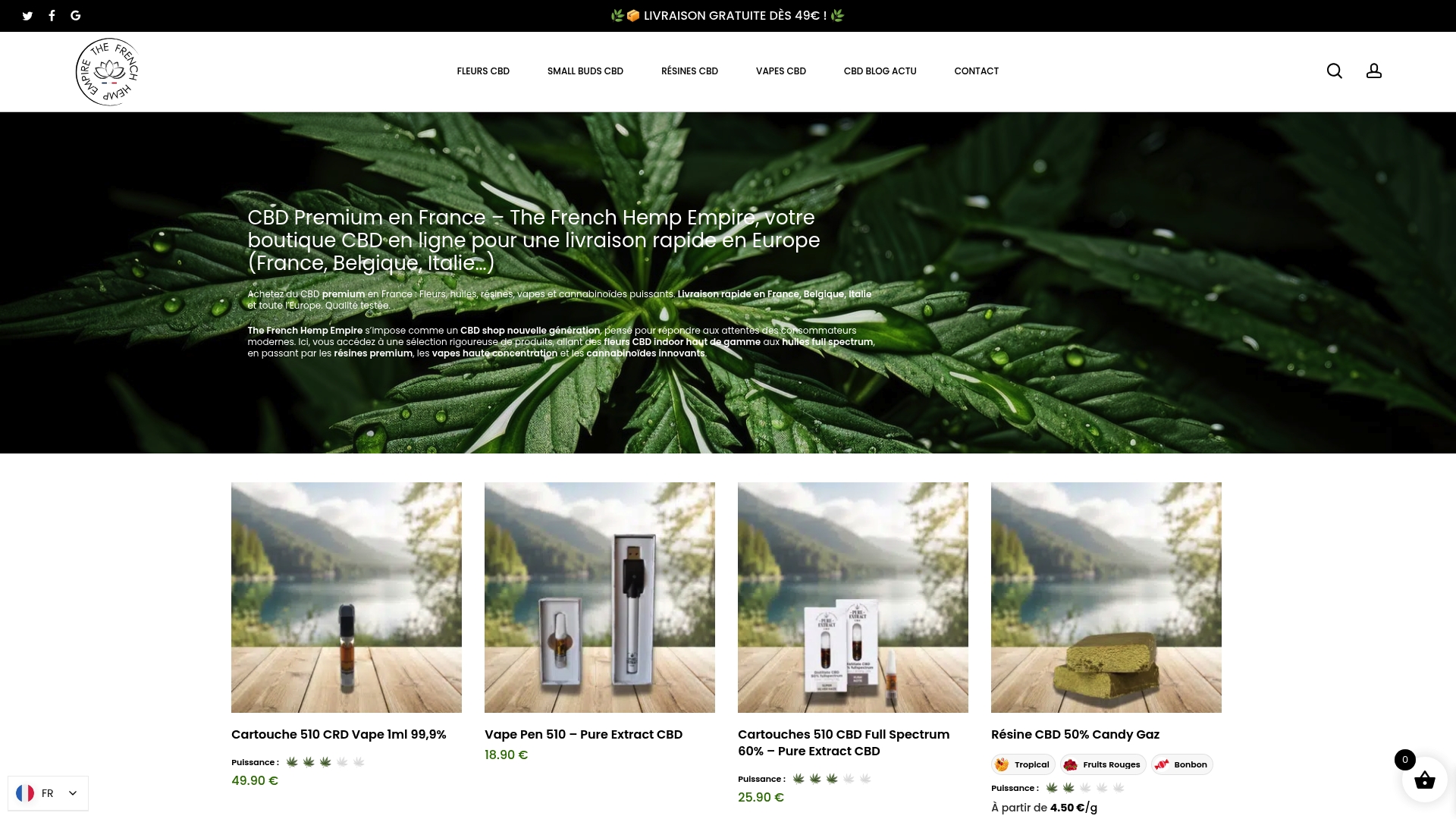
Compliance with the legal THC limit of 0.3% is certified by a third-party laboratory for each batch. For users wishing to explore high-concentration products, the dedicated high-concentration CBD details usage precautions and available formulations. Consult the full range at thefrenchhempempire.fr to access product sheets and corresponding Certificates of Analysis (COAs).
Useful sources and official texts for further reading
- French Customs — CBD and dangerous substances: official information on the risks associated with misleading labels and non-compliant products.
- Ameli — Cannabidiol (CBD): definition and precautions: precautions for use and public health framework applicable in France.
- Cannanews — CBD+ vs CBD: explanation of the differences in composition between classic CBD and CBD enriched with minor cannabinoids.
- My Vape Review — Mass-Market vs Premium CBD: analysis of the differences between mass production and premium ranges (extraction, third-party testing, formulation).
- Evidena — CBD Oil Quality: A guide to quality markers and methods for controlling CBD oils.
- UPC CBD — Union of Hemp Professionals : French professional organization of reference for standards and regulations in the sector.
- Thefrenchhempempire — Quality, analysis and traceability: a practical guide on reading COAs and verifying CBD products.
This article is provided for general informational purposes only. It does not constitute medical, legal, or regulatory advice. For any questions relating to your personal situation or applicable regulations, consult a healthcare professional or the official sources mentioned above.