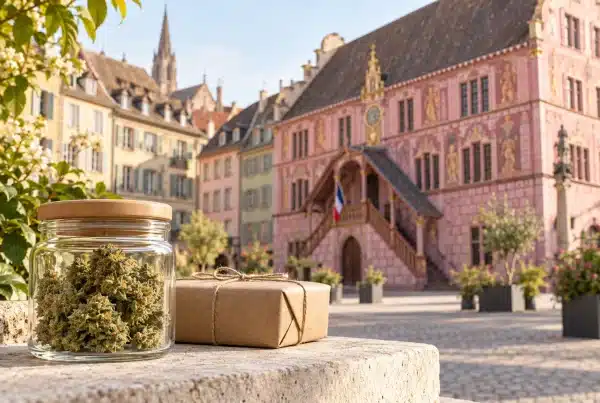
A spectacular flower in a photo doesn't provide the same information as a lab report. An aromatic description, size, and stated origin answer yet more questions. This guide helps you connect these elements without confusing appearance, composition, and personal preference. You'll be able to browse The French Hemp Empire's CBD flowers with a more discerning eye, understand the terminology of resins, and ask the right questions before making a purchase. The goal is to help you better understand the products, without turning a visual detail into a promise.
CBD trichomes: what exactly are we talking about?
Trichomes are structures produced on the surface of the plant. Some are glandular: they possess a secretory portion where resin compounds accumulate. In cannabis, these structures participate in the production and storage of cannabinoids and terpenes. The term "CBD trichomes," used in research, therefore refers to the trichomes of flowers rich in cannabidiol. It does not mean that every visible bud is a pure CBD crystal.
The work of Livingston and his colleagues, published in The Plant Journal, distinguishes, among other things, bulbous, sessile, and pedunculate forms. Some remain close to the surface; others bear a rounded head at the end of a stalk. You don't need to recognize all these forms to buy a flower. The main thing to remember is that a granular appearance under high magnification corresponds to a complex plant structure, and not to a uniform layer from which one could directly deduce the composition.
This precision changes the way you look at a photograph. Instead of seeking "as much white as possible," begin by observing the overall structure: what does the framing show, what areas are in focus, is the flower photographed in its entirety or in detail? Your initial reading becomes descriptive. You can then consult the seller's information to determine which product is being presented and which batch the available documents belong to. The image retains its relevance, with a suitable place in your comparison.
Do not confuse glandular heads and flower filaments
In a close-up image, several elements overlap. The long, often orange or brownish filaments generally correspond to the stigmas, commonly referred to as "pistils" in the trade. They are distinct from the small glandular structures. Their color does not indicate the CBD level. Therefore, if you are describing a photograph to the seller, specify whether your question concerns the filaments, the shiny surface, or a deposit that seems unusual to you.
A comment like "the flower looks very white in the photo" can sometimes lack precision. You can ask for an overall view and a close-up, then indicate the area you're unsure about. This method is more useful than a diagnosis based on a thumbnail. It allows you to get an answer about the correct element without assuming that all the light-colored areas are the same. Also, keep the exact name of the product code: a visual comparison must remain relevant to the actual product being considered.
CBD trichomes: why the frosty effect doesn't give a percentage
A photograph records the light reflected by a surface. A dosage measures a substance using a specific method and on a sample. These two operations do not address the same question. You may appreciate the appearance of a flower and strive for a refined presentation; however, the percentage must be considered within the compositional data. A highly detailed image does not become a measuring instrument simply because small structures are clearly visible.
A 2025 study of individual trichomes compared a medicinal cannabis variety with CBD-rich hemp. Researchers used in-depth chemical analysis to study their composition and compared it to that of the inflorescences. The observed profiles notably highlight the role of genetic type in the composition. This work serves as a reminder that a small structure can contain a range of substances: its appearance is not a chemical label that can be read from a distance.
When making your purchases, observing CBD trichomes leads to a simple piece of advice: separate your questions. "Do I like this presentation?" concerns the visual aspect. "What profile is advertised?" concerns the product information sheet. "What concentrations were measured?" concerns the batch report. You can gather this information to inform your decision without waiting for a single answer. This approach also helps you compare two flowers with the same percentage but different descriptions and packaging.
The color of the trichomes: a clue to be placed in its context
You'll encounter descriptions of clear, milky, or amber-colored buds. Observations published in 2023 in the Journal of Cannabis Research document changes in color and morphology during development. The study focuses on THC-rich genotypes; it doesn't provide a universal rule for evaluating any commercially available CBD flower based on a photograph.
To interpret the CBD trichomes of a dried product, avoid shortcuts like "amber equals this effect" or "transparent equals bad flower." Your screenshot alone doesn't tell you the product's history. White balance, lighting, and magnification also complicate comparison. If a detail is important to you, ask about the conditions under which the image was taken and what information accompanies the reference. You'll get a more useful basis than a categorical interpretation of a single shade.
Harvesting advice read in a forum often refers to a plant observed during its growth. Your situation as a buyer is different: you are examining a product that has been prepared, packaged, and displayed in a shop. The relevant questions then become the visual appearance, the delivered product code, and the batch documentation. This distinction allows us to maintain an interest in botany without automatically applying a cultivation schedule to the evaluation of a received packet.
CBD trichomes: compare photos without being guided by framing
To compare the CBD trichomes of two products, first look for comparable images. A full-bud photograph and a macro shot of a small area don't give the same impression. The background, focus, and lighting can accentuate different details. Before declaring the more visually striking product superior, look at what is actually shown. You might appreciate a particular presentation while recognizing that the framing doesn't allow you to distinguish all the characteristics.
To observe CBD trichomes, a practical method is to note three visible elements and three pieces of information to verify. In the first column, you can write the advertised size, the bud's appearance, and the areas shown. In the second, keep track of the stated origin, the composition, and the estimated weight. This simple separation prevents a single visual impression from overshadowing the other criteria. It remains useful when you're browsing several pages and want to return to a short selection, with the reasons for your choice clearly identified.
| What you are watching | What this can bring | That this alone does not demonstrate |
|---|---|---|
| A close-up view | An overview of the surface and its presentation | A precise level of CBD or THC |
| A whole head | An idea of the shape of the photographed product | The appearance of all the heads in the lot |
| An aromatic description | A guide to compare your preferences | A complete measurement of the molecules present |
| A laboratory report | Results based on the specified parameters and sample | All possible checks on all future batches |
You can apply this framework to other details highlighted in a store. An unusual color, a familiar name, or a particular finish might catch your eye. Then, take the time to review the product information. The comparison becomes more balanced when your decision is based on several consistent elements, rather than a single photograph or adjective. You'll also know what information to ask for when a question remains unanswered.
Small buds and large flowers: size does not determine quality
A search for CBD trichomes might lead you to compare large buds and small buds. The Small Buds CBD category features small flowers. Size describes appearance; it doesn't replace the specific information for each product. You can choose this size or look for a larger bud, then consider the aroma, the stated origin, and the packaging. Your visual preference is important but doesn't become a measure of composition.
Imagine two products: one shown in a very tight macro shot, the other in a wide shot with several small buds. The first may appear more detailed simply because the image brings you closer to the surface. Before making a decision, look for comparable information and note the characteristics that matter to you. Your budget, flavor preferences, and desired quantity may lead to a different decision than the one suggested by the most spectacular photograph.
For a first purchase, a limited quantity may suffice. To find a favorite item again, you can check a different weight if the quantity is significant. In each case, note the exact name and size. You can then link your observations to the correct product upon receipt. This system gives visual cues a useful role: they become one of the reference points for your selection, along with the product information and the total amount in your basket.
CBD trichomes and resin: understanding the link without assuming purity
Resins represent a different type of presentation than the whole flower. Research on trichome separation published in 2025 shows that the collected fractions can include glandular heads and various plant elements. Therefore, terms like "pollen," "kief," or "filtered" should be interpreted in conjunction with the product description. A trade name does not automatically indicate the exact composition of what is being sold.
Research published in 2026 on electrostatic separation also combined microscopic observation with chemical analysis to study the resulting fractions. The value of this research, for your reading purposes, is methodological: the appearance and analytical results are examined together. The performance of a process studied under these conditions should not be automatically attributed to a store-bought resin using similar terminology. A commercial product requires its own specific information.
When selecting CBD resins, start by looking at the stated composition, presentation, and available information. Then you can consider the texture and packaging. If a specific preparation method is important to you, ask the seller for details about the product. Resins offered for technical, aromatic, or collecting purposes are not intended for human or animal consumption and should not be ingested or added to food or beverages.
Does a bright flower prove that it is natural or without additives?
The appearance of CBD trichomes alone is insufficient to reconstruct all the preparation steps. A photograph is no substitute for information on the composition or the stated processing methods. If your primary criterion concerns an unenriched flower, state this explicitly. Ask what information is available about the product and keep the answer with its exact name. The desired detail will then be addressed directly, rather than being inferred from a shine, color, or marketing adjective.
Your analysis of CBD trichomes may also raise questions about aromas. A description of lemon or pine helps you compare a preference; it doesn't automatically tell you all the steps involved in preparing the product. You can ask if the description is simply outlining a claimed profile and what composition information accompanies it. The goal is to choose based on the information actually provided. This isn't about attributing an additive to every expressive flower, nor is it about considering a discreet presentation as proof of its absence.
A useful question should be able to receive a precise answer. "Is this product enriched or flavored?" provides more than a general inquiry about its quality. Include the product name, the specific variation you're looking for, and the feature that matters to you. You can then decide if the available information meets your needs. This structure remains valid for all product lines, without assuming that a term applied to one product automatically describes the entire catalog.
CBD trichomes: what role should be given to analysis?
NIST's CannaQAP program focuses on the comparability of measurements between laboratories. Its second exercise specifically examined cannabinoids, moisture content, and toxic elements in plant material. This approach underscores the importance of a defined method, sample, and parameters for obtaining accurate results. Therefore, when considering composition, consult the relevant documentation for the product and verify what was actually measured.
To delve deeper into this topic, you can consult our guide to CBD analysis certificates. The key point here is complementarity: the photograph presents one aspect, while the report provides results within its scope. If you are looking for information on a specific contaminant, verify that it is included in the tests performed. A single page listing cannabinoids cannot answer all possible questions about a product.
When comparing two product sheets, keep the documents with the correct name and batch number. Avoid comparing a current photograph with a report for a different product. If the connection isn't clear, ask before paying. This will allow you to make an informed decision where each element remains relevant: visual preference, advertised profile, quantity, and available results. This method is especially useful when several products share a similar name or presentation.
Upon receipt: observe methodically and limit handling
The 2023 studies cited above also show that post-harvest handling can affect the integrity of glandular structures. For you, the practical recommendation is to limit unnecessary handling: you don't need to crush a flower or rub it repeatedly to decide if its presentation is satisfactory. Start by checking the name, the packaging, and the apparent condition of the container. Keep this information so you can find the reference number if you need to ask for clarification.
If you wish to document a detail, take a clear photograph of the entire product, followed by a second, closer image. Use the same lighting for both comparisons. Note your observations without immediately interpreting them as a diagnosis: light-colored areas, filamentous elements, or differences from the image you consulted. If anything looks suspicious or the product's integrity is compromised, set it aside and contact the seller. A photograph alone cannot confirm the absence of contamination.
Follow the storage instructions provided and keep labeled products separate. Close containers tightly and avoid unnecessary exposure to heat, direct sunlight, or moisture. Store out of reach of children and pets. These storage instructions are provided with your purchase; they are not a method for repairing a damaged product. If you have any questions about its condition, please contact us with your batch and order information.
CBD trichomes: your method before choosing a reference
Start with a specific question: are you looking for a particular presentation, a specific flavor profile, or a stated origin? Then, look at the photos with this in mind, and consult the corresponding specifications. Make a short list and explain the differences between them. You can ask for clarification on any missing information and choose the packaging you actually want. The price per gram, the total amount, and the delivery charges complete this overview as you prepare your order.
A more spectacular flower isn't automatically the best purchase for your project. You might prefer a variety whose description appeals to you more, a smaller size to explore, or a different size that suits your budget. Keep asking yourself the same questions throughout. Your choice will then be based on a coherent combination of preference, available information, and quantity, with names you'll be able to find again for future orders.
Your questions about CBD trichomes and flowers
Are CBD trichomes pure cannabidiol crystals?
No. The glandular structures of the flower can contain a range of compounds. Their glossy appearance does not mean that a surface is covered with isolated CBD. Determining the composition requires proper measurement and an identified sample.
Does a very frosty flower necessarily contain more CBD?
You cannot establish this ranking based solely on the image. Framing, lighting, and the area photographed all influence your impression. Compare the available results for the relevant references and consider appearance as a presentation criterion.
Does an amber color allow us to predict an effect?
A nuance observed in a commercial photograph does not guarantee a specific effect on the individual product. Observations regarding development must be considered within their context and do not automatically apply to all dried products.
Can a flower be recognized by its appearance?
Appearance alone does not demonstrate the exact composition or compliance with all applicable regulations. Consult the product information, the stated intended use, and relevant documentation. A photograph is not a substitute for this verification.
Choose your flowers with a more precise eye
CBD trichomes offer an interesting glimpse into the botany of hemp. When making your purchase, their analysis is most valuable when considered in conjunction with other information: reference number, composition, available documentation, advertised profile, and desired quantity. Browse the flower and small bud categories of The French Hemp Empire using this method, then select the products that best suit your preferences. You'll appreciate a well-presented product while maintaining a comparison based on multiple factors.
This guide is intended for adults only and does not recommend any edible use of the flowers. It is not intended as medical advice. Do not drive or operate machinery after use. A CBD product may contain THC, and a low advertised THC content does not guarantee a negative test. For personal health or treatment questions, consult a healthcare professional and follow the specific instructions for each product.