CBD products with no detectable THC do exist in France, but the term "CBD 0 THC" represents a more nuanced technical reality than a simple label. Achieving a strictly zero THC level is technically impossible for a natural hemp flower; however, certain formats allow for a level undetectable by standard analytical methods. It is this distinction, and not a marketing claim, that should guide any purchase of legal cannabidiol in France.
Immediate recommendations:
- Preferred format: CBD isolate (purity greater than 99%) or a broad spectrum extract whose COA indicates "ND" (not detected) on the Delta-9 THC line.
- Proof to be required: an independent, dated Certificate of Analysis (COA) bearing a batch number and specifying the analytical method (GC-MS or LC-MS).
- Regulatory point: the French legal threshold is set at a THC level of 0.3% or less in the finished product. Since May 15, 2026, CBD products intended for ingestion, such as certain oils, gummies, and infusions, are subject to significant restrictions under the European Novel Food Regulation.
Table of Contents
- What is the French legal framework for CBD without THC?
- What exactly does "CBD 0 THC" mean on a product?
- Which CBD product formats present what level of THC risk?
- How can you verify that a CBD product is truly free of detectable THC?
- What do screening tests detect and what risks do they pose depending on the product?
- Buying checklist to aim for a near-zero risk of detectable THC
- How Thefrenchhempempire guarantees the absence of detectable THC
- Key points
- Thefrenchhempempire: verified CBD products, with no compromise on traceability
- Useful resources for further reading on the topic
What is the French legal framework for CBD without THC?
The sale of hemp flowers and leaves is permitted in France as long as the THC content in the finished product remains at or below 0.3%. The Council of State confirmed this framework by overturning the decree that prohibited the sale of the flowers, thus establishing a stable legal basis for both sellers and consumers.
Key point: the legal THC limit in the finished product in France is 0.3%. Meeting this limit authorizes marketing, but does not guarantee the absence of a positive result on a drug test.
This point deserves to be emphasized: commercial compliance and the criminal risk associated with roadside drug testing operate according to distinct principles. A legally marketed product may contain up to 0.3% THC; however, saliva tests used during roadside checks detect the presence of THC regardless of the quantity, without reference to this commercial threshold. Therefore, a product's compliance does not protect its consumer from a positive result.
The regulatory update of May 15, 2026, has tightened France's position on edible CBD : oils for oral consumption, gummies, infusions, and capsules are now subject to the European Novel Food Regulation, whose prior scientific evaluation requirements make their marketing virtually impossible given the current state of applications submitted to the EFSA. Topical products and flowers intended for vaporization are not subject to this restriction but remain subject to the 0.3% THC threshold. The official MILDECA website is the institutional reference for monitoring developments in this framework.
What exactly does "CBD 0 THC" mean on a product?
The label "0% THC" on packaging does not necessarily mean an absolute and measurable absence of THC. Understanding analytical limits is essential for correctly interpreting a laboratory report.
- LOD (limit of detection): the minimum concentration below which an instrument cannot confirm the presence of a molecule. Below this threshold, the result is noted as "ND" (not detected), which does not mean absolute zero, but zero measurable with the method used.
- LOQ (limit of quantification): the minimum concentration at which a device can provide a reliable numerical value. Between LOD and LOQ, the substance is detected but not precisely quantifiable.
- "ND" on a COA: The Delta-9 THC line displays "ND" when the concentration is below the laboratory's LOD. This is the most favorable indication for a consumer wishing to minimize their THC exposure.
Natural hemp flowers clearly illustrate this reality: they almost always contain traces of THC at varying levels, making any claim of "0.0% absolute THC" on raw flower technically unfounded. Variability between batches, the risk of cross-contamination during production, and labeling errors are all factors that can introduce traces of THC even into products marketed as being THC-free.
CBD isolate, obtained through advanced purification processes, is the only form that can consistently achieve undetectable THC levels. Another myth worth dispelling is that CBD does not convert to THC in the body. According to Drugs Info Service, no validated metabolic mechanism supports this conversion under normal usage conditions. A positive test means that the consumed product contained THC.
Which CBD product formats present what level of THC risk?
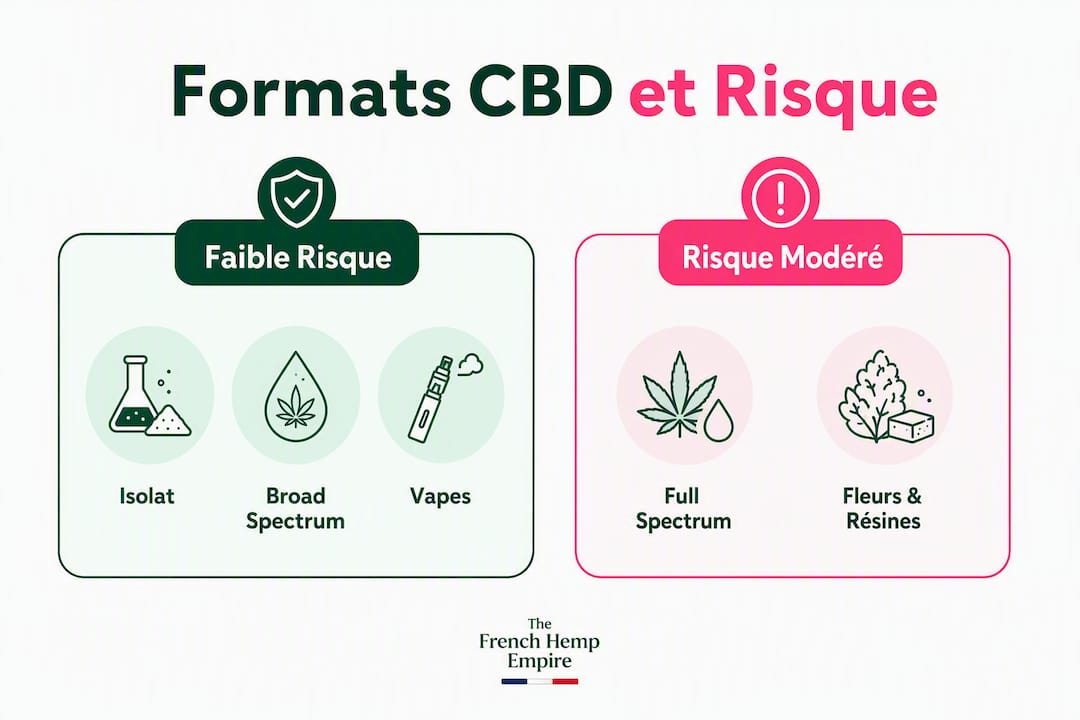
The choice of format directly affects the level of residual THC and, consequently, the risk during a test.
CBD isolate
contains no detectable THC when properly produced. This format offers maximum safety against drug tests. However, the absence of other cannabinoids and terpenes eliminates the entourage effect, which results from the synergy between the different molecules in hemp.
Broad
spectrum extracts retain terpenes, flavonoids, and minor cannabinoids (CBG, CBN, etc.), but THC has been removed by chromatography. According to expert recommendations, this is the best compromise for experiencing the entourage effect without detectable THC, provided the Certificate of Analysis (COA) confirms "ND" on the Delta-9 THC line. Supercritical CO2 extraction is the gold standard for obtaining this type of clean extract, free of solvent residue.
Full spectrum:
This extract naturally contains all the cannabinoids present in the plant, including traces of THC. Even below the legal threshold of 0.3%, these traces can be detected in saliva or urine tests. Full spectrum extracts are strongly discouraged if a drug test is possible.
Flowers and Resins:
The natural variability in THC levels between plants, between batches, and depending on growing conditions makes it impossible to guarantee "0.0% THC" in raw flower. Resins, depending on their manufacturing process, can have varying concentrations. Premium CBD flowers remain legally available provided they comply with the 0.3% THC threshold in the finished product, but consumers must request a Certificate of Analysis (COA) for each batch before making a purchase.
Vapes and e-liquids:
E-liquids for vaping are often formulated with isolate or broad-spectrum CBD, precisely to avoid coil buildup and traces of THC. CBD vapes based on isolate offer rapid absorption and a minimal risk profile in terms of drug testing.
Pro tip: the choice between isolate and broad spectrum depends on the objective: isolate for maximum security against controls, broad spectrum to retain the entourage effect without detectable THC.
How can you verify that a CBD product is truly free of detectable THC?
An independent COA (Certificate of Analysis) is the only objective proof that a product contains—or does not contain—detectable THC. Here are the elements to systematically check:
Essential elements on a COA:
- Batch number: The COA must correspond exactly to the batch of the product purchased, not to a generic batch or a previous test.
- Date of analysis: an analysis dated more than a year ago on a product in stock is insufficient; recent analyses are preferred.
- Laboratory identity: the laboratory must be independent of the seller, ideally accredited (ISO 17025 or equivalent), with a link to the full report accessible online.
- Analytical method: GC-MS (gas chromatography coupled with mass spectrometry) or LC-MS (liquid chromatography coupled with mass spectrometry) are the reference methods for the quantification of cannabinoids.
- Delta-9 THC line: the value should display "ND" (not detected) or a number lower than the laboratory's LOQ. A numerical value, even a low one, indicates a measurable presence.
- LOD and LOQ are indicated: their presence on the report allows for an assessment of the analysis's sensitivity. A COA without these values is less reliable.
Warning signs to avoid:
- Complete absence of COA on the product sheet.
- COA without a lot number or with a lot number different from that of the product received.
- Analyses carried out by the seller himself ("tested in-house"), without any identified third-party laboratory.
- Vague mentions such as "compliant with standards" without any numerical report.
The French Hemp Empire's guide to reading Certificates of Analysis details each line of a typical COA and explains how to interpret the values for the main cannabinoids.
What do screening tests detect and what risks do they pose depending on the product?
CBD is not detected by standard drug tests. Only THC, or more precisely its main metabolite (THC-COOH for urine tests), is targeted. A product truly free of detectable THC cannot produce a positive result.
| Test type | Target molecule | Detection window (occasional use) | Relative sensitivity |
|---|---|---|---|
| Salivary | Delta-9 THC | 6–24 hours | Raised for recent use |
| Urinary | THC-COOH (metabolite) | From a few hours to several days | Medium to high |
| Capillary | THC metabolites | Up to 24 hours | Very high, chronic use |
Studies cited by Drogues Info Service indicate that even legal products containing THC can leave a detectable trace in saliva for at least 3 hours after consumption. This salivary window can extend up to 24 hours depending on the frequency of use.
Practical recommendations:
- Prefer isolate or broad spectrum formats with COA indicating "ND" on the Delta-9 THC.
- Keep the COA for the purchased lot, accessible in case of dispute.
- Avoid full spectrum products and flowers not accompanied by a recent COA if a roadside check is possible.
- Never rely solely on the mention of "legal" or "compliant" on packaging without documentary verification.
Buying checklist to aim for a near-zero risk of detectable THC
Here are the steps to follow before finalizing any purchase of CBD products intended to minimize THC exposure:
- Request the COA lot by lot: demand the certificate corresponding precisely to the lot for sale, not a generic document. A reputable seller will provide it promptly.
- Check for the "ND" designation on Delta-9 THC: this is the crucial line. A numerical value, even a very low one, indicates a measurable presence.
- Choose between isolate and broad spectrum: these two formats offer the lowest risk profile. The traceability and origin of the CBD must be documented by the seller.
- Prefer supercritical CO2 extraction: this method guarantees the absence of solvent residues and a precise separation of cannabinoids.
- Avoid ingestible products since May 2026: oils for swallowing, gummies, and infusions are now heavily restricted in France. Focus purchases on topical products or vaporizers.
- Be wary of very low prices without analyses: a product without COA that is accessible or sold at an abnormally low price offers no guarantee of conformity.
- Adjust the dosage when changing formats: switching from a full spectrum to an isolate or broad spectrum product can alter the perceived effects. Start with a low dose and adjust gradually.
How Thefrenchhempempire guarantees the absence of detectable THC
Thefrenchhempempire structures its transparency approach around several verifiable commitments, accessible directly on the website.
Guarantees offered:
- Traceability of origin: — the origin of the batches is documented, allowing the supply chain to be traced from cultivation to the finished product.
The quality, analysis and traceability page of Thefrenchhempempire details the extraction methods, the standards applied and the reading of analytical reports for each product category.
Key points
A CBD product without detectable THC is available in France, provided you choose the right format and require an independent COA per batch indicating "ND" on the Delta-9 THC line.
| Point | Details |
|---|---|
| “ND” ≠ absolute zero | "Not detected" means below the laboratory's detection limit, not a total physical absence of THC. |
| Legal threshold and screening are distinct | Respecting the 0.3% THC threshold in the finished product allows sale, but does not protect against a positive saliva test if THC is present. |
| Isolate or broad spectrum | These two formats are the only ones that allow reproducibly achieving a THC level that is undetectable on a COA. |
| Inedibles restricted since May 2026 | Certain ingestible forms of CBD, such as oils for oral consumption, gummies and infusions, are now very restricted in France due to the Novel Food Regulation. |
| Thefrenchhempempire | Publishes independent batch COAs with GC-MS or LC-MS analytical method, and offers customer support for verification before purchase. |
A clear-eyed look at CBD consumption without THC
The promise of "CBD 0 THC" is often presented as an absolute guarantee, when in reality it's based on a more complex analytical reality. What matters isn't the label, but the rigor of the process behind it: the extraction method, the laboratory, the date of analysis, and the batch number. A consumer who demands this information before buying is infinitely better protected than one who relies on a "THC-free" logo on packaging without any supporting documentation.

French regulations are evolving rapidly, as illustrated by the restriction on edible products in 2026. This reinforces the importance of sourcing from suppliers who document their compliance in real time, batch by batch, and not based on one-off analyses carried out several months ago. Traceability is not a marketing ploy: it is the minimum requirement for informed consumption.
Thefrenchhempempire: verified CBD products, with no compromise on traceability
For French consumers looking to minimize any risk of detectable THC, Thefrenchhempempire offers a selection of documented products : isolates, broad spectrum extracts, CBD vapes based on isolate and controlled flowers, all accompanied by independent COAs accessible by batch.
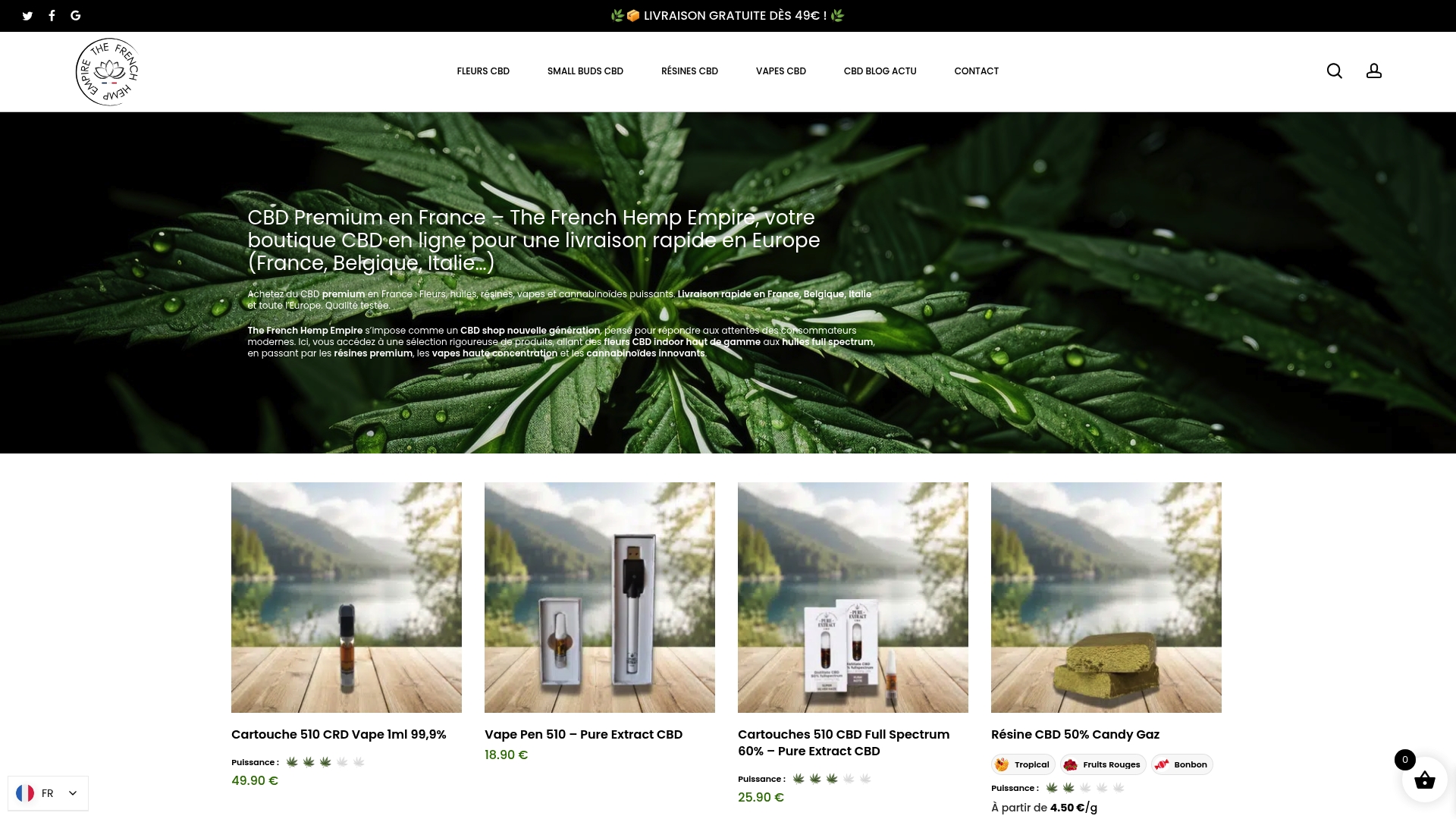
Each product page details the extraction method and links to the analytical report corresponding to the batch in stock. Customer service responds promptly to batch verification requests before purchase. For consumers looking to explore isolate-based vaporizers, our range of vapes and e-liquids is the safest starting point. Browse the shop, check the COA of the available batch, and buy with the assurance that analytical transparency is at the heart of every product we offer.
Useful resources for further reading on the topic
- MILDECA — CBD (drogues.gouv.fr) : official page of the Interministerial Mission for the Fight against Drugs and Addictive Behaviors, institutional reference on the status of CBD in France.
- Council of State — annulment of the decree prohibiting the sale of cannabis flowers and leaves : a foundational legal decision for the current legal framework for CBD flowers in France.
- Drugs Info Service — CBD and saliva testing : detailed analysis of screening mechanisms, detection windows and the myth of CBD transforming into THC.
- SixActualites — CBD: update on French regulations in 2026 : summary of recent regulatory developments, including the restriction of edibles under Novel Food.
- Ministry of Agriculture — CBD-containing foodstuffs : official reminder about the ban on CBD-containing foodstuffs not authorized by European regulations.
This article is provided for general information purposes only and does not constitute legal or medical advice. For any questions regarding the regulations applicable to your situation, consult the relevant official texts or a qualified professional.
Recommendation
- CBD legal in France and Europe: regulations, THC 0.30% and Novel Food – The French Hemp Empire
- CBD vs THC: Differences, effects, legality, and points to consider – The French Hemp Empire
- CBD gets you high without illegal THC: what the law says
- Cannabinoid levels in small CBD flowers: a legal guide 2026