


Cannabidiol (CBD) is defined as a natural compound extracted from hemp (Cannabis sativa) that acts on the endocannabinoid system to regulate stress, pain, and sleep, without psychoactive effects. Unlike tetrahydrocannabinol (THC), CBD does not alter perception or behavior. Its biological mechanism of action, validated by clinical studies and regulated by organizations such as the French National Agency for Medicines and Health Products Safety (ANSM) and the World Health Organization (WHO), makes it a serious option for natural CBD wellness. Product quality and traceability remain crucial criteria for safe and effective use.
How does CBD work in the body for natural well-being?
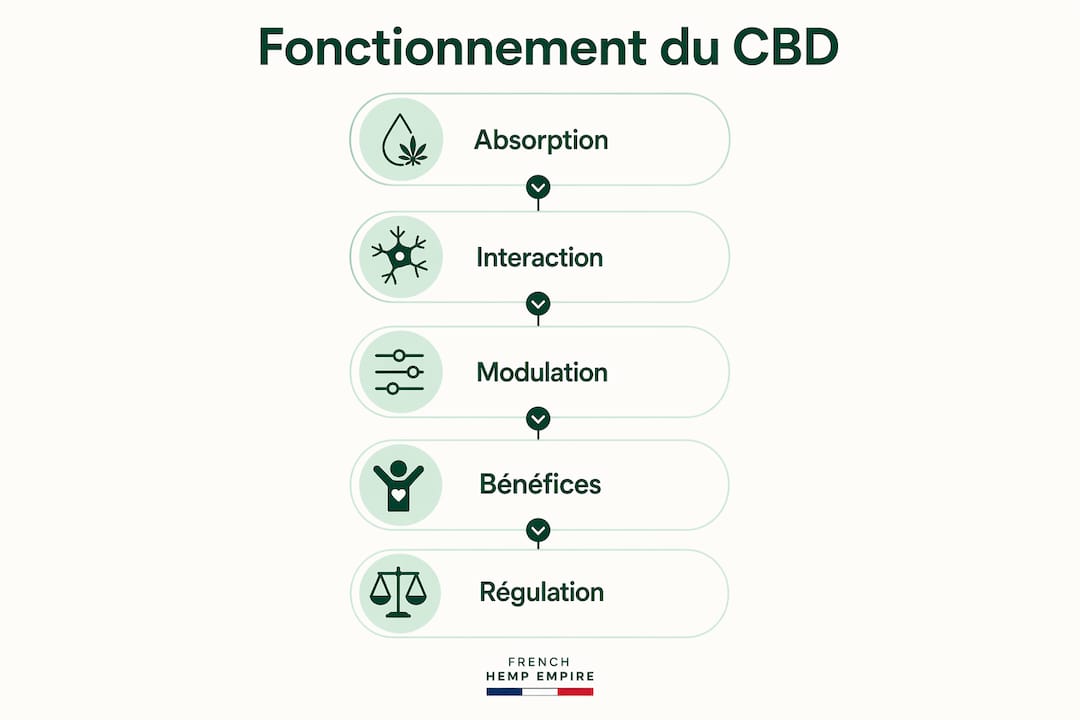
CBD primarily acts as a modulator of the endocannabinoid system, a network of receptors and molecules found throughout the body. This system regulates essential functions such as mood, stress response, pain, and the sleep cycle. Understanding this mechanism is key to grasping why CBD's natural wellness benefits are generating so much scientific interest.
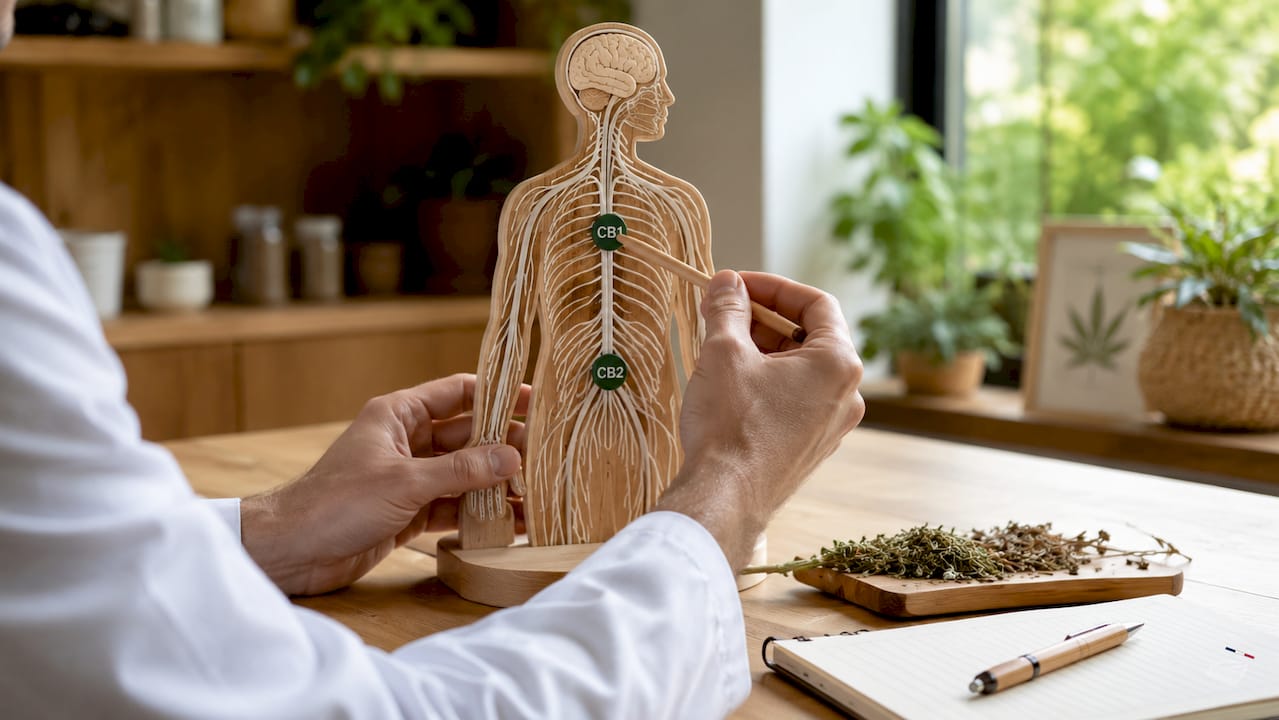
CB1 and CB2 receptors: two distinct targets
The endocannabinoid system relies on two main families of receptors. CB1 receptors are concentrated in the brain and central nervous system. CB2 receptors are found primarily in the immune system and peripheral tissues.
CBD does not bind directly to these receptors like THC does. It acts indirectly, by modulating their sensitivity and prolonging the action of the body's natural endocannabinoids. This gentle modulation explains its gradual and personalized effects on stress and sleep, without major side effects.
Interactions with other key receptors
CBD also interacts with receptors located outside the endocannabinoid system. Among the most documented are:
- 5-HT1A (serotonin) receptor: involved in the regulation of anxiety and mood. CBD activates this receptor, contributing to a measurable anxiolytic effect.
- TRPV1 receptor : sensitive to heat and pain. CBD modulates TRPV1 receptors and inhibits the FAAH enzyme, thus reducing the perception of chronic pain.
- PPARγ receptor : involved in the regulation of inflammation and cellular metabolism.
These multiple interactions explain why the effects of natural CBD affect several physiological systems simultaneously, without targeting a single mechanism.
Fundamental difference with THC
THC binds directly to CB1 receptors in the brain, producing psychoactive effects. CBD, on the other hand, does not. This distinction is fundamental to understanding why CBD is legal in France and Europe, provided the THC content remains below 0.3%. To delve deeper into this topic, Thefrenchhempempire's CBD vs. THC page details the regulatory and biological differences between these two molecules
Pro tip: Start with a low dose (5 to 10 mg per day) and observe your individual response for a week before increasing. The endocannabinoid system varies from person to person.
What are the methods of consuming CBD and how effective are they?
The method of CBD administration directly determines its bioavailability, that is, the proportion of the molecule that actually reaches the bloodstream. Choosing the right method is crucial for the product's effectiveness in promoting well-being.
Comparative table of the main routes of administration
| Consumption patterns | Bioavailability | Action deadline | Duration of effect |
|---|---|---|---|
| Sublingual (oil under the tongue) | 13–19 % | 15–45 min | 4–6 h |
| Oral (capsules, food) | 6% (up to 17x with fatty meals) | 60–120 min | 6–8 a.m |
| Inhalation (vaporization) | 30–40 % | 5–10 min | 2–3 h |
| Topical (cream, balm) | Local only | 15–30 min | 2–4 h |
The sublingual route offers a good balance between speed and duration of effect. The oral bioavailability of CBD is approximately 6%, but it increases up to 17 times when CBD is consumed with a high-fat meal. This has a direct implication: taking CBD oil after a meal containing fats significantly improves its absorption.
Topical route: local action without systemic absorption
Topical CBD does not enter the bloodstream. It acts locally to relieve pain and inflammation, with a duration of action lasting approximately 2 to 4 hours. This method is suitable for targeted muscle or joint pain, without affecting overall health.
Inhalation and vaporization
Vaporizing CBD flowers offers the highest bioavailability and fastest action. It's ideal for those seeking an immediate effect, particularly for managing a stress spike. Thefrenchhempempire offers a range of CBD vapes specifically designed for this purpose, using lab-tested extracts.
Pro tip: For sleep, opt for oral administration (capsules or ingested oil) taken 60 to 90 minutes before bedtime. The extended duration of action (6 to 8 hours) better aligns with the sleep cycle.
What are the benefits of CBD for stress, sleep, and pain?
The health benefits of CBD are supported by clinical studies and documented user feedback. The three best-documented areas are stress management, sleep quality, and pain modulation.
Stress and anxiety reduction
A study by Shannon et al. (2019) shows that 79% of participants experienced a reduction in anxiety with a daily dose of 25 mg of CBD. This reduction is explained by the activation of the 5-HT1A receptor, which modulates serotonin release. The recommended dose for stress management is between 15 and 30 mg per day, depending on the individual.
Sleep improvement
CBD improves sleep quality primarily by reducing nighttime anxiety, not by directly inducing sleep. This distinction is important: CBD is not a sedative. According to available data, 66% of users experience a subjective improvement in sleep after one month of regular use. For people suffering from stress-related insomnia, this indirect action may be enough to restore a normal sleep cycle.
Chronic pain management
CBD acts on pain through several complementary mechanisms:
- Inhibition of the FAAH enzyme : prolongs the action of natural endocannabinoids, reducing sensitivity to pain.
- Modulation of TRPV1 receptors : decreases the transmission of pain signals.
- Anti-inflammatory effect via PPARγ : reduces inflammation which is the cause of many chronic pains.
Full spectrum vs isolate: which extract to choose?
The type of extract influences the effectiveness of CBD. Full-spectrum extracts contain all the cannabinoids and terpenes of hemp. Theentourage effect refers to the synergy between these compounds, which can enhance the overall effectiveness of CBD. Isolates, on the other hand, contain only pure CBD, without any other cannabinoids. Some users prefer isolates to avoid any trace of THC; others favor full-spectrum extracts for a potentially more comprehensive effect.
What precautions should be taken for safe and effective natural CBD?
The quality of CBD products varies considerably depending on the supplier. Mislabeled products may contain THC levels exceeding the legal limit of 0.3%, or pesticide residues. Here are the criteria to check before making a purchase.
-
Check the laboratory analysis certificates. Vidal (March 2026) recommends favoring suppliers with independent and rigorous laboratory analyses. These certificates confirm the actual CBD content and the absence of excess THC.
-
Choose products made from organic hemp. Organic CBD comes from hemp grown according to strict organic farming standards, without pesticides or harmful residues. This origin guarantees a safer product for your health.
-
Start with low doses and increase gradually. An initial dose of 5 to 10 mg per day allows for assessment of individual tolerance before adjusting. Individual variability is real and well-documented.
-
Consult a doctor if you are taking medication. CBD is a potent enzyme inhibitor. It can interact with certain medications, particularly anticoagulants and antiepileptics. Medical advice is essential if you are on chronic medication.
-
Control product traceability. The origin of the hemp, the extraction method, and the growing conditions must be documented and accessible. Thefrenchhempempire publishes its certificates of analysis for each product, guaranteeing complete transparency.
Key points
CBD acts on the endocannabinoid system to regulate stress, sleep and pain, without psychoactive effects, provided that certified quality products are chosen.
| Point | Details |
|---|---|
| Mechanism of action | CBD modulates the endocannabinoid system via CB1, CB2 and 5-HT1A receptors without psychoactive effects. |
| Absorption method | The sublingual route offers 13–19% bioavailability with an effect in 15–45 minutes. |
| Documented benefits | 79% of participants in a clinical study experienced a reduction in anxiety at 25 mg/day. |
| Quality and safety | Independent laboratory analysis certificates are the most reliable selection criterion. |
| Medical precaution | CBD can interact with certain medications; medical advice is necessary in case of chronic treatment. |
CBD in everyday life: what experience really teaches us
The discourse surrounding CBD often oscillates between two extremes: outright distrust and exaggerated promises. Neither of these stances helps people seeking a concrete solution to their stress or sleep problems.
Recent studies and user feedback show that CBD works better as a tool for gradual regulation than as an immediate solution. Those who benefit most are those who incorporate it into a stable routine, at a consistent dose, over several weeks. Those who give up after three days because they feel "nothing" are missing the point: the endocannabinoid system takes time to respond.
The other point that is consistently underestimated is the impact of product quality. Poorly extracted CBD, without a certificate of analysis, can contain cannabinoid levels far removed from what is stated. I have seen users conclude that CBD "doesn't work" when they had simply consumed an under-dosed or contaminated product. Product traceability is not a marketing ploy. It is a fundamental requirement for CBD to produce a real effect.
For beginners, I recommend starting with a low-concentration (5%) sublingual oil, keeping a log for four weeks, and consulting a doctor if you are currently taking any medication. CBD can be a valuable tool for natural wellness, but it deserves to be used with the same care as any other health approach.
— Vanessa
The Frenchhemp Empire's CBD products: quality and transparency
Thefrenchhempempire offers a selection of legal CBD products made from certified hemp, with independent lab analyses available for each product. The range covers the main consumption methods documented in this article.
Premium CBD flowers are available in several varieties, grown according to strict organic standards. CBD resins and oils complete the offering for users seeking full-spectrum extracts or more concentrated formats. Every product complies with the legal THC limit of 0.3% and benefits from complete traceability from cultivation to delivery. To choose the product best suited to your needs, Thefrenchhempempire's guide to recognizing high-quality CBD provides the essential criteria to look for in 2026.
Frequently Asked Questions
How does CBD work on stress?
CBD activates the 5-HT1A receptor linked to serotonin and modulates the endocannabinoid system, reducing the physiological response to stress. A 2019 clinical study showed a reduction in anxiety in 79% of participants taking 25 mg per day.
What is the best way to consume CBD for sleep?
Oral administration (capsules or ingested oil) is the most suitable method for sleep, with an effect lasting 6 to 8 hours. It is recommended to take it 60 to 90 minutes before bedtime.
Is CBD legal in France?
CBD is legal in France provided that the THC content of the final product is less than 0.3%, in accordance with European regulations. Products must be derived from authorized hemp varieties.
Can CBD interact with medications?
Yes. CBD inhibits certain liver enzymes involved in drug metabolism. This interaction particularly concerns anticoagulants and antiepileptics. Medical advice is necessary before use if you are currently taking any medication.
What CBD dose should I start with?
An initial dose of 5 to 10 mg per day is recommended to assess individual tolerance. The dose can be gradually adjusted up to 15–30 mg depending on the observed effects, with a one-week observation period between each adjustment.


