CBD may alleviate some aspects associated with chronic pain, such as disrupted sleep or anxiety, but it does not act as a potent analgesic in the classical pharmacological sense. Current data do not support the conclusion that it significantly reduces the intensity of neuropathic, arthritic, or fibromyalgia pain. Furthermore, the 2026 Cochrane Review concludes that there is low to very low confidence in the available evidence for cannabis-based medicines.
This observation needs to be qualified: most trials showing a pain-relieving benefit rely on THC/CBD combinations, not on isolated CBD sold in stores. Here's what you need to know before considering a trial:
- CBD alone acts primarily indirectly, via sleep, anxiety and mild inflammation, rather than on the raw intensity of pain.
- THC/CBD combinations sometimes show a modest effect on neuropathic pain, a result that does not automatically translate to CBD sold over the counter.
- A supervised trial over two to four weeks, at a stable dose and with the agreement of a doctor or pharmacist, remains the most reasonable way to judge a personal effect.
Key point: there is no solid evidence to support the use of isolated CBD as a treatment for chronic pain. However, it can be a reasonable complement to existing medical care, provided that modest effects are expected and a rigorous protocol is followed.
Key points
Isolated CBD has not demonstrated clear efficacy against chronic pain, but it may indirectly support sleep and pain tolerance in a controlled and time-limited trial.
| Point | Details |
|---|---|
| Actual effect of CBD | It acts primarily on sleep and anxiety, not as a direct analgesic on the intensity of pain. |
| CBD/THC distinction | Most of the documented analgesic benefits come from THC/CBD combinations, not from CBD alone. |
| Test protocol | Start at a low dose, keep a diary, evaluate after two to four weeks at a stable dose. |
| Safety first | Check potential drug interactions via the liver before starting. |
| Choose a reliable product | Opt for premium CBD flowers from Thefrenchhempempire, accompanied by an independent certificate of analysis and clear traceability. |
Table of Contents
- How CBD affects pain, sleep, and inflammation
- What does the clinical evidence show, and where are its limitations?
- Oil, capsule, topical or inhalation: which form to choose depending on the pain?
- What testing protocol should be followed to test CBD on chronic pain?
- CBD and chronic pain: what precautions and interactions should be monitored?
- How to recognize a reliable CBD product before trying it?
- What The French Hemp Empire guarantees regarding traceability and quality
- What scientific caution should not make us forget
- Try CBD under the best conditions with Thefrenchhempempire
- Sources
How CBD affects pain, sleep, and inflammation
CBD interacts with the endocannabinoid system, a network of receptors (CB1, CB2) that regulates pain perception, mood, and inflammation. Unlike THC, it doesn't directly activate these receptors; rather, it modulates their function and influences the availability of certain internal messengers, resulting in a more diffuse effect than that of a conventional painkiller.
Two other targets play a documented role. The TRPV1 receptor, involved in the sensation of heat and pain, responds to CBD in a manner comparable to low-dose capsaicin. The 5-HT1A receptor, linked to serotonin, partly explains the reported effects on anxiety and sleep. Work published in Frontiers in Pharmacology describes anti-inflammatory properties and a reduction in oxidative stress observed in the laboratory, with positive effects on sleep and anxiety that may indirectly improve tolerance to chronic pain.
This last nuance is extremely important. A mechanism observed in preclinical studies, on cells or in animals, does not guarantee an equivalent clinical effect in humans. The gap between plausible biology and measurable benefit remains one of the least understood points by the public.
- Endocannabinoid system: modulates the perception of pain without canceling it out.
- TRPV1 and 5-HT1A: explain the effects on pain sensitivity, anxiety and sleep.
- Anti-inflammatory and antioxidant: effects established in preclinical studies, less clear in clinical studies.
- Transposition between mechanism and actual effect: a persistent gap that current research does not bridge.
Pro tip: Don't judge CBD on its ability to "cut" pain like an anti-inflammatory. Instead, observe whether it improves your sleep or reduces your stress levels over several days: that's often where the real benefit lies.
What does the clinical evidence show, and where are its limitations?
The Cochrane systematic review, updated in 2026, remains the most rigorous reference on the subject.
The available evidence on cannabis-based medicines for neuropathic pain is, on the whole, of low to very low certainty, which prevents us from concluding that there is a consistent and generalizable benefit.
This ruling applies to cannabis-based medicines in general, a category that often includes THC/CBD combinations. The most studied signal concerns neuropathic pain and multiple sclerosis, where some patients report a modest benefit, generally with products containing THC. The PMC emphasizes this distinction : the majority of evidence for pain relief relies on formulations combining the two molecules, not on isolated CBD found in stores.
For osteoarthritis, lower back pain, and fibromyalgia, the picture is less clear. Data remains limited or inconclusive, and reported improvements often relate to sleep rather than a significant reduction in perceived pain. Trials on fibromyalgia, long COVID, and myalgic encephalomyelitis are too limited to recommend CBD for these specific conditions, which calls for particular caution for individuals with these disorders.
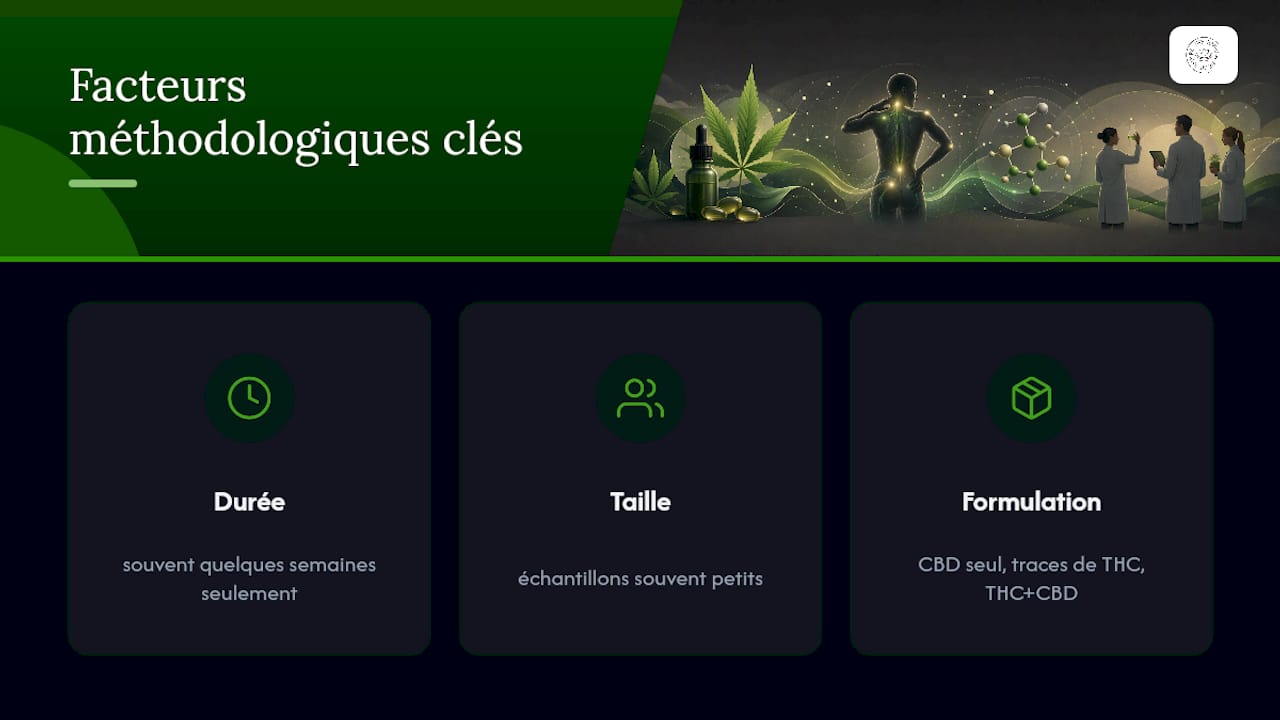
Three methodological factors largely explain these contrasting results. The duration of trials rarely exceeds a few weeks, whereas chronic pain evolves over months or even years. Sample sizes are often small, which limits the statistical power of the conclusions. Finally, the formulations vary considerably: CBD alone, CBD-dominant with traces of THC, or a balanced THC/CBD combination, each with a different effect profile. An analysis published in The Lancet (00393-7) also reminds us that the placebo effect plays a significant role in this type of trial, further complicating the interpretation of isolated positive results.
Oil, capsule, topical or inhalation: which form to choose depending on the pain?
The choice of form directly influences the onset of action and where CBD acts. Diffuse pain and sleep disturbances are better suited to systemic administration, while localized pain, such as in an osteoarthritic joint, sometimes responds better to targeted application.
- Sublingual administration (oil placed under the tongue): absorption occurs partially through the oral mucosa, which accelerates the effect compared to a swallowed capsule. Generally, 15 to 45 minutes are needed before the first noticeable effects are felt.
- Oral route (capsules, tablets): CBD passes through the digestive system and liver before taking effect, which slows the onset of action but often prolongs it over several hours. This form is suitable for regular and predictable intake.
- Topical application (cream, balm): useful for localized pain such as in the knee or lower back, with limited systemic absorption. The effect remains confined to the applied area, without significant influence on sleep or general anxiety.
- Inhalation (vaping): the effect is the fastest, occurring within minutes, but it requires health precautions related to inhalation itself, regardless of the CBD. This method is not suitable for continuous use by individuals with respiratory sensitivities.
For diffuse pain accompanied by sleep disturbances, sublingual oil often remains the simplest starting point to adjust.
What testing protocol should be followed to test CBD on chronic pain?
The rule that recurs in almost all precautionary recommendations can be summed up in three words: start low, increase slowly. This approach limits the risk of adverse effects while allowing time to observe a real effect, without confusing it with a simple natural variation in pain from one day to the next.
- Week 1: Start with a low dose, for example a few drops of CBD-standardized oil, taken once or twice a day at a fixed time.
- Week 2: If no adverse effects appear and the benefit remains absent, gradually increase the dose in moderate increments rather than doubling it abruptly.
- Weeks 3 and 4: maintain the dose at a stable level for at least two full weeks before judging the effect, as benefits on sleep or nervous tension often take time to stabilize.
- Four-week review: assess three concrete indicators: sleep quality, perceived muscle tension level, and overall daily pain tolerance.
Keeping a daily log, even a brief one, completely changes the quality of this assessment. Note the time of administration, the dose, and a simple rating from 0 to 10 for sleep and pain. Without this tracking, human memory tends to overestimate good days and underestimate bad ones, which skews the final judgment.
Pro tip: If after four weeks at a stable dose you do not notice any improvement in sleep, blood pressure or pain tolerance, it is reasonable to stop rather than continue increasing doses without any observed benefit.
CBD and chronic pain: what precautions and interactions should be monitored?
CBD is not withoutside effects, and its interaction with certain medications is the most serious point of concern, especially for people who are managing nerve pain or long-term muscle pain under medical treatment.
- CBD is metabolized by liver enzymes of the CYP450 group, the same ones that process many common drugs such as anticoagulants, antiepileptics and some statins: an interaction can alter their concentration in the blood and requires prior medical advice.
- The most frequently reported side effects remain drowsiness, diarrhea and fatigue, generally mild but more pronounced at high doses.
- An elevation of liver enzymes has been observed in some contexts of prolonged use at high doses, which justifies biological monitoring in people undergoing long-term treatment.
- Pregnancy, breastfeeding and liver failure are situations where caution should prevail, due to a lack of sufficient data on long-term safety.
These precautions are not limited to neuropathic pain: a person being treated for severe osteoarthritis with anti-inflammatory or anticoagulant medication is at the same risk of interaction as a person being treated for nerve pain related to diabetic neuropathy. The principle of caution must be applied equally, regardless of the type of chronic pain involved.
Before starting, tell your doctor or pharmacist about all current treatments, including dietary supplements. If you are taking a medication with a narrow therapeutic index, liver function testing at the beginning and during the trial may be a reasonable precaution to discuss with your doctor.

How to recognize a reliable CBD product before trying it?
A mislabeled CBD product may contain more or less cannabinoids than indicated on its packaging, or even undesirable contaminants. Quality control involves four concrete points, easy to check before purchase.
- Demand a recent Certificate of Analysis (COA), produced by an independent laboratory, that details the exact cannabinoid content and the absence of contaminants.
- Choose the spectrum that suits your situation: an isolate is suitable if you want to avoid any trace of THC, while a broad or full spectrum can offer an entourage effect, provided you tolerate minute traces of THC.
- Check that the THC content complies with the current legal limit and that the COA includes tests for contaminants such as pesticides and heavy metals.
- Favor suppliers who are transparent about the origin of the hemp and the extraction method used, two elements that directly influence the purity of the final product.
| Criteria | What you need to check |
|---|---|
| Certificate of analysis | Recently dated, issued by a third-party laboratory, with precise CBD and THC levels |
| Spectrum | Isolate, broad spectrum or full spectrum depending on your THC tolerance |
| Contaminants | Tests for pesticides, heavy metals and residual solvents included in the COA |
| Traceability | The origin of the hemp and the extraction method are clearly communicated |
A supplier who refuses to provide their COA upon request should be excluded, regardless of the quality displayed on the packaging.
What The French Hemp Empire guarantees regarding traceability and quality
This approach does not transform a CBD product into a medicine: it simply ensures that what you buy corresponds to what is indicated on the label.
- Independent laboratory analyses are available to verify the actual composition of the products.
- Compliance with the legal THC threshold applicable in France and Europe.
- Internal educational pages to delve deeper into the workings of the endocannabinoid system and safety issues related to CBD use.
- Detailed technical data sheets per product, without unsubstantiated therapeutic claims.
These guarantees address a question of quality and traceability, not a question of clinical efficacy, which remains framed by the data presented above.
What scientific caution should not make us forget
Faced with such mixed evidence, the temptation is to make a hasty judgment one way or the other: either reject CBD outright or continue to attribute pain-relieving properties to it that no solid data supports. Both positions miss the point. The Cochrane review doesn't say that CBD does nothing; it says that evidence of a reliable and generalizable effect is still lacking, which is a different matter.
What I take away most from this report is the gap between the prevailing marketing, which often sells CBD as a substitute for painkillers, and the clinical reality, which is more modest but not nonexistent. The most significant benefit remains indirect, through sleep and stress relief, not through direct pain relief. This is a useful indicator, not a slogan.
The real priority for a reader suffering from chronic pain is therefore not to seek the most concentrated product, but to establish a rigorous trial protocol, using a product with a verifiable composition, and to discuss it openly with their doctor. It is this discipline, more than the molecule itself, that makes the difference.
— Vanessa
Try CBD under the best conditions with Thefrenchhempempire
Unlike a product purchased without a certificate of analysis or a clear indication of spectrum, Thefrenchhempempire gives you access to CBD flowers and oils whose composition can be verified before purchase, a crucial point when following a multi-week trial protocol for chronic pain.
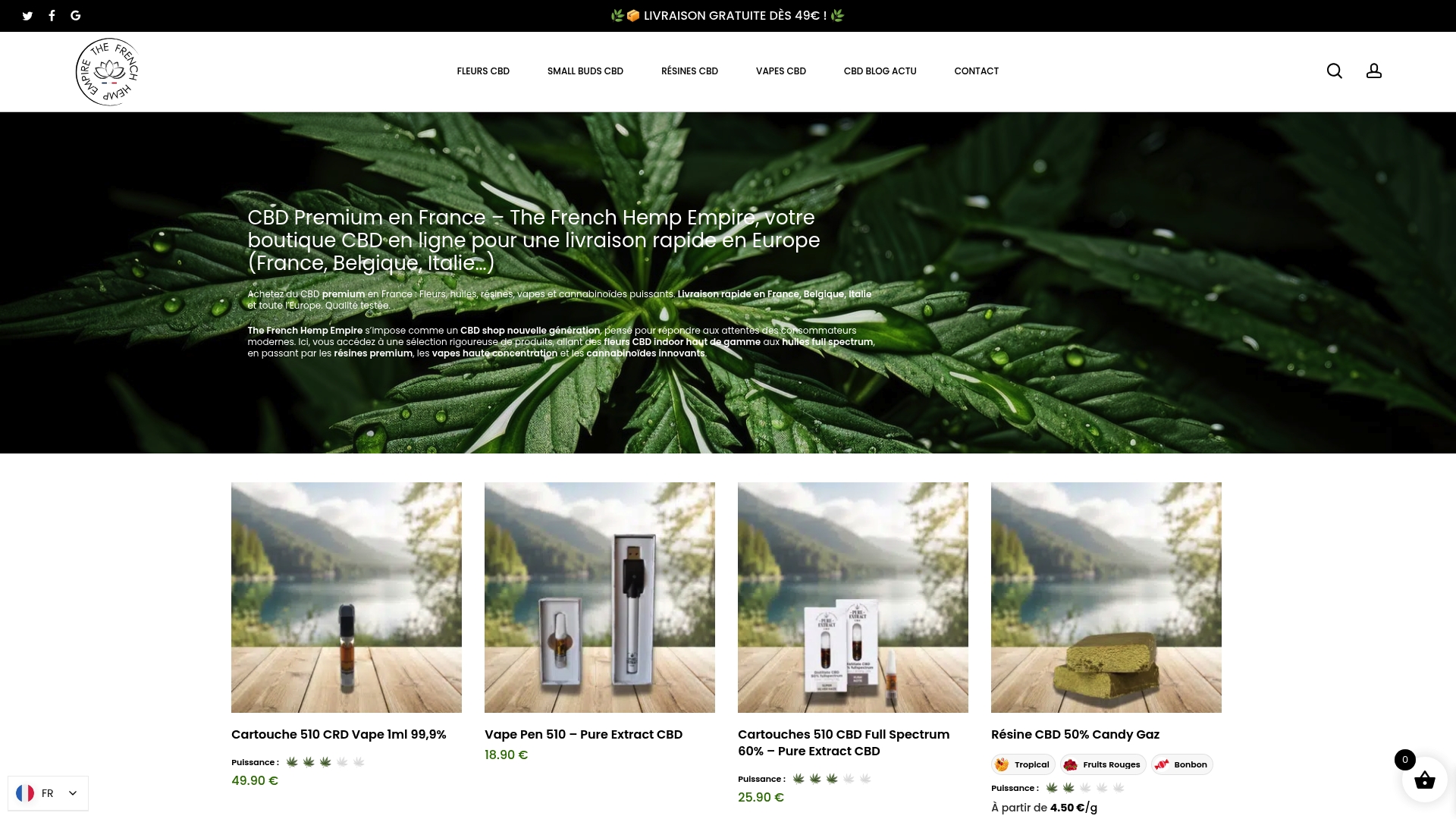
This shop caters to those who want to try CBD responsibly: the origin of the hemp is clearly stated, the THC limit is respected, and independent lab analyses are available for each product. Whether you're looking for sublingual oil for systemic use or premium CBD flowers to start a supervised trial, you know exactly what you're putting into your body. The product descriptions detail the cannabinoid content and extraction method, two pieces of information often missing from less rigorous suppliers.
Browse our range of CBD now to choose a product suited to your testing protocol, with supporting certificate of analysis.
This article provides general information and is not a substitute for professional medical advice. Consult a qualified healthcare professional about your specific situation before taking any action based on this content.
Sources
- What are the benefits and risks of cannabis-based medicines for adults with chronic neuropathic pain? —Cochrane
- CBD pharmacology and potential in recovery — Frontiers in Pharmacology (2023)
- Distinction between CBD alone and THC:CBD combinations — PMC article