Buy 90% THCA: read the analysis before ordering
A vape labeled with 90% THCA can immediately grab attention. The figure seems precise, the 1ml format is easy to recognize, and the choice of flavor profiles makes ordering seem more appealing. But a question precedes the choice between Amnesia Haze and Blackberry Kush: what exactly does this "90%" measure, and what happens to the THCA when the product is heated? For a purchase in France, simply reading the "delta-9-THC" line of any potential analysis isn't always enough to answer that.
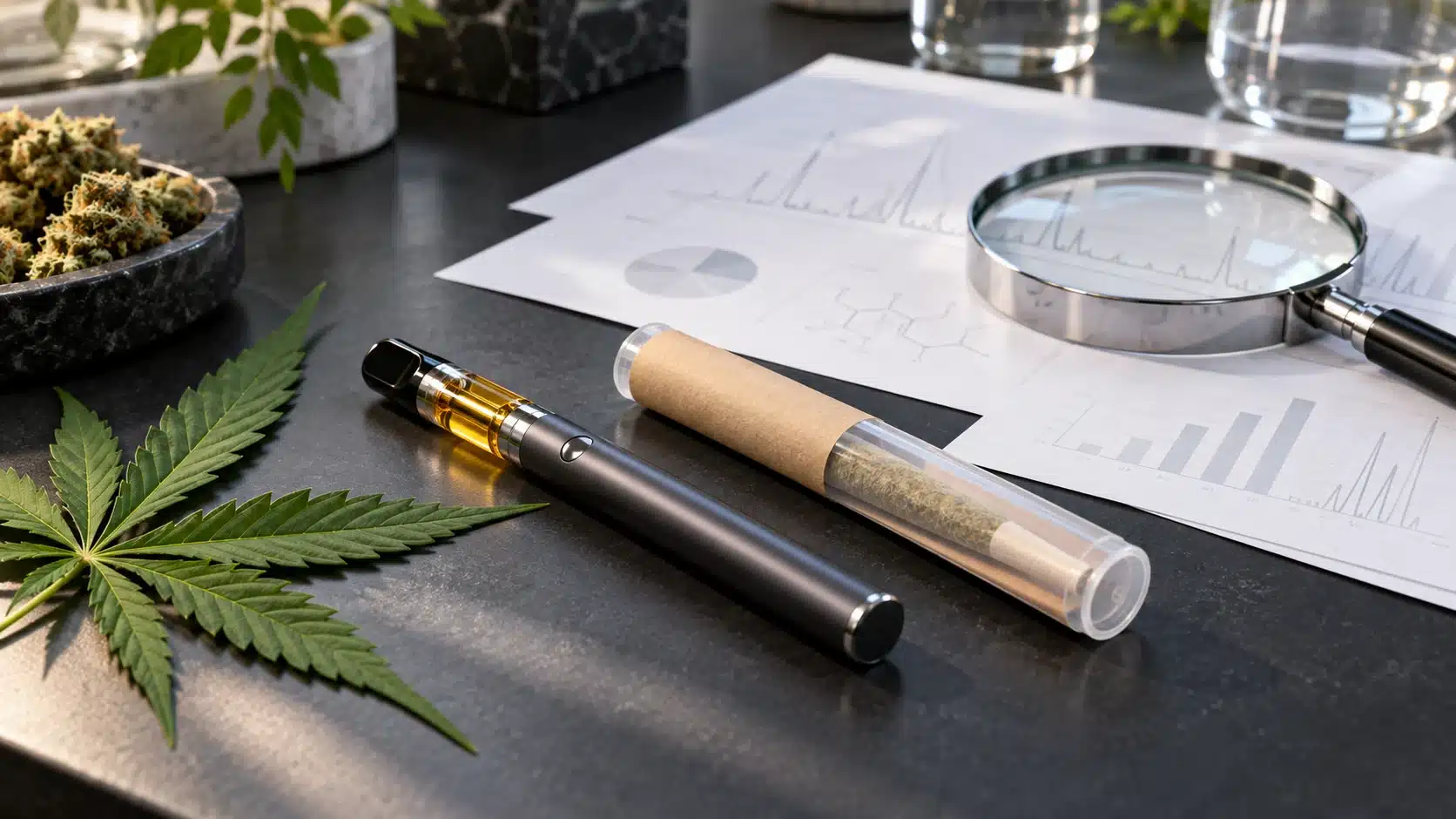
The French Hemp Empire's THCA category currently features two Rollz products: a vape advertised as containing 90% THCA in a 1ml bottle and a pre-roll advertised as containing 30% THC-A in a 2g bottle. Their product pages listed €39.90 and €14.90 respectively at the time of our review. This guide explains the documents to request before considering the purchase of either product. It does not verify the conformity of these products: no analysis of the actual batches sold was provided to us for this article.
Why percentages are not enough
Regarding the THCA 90% Rollz 1ml vape, 90% refers to the stated concentration of the cannabinoid; 1ml refers to the stated volume of the device. These two quantities are not interchangeable. The title does not specify whether the percentage is derived from an analysis of the final batch, the raw material, or the formulation before packaging. Nor does it, on its own, provide the delta-9-THC result.
The THC-A 30% Rollz 2g pre-roll presents a comparable reading. The 2g refers to the advertised weight of the pre-roll, and the 30% refers to the advertised THC-A content. Without a certificate of analysis corresponding to the final product, you cannot automatically attribute 30% to each gram of plant material, nor convert the percentage into a measured quantity of cannabinoid. The package weight, the sample definition, and the basis for the percentage are all important.
These details aren't just laboratory specifications reserved for specialists. They determine what you're buying. Two products can have the same brand name but different measured compositions. A very high advertised level makes verification even more important, because the issue of THCA isn't limited to the presence of THC already measured in its delta-9 form.
THCA can contribute to total THC
THCA, or tetrahydrocannabinolic acid, is a precursor to delta-9-THC. Under the influence of heat, it can lose part of its structure in the form of carbon dioxide: this is decarboxylation. The Council of State reiterated this in a decision dated June 6, 2025.It also explained that relevant analytical methods can take into account both the THC initially present and that likely to result from the conversion of THCA.
This is why two separate lines in a document must be read together: delta-9-THC and THCA. A delta-9-THC result below a limit, read in isolation, does not necessarily establish the total potential THC content of a THCA-rich formulation. The exact way to report this potential depends on the method used and the document produced by the laboratory.
There is a mass factor of approximately 0.877 for expressing the theoretical THC potential corresponding to a given mass of THCA by mass. This results from the mass loss during decarboxylation. As a purely mathematical illustration, 90% THCA expressed by mass of the product would correspond to approximately 78.9% of the THC potential derived from that THCA, even before adding the THC already present. For 30% THCA, the same calculation would yield approximately 26.3%. These hypothetical figures are not the analytical results of Rollz products and do not describe the actual yield of use. They illustrate why claims of 90% or 30% require particularly strong evidence.
Therefore, do not take a low initial delta-9-THC as the complete answer if the same formulation shows a very high THCA. Ask how the laboratory calculated or measured the relevant total THC for the batch. If a certificate only shows a "THC" line without specifying its definition, ask whether it refers to the delta-9 already present or a result that takes THCA into account.
What do the French texts consulted say?
In June 2024, the ANSM (French National Agency for Medicines and Health Products Safety) amended a decision regarding the classification of several cannabinoids to exclude THCA from the relevant generic classification, subject to compliance with the THC content limits stipulated by French regulations applicable to hemp. This conditional exclusion does not constitute automatic authorization for all formulations sold under the name THCA.
In its decision of June 6, 2025, the Council of State reiterated the 0.3% THC content requirement and the potential inclusion of THCA, which can convert to THC. It explained that the method applicable to plant varieties heats the samples and thus measures the total THC, regardless of whether the substance is initially present as THC or THCA. It also specified that analytical methods compliant with current guidelines take into account the risk of decarboxylation in hemp-derived products.
For you, the buyer, the consequence is practical: neither "THCA not generally classified" nor "less than 0.3% delta-9-THC before heating" constitutes, on their own, complete proof of conformity for a concentrated product. The batch documentation must clearly state the concentrations and the method used. If the offer claims conformity without making this information available, request the necessary documents before finalizing the purchase.
It would also be excessive to declare a particular vape or pre-roll compliant or non-compliant based solely on its title. Legal qualification requires product identification, its actual composition, batch number, and the applicable analytical method. This article provides questions to ask; it does not replace this individualized examination.
One sheet advertises 90% and another advertises 30%
The two products in this category have different formats and advertised concentrations. The vape is advertised as 1 ml and 90% THCA, with ten terpene options in its selector. The pre-roll is advertised as 2 g and 30% THC-A, with nine options visible in its selector at the time of our review, although its full description mentions ten. The starting price also differs. This information helps identify the products; it does not address the question of batch conformity.
| Information about the record | Vape Rollz | Rollz Pre-roll |
|---|---|---|
| Announced format | 1 ml | 2 g |
| Announced concentration | 90% THCA | 30% THC-A |
| Price observed | 39,90 € | €14.90 each |
| Visible choice of terpenes | 10 options | 9 options in the viewed menu |
| Decisive document to request | Analysis of the formulation and the final batch | Analysis of the pre-roll and the final batch |
Don't compare 90 and 30 as if it were simply a matter of intensity between vaping and flower. The matrices are different, the unit masses are different, and the intended use exposes the THCA to heat. The first useful comparison is between the analyses and how they define the results. The choice of format or flavor comes later, once the essential information is clear.
The six elements to find on a certificate of analysis
1. The batch number and the sample
The document must be linked to what is being sold. Check the Rollz reference, the batch number, and the nature of the sample: extract, final liquid, finished pre-roll, or other material. A distillate analysis prior to assembly does not necessarily describe the composition of the finished product. If the certificate relates to a raw material, ask if there is also data for the actual packaged product.
2. THCA and delta-9-THC separately
A detailed presentation should clearly distinguish the THCA content from any delta-9-THC already present. Examine the units and the basis of calculation. A percentage by mass is not the same as a concentration per milliliter. Read the chemical names, including the distinction between THCA and other cannabinoid acids; a similar abbreviation may refer to a different substance.
3. The potential total THC and its method
Ask if the lab provides a post-processing measurement or a total THC calculation that accounts for potential THCA conversion. Verify the formula, results, and uncertainties provided, rather than applying a single figure to the percentage from the sales page. The analytical result should match the matrix and batch sold.
4. Other cannabinoids
The statement "THCA 90%" is not a complete list of components. An analytical profile can also provide information on CBD, other cannabinoids, and potential derivatives, depending on the laboratory's protocol. This information helps to understand the composition of the rest of the advertised formula. Do not deduce "10% terpenes" simply by subtracting 90 from 100: the actual breakdown requires documentation.
5. Relevant controls for the product
A certificate may only cover cannabinoids or include other analyses. Examine what was actually tested for and what the detection limits were. The presence of a lab signature does not automatically mean that all conceivable contaminants were tested for. For vaping products, also ask for the ingredients in the final formulation and the manufacturer's information about the device.
6. The date and identity of the laboratory
Check the sampling or issue date, the identity of the entity that performed the test, and its correspondence with the stock offered. If you order several months after a product sheet was published, the batch may have changed. A historical analysis of a flavor variant is not necessarily that of the variant or batch currently being shipped.
What should you ask if the information sheet only says "THC compliant"?
The vape product information sheet uses a general formula for THC compliance without providing a complete batch analysis in the main text. If you're looking for a verifiable answer, ask what exact percentage was measured, what type of THC it is, whether THCA is included in the total value, and what testing method was used. Also, ask to see the batch documentation before paying. A statement of compliance may be accurate, but it doesn't explain the figures when the product displays 90% THCA.
You can make a short request: "For the Rollz THCA 90% vape you are currently shipping, can you please provide the final batch analysis showing THCA, delta-9-THC, and potential total THC, along with the method and batch number?" For the pre-roll, simply replace the reference number. This request seeks the missing information without prejudging the result.
If the response only addresses a delta-9 threshold before conversion, explicitly ask how the advertised THCA is factored in. If the seller cannot link the documentation to the final product, postpone the purchase decision. You cannot resolve an apparent contradiction between a highly focused title and a general claim of compliance based solely on the store's reputation.
It is possible that documents may explain a difference in the basis of calculation, terminology, or sampling. These documents must be obtained before drawing any conclusions. Reducing the issue to "THCA is legal" or "all THCA is prohibited" avoids the central question instead of addressing it.
The heating applies to both models
Both pre-rolling and vaping involve heat exposure in their intended use. Therefore, the chemical properties of THCA warrant direct attention: the potential for THC formation is not entirely unrelated to the product. This observation does not imply that conversion would be complete or identical in every real-world situation. It explains why the composition before heating cannot be interpreted without this information.
The amount actually transformed during use can depend on many factors. No single figure derived from the brand name can predict the inhaled dose, individual reaction, duration, or intensity of an effect. The mass factor presented above is intended to help understand an analytical potential, not to predict exactly what will happen in a person's body.
The product information sheets state that these products are intended for adults and advise against driving after exposure. Do not drive after using a formulation that may impair alertness. The low delta-9-THC level before heating that a seller might advertise does not guarantee the absence of risk of detection or impaired driving for a product high in THCA.
Flavors: a secondary, but real decision
The vape app currently offers options such as Amnesia Haze, Blackberry Kush, Blue Dream, Gelato Drip, Chem Dawg, Jet Fuel, Midnight Octane, Skunk, Sugar Dough, and Tahoe OG. The pre-roll menu includes profiles like Grape Ape, Cherry Gelato, and Super Lemon Haze. These names can guide your flavor preferences once you've determined the ingredients. However, they don't indicate the total THC content.
Don't automatically assume that a flower with the same name has the same scent as a liquid or pre-roll formulation. A terpene profile can be designed to evoke a variety without demonstrating the botanical origin of the material. If you're looking for a specific note, ask for a description of the chosen variety and a list of aromatic ingredients. If this isn't of great interest to you, focus on the analytical data before comparing scents.
Offering ten terpene options for vaping and nine visible options for pre-rolling doesn't mean ten or nine identical cannabinoid analyses. Some data may be common to a base formulation; other data depends on the final blend and batch. Ask which analysis the selected variant actually covers. This will prevent you from confusing the marketing menu with the documentation for each individual product.
Two practical examples for reading an offer
A vape with a claimed 90% THCA content and a low initial delta-9
Suppose a product label only displays a line stating "delta-9-THC less than 0.3%" and the title "THCA 90%". These two elements alone do not answer the question of the potential total THC content. The next step is to request an analysis of the final vape, with the THCA measured on the same basis and the result accounting for any potential conversion. No terpene selection will resolve this documentation requirement.
A 30% pre-roll advertised with analysis of a raw material
Suppose the submitted document measures an extract used in manufacturing, but not the finished 2g pre-roll. The extract percentage cannot be automatically attributed to the entire pre-roll. Ask to what mass the commercial "30%" applies and if there is a quality control process for the final product. This verification is necessary before any comparison with vaping or any other product.
These examples are reading scenarios, not observations about currently sold batches. They serve to show where an error can occur: adding figures that do not have the same base, using a certificate for a different material, or ignoring the THCA conversion potential.
Frequently asked questions before buying
Is a THCA 90% vape automatically compliant in France?
No. The commercial title does not establish batch conformity. The exclusion of THCA from certain classifications is conditional, and consideration of the THC that may result from its conversion is important. Request the relevant analyses and evaluations for the final product.
Is less than 0.3% delta-9-THC sufficient?
Not necessarily when the product contains THCA that can be converted. The Council of State has specifically addressed this issue. It is necessary to understand the measurement method, the total potential result, and the framework that applies to the product being sold.
Is the calculation 0.877 × THCA the actual inhaled content?
No. The factor is used to express a mass conversion potential in certain analytical calculations. It does not measure the actual conversion during use, nor the amount absorbed by a person. Batch analysis and its protocol remain essential.
Why is vaping advertised in millilitres and pre-roll in grams?
Their physical formats differ: the vape is advertised as having a volume of 1 ml, the pre-roll as having a mass of 2 g. These numbers cannot be directly compared to their percentages without knowing the mass of the formulation, the basis of the results, and the measured composition.
Can I trust an old analysis of another variant?
A previous analysis can provide context, but it doesn't prove the composition of the batch and variant you will receive. Verify the identifiers and the nature of the analyzed sample.
What should I do if I am not given any certificate?
Request the final batch number, including the cannabinoids and the relevant method. If you don't receive a sufficient answer, postpone purchasing this concentrated product. The title, photo, and a general statement of conformity are insufficient to perform an analysis.
Before the basket, a numerical answer linked to the lot
Rollz THCA 90% vape and Rollz THC-A 30% pre-roll have distinct formats and flavor profiles. However, for both, the most important information is the same: a certificate corresponding to the final batch, clearly defining the declared THCA content, delta-9-THC, and total potential. The regulations and the Council of State's decision demonstrate why this information is essential in France.
Start by requesting these documents and an explanation of the measurement method. You can then examine the price, format, and terpene variant on the THCA category pages. A truly clear offer should allow you to link each figure to the specific product you intend to order.