The entourage effect of CBD refers to the synergy between natural compounds in cannabis, including cannabidiol, terpenes, and flavonoids, which work together to produce more nuanced effects than CBD alone. This concept, popularized by Israeli researcher Dr. Raphael Mechoulam, explains why a full-spectrum extract behaves differently from a pure isolate. For anyone interested in CBD products, understanding the meaning of the entourage effect is an essential step in making informed choices.
What exactly does the CBD entourage effect mean?
The entourage effect is defined as a synergistic interaction between CBD, other cannabinoids, terpenes, and flavonoids present in the cannabis plant. This interaction produces more complex, modulated effects than those obtained with isolated CBD. The concept formalizes why some full-spectrum extracts act differently from pure isolates, even at equivalent cannabinoid concentrations.
The term "entourage" refers to all the molecules that "surround" CBD in the plant. These compounds are not simply passive companions. They actively modify how CBD interacts with the endocannabinoid system, the network of biological receptors that regulates pain, mood, and sleep.
The practical meaning of this concept is straightforward: a CBD product with a complete molecular profile isn't simply "stronger" than an isolate. It's fundamentally different. This distinction guides product selection for individuals seeking specific effects.
Which compounds in cannabis contribute to the entourage effect?
The main players in this synergy belong to three distinct families of molecules.
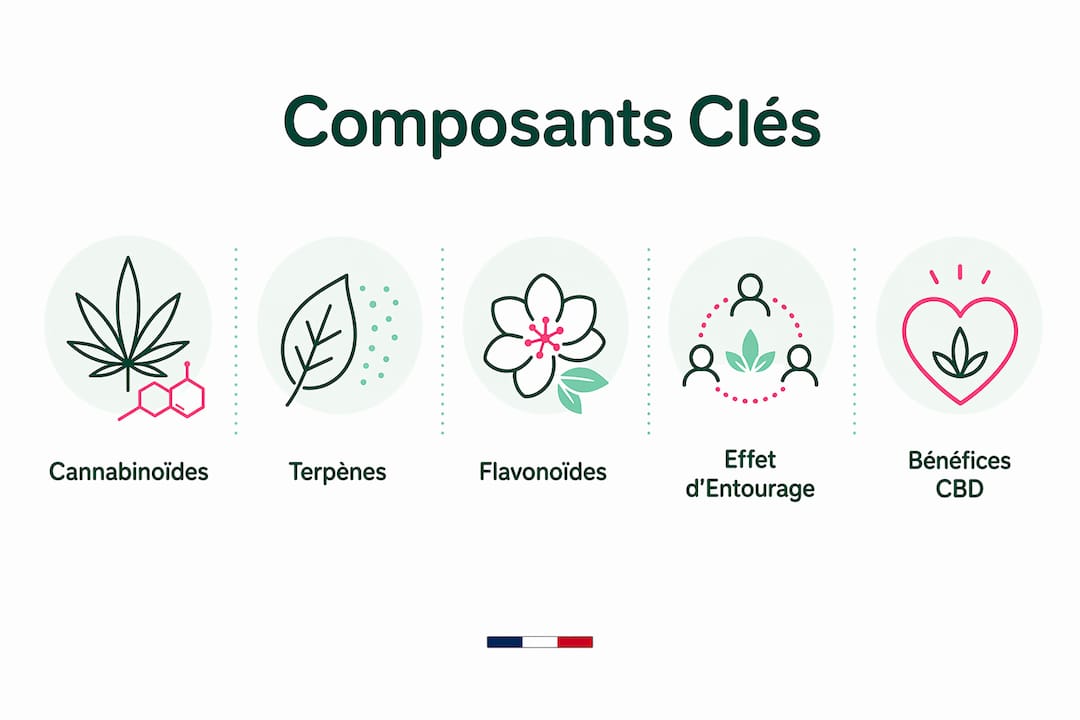
Cannabinoids are the best-known group of cannabinoids. CBD and THC are the two major cannabinoids, but the plant produces over a hundred others, known as minor cannabinoids: CBG (cannabigerol), CBN (cannabinol), and CBC (cannabichromene). Each interacts differently with the CB1 and CB2 receptors of the endocannabinoid system. To better understand the differences between CBD and THC, it is helpful to distinguish their respective mechanisms of action.
Terpenes are the aromatic molecules that give each cannabis strain its characteristic smell and flavor. Terpenes such as myrcene, limonene, and linalool modulate the perception and certain effects associated with cannabinoids. Their precise influence in humans remains partially validated, but their role in the entourage effect is recognized by the scientific community.
Flavonoids form the third group. These plant pigments, present in many plants, possess documented antioxidant and anti-inflammatory properties. In cannabis, specific flavonoids such as cannaflavin A and B are being studied for their potential contribution to overall synergy.
Pro tip: When buying a CBD product, make sure the independent lab analysis certificate details not only the CBD and THC levels, but also the terpene profile. A complete profile is the only reliable indicator of a potential entourage effect.
How does the entourage effect influence the effects of CBD?
The endocannabinoid system regulates pain, mood, and sleep through the combined interactions of cannabinoids and terpenes. CBD modulates the activity of receptors in this system, influencing other biological mediators. When other compounds are present, this modulation becomes more refined and potentially more tailored to individual needs.
The effects observed in the studies cover several areas: anxiety management, pain response, inflammation regulation, and sleep quality. These effects are not amplified uniformly. They are modulated, meaning they are adjusted according to the precise composition of the product used.
The type of spectrum of the product directly determines the potential intensity of this effect. The following table summarizes the key differences:
| Spectrum type | Composition | Potential for an entourage effect |
|---|---|---|
| Full spectrum | CBD, THC (≤ 0.3%), minor cannabinoids, terpenes, flavonoids | Maximum |
| Broad spectrum | CBD, minor cannabinoids, terpenes, no detectable THC | Intermediate |
| CBD Isolate | 99%+ pure CBD | Absent |
Pro tip: A full-spectrum product doesn't automatically guarantee an entourage effect. The quality of the extraction and the preservation of terpenes during the manufacturing process are crucial. Choose brands that publish their extraction methods.
What types of CBD products should you choose to benefit from the entourage effect?
Choosing the product is the most concrete decision a consumer can make to activate or not this synergistic effect. Here are the criteria to consider:
- Full spectrum: Full spectrum CBD oils contain cannabinoids, terpenes, and trace amounts of THC, potentially promoting a more complete entourage effect. They are suitable for people without THC restrictions and residing in a country where the legal limit of 0.3% is respected.
- Broad spectrum: Broad spectrum products contain several cannabinoids and terpenes but no detectable THC. They are a compromise for people sensitive to THC or subject to professional drug testing.
- CBD Isolate: Isolate is pure CBD, without any other compounds. It offers maximum CBD concentration but no entourage effect. It remains suitable for very targeted uses or for people who react poorly to other compounds.
- CBD flowers and resins: These formats naturally retain all the terpenes and cannabinoids of the plant. They often represent the most complete molecular profile, provided that cultivation and storage are properly controlled.
- Certificates of analysis: The absence of full certification limits the guarantee of a real and reproducible entourage effect. Relying solely on the "full spectrum" label without independent laboratory analyses exposes one to unverified claims.
To delve deeper into the selection criteria, the guide on CBD product quality details the elements to check on each label and certificate.
What does recent scientific research say about the entourage effect?
Research on the entourage effect is progressing, but it remains incomplete. In vitro studies show a more complex modulation of inflammatory and neuronal pathways by multiple extracts compared to isolated compounds. These results are biologically significant. However, they have not yet been directly translated into standardized clinical recommendations.
European health agencies recognize the pharmacological value of cannabis compounds but have not officially validated the entourage effect as a regulatory criterion. This lack of official validation stems from the absence of randomized controlled trials comparing isolates and full extracts with sufficient methodological rigor.
| Level of evidence | Domain | State in 2026 |
|---|---|---|
| In vitro | Inflammation, neuroprotection | Documented positive results |
| Animal studies | Pain, anxiety | Encouraging data |
| Human clinical trials | General therapeutic effects | Heterogeneous, insufficient |
| Regulatory validation | Official criterion | Not established |
The entourage effect is an elegant explanation but remains only partially validated in humans. Clinical results are still heterogeneous. Research highlights the importance of considering all the compounds in a product, and not just its concentration of main cannabinoids.
Combinations of compounds, even in the absence of measurable THC, can modulate the perceived effects. This observation justifies product choices based on the full spectrum and individual sensitivities rather than solely on the stated CBD level.
How to incorporate the entourage effect into your CBD routine?
Adopting a methodical approach allows you to objectively observe the effects and adjust your product choices.
- Start with a low dose. Gradual dosing is the basic rule. Beginning with a minimal dose and increasing it slowly allows you to identify the threshold of effect without overexposure to the active compounds.
- Keep a logbook. Noting the date, the product used, the spectrum, the dose and the effects felt allows for an objective comparison of the results between an isolate and a full spectrum or broad spectrum product.
- Consult a healthcare professional. A doctor or pharmacist can guide you towards the appropriate type of product, especially if you are currently taking medication, as some cannabinoids interact with liver enzymes involved in drug metabolism.
- Read labels and certificates carefully. A quality product displays its complete profile: CBD, THC, minor cannabinoids, and major terpenes. A certificate of analysis from an accredited laboratory is the minimum acceptable proof.
- Try different formats. Flowers, oils, and resins offer distinct terpene profiles. Varying the formats allows you to identify the one that best suits the desired effects, whether it's relaxation, stress management, or sleep support.
Pro tip: Wait at least two weeks before changing products or dosages. The effects of CBD and the entourage effect take time to develop. A hasty assessment will lead to inaccurate conclusions.
Key points
The CBD entourage effect refers to the synergy between cannabinoids, terpenes and flavonoids which produces more nuanced effects than isolated CBD, but this synergy remains only partially clinically validated and depends directly on the quality and spectrum of the product chosen.
| Point | Details |
|---|---|
| Definition of the entourage effect | Synergistic interaction between CBD, minor cannabinoids, terpenes and flavonoids of cannabis. |
| Product spectrum | Full spectrum offers the highest entourage potential; isolate produces none. |
| Scientific validation | The in vitro evidence is strong; human clinical trials remain insufficient in 2026. |
| Quality control | An independent certificate of analysis detailing the terpene profile is essential. |
| Practical approach | Gradual dosage, monitoring diary and medical advice allow for an objective assessment of the effect. |
What the experiment reveals about the entourage effect
The concept of the entourage effect is often presented as a guarantee of the superiority of full-spectrum products. This simplification is misleading. Molecular synergy is real at the biological level, but it does not manifest itself in the same way in every person. Individual variability, consumption habits, and the quality of extraction play a role at least as important as the spectrum displayed on the label.
What strikes me most is the market's tendency to use the entourage effect as a marketing ploy without providing the corresponding analytical evidence. A product labeled "full spectrum" without a lab certificate detailing the terpene profile guarantees nothing. The label alone is insufficient.
The good news is that the quality of CBD products available in Europe has improved significantly since 2024. Reputable manufacturers now publish comprehensive analyses, including dominant terpenes and minor cannabinoids. This transparency finally allows consumers to make choices based on real data rather than marketing claims.
My advice: don't look for the product that promises the strongest entourage effect. Look for one whose analytical profile matches your specific needs, and whose manufacturer can substantiate each component with third-party analysis. That's the only approach that makes sense in 2026.
— Vanessa
The French Hemp Empire products and the entourage effect
Thefrenchhempempire offers a selection of CBD products designed to provide complete and verifiable molecular profiles. The premium CBD flowers available in the shop are cultivated and preserved to maintain their natural terpene profile. CBD resins complement this offering with varying cannabinoid concentrations, suitable for different consumer profiles.
Each product comes with an independent laboratory analysis certificate detailing the CBD, THC, and main terpene levels. This analytical transparency is essential for assessing a product's potential entourage effect. To help you make an informed choice, the CBD quality criteria provides key information. Delivery is discreet and fast throughout Europe, strictly adhering to the legal THC limit of 0.3%.
Frequently Asked Questions
What is the CBD entourage effect?
The CBD entourage effect refers to the synergy between cannabinoids, terpenes, and flavonoids in cannabis, producing more nuanced effects than CBD alone. This concept explains why full-spectrum extracts behave differently from pure isolates.
What is the difference between full spectrum and broad spectrum?
Full spectrum CBD contains all cannabinoids, terpenes, and trace amounts of THC (≤ 0.3%), while broad spectrum CBD offers a similar composition but with no detectable THC. Both formats promote the entourage effect, unlike CBD isolate.
Is the entourage effect scientifically proven?
In vitro studies validate the synergistic modulation of biological pathways by complete extracts. Human clinical trials remain heterogeneous and insufficient for official regulatory approval in Europe to date.
How can you verify that a CBD product offers a genuine entourage effect?
The only reliable way is to require a certificate of analysis from an independent laboratory that details the terpene profile and minor cannabinoids, beyond just the CBD and THC levels.
Do terpenes really play a role in the entourage effect?
Terpenes such as myrcene, limonene, and linalool modulate the perception and certain effects associated with cannabinoids. Their precise influence in humans remains partially validated, but their contribution to overall synergy is recognized by current research.