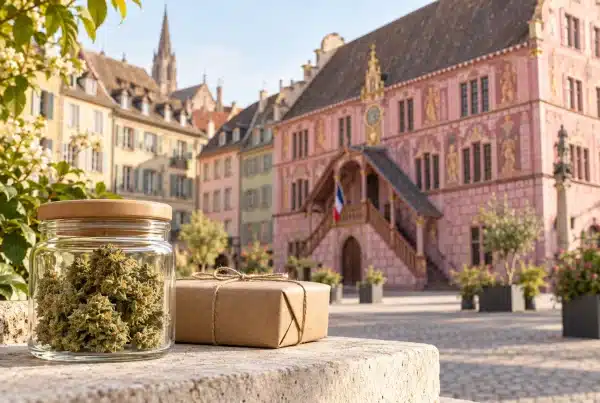
To choose a reliable CBD flower, it's essential to prioritize traceability and an independent certificate of analysis, then check the THC and CBD levels, as well as the product's visual and olfactory appearance. European regulations are evolving rapidly in this area, requiring buyers to exercise renewed vigilance before each order.
In short:
- Traceability and an independent certificate of analysis are essential to guarantee the quality and conformity of a CBD flower.
- A THC level above 0.3%, musty odors or an abnormally low price indicate questionable quality or a violation of regulations.
- Flowers grown indoors offer greater aromatic regularity and trichome density, unlike those grown outdoors which are more variable.
- Checking the consistency between the certificate of analysis and the batch number helps to avoid contaminated or non-compliant products.
- Storing flowers in an airtight container away from light prolongs their quality, especially for vaporization or infusion.
Table of Contents
- Essential criteria for judging the quality of a CBD flower
- Differences between indoor, greenhouse and outdoor cultivation
- Recognizing a quality flower by sight and smell
- CBD and THC levels and new European regulations
- Traceability and reading of a certificate of analysis (COA)
- Choose your flower according to your level of experience and its intended use
- Properly storing your flowers and choosing how to consume them
- Essential checks before making an online purchase
- What industry experience reveals about actual quality
- Find traceable CBD flowers at The French Hemp Empire
- Sources
- Frequently Asked Questions
Essential criteria for judging the quality of a CBD flower
Evaluating CBD flower relies on a precise hierarchy of criteria, not on a general impression. The first step is to demand a Certificate of Analysis (COA) issued by a third-party laboratory, along with clear batch traceability. The cultivation method is the next consideration, as it determines the aromatic richness and consistency of the product from one batch to the next. Finally, the visual appearance and aroma constitute a final check, accessible to any consumer even before opening the package.
Certain signals should immediately alert the buyer, whether they are buying in a physical store or online.
- A musty, damp hay or distinctly chemical smell indicates contamination or improper drying.
- The complete absence of a certificate of analysis on the product sheet or upon request constitutes grounds for refusing purchase.
- An abnormally low price compared to equivalent flowers on the market often hides insufficient cultivation or analysis quality.
The relationship between price and quality deserves particular attention. An indoor-grown flower with a full Certificate of Authenticity (COA) is structurally more expensive than an outdoor flower without documentation, and this price difference reflects the actual costs of production and quality control. A study supported by the Interministerial Mission for the Fight against Drugs and Addictive Behaviors revealed that 8 out of 10 CBD products had a different CBD content than indicated on the label, demonstrating that price alone never guarantees a product's compliance.
Differences between indoor, greenhouse and outdoor cultivation
The cultivation method of a CBD flower directly influences its aromatic profile, density, and the consistency of the batches offered for sale. Indoor cultivation offers precise control over light, humidity, and temperature, often resulting in more pronounced terpene profiles and denser flowers. Outdoor cultivation, exposed to the vagaries of the weather, is generally more economical but produces batches with greater variation in composition from one harvest to the next. Greenhouse cultivation falls between these two approaches, combining natural light with partial protection from the elements.
- Indoor growing is suitable for buyers seeking consistent aroma and high trichome density, at the cost of a higher price.
- Outdoor products are aimed at tight budgets, with a greater tolerance for variability between batches.
- The greenhouse offers an interesting compromise for those seeking a balance between price and regularity.
These differences in cultivation don't just affect the taste. Prolonged exposure to outdoor humidity increases the risk of mold growth on poorly dried outdoor flowers, hence the heightened importance of the certificate of analysis for these batches.
The choice between these three modes therefore depends as much on the available budget as on the level of requirement for the consistency of the desired effects.
Recognizing a quality flower by sight and smell
Directly observing a CBD flower reveals a great deal about its quality, even before consulting a technical document. The trichomes, those tiny crystals that cover the surface of the flowers, should be visible and dense: their abundant presence generally indicates a mature plant grown under good conditions. The color should remain vibrant, without any brown or grayish hues that would betray overly long drying times or improper storage. Finally, the texture should be firm without being brittle, a sign of controlled moisture levels.
- Observe the density and color of the trichomes, which should appear as a fine crystalline down rather than a scattered powder.
- Check that the dominant colour remains green or orange depending on the variety, without brown areas indicating a drying defect.
- Smell the flower up close: a clear aroma, whether earthy, citrusy or floral depending on the terpene profile, signals proper preservation.
- Discard any flower that gives off a musty, ammonia-like odor or is completely neutral, the latter suggesting a flower that is too old or has been stored incorrectly.
Pro tip: always compare the smell advertised on the product sheet with that of the sachet received: a clear difference between the two is often the most reliable sign of a problem with preservation or authenticity of the batch.
A common mistake is to judge the quality of a flower solely by its price tag, ignoring the texture or actual aroma of the product. Another classic confusion affects novice buyers, who sometimes mistake hemp leaves for real flowers, when in fact the latter contain a much higher concentration of trichomes and cannabinoids.
CBD and THC levels and new European regulations
For several years, the European Union has set a maximum THC content of 0.3% for legally marketed hemp products, but this framework continues to evolve. European Commission Regulation 2026/1828 introduces maximum levels for the sum of Δ9-THC and Δ9-THCA in certain hemp leaves intended for infusion, with application scheduled for January 1, 2027, for the products concerned. This regulation also imposes stricter labeling requirements, including warnings designed to protect children.
The regulation specifies maximum levels of Δ9-THC equivalents and labelling requirements for hemp leaves intended for infusion, including a ban on adding fats during preparation. (
Extract from the text annexed to Regulation (EU) 2023/915 by Regulation 2026/1828)
Since 2024, French health authorities have observed an increase in poisonings linked to CBD products containing prohibited substances or THC levels exceeding the legal limit, as reported in a press release from ANSES (the French Agency for Food, Environmental and Occupational Health & Safety). This trend means that buyers must systematically compare the product label with the provided certificate of analysis and be wary of any flower whose stated THC level appears inaccurate or absent. If there is any doubt about the compliance of a product already purchased, it can be reported to the relevant health authorities.
Traceability and reading of a certificate of analysis (COA)
A reliable certificate of analysis must include several essential elements: a complete cannabinoid profile with the exact CBD and THC levels, pesticide residue testing, heavy metal analysis, and verification of any residual solvents from the extraction process. Without these four categories of information, the document cannot be considered a complete Certificate of Analysis (COA).
- Verify that the issuing laboratory is indeed an independent third party, separate from the seller or producer.
- Check the certificate's issue date and its exact correspondence with the batch number printed on the packaging.
- Look for explicit mention of the testing methods used, a sign of the laboratory's reliability.
Pro tip: before any purchase, open the certificate of analysis provided on the product sheet and compare its batch number with the one written on the packaging received: a discrepancy should immediately raise an alarm.
The certificates of analysis and reading guides published by The French Hemp Empire detail each section of these documents so that the buyer can verify for themselves the consistency between the label and the laboratory results before placing any order.

Choose your flower according to your level of experience and its intended use
The choice of CBD flower largely depends on the buyer's profile and the desired effect, whether it's relaxation, stress management, or sleep aid. A beginner is generally better off choosing a hybrid flower grown indoors, with a moderate CBD content, to assess their tolerance without experiencing overly strong effects. A more experienced user, on the other hand, may seek out more specific terpene profiles, combined with higher CBD levels, depending on the effects they have already experienced.
- Beginners benefit from starting with hybrid flowers with mild profiles, avoiding excessively high CBD levels during initial uses.
- Regular consumers can refine their choice towards indica or sativa varieties depending on the desired effect, whether calming or more stimulating.
- Anyone undergoing medical treatment should consult a healthcare professional before introducing CBD, due to possible interactions.
ANSES has also proposed classifying cannabidiol as a substance presumed to be toxic to reproduction based on animal studies, which justifies particular caution for pregnant women or people engaged in a parental project.
Properly storing your flowers and choosing how to consume them
The storage conditions of CBD flower directly influence its quality over time. Storing it away from light, in an airtight container and at a stable temperature, preserves the trichomes and limits the degradation of terpenes.
- Place the flowers in an airtight jar, away from any source of direct light and heat.
- Avoid non-airtight plastic bags, which promote loss of aroma and excessive moisture.
- Opt for infusion or vaporization rather than combustion, the latter producing substances from plant combustion that are absent from other methods of consumption.
- Never add fats when infusing hemp leaves when the product labeling explicitly prohibits it, in accordance with new European requirements.
Each method presents its own compromises between ease of use and health precautions, which justifies choosing according to one's habits.
Essential checks before making an online purchase
Buying CBD flowers online requires checking certain points before placing an order to avoid contaminated or mislabeled products. The product page should clearly display the certificate of analysis, the seller's legal information, and a transparent return policy.
- Always consult the COA associated with the exact batch, and not a generic document valid for an entire range.
- Read customer reviews with a critical eye, being wary of overly positive ratings.
- Look out for product information that is vague about origin, THC level, or the absence of mention of the analysis laboratory.
Pro tip: always keep the packaging and batch number of a product until the end of its use: these elements are essential in case of reporting an adverse effect.
In case of an unexpected reaction after consumption, a report can still be made via the official portal for reporting adverse health events, which allows the authorities to monitor alerts related to CBD products.
What industry experience reveals about actual quality
Document transparency remains the best indicator of reliability in this sector, more trustworthy than any sales pitch. Many buyers still rely on a website's appearance or the number of reviews displayed, whereas only a current certificate of analysis, properly linked to the batch, guarantees verifiable information. Some online shops publish their independent certificates of analysis and detail the origin of their flowers, a recommended approach for any seller, regardless of their status. To further explore these checks, guides on CBD quality and traceability detail the methods to follow to identify a reliable product.
— Vanessa
Find traceable CBD flowers at The French Hemp Empire
Choosing a compliant CBD flower requires time and methodical verification of each document, an effort that some shops simplify by directly publishing their independent laboratory analyses on each product page.

The CBD Flowers category on this website features varieties whose origin and cannabinoid levels are documented batch by batch, with a certificate of analysis available for review before ordering. Buyers looking to start with a smaller size can opt for the Small Buds CBD, designed for a more affordable first try. Every order benefits from discreet delivery within Europe, an important consideration for many privacy-conscious buyers. Before finalizing your order, simply open the certificate of analysis associated with your chosen product and verify that it matches the batch number printed on the packaging.
Sources
This article draws on European Commission Regulation 2026/1828, the World Health Organization's Q&A on cannabidiol, and ANSES's statements on CBD-related poisonings and its proposed classification of CBD. These official documents can be consulted directly for further information on each regulatory or health-related point.
This article provides general information and is not a substitute for professional medical advice. Consult a qualified healthcare professional about your specific situation before taking any action based on this content.
- Commission Regulation (EU) 2026/1828
- ANSES Press Release — Increase in poisonings caused by CBD products containing other substances
Frequently Asked Questions
Why shouldn't you smoke CBD flowers?
Smoking CBD flowers involves burning plant matter, which produces undesirable substances not present in other consumption methods, such as vaporization or infusion. This method of consumption therefore presents a different risk profile, leading many consumers to favor combustion-free methods.
What are the best CBD flowers?
There is no universally superior variety: the best CBD flower is the one whose certificate of analysis confirms the THC level is within acceptable limits and that there are no contaminants, with a terpene profile suited to the intended use. Guides on flower types and their effects detail indica, sativa, and hybrid profiles according to the desired effects.
What is the best website to buy CBD flowers?
The decisive factor is not the website's reputation but the availability of independent, up-to-date certificates of analysis linked to each batch, combined with a clear traceability policy regarding the origin of the flowers. A seller who systematically publishes these documents, as The French Hemp Empire does for its CBD flower range, offers a higher level of guarantee than a website without verifiable documentation.
Which CBD is best for neck pain?
Currently, there is no solid scientific data to recommend a specific strain or dosage of CBD for neck pain, with the World Health Organization itself acknowledging that clinical evidence remains limited for many uses. Anyone experiencing persistent pain should consult a healthcare professional before considering CBD as a solution.